Best MBA/MPH Programs in New York
Compare 4 accredited MBA/MPH programs in New York, with graduate earnings, cost, debt, and completion data from IPEDS and the U.S. College Scorecard.

Median earnings for the highest-ranked New York MBA/MPH exceed $100,000 five years out, but the degree's career payoff depends on matching the MPH concentration to hospital, health system, or health policy leadership, the domain of a Master's in Healthcare Management in New York.
The ranked set here is short: Columbia, Stony Brook, Buffalo, and Syracuse, all campus-based; online and hybrid options are part of the comparison. Admissions split between business and public health review, so GMAT/GRE waivers, tuition, and earnings expectations matter more than brand.
Key Points
- Every ranked dual MBA/MPH in New York is campus-based, with no fully online option.
- Stony Brook and Buffalo list in-state tuition near $14,200 and $14,500.
- Test policies are set separately by each business and public health school.
Best MBA/MPH Schools in New York, Ranked
Four New York schools offer a dual MBA/MPH that we could verify, and all four are campus-based. Compare them on cost, graduate outcomes, and format. Net price figures below are approximate institution-wide averages after aid, not quotes for the dual degree.
Columbia University in the City of New York
#1New York, NY · ~$58,000/yr (est.)
Best for: Full-time students seeking an Ivy network
Columbia pairs its Full-Time MBA with a Master of Public Health in an established dual-degree track that takes one fewer year than earning the degrees separately. The school graduates about 96% of its students, and its approximate institution-wide average net price after aid is around $21,590, which is not a quote for the dual degree. You apply separately to both schools, each decides independently, and the business school does not allow deferrals.
- Dual degree takes one fewer year than separate degrees
- Apply separately to the Business School and the public health program
- Each school makes its admission decision independently
- Register in one school per term and pay that school's tuition
- Aid comes from the school of residence; scholarships usually not transferable
- No deferral to future terms
- Campus-based delivery
Stony Brook University
#2Stony Brook, NY · ~$14,000/yr (est.)
Best for: Students wanting health analytics concentrations
Stony Brook's combined MBA/MPH is jointly run by the Program in Public Health and the College of Business, with Health Analytics, Health Policy and Management, and Community Health concentrations. The school graduates about 76% of its students, and its approximate institution-wide average net price after aid is around $18,784, not a quote for the dual degree. Combined-program students pay the graduate MBA tuition rate, and about 20 credits overlap across the two degrees.
- 81 total credit hours with about 20 credits of overlap
- Three concentrations: Community Health, Health Analytics, Health Policy and Management
- CEPH accredited public health component
- GMAT or GRE scores accepted
- MPH admissions committee reviews first, then the College of Business approves
- Campus-based delivery
University at Buffalo
#3Buffalo, NY · $10,000 – $15,000/yr (est.)
Best for: Future hospital administrators in health services
Buffalo's MPH/MBA is a collaboration between the School of Management and the School of Public Health and Health Professions, with a Health Services Administration focus. The school graduates about 75% of its students, and its approximate institution-wide average net price after aid is around $20,995, not a quote for the dual degree. A practicum counts toward the MPH field experience, and the Dawn Gideon-Huron Scholarship is available.
- Health Services Administration concentration
- CEPH accredited public health component
- Practicum satisfies the MPH field experience
- Apply to and be admitted by both programs independently
- Up to 15% of total credits can count toward both degrees
- Dawn Gideon-Huron Scholarship available
- Campus-based, within the full-time MBA community
Syracuse University
#4Syracuse, NY · $45,000 – $50,000/yr (est.)
Syracuse combines the Whitman School of Management and the Maxwell School of Citizenship and Public Affairs in a three-year, 81-credit MPH/MBA. The school graduates about 84% of its students, and its approximate institution-wide average net price after aid is around $38,793, not a quote for the dual degree. Program-level earnings and debt are not yet available for this program, so it is harder to judge on outcomes than the others.
- Three-year program, 81 total credit hours
- Dual degree from the Whitman and Maxwell Schools
- CEPH accredited public health component
- Flexible timeline allows for internships or added coursework
- Careers in public, private, and nonprofit sectors
- Campus-based delivery
Cost & outcomes by school
Federal data for the highest-earning MBA/MPH programs, independent of the ranking above. Earnings are this field's master's graduates four years after completing, where the Scorecard reports them.
| School | Earnings | Tuition / yr | Debt | Grads/yr | Format |
|---|---|---|---|---|---|
| Columbia University in the City of New York NY | $98,728 | $57,973 | $72,167 | 350 | Campus |
| University at Buffalo NY | $87,916 | $14,530 | $40,798 | 92 | Campus |
| Stony Brook University NY | $81,990 | $14,222 | $41,170 | 32 | Campus |
| Syracuse University NY | — | $48,132 | — | 19 | Campus |
Sources: U.S. Department of Education. Tuition and graduates: IPEDS. Earnings and debt: College Scorecard, this field's master's graduates; a dash means no figure is reported.
Cost, debt & payoff
Median earnings of this field's master's graduates (4 yrs after completing) vs. their median federal loan debt · U.S. College Scorecard
Across these programs the median graduate earns about $87,916 and finishes with roughly $41,170 in debt — a ratio that clears a common rule of thumb (keep debt below first-year salary). Tuition and debt vary widely school to school, so check the per-school figures in the table above before you shortlist.
Online and Hybrid MBA/MPH Options in New York
An online or hybrid MBA/MPH dual degree lets you earn both a business degree and a public health degree with some or most coursework delivered remotely. That format is not available at the schools ranked here. Columbia University, Stony Brook University, University at Buffalo, and Syracuse University all deliver their dual degrees on campus, and none lists a fully online MPH program. Residency and practicum rules don't apply in the usual online sense; Buffalo's practicum, however, doubles as the MPH field experience.
Hybrid and Flexible Routes
If you need flexibility, the closest options are structural rather than remote. Syracuse describes a three-year timeline with a flexible completion schedule, and Stony Brook's 81 credits include roughly 20 credits of overlap between the two degrees. Ask each admissions office directly whether any courses can be taken remotely or part-time, since published pages don't confirm it.
Accreditation
Stony Brook's MBA/MPH is listed as CEPH accredited. For Columbia, Buffalo, and Syracuse, our data does not confirm AACSB status for the business school or CEPH status for the public health school, so check each accreditation page before applying. CEPH matters because many public health employers and certification pathways expect a degree from a CEPH-accredited MPH program.
GMAT and GRE Waivers at Ranked New York MBA/MPH Schools
Test-required or test-optional is rarely one decision in a dual degree, because the MBA program and the public health school usually set their own rules and review you separately.12
What each school publishes
- Stony Brook University: Program materials for the combined MBA/MPH indicate an entrance exam is required, with the GRE or GMAT accepted.
- Columbia University: The public health side reports that scores are optional for many of its master's programs, including GRE-optional review for Fall 2026 entry. Columbia's dual-degree structure uses separate applications and independent decisions, so confirm the business school's current testing rule directly rather than assuming the same standard carries across.
- University at Buffalo: Applicants must apply to, qualify for, and be admitted by each degree independently. Buffalo's collaborative MBA/MPH page does not publish a current exam requirement or waiver criteria.
- Syracuse University: No waiver policy for the dual program is published on its program pages.
Before you register for a test
Where business schools do grant waivers (a pattern shared by many No-GRE master's programs), the usual triggers are several years of full-time professional work, a prior graduate or professional degree, or an undergraduate GPA above a stated line. If you are close to any of those, email both admissions offices first. A waiver confirmed in writing beats a test fee you did not need to pay.
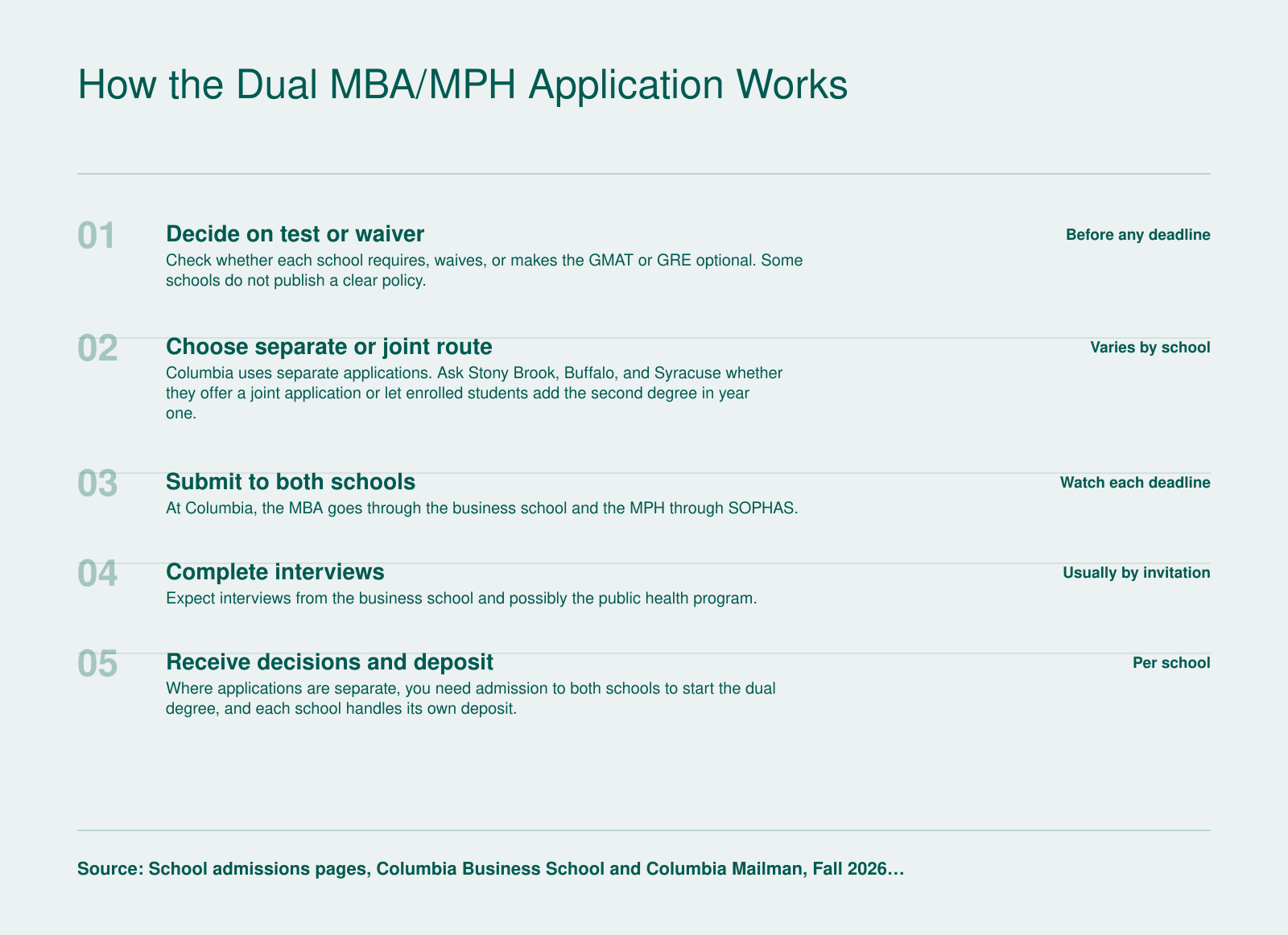
How the Dual MBA/MPH Application Works
Most dual-degree applicants move through the same five stages, but structure differs by school. For Fall 2026 entry, Columbia Business School listed MBA rounds on Sept 3, 2025, Jan 6, 2026, and Mar 26, 2026. Columbia Mailman lists a preferred Dec 1 date for most fall master's programs. Confirm dual-degree dates directly with each school.
Related Articles
MBA/MPH Cost and Healthcare Management Employer Demand in New York
Public and private schools offering Master's Programs in New York charge very different tuition. Stony Brook University and University at Buffalo list program tuition near $14,200 and $14,500 for in-state students, rising to about $29,200 and $28,200 for out-of-state students. Syracuse University lists about $48,100, and Columbia University in the City of New York about $58,000, with no residency discount at either.
What the Full Degree Costs
One year of tuition understates the bill. Stony Brook and Syracuse both list 81 total credits, and Syracuse runs three years. If its figure is an annual rate, tuition alone could pass $140,000 before living costs. Columbia saves one year compared with earning the degrees separately, but its two-school structure means you should confirm each school's current rate. Reported net price, which reflects aid, tells a different story: about $18,800 at Stony Brook, $21,000 at Buffalo, $21,600 at Columbia, and $38,800 at Syracuse. Treat these as institution-level estimates, not dual-degree quotes.
Debt Among Graduates
Program-level median debt is published for three schools: about $41,200 at Stony Brook (roughly $468 a month over ten years), $40,800 at Buffalo ($464), and $72,200 at Columbia ($821). Syracuse does not publish a program-level figure.
New York Employer Demand
The clearest labor-market signal is for medical and health services managers, a common destination in healthcare management for these graduates, though not all hold an MBA. As of May 2025, New York employed about 33,200 of them at a median wage of $164,1202, against a national median of $123,860.1 The New York City metro area counts about 35,260 at $167,580.3 That wage premium helps offset the higher private-school price, but weigh it against the debt figures above.
Top Graduate Earnings Among Ranked Programs
Highest program-level earnings among the ranked schools
Frequently Asked Questions About MBA/MPH Programs in New York
How long does a dual MBA/MPH take in New York?
How much does an MBA/MPH cost in New York?
Can I complete an MBA/MPH online in New York?
Can I add the MPH after starting an MBA in New York?
Compare MBA/MPH programs on the data that matters
Explore more MBA specializations or browse every graduate field.
All MBA programs