Best MBA/MPH Programs
Compare 50+ accredited MBA/MPH programs at 40+ schools, with graduate earnings, cost, debt, and completion data from IPEDS and the U.S. College Scorecard.

Hospital systems and health departments increasingly want managers who can read a balance sheet and an epidemiology report with equal fluency. The MBA/MPH dual degree is built for that overlap, pairing the financial strategy and operations of an MBA in Management with biostatistics, health policy, and population health.
The trade is time and money. Dual enrollment usually finishes faster than earning the two degrees back to back, because the schools let students count some credits toward both, but the full-time commitment is still measured in years, not semesters.
Prestige alone does not settle the choice. Graduate debt and net price vary widely among the best-known names, and employers hiring for healthcare administration tend to care more about the combined skill set and internship experience than about the school's brand.
Key Points
- A strong MBA/MPH needs AACSB business accreditation plus CEPH public health accreditation.
- Healthcare manager pay hit a $123,860 median in May 2025, with 24 percent job growth projected.
- Shared credits, not sticker price, decide what your dual degree costs after aid.
The 10 Best MBA/MPH Dual Degree Programs
The strongest MBA/MPH dual degrees pair rigorous management training with a public health curriculum that can be applied immediately in hospitals, health systems, government agencies, and consulting firms. These are the programs where the business-plus-public-health payoff shows up most clearly in graduate earnings, net price, and completion rates.
University of California-Berkeley
#1Berkeley, CA · ~$16,000/yr (est.)
Best for: Health policy and management career changers
UC Berkeley, in Berkeley, California, offers a campus-based concurrent MBA/MPH built around health policy and management, with two full-time summer internships and access to both Haas and Berkeley Public Health career services. Graduate tuition is $12,260 in state and $44,148 out of state, with an average net price of $13,481, and the university's graduation rate is 92.8%. Four years after finishing, median earnings are reported at $86,225.
- CEPH accredited program
- Complete in 2.5-year concurrent degree program
- Two distinct full-time summer internships
- Long-standing partnership between schools
- Access to career services and faculty mentors
- Concentration in Health Policy and Management
Yale University
#2New Haven, CT · ~$50,000/yr (est.)
Best for: Healthcare executives wanting accelerated, integrated training
Yale, in New Haven, Connecticut, offers a campus-based accelerated MBA/MPH in health care management that can be completed in 22 months, while a separate three-year joint-degree pathway offers more scheduling flexibility. Graduate tuition is $67,250 for both in-state and out-of-state students, the average net price is $23,777, and the university's graduation rate is 95.7%. One year after finishing, median earnings are reported at $72,627, and four years after finishing they reach $105,402.
- 22-month program
- Starts in summer
- Capstone required
- Core courses in biostatistics, epidemiology, and social sciences
- International Experience course included
- Applied practice experience in the health care industry
- Admission to both Yale School of Public Health and Yale School of Management required
- Electives available at any Yale school
University of California-Los Angeles
#3Los Angeles, CA · ~$14,000/yr (est.)
Best for: Policy-minded aspiring hospital administrators
UCLA, in Los Angeles, California, offers campus-based three-year concurrent MPH/MBA options in both health policy and health management, each requiring 78 quarter credits and a summer internship with a consulting report. Graduate tuition is $12,260 in state and $44,148 out of state, the average net price is $12,548, and the university's graduation rate is 92.6%. One year after finishing, median earnings are reported at $75,311, and four years after finishing they reach $110,900.
- 3-year program
- 78 total credit hours
- Concentration in Health Policy
- Summer internship with consulting report
- Onsite, weekday classes
- Concentration in Health Management
- Prior work experience valued
- Summer internship required
- Capstone consulting report
- Financial aid and scholarships available
University of Virginia
#4Charlottesville, VA · ~$24,000/yr (est.)
The University of Virginia, in Charlottesville, Virginia, offers a campus-based three-year MBA/MPH focused on healthcare innovation and entrepreneurship, delivered jointly by Darden and the Department of Public Health Sciences. Graduate tuition is $19,472 in state and $57,261 out of state, the average net price is $21,565, and the university's graduation rate is 95.6%. One year after finishing, median earnings are reported at $63,861.
- 3-year program including two summers
- Focus on health care innovation and entrepreneurship
- Covers healthcare delivery systems, biotechnology, and medical devices
- Jointly administered by Darden and Public Health Sciences
- Requires separate admission to both programs
- Develop depth through elective courses
University of Michigan
#5Ann Arbor, MI · $29,000 – $58,000/yr (est.)
The University of Michigan, in Ann Arbor, Michigan, offers an MPH/MBA in a hybrid format that combines the School of Public Health and Ross School of Business over three years, with 90 credits and two paid internships, one in a healthcare organization. Graduate tuition is $18,516 in state and $62,749 out of state, the average net price is $13,138, and the university's graduation rate is 93.2%. One year after finishing, median earnings are reported at $62,622.
- 3-year program
- 90 total credit hours
- Paid administrative internships
- Faculty-assisted internship placement
- Jointly offered by SPH and Ross
- Separate admission to both schools
- Healthcare organization internships
Dartmouth College
#6Hanover, NH · $65,000 – $70,000/yr (est.)
Dartmouth College, in Hanover, New Hampshire, offers a campus-based MBA/MPH from the Tuck School of Business and Geisel School of Medicine, emphasizing healthcare leadership across hospitals, biotech, government health programs, and nonprofits. Graduate tuition is $66,123 for both in-state and out-of-state students, the average net price is $29,519, and the university's graduation rate is 95.5%.
- Customizable education to fit interests
- Leadership in health care industry
- Joint degree with Geisel School
- Tuck faculty and case method teaching
Johns Hopkins University
#7Baltimore, MD · ~$65,000/yr (est.)
Johns Hopkins University, in Baltimore, Maryland, offers a campus-based two-year MPH/MBA through the Bloomberg School of Public Health and Carey Business School, requiring 127 credits and covering health insurance, biostatistics, finance, ethical leadership, and negotiation. Graduate tuition is $64,730 for both in-state and out-of-state students, the average net price is $18,809, and the university's graduation rate is 93.8%. One year after finishing, median earnings are reported at $70,790.
- Entrance exam required; GRE or GMAT accepted
- 2-year program
- 127 total credit hours
- Integrated public health and business curriculum
- Single application via SOPHAS
- Offered by Bloomberg and Carey schools
- MPH awarded upon MBA completion
- GMAT/GRE waiver for qualified candidates
Washington University in St Louis
#8St. Louis, MO · ~$65,000/yr (est.)
Washington University in St. Louis, in St. Louis, Missouri, offers a campus-based MPH/MBA that splits time between Olin Business School and the Brown School, requiring 95 credits plus a 360-hour practicum and a capstone. Graduate tuition is $64,500 for both in-state and out-of-state students, the average net price is $21,786, and the university's graduation rate is 94.3%. One year after finishing, median earnings are reported at $59,463.
- 95 total credit hours
- 360 clinical hours
- Capstone required
- CEPH and AACSB accredited
- Practicum at BJC Center for Clinical Excellence
- Internships at Aetna, Eli Lilly, and Humana
- Scholarships available
- Two separate applications required
University of Georgia
#9Athens, GA · ~$11,000/yr (est.)
The University of Georgia, in Athens, Georgia, offers a campus-based three-year MBA/MPH with Terry College of Business, focused on the Health Policy and Management concentration and structured with one year in the MPH, one in the MBA, and a third integrating both. Graduate tuition is $10,034 in state and $30,272 out of state, the average net price is $13,936, and the university's graduation rate is 89.7%. One year after finishing, median earnings are reported at $47,001.
- 3-year program
- Starts fall or spring
- Apply first to MPH, then Terry College
- Full year of MPH courses first
- Health economics and policy analysis courses
- Internship and applied practice required
The University of Texas Health Science Center at Houston
#10Houston, TX · $11,000 – $34,000/yr (est.)
The University of Texas Health Science Center at Houston, in Houston, Texas, offers an online MBA/MPH designed for working professionals, covering healthcare management, public health principles, and business strategy. Graduate tuition is $10,038 in state and $37,422 out of state, and one year after finishing, median earnings are reported at $60,515.
- Online program
- Dual degree MBA/MPH
- Flexible for professionals
- Healthcare management focus
- Public health principles
- Business strategy included
- Bachelor's degree required
- Work experience needed
Cost & outcomes by school
Federal data for the highest-earning MBA/MPH programs, independent of the ranking above. Earnings are this field's master's graduates four years after completing, where the Scorecard reports them.
| School | Earnings | Tuition / yr | Debt | Grads/yr | Format |
|---|---|---|---|---|---|
| University of California-Los Angeles CA | $110,900 | $14,476 | $52,445 | 198 | Campus |
| Yale University CT | $105,402 | $49,500 | $62,532 | 160 | Campus |
| Case Western Reserve University OH | $102,438 | $53,980 | $69,447 | 36 | Campus |
| Johns Hopkins University MD | $99,605 | $64,730 | $65,952 | 127 | Campus |
| Columbia University in the City of New York NY | $98,728 | $57,973 | $72,167 | 350 | Campus |
| University of Virginia VA | $92,024 | $23,526 | $45,801 | 52 | Campus |
| Claremont Graduate University CA | $91,103 | $37,180 | $92,618 | 11 | Hybrid |
| University of Alabama at Birmingham AL | $91,073 | $8,640 | $32,000 | 276 | Hybrid |
| University of Pennsylvania PA | $90,435 | $47,844 | $66,000 | 59 | Campus |
| University of Illinois Chicago IL | $89,402 | $17,550 | $45,712 | 196 | Campus |
| Emory University GA | $88,896 | $48,750 | $66,000 | 136 | Campus |
| Boston University MA | $88,820 | $67,626 | $62,334 | 265 | Campus |
Sources: U.S. Department of Education. Tuition and graduates: IPEDS. Earnings and debt: College Scorecard, this field's master's graduates; a dash means no figure is reported.
Cost, debt & payoff
Median earnings of this field's master's graduates (4 yrs after completing) vs. their median federal loan debt · U.S. College Scorecard
Across these programs the median graduate earns about $86,065 and finishes with roughly $47,787 in debt — a ratio that clears a common rule of thumb (keep debt below first-year salary). Tuition and debt vary widely school to school, so check the per-school figures in the table above before you shortlist.
How We Built This MBA/MPH Ranking (And Why Dual Accreditation Matters)
AACSB lists 1,085 accredited institutions across 71 countries and territories,2 while CEPH accredits public health schools through a separate process.1 A strong MBA/MPH needs both seals, which is why accreditation anchors how we judge these programs, including the best MBA programs and best MPH programs.
What the Numbers Measure
We look at four inputs: program-level earnings after completion, median federal debt, average net price after aid, and institution-wide graduation rate. Read the last two carefully. Net price and graduation rate describe the whole university, not the dual-degree cohort. Earnings and debt come closer to the program itself, but they may be unpublished for smaller programs, so use them as a guide, not a guarantee.
Why Two Seals Matter
A CEPH-accredited school or program of public health is what many public health employers, including federal agencies, expect to see behind an MPH. It also commonly matters if you later pursue a DrPH or PhD. AACSB is the business-side benchmark that employers and doctoral business programs often look for.
Accreditation is unit-specific. CEPH lists Columbia Mailman through 12/31/2032, Johns Hopkins Bloomberg through 7/1/2031, and Yale through 7/1/2029.1 Boston University's listing ran through 7/1/2026, so confirm its current term.1 Emory, UNC Chapel Hill, Tulane, and UC Berkeley appear among CEPH-accredited schools1, though the material we reviewed gave no end dates. On the business side, Emory extended its AACSB accreditation in 2026.2 We could not confirm current AACSB status for the other universities from the directory records available to us, so verify it yourself.
Check It in Two Steps
First, search the CEPH list of accredited schools and programs. Confirm the exact school or program, and note that "applicant" status means in process, not accredited. Second, use the AACSB accredited school search to confirm that the business school that administers the MBA is listed. Recheck both before you apply, because decisions and extensions change.
What an MBA/MPH Really Costs: Sticker Price vs. Net Price
What will an MBA/MPH actually cost after aid? The answer sits between two numbers that rarely match: published tuition and average net price.
Sticker Price vs. Net Price
Among the schools ranked here, published annual graduate tuition for the dual program runs from roughly $10,500 at Southern Illinois University-Edwardsville to about $28,900 in-state at the University of Michigan. Michigan's out-of-state rate climbs to about $57,800. Average net price, which is cost of attendance minus grant aid, is far tighter: from about $7,000 at University of Michigan-Flint to about $17,200 at the University of Toledo.
The two figures differ because the net price figure is a university-wide average that largely reflects undergraduates and may include grants master's students cannot receive. Michigan's tuition is the highest here, yet its net price sits mid-pack. Treat the gap as a rough signal, not a forecast.
Program Totals for Named Schools
Few programs publish one combined dual-degree price, so the totals take some assembly:
- Columbia: Mailman lists 2026-2027 accelerated/dual MPH tuition of $78,552 across two semesters, plus estimated fees of $8,391, within a three-semester MPH plan.1 Business school tuition is separate, and students pay the rates of whichever school they are in that term.
- Boston University: Two years and 82 credits, with at least 40 in residence at the public health school. Students pay one full-time tuition charge per year while enrolled in both schools, and summer courses are billed per credit. The 2025-2026 on-campus MPH rate is $34,935 per semester.
- UNC Chapel Hill: The online MPH charges $1,735 per credit plus $28.69 in fees per credit.3 That is a per-credit model, and it is unconfirmed for the MBA/MPH.
- Johns Hopkins: The dual degree spans two schools, Bloomberg and Carey. Check each school's current rates.
Funding Levers
Emory's Rollins School gives health-science dual-degree students a 25% tuition scholarship for two semesters in residence there. Confirm whether it covers the MBA/MPH. BU Questrom automatically considers MBA applicants for merit scholarships, but BU's Dual Degree Scholarship excludes MBA/MPH students. Columbia scholarships generally don't transfer between schools.2
When comparing affordable MBA programs, also ask about employer tuition benefits, which often cap annual reimbursement, and graduate assistantships, which vary by school and department. Domestic students may qualify for loans or work-study, subject to annual funding.
Finally, net price is an approximation, not a quote. Request a personalized estimate from each program's financial aid office before comparing.
Three MBA/MPH Schools With the Strongest Return on Investment
These three schools lead the ranking by return on investment, where the ROI ratio compares each institution's median earnings 10 years after entry with median federal graduate debt. The ratio is a school-level value signal from federal data, not a guarantee for any one MBA/MPH program. When you compare offers, check the median monthly payment against the starting salary in your target health care role.
| School | Net Price | Median Federal Debt at Completion | Median Monthly Payment (10-Year Plan) | 10-Year Median Earnings | ROI Ratio |
|---|---|---|---|---|---|
| Johns Hopkins University | $18,809 | $10,250 | $750 | $87,555 | 8.5x |
| Yale University | $23,777 | $12,975 | $711 | $100,533 | 7.7x |
| University of California-Berkeley | $13,481 | $13,000 | N/A | $92,446 | 7.1x |
Related Articles
The true cost of an MBA/MPH is not the price of two degrees added together. It comes down to how many credits the two schools let you share, because every shared credit is tuition you don't pay twice.
MBA/MPH vs. a Standalone MPH or MBA
The dual degree buys you breadth, but it costs an extra year or so of tuition and time compared with a single master's. Whether that trade pays off depends on the job you want.
Side-by-Side Comparison
Typical ranges, which vary by school and format:
- MBA/MPH: Usually about three years (or less in accelerated formats), roughly 70 to 90 combined credits, and the highest total cost of the three. Core skills: health policy and epidemiology plus finance, strategy, and operations. Best fit: Healthcare Management, hospital administration, and health-care consulting.
- Standalone MPH: Usually one to two years, around 40 to 60 credits, and the lowest cost of the three. Core skills: biostatistics, epidemiology, health education, and policy. Best fit: research, program, and government or nonprofit roles.
- Standalone MBA: Usually two years, around 50 to 65 credits, with cost varying widely by school. Core skills: finance, marketing, operations, and general management. Best fit: consulting, finance, and general management across industries.
The Real Difference: MPH Alone vs. the Dual Degree
The MPH alone prepares you to study and improve population health. It suits epidemiology, research, and program roles. The dual degree adds the business toolkit, so you can run budgets, build strategy, and manage operations. If your goal is healthcare administration, leading a health system, a consulting practice, or a pharma business unit, that added layer matters. If you want to analyze outbreaks or design community programs, it likely doesn't.
What the Pay Figures Show
Program-oriented estimates put MBA/MPH pay at roughly $90,000 to $140,000, standalone MBA pay at $80,000 to $120,000, and standalone MPH pay at $65,000 to $100,000. Treat these as broad ranges, not a proven premium. They don't control for experience, school, industry, or location, and no study shows the dual credential reliably out-earns a comparable MBA.
How Long an MBA/MPH Takes: A Typical Three-Year Timeline
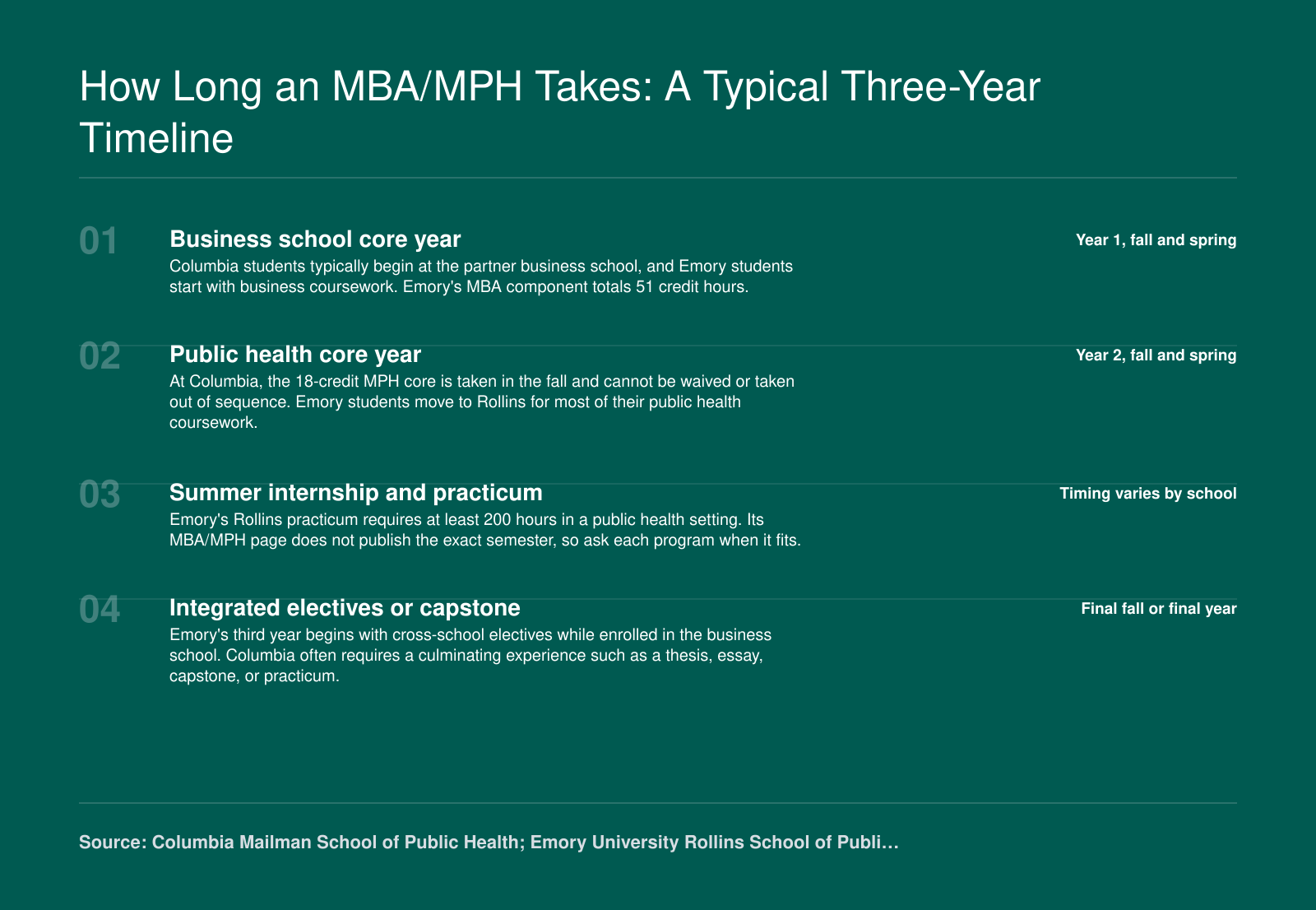
How long does an MBA/MPH take? Most full-time dual degrees run roughly two and a half to three years. Emory lists five semesters of full-time, in-person study, and many programs spread the work across three academic years with a summer of applied practice in between. Accelerated tracks can shorten that path, and part-time or online formats can stretch it, so confirm the exact length with each school. The steps below show the usual order: a business year, a public health year, a summer of applied practice, then integrated electives or a capstone. Sequencing varies by school. Columbia, for example, advises against spending your final year at the public health school, because culminating work is often cross-registered at the business school.
The Bureau of Labor Statistics reports medical and health services managers earned a median annual pay of $123,860 in May 2025. Employment is projected to grow 24 percent from 2025 to 2035, much faster than average, making healthcare leadership a strong target for MBA/MPH graduates.
Getting in: MBA/MPH Test Policies, GPA Targets, and Deadlines
Requirements vary more than most applicants expect, and several schools publish no fixed GPA or work-experience minimum. Treat the points below as a starting guide and confirm current-cycle details with each admissions office before you plan your timeline.
- Separate or joint applicationsMost programs require admission to both schools. Boston University uses two applications, one to Questrom and one to the School of Public Health, with a separate decision from each. Columbia allows simultaneous applications to Columbia Business School and Mailman, or a later MPH application during the first half of the MBA. Johns Hopkins is the simplest: one application through SOPHAS, though the Bloomberg and MBA committees review it independently.
- GMAT/GRE policyColumbia asks every MBA applicant for a GMAT, Executive Assessment, or GRE score, and its materials describe no general waiver for the dual degree. Johns Hopkins treats tests as optional for the MPH and accepts GRE, GMAT, MCAT, or LSAT scores. Skipping the score is not penalized, but you should show quantitative ability through your transcripts or supplemental questions. BU's public health school does not require the GRE and will not consider it. Questrom's current policy for dual-degree applicants and Emory's testing rules were not confirmed, so check both directly.
- GPA and work experienceNone of these programs publishes a minimum admissions GPA that we could verify, and review is generally holistic. Columbia asks you to report your GPA exactly as it appears on your transcript. BU's 2.70 figure is the Questrom GPA needed to stay in good standing once enrolled, not an admissions cutoff. No minimum years of experience were stated, but BU values public-health-related work, volunteering, research, or internships, and Columbia asks for a full account of your employment history. Health care experience strengthens an application even when it is not required.
- Essays, recommendations, resume, and interviewExpect a resume, essays, and recommendations for both the business and public health sides. Business schools often add an interview by invitation. Essays should explain why you need both credentials. Specific prompts change each cycle, so read the current-year instructions.
- Rounds and deadlinesThe business school's round usually sets your timeline. Columbia has no single combined deadline: you must meet the MBA deadline and Mailman's applicable deadline. Johns Hopkins follows the full-time MPH deadlines, which are updated each July. BU requires fall entry for concurrent applications, and each school keeps its own deadline. We could not confirm exact 2026-27 dates, so verify them before you start. Emory's dual-degree structure and deadlines also need checking with the school.
MBA/MPH programs by state
Compare MBA/MPH programs on the data that matters
Explore more MBA specializations or browse every graduate field.
All MBA programs