Accelerated Clinical Nurse Leader (CNL) MSN Programs
Compare 60+ accredited fastest Clinical Nurse Leader programs at 40+ schools, with graduate earnings, cost, debt, and completion data from IPEDS and the U.S. College Scorecard.
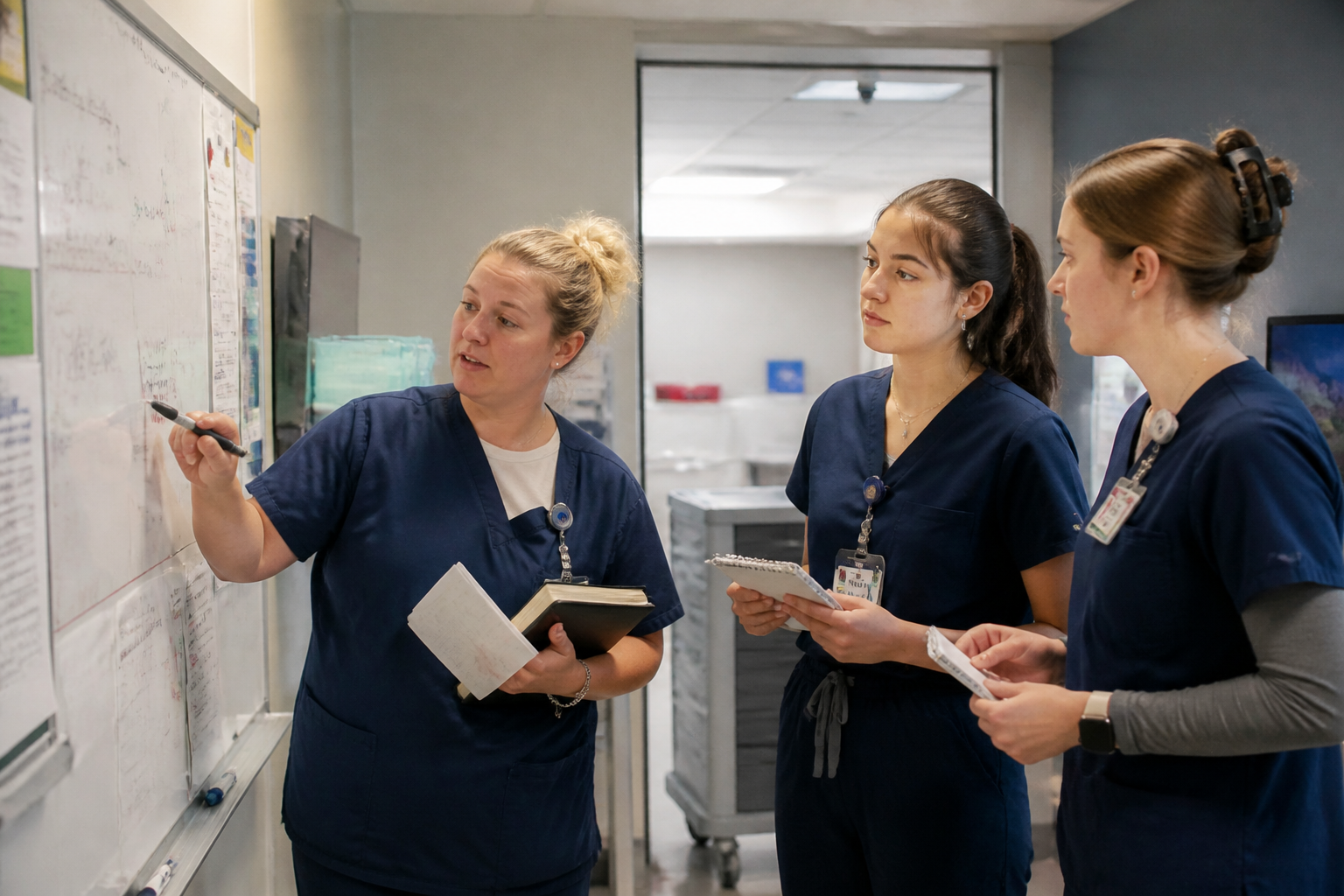
Direct-entry CNL students compress first-time RN licensure and a master's into roughly 15 to 24 months; post-BSN RNs layer CNL coursework onto an existing license. That single difference reshapes costs, prerequisites, and clinical placement responsibilities before the first semester.
A Clinical Nurse Leader is a master's-prepared generalist from Nursing Master's Programs who coordinates care and quality at the point of care, not an administrator or nurse practitioner; it is not an accelerated nurse practitioner program. For career changers, the fastest programs here front-load full-time clinical immersion and nurse residency blocks, leaving little margin for part-time pacing or employer delay.
Key Points
- Direct-entry tracks combine prelicensure courses with CNL clinical immersion for career changers.
- Cleveland State arranges clinical placements and runs the CNL MSN fully online.
- Public in-state tuition anchors the low end for accelerated CNL tracks.
The 8 Fastest Accelerated CNL MSN Programs in 2026
Fewer than 11 verifiable accelerated CNL MSN programs met the bar for this list, so it runs eight deep. The entries below highlight direct-entry pathways for career changers alongside post-BSN tracks for working RNs. Each program is CCNE accredited and prepares graduates for CNL certification eligibility.
Augusta University
#1Augusta, GA · $7,000 – $21,000/yr (est.)
Best for: Career changers entering nursing leadership
Augusta University's Clinical Nurse Leader MSN is a direct-entry program for non-nursing bachelor's graduates, taught in Augusta and Athens. The accelerated on-campus pathway can be completed in 16 months and prepares students for both NCLEX and CNL certification. It is CCNE accredited and approved by the Georgia Board of Nursing.
- Direct-entry for non-nursing bachelor's degrees
- 16-month accelerated program possible
- 60 credit hours and 1,020 clinical hours
- CCNE accredited
- Georgia Board of Nursing approved
- Taught in Augusta and Athens
- Prepares for NCLEX and CNL certification
- Scholarships and financial aid available
Mississippi Christian University
#2Clinton, MS · ~$16,000/yr (est.)
Best for: Working RNs needing flexible online study
Mississippi Christian University's online MSN Clinical Nurse Leader track is built for working RNs, using accelerated seven- and eight-week courses. The program can be completed in 18 to 24 months with 35 to 36 credits and is CCNE accredited. Students complete a clinical practicum and a capstone project.
- Fully online format
- Accelerated seven- and eight-week courses
- 18 to 24 month completion
- 35 to 36 credit hours
- CCNE accredited
- Clinical practicum and capstone project
- BSN and active RN license required
- 2.5 minimum undergraduate GPA for consideration
Touro University California
#3Vallejo, CA · $30,000 – $35,000/yr (est.)
Best for: ADN-prepared RNs advancing to leadership
Touro University California's hybrid MSN Clinical Nurse Leader concentration is an 18-month pathway open to RNs with an associate degree or BSN. The 46-unit curriculum blends online coursework with 400 clinical hours and a quality improvement project. Small cohorts and rolling admissions support working nurses pursuing CNL certification.
- 18-month accelerated hybrid program
- 46 total credit hours
- 400 clinical hours included
- Open to ADN or BSN RNs
- Rolling admissions with fall start
- Quality Improvement Project built in
- Prepares for CNL certification
- Small cohort sizes with coaching
Cleveland State University
#4Cleveland, OH · ~$11,000/yr (est.)
Cleveland State's online MSN Clinical Nurse Leader is a 100 percent online, no-campus-visit program for RNs with a BSN. It runs part-time in about one year and seven months, requires 32 credits and 500 clinical hours, and is CCNE accredited. Fall start and clinical placement support are included.
- 100% online with no campus visits
- Part-time completion in about one year seven months
- 32 credit hours total
- 500 clinical hours included
- Clinical placement support provided
- CCNE accredited
- Fall intake with asynchronous classes
- Active RN license and BSN required
University of Virginia
#5Charlottesville, VA · ~$24,000/yr (est.)
University of Virginia's direct-entry Clinical Nurse Leader MSN is an on-campus accelerated program for non-nursing bachelor's graduates. The 24-month, 75-credit pathway includes more than 800 clinical hours and prepares students for RN licensure and CNL certification. It is CCNE accredited and consistently shows high NCLEX pass rates.
- 24-month accelerated direct-entry pathway
- 75 credit hours total
- More than 840 clinical hours
- CCNE accredited
- Prepares for RN licensure and CNL certification
- On-campus in Charlottesville
- Fall and spring start terms
- Direct-entry for non-nursing bachelor's holders
California State University-San Marcos
#6San Marcos, CA · ~$10,000/yr (est.)
California State University San Marcos offers a campus-based MSN Clinical Nurse Leader concentration for BSN-prepared RNs. Students can finish full-time in about two years or part-time in two and a half years, with gerontology and education specialization options. The program is CCNE accredited and requires one year of RN experience.
- Full-time master's in about two years
- Part-time option in about two and a half years
- 21-unit Clinical Nurse Leader concentration
- BSN and California RN license required
- 3.0 GPA and one year RN experience
- CCNE accredited
- Campus-based in San Marcos
- Thesis or project required
- Gerontology specialization option
- 45 to 58 graduate units overall
- Advanced field study included
- Maintain 3.0 GPA to continue
- Five-year completion limit
- Education specialization option
- Prepares nurses for education roles
- Three letters of reference required
- 2-3 page essay required
- Malpractice insurance required
- Physical health exam required
The University of Texas Medical Branch at Galveston
#7Galveston, TX · ~$13,000/yr (est.)
The University of Texas Medical Branch at Galveston's Clinical Nurse Leader MSN is a hybrid program that pairs online coursework with brief campus visits. The seven-semester path is designed for BSN-prepared RNs with a year of experience and small class sizes. It is CCNE accredited and includes clinical practicums with a quality and safety focus.
- Hybrid online with brief campus visits
- Seven semesters and 16 courses
- Requires BSN degree
- 3.0 minimum GPA
- One year RN experience required
- Active RN license required
- CCNE accredited
- Small class sizes
University of New Hampshire
#8Durham, NH · ~$17,000/yr (est.)
The University of New Hampshire's Clinical Nurse Leader MSN is an online program for RNs with a bachelor's degree. It requires 39 credits and 500 clinical hours, and it is CCNE accredited. The flexible, non-licensure CNL track supports working professionals seeking certification eligibility.
- Online program delivery
- 39 credit hours required
- 500 clinical hours included
- Unencumbered RN license required
- Bachelor's degree prerequisite
- 3.0 minimum GPA
- CCNE accredited
- Eligible for CNL certification
None of the ranked Clinical Nurse Leader programs match the fastest lens yet. The full ranking is at the link above.
Cost, debt & payoff
Median earnings of this field's master's graduates (4 yrs after completing) vs. their median federal loan debt · U.S. College Scorecard
Across these programs the median graduate earns about $123,036 and finishes with roughly $50,404 in debt — a ratio that clears a common rule of thumb (keep debt below first-year salary). Tuition and debt vary widely school to school, so check the per-school figures in the table above before you shortlist.
Direct-Entry CNL MSN vs. Post-BSN Accelerated Tracks: What You're Signing up For
An accelerated Clinical Nurse Leader (CNL) MSN is a compressed master's degree that prepares a nurse to coordinate care and outcomes at the unit level, and it comes in two very different shapes depending on whether you already hold a nursing license.
The two routes
- Direct-entry (entry-level) CNL MSN: Built for career changers who hold a bachelor's degree in another field, these direct-entry MSN programs for non-nurses cover prelicensure nursing coursework and clinicals first; the graduate CNL content follows.
- Post-BSN or RN-to-MSN CNL tracks: Built for working nurses, these skip the licensure prep entirely and compress the master's coursework alone, so they finish considerably faster.
Direct-entry is the door, CNL is the room
These two labels get conflated constantly. "Direct-entry MSN" describes how you were admitted: as a non-nurse. The CNL is the specialty you graduate into. Many direct-entry programs do lead to CNL eligibility, but others produce generalists or point toward different specialties, so confirm the specialty outcome before you apply.
Licensure, certification, and pace
Direct-entry students sit for the NCLEX-RN either partway through the program or near the end, depending on the school's sequencing. Graduates are then eligible for the Commission on Nurse Certification's CNL exam.
Plan on full-time, year-round study. Accelerated formats leave very little room for outside employment, and most schools say so plainly.
Pathway Comparison: Length, Credits, and Clinical Hours
The three accelerated CNL routes differ mainly by where you start. Direct-entry tracks pair a full pre-licensure curriculum with CNL immersion, while BSN-to-CNL and RN-to-MSN tracks attach CNL clinical work to an existing nursing foundation. AACN expects 500 total CNL clinical hours for students newly enrolled on or after January 1, 2024, so the fastest realistic option depends on whether you already hold an RN license.
| Pathway | Typical Length | Credit Range | Clinical Hours | Best For |
|---|---|---|---|---|
| Direct-entry CNL MSN | 2 years | 75 credit hours | 790 total clinical hours; 326 CNL immersion hours | People with at least a bachelor's degree in a non-nursing profession who want a fast-track nursing master's degree and eligibility for the NCLEX and CNL certification exams |
| BSN-to-CNL MSN | N/A | N/A | 420 MSN Clinical Nurse Leader clinical hours | Students entering the MSN Clinical Nurse Leader specialization after completing the BSN portion of the RN-to-BSN-to-MSN pathway |
| RN-to-MSN CNL | N/A | 51-153 total program credits; 54-57 credits from Sacred Heart University may be required after transfer credits | 72 BSN clinical hours plus 420 MSN Clinical Nurse Leader clinical hours | Registered nurses pursuing a combined RN-to-BSN-to-MSN pathway with a Clinical Nurse Leader specialization |
Prerequisites for Non-Nurses Applying to Direct-Entry CNL Programs
- Bachelor's degreeA bachelor's degree in any non-nursing field is the baseline; prior nursing coursework or clinical experience is generally not required.
- GPA and gradesA cumulative 3.0 GPA is the most common posted minimum, though some programs accept 2.70–2.75 and competitive applicants often hold 3.2–3.5 or higher.
- Science prerequisitesExpect anatomy and physiology I and II with labs, microbiology with lab, general chemistry with lab, statistics, and lifespan development or human growth; total prerequisites often range from five to nine courses.
- Recency and transferScience prerequisites are often required within five to seven years, though one school recommends three; regionally accredited community college credit and some online labs may be accepted, so verify each program's policy.
- Health experience and documentsSome programs prefer a CNA credential or direct healthcare experience; plan for essays, references, and a background check.
Related Articles
What an Accelerated CNL MSN Really Costs
Sticker tuition tells only part of the story for accelerated CNL programs, where mandatory fees, clinical costs, and lost wages can rival the tuition line itself.
Tuition and the Published Fees
Public in-state pricing anchors the low end in comparisons of affordable clinical nurse leader MSN programs. The University of Virginia's full-time direct-entry CNL program lists 2026-27 tuition at $28,186 for Virginia residents and $47,870 for non-residents; once comprehensive and activity fees are added, published totals reach $32,152 and $52,518 respectively, and a required summer term applies to everyone. Private per-credit rates sit higher: Rush charges $1,493 per credit for its CNL leadership track. UVA also builds in $4,220 for student health insurance.
The Extras People Forget
Beyond tuition, budget for the costs that rarely appear in a brochure:
- Clinical and compliance fees: Morningside, for example, adds a $45 background check, $35 compliance tracking, annual HIPAA and OSHA charges ($23 each), and a $235 per-term nursing technology fee.
- Licensure and certification exams: NCLEX registration plus the CNL certification exam.
- Lost income: full-time accelerated study usually means little or no paycheck for 12 to 24 months.
Paying for It
Federal Direct Unsubsidized and Grad PLUS loans cover most graduate costs. HRSA's Nurse Corps programs can repay a large share of qualifying debt1 or fund tuition up front2, and many hospitals offer tuition assistance or sponsored tracks. Weigh that full outlay, the total cost of a master's degree, against the salary figures that follow.
CNL Earning Potential at a Glance
Clinical Placements and State Authorization for Online and Hybrid Students
Who finds your clinical site
Placement responsibility varies by track. Cleveland State arranges placements through its team and runs fully online with no residencies. Hybrid tracks may add lab intensives or simulation days. The University of Nebraska Medical Center requires faculty-approved sites and an institutional contract before hours begin, and preceptors must hold an APRN, MD, DO, PA, LMHP, or LP credential.1 Olivet Nazarene expects students to identify their own preceptors, with program director approval needed about four weeks before a course starts.2 Quinnipiac allows clinical hours in Connecticut or a home state, but students in New York cannot complete rotations there.3
State authorization and pre-apply questions
Online and hybrid programs are not authorized everywhere. Arkansas State lists authorized enrollment in Arkansas, Missouri, Tennessee, and Mississippi4; UNLV places students in the Las Vegas metro area and limits out-of-state enrollment to Alaska, Montana, North Carolina, Oklahoma, and Utah.5 Before applying, check the program's state authorization page for your state and any state where you would complete hours. Ask admissions three questions: Is a clinical site guaranteed, or will I source my own preceptor? Who approves preceptors and how far in advance? Does the program hold authorization in my state and in every state where I plan to do clinical work?
Clinical Nurse Leader programs by state
Quick Answers: GRE Policies and Exam Pass Rates
Do accelerated CNL MSN programs still require the GRE?
What NCLEX-RN pass rates should you look for before choosing a program?
What CNL certification pass rates should you check?
Compare Clinical Nurse Leader programs on the data that matters
Explore more Nursing specializations or browse every graduate field.
All Nursing programs