Best Clinical Nurse Leader (CNL) MSN Programs in California
Compare 13 accredited Clinical Nurse Leader programs in California at 7 schools, with graduate earnings, cost, debt, and completion data from IPEDS and the U.S. College Scorecard.

The Clinical Nurse Leader is an advanced generalist: a master's-prepared nurse accountable for care quality and outcomes within a specific unit or patient cohort, working at the point of care rather than from an administrative office.
California's tracks range from roughly 30-unit post-BSN degrees to two-year Direct Entry MSN programs for career changers, delivered on campus, hybrid, and online. Listed tuition runs from about $9,600 a year at CSU campuses to more than $30,000 at private universities. Earnings data specific to CNL graduates is not yet published, which makes cost the clearer variable.
Key Points
- University of San Francisco's Master's Entry MSN/CNL does not require the GRE or TEAS.
- CSU campuses list in-state graduate tuition near $9,600 yearly, versus about $16,000 to $31,000 at private schools.
- Online and hybrid CNL tracks still require in-person clinical immersion, such as practicums or campus intensives.
Best Clinical Nurse Leader MSN Programs in California: Our Rankings
We ranked these programs on verified outcomes such as graduate earnings, net price, and debt, drawing on federal IPEDS and College Scorecard data. Program-level earnings are not yet available for these CNL tracks, so institution-level figures carry more weight here. Graduation rates below describe each school as a whole, not the CNL program. We found no announced CNL admissions pause at the other schools listed, but check each admissions page before you apply.
University of San Diego
#1San Diego, CA · ~$31,000/yr (est.)
Best for: BSN nurses preferring in-person campus study
The University of San Diego (San Diego, campus) offers a 31-unit MSN with a Clinical Nurse Leader focus, CCNE-accredited, and graduates are eligible for CNL certification. The school graduates about 84% of its students. Federal data lists in-state graduate tuition near $30,400 a year, so it sits at the premium end of this list. The curriculum pairs physical assessment, pharmacology, and health policy with a required independent practicum.
- 31-unit advanced generalist degree
- Campus-based program in San Diego
- Eligible for CNL certification on completion
- Required independent practicum
- Courses in physical assessment, pharmacology, and health policy
- B- minimum grade required in courses
- Health, immunization, and background check requirements before clinical rotations
- CCNE accredited
Touro University California
#2Vallejo, CA · $30,000 – $35,000/yr (est.)
Best for: Associate-degree RNs wanting a hybrid route
Touro University California (Vallejo, hybrid) runs an accelerated 18-month MSN with a Clinical Nurse Leader concentration, CCNE-accredited, with entry tracks for both ADN and BSN nurses. It blends online coursework with 400 clinical hours and a quality improvement project. Federal data lists in-state graduate tuition near $33,500 a year. Applications are rolling, with one fall start each year. The program also prepares graduates to qualify for the California Public Health Nurse certificate.
- 18-month accelerated hybrid format
- 46 total credit hours
- 400 clinical hours
- Two entry tracks: ADN or BSN
- Real-world Quality Improvement Project
- Prepares for CNL certification and Public Health Nurse certificate eligibility
- Rolling admissions, one fall start per year
- CCNE accredited
West Coast University-Anaheim-Orange County
#3Anaheim, CA · ~$16,000/yr (est.)
Best for: Working nurses needing fully online flexibility
West Coast University (Anaheim, online) offers a 30-credit online MSN Nurse Leader track priced at $700 per credit, $21,630 total, making it one of the lower-cost private options here. The school describes the track as CCNE-accredited, but confirm that on the CCNE directory before enrolling. The school graduates about 60% of its students. Note the track is titled Nurse Leader, not Clinical Nurse Leader, so ask whether it leads to CNL certification eligibility.
- 30 credits, listed as distance education
- Three paces: 8, 12, or 24 months
- New 8-week sessions start year-round
- $700 per credit, $21,630 total tuition
- Requires BSN, 3.0 GPA, and active unencumbered RN license
- Nurse Leader Practice Integration Experience
- Clinical Placements team finds preceptors
California State University-San Bernardino
#4San Bernardino, CA · ~$10,000/yr (est.)
California State University, San Bernardino (San Bernardino, hybrid) offers an MSN with a Population Health for Clinical Nurse Leaders concentration. Federal data lists in-state graduate tuition near $7,600 a year, far below the private schools on this list. The school graduates about 55% of its students. Full-time students typically finish in two to two and a half years, and part-time progression is possible. We could not verify the program's CCNE status here, so confirm it with the department.
- Hybrid online graduate format
- One of three MSN concentrations
- Core courses plus a chosen concentration
- Two to two and a half years full-time
- Part-time progression available
University of San Francisco
#5San Francisco, CA · ~$30,000/yr (est.)
The University of San Francisco (San Francisco, campus) offers a Master's Entry MSN in Clinical Nurse Leader for career changers who hold a non-nursing bachelor's degree. It prepares students for California RN licensure, so it is a different route from post-BSN programs. The school graduates about 70% of its students. Federal data lists in-state graduate tuition near $29,900 a year. The program is CCNE-accredited and approved by the California BRN.
- For bachelor's degree holders without a nursing background
- Two-year full-time campus program
- 68 units required
- Over 1,000 clinical hours, including Kaiser Permanente sites
- Prepares for RN licensure, with NCLEX taken in the fifth semester
- Fall and spring starts
- LVN and military credit options
- CCNE accredited
California State University-San Marcos
#6San Marcos, CA · ~$10,000/yr (est.)
California State University, San Marcos (San Marcos, campus) lists three CNL-related MSN options: the base Clinical Nurse Leader concentration plus Gerontology and Education variants. Federal data lists in-state graduate tuition near $7,600 a year, and the school graduates about 55% of its students. Flag: the university's current MSN page says applications are not being accepted and describes a different MSN structure, so we could not confirm an active CNL concentration. Contact the nursing department before planning around this program.
- Unit-level leadership focus for acute care settings
- 21-unit CNL concentration
- Two years full-time or 2.5 years part-time
- BSN, 3.0 GPA, one year RN experience, and California RN license required
- Thesis or project required
- Fall admission with a March 1 deadline in the catalog
- CCNE accredited, but current admissions status unconfirmed
- Optional gerontology specialization
- 45 to 58 graduate units required
- Campus-based, fall admission only
- Five-year completion limit
- Optional education specialization
- Three letters of reference and a 2 to 3 page essay required
- Physical exam, immunization record, and malpractice insurance required
- Fall admission with a March 1 deadline
Western University of Health Sciences
#7Pomona, CA · ~$36,000/yr (est.)
Western University of Health Sciences (Pomona, hybrid) offers an MSN in Health Systems Leadership with a Clinical Nurse Leader concentration, CCNE-accredited, open to both ADN and BSN-prepared RNs. Federal data lists in-state graduate tuition near $34,600. Outcome data for this school is limited, so it ranks last. Students can complete the program in two years of full-time study while continuing to work, and extended track options are available.
- Hybrid format with online and on-campus components
- Two-year full-time completion
- Open to ADN or BSN-prepared RNs
- RN license required
- Extended track options available
- CCNE accredited
Cost & outcomes by school
Federal data for the highest-earning Clinical Nurse Leader programs, independent of the ranking above. Earnings are this field's master's graduates four years after completing, where the Scorecard reports them.
| School | Earnings | Tuition / yr | Debt | Grads/yr | Format |
|---|---|---|---|---|---|
| Touro University California CA | $159,592 | $33,867 | $52,593 | 16 | Hybrid |
| California State University-San Marcos CA | $148,800 | $9,606 | $60,000 | 31 | Campus |
| University of San Francisco CA | $147,482 | $29,960 | $96,735 | 140 | Campus |
| West Coast University-Anaheim-Orange County CA | $136,520 | $16,178 | $35,570 | 591 | Online |
| Western University of Health Sciences CA | $132,638 | $36,400 | $117,811 | 95 | Hybrid |
| University of San Diego CA | $124,822 | $31,240 | $119,008 | 52 | Campus |
| California State University-San Bernardino CA | — | $9,612 | — | 9 | Hybrid |
Sources: U.S. Department of Education. Tuition and graduates: IPEDS. Earnings and debt: College Scorecard, this field's master's graduates; a dash means no figure is reported.
Cost, debt & payoff
Median earnings of this field's master's graduates (4 yrs after completing) vs. their median federal loan debt · U.S. College Scorecard
Across these programs the median graduate earns about $147,482 and finishes with roughly $60,000 in debt — a ratio that clears a common rule of thumb (keep debt below first-year salary). Tuition and debt vary widely school to school, so check the per-school figures in the table above before you shortlist.
Online and Hybrid CNL Master's Programs in California
An online or hybrid Clinical Nurse Leader MSN is not a fully remote degree. All programs on this page require in-person clinical immersion, whether through practicums, precepted hours, or campus intensives. University of San Diego offers an online asynchronous MSN Clinical Nurse Leader, but it builds in four in-person practicums; the school's clinical placement coordinator arranges approved sites, so students do not need to find their own preceptors. Touro University California and Western University of Health Sciences use hybrid formats, while Cal State San Bernardino's Population Health for Clinical Nurse Leaders is hybrid and Cal State San Marcos lists its MSN Clinical Nurse Leader concentration as campus-based. West Coast University's online MSN Nurse Leader includes precepted clinical hours; its Clinical Placements team helps obtain a preceptor and site, but the school labels it Nurse Leader rather than CNL. University of San Francisco's Master's Entry MSN-CNL is campus-based in San Francisco and requires more than 1,000 clinical hours; the Orange County campus has paused applications. Placement responsibility for several hybrid and campus programs is not clearly published, so students should confirm site arrangements directly.
Which Ranked California CNL Master's Programs Waive the GRE?
Does every California CNL master's program require the GRE? Not from what these ranked programs publish. University of San Francisco's Master's Entry MSN/CNL is among the No-GRE master's programs; it explicitly states it does not require the GRE or TEAS; applicants need a cumulative GPA above 2.75 and science labs of 4+ units completed within five years. University of San Diego also lists no entrance exam requirement; the remaining ranked schools (Touro University California, West Coast University, Cal State San Bernardino, Cal State San Marcos, and Western University of Health Sciences) do not publish a clear GRE policy for their CNL or master's-entry tracks.1 Do not assume a waiver without confirmation; among these ranked programs, only USF and USD currently publish no-exam policies.
Common prerequisites include a bachelor's degree: a BSN for post-BSN CNL tracks or a non-nursing bachelor's for Direct-Entry MSN in California tracks. Most programs set a minimum cumulative GPA around 3.0, though USF's floor is 2.75. Anatomy, physiology, microbiology, and statistics are typical science prerequisites, and post-BSN paths require an active RN license. Deadlines vary; USF lists September 1 for spring and February 1 for fall. Confirm the start term and deadline on each program's admissions page.
Related Articles
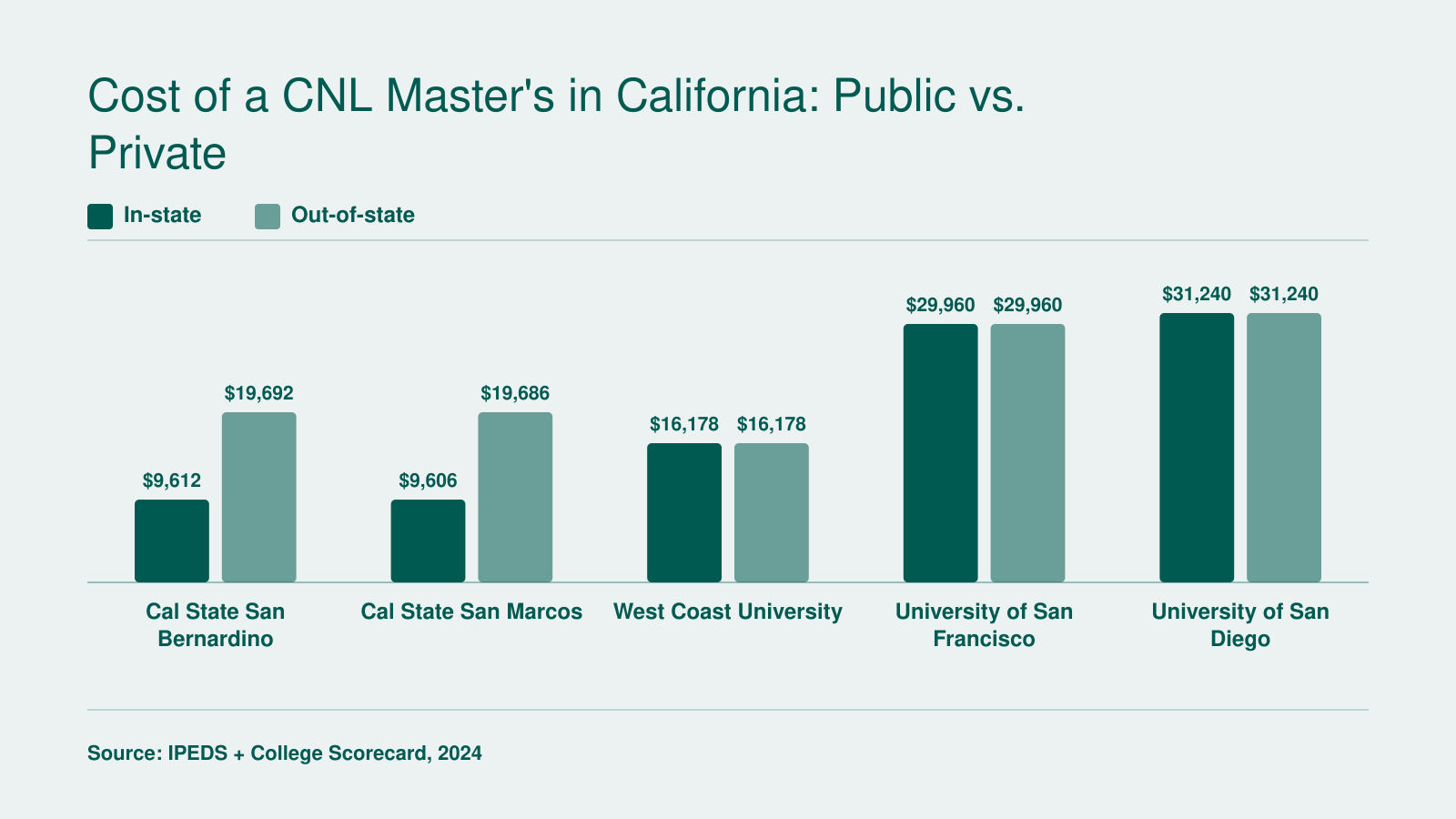
Cost of a CNL Master's in California: Public vs. Private
The CSU campuses here list in-state graduate tuition and fees near $9,600 per year and out-of-state near $19,700, while the private schools list about $16,000 to $31,000 with no residency difference. Per-unit pricing for the CNL track is thinly published: University of San Diego lists $1,900 per unit across 31 units (about $58,900 in tuition), well above the figure charted here, so confirm which applies to your cohort, and University of San Francisco has no confirmed 2026 per-unit rate for its 68-unit entry-level track. Net price figures are institution-wide averages after aid, not a quote for CNL students, and both University of San Diego and West Coast University mention financial aid options on their program pages, so ask each about scholarships.
Licensure and CNL Certification in California
Becoming a Clinical Nurse Leader in California, sometimes compared with an MSN Nurse Executive Leadership, usually involves two separate credentials: a state RN license and, optionally, national CNL certification.
RN licensure
RNs entering a post-BSN track already hold a California license. Master's-entry (ELM) students must finish their clinicals, apply to the California Board of Registered Nursing (BRN) by examination, complete a background check, and pass the NCLEX-RN. The BRN publishes first-time NCLEX pass rates by school, but it does not appear to report CNL cohorts separately, so check its pass-rate page for the school you are considering rather than relying on third-party tables.
CNL certification
The American Association of Colleges of Nursing (AACN) offers the credential through its Commission on Nurse Certification. Candidates must be in the final term of, or have graduated from, an accredited CNL master's or post-master's program, a path distinct from a Clinical Nurse Specialist (CNS) MSN. They also need an active, unrestricted RN license. The program must include at least 500 clinical hours, 300 of them in CNL immersion. Anyone who passes before finishing must complete the remaining requirements within two years.
The exam is computer-based and lasts three hours. It has 140 questions, 130 of them scored. Scores run from 150 to 500, and 350 is passing.
Renewal
Certification lasts five years. Renewal requires a current unrestricted RN license, at least 2,000 hours of relevant employment, and 50 CNL-aligned contact hours. The 2026 renewal fee is $310.
California does not require CNL certification to practice. It is a voluntary credential that employers value.
How to Choose a Clinical Nurse Leader Master's Program in California
Three MSN paths sound alike but lead to different careers across Master's Programs in California, so choose the role before the school.
Confirm the role fits
A Clinical Nurse Leader is a master's-prepared advanced generalist who coordinates care quality at the point of care within a single unit or clinical microsystem.12 The CNL is not an administrator and is not an APRN.34 A Clinical Nurse Specialist is an APRN with specialty or population preparation, working across patients, nursing practice, and systems.5 In California the CNS is a separate Board of Registered Nursing certification that requires a California RN license, a qualifying graduate degree, and a Board-approved CNS program or accepted national certification; it is not automatic with any MSN.67 A Nurse Administrator MSN in California prepares you for organizational and managerial work, not point-of-care clinical leadership. If you want CNS authority, the CNL is the wrong program.
Weigh the practical criteria
- Accreditation and certification: Confirm CCNE accreditation and eligibility for the national CNL certification exam.
- Entry point: Decide between a master's-entry track for non-nurses and a post-BSN track for working RNs.
- Format and placements: Check that online or hybrid formats come with local clinical placement support.
- Cost vs. earnings: Compare total cost against realistic graduate pay.
Before you apply, contact the admissions office to verify your start term and the current GRE policy.
Compare Clinical Nurse Leader programs on the data that matters
Explore more Nursing specializations or browse every graduate field.
All Nursing programs