Accelerated Nursing Informatics MSN Programs
Compare 70+ accredited fastest Health/Nursing Informatics programs at 60+ schools, with graduate earnings, cost, debt, and completion data from IPEDS and the U.S. College Scorecard.

Two routes lead to ANCC informatics certification: 2,000 hours of informatics practice, or a graduate informatics nursing program with at least 200 faculty-supervised practicum hours. For a working RN aiming at clinical informatics, EHR optimization, or analytics roles, the degree route is faster, provided it doesn't take three years.
The programs ranked here favor the shortest timelines, weighed against cost, practicum demands, ADN-to-MSN options, online availability, and graduate earnings rather than reputation.
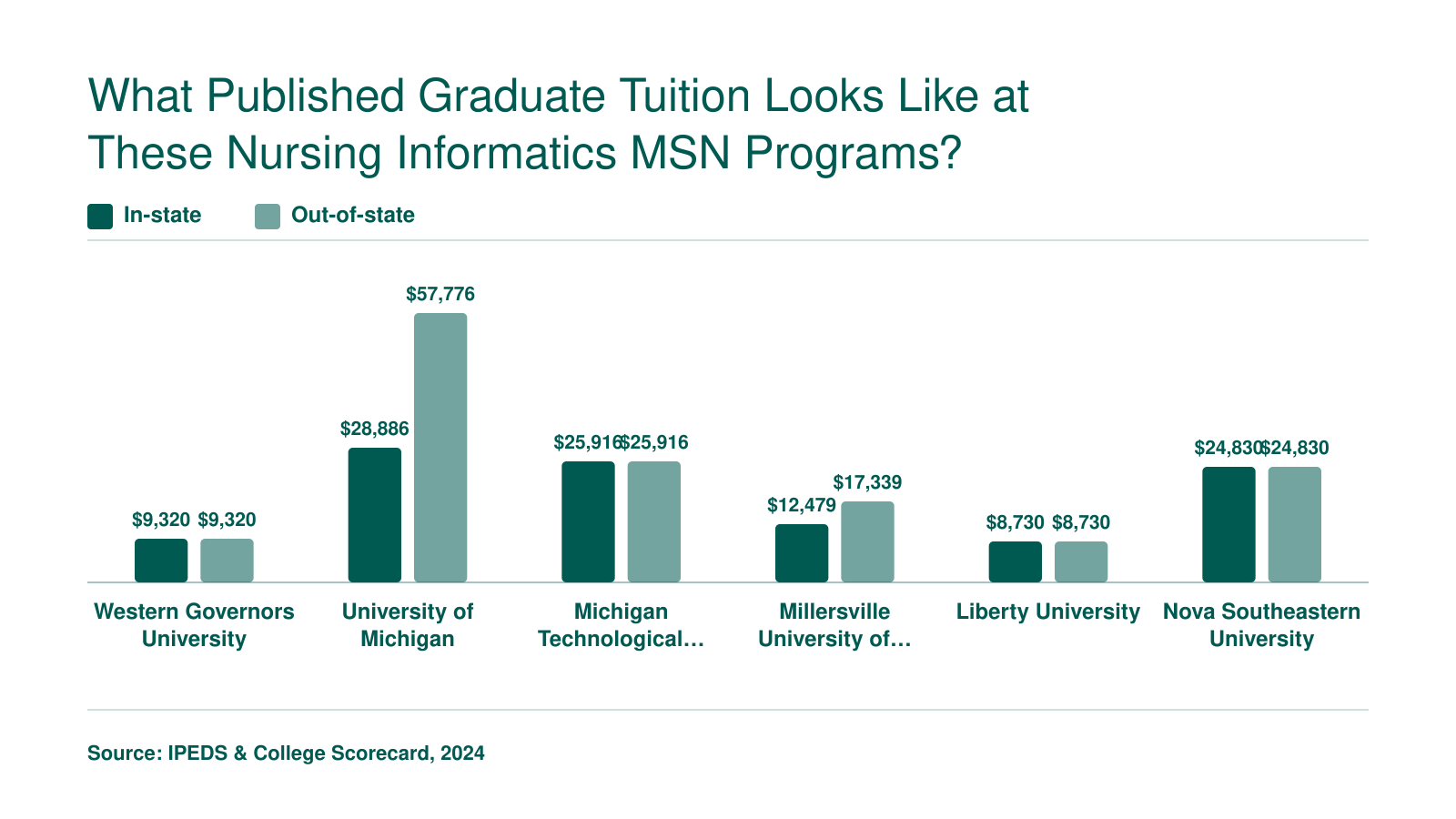
Speed has a price. Liberty's $8,730 in-state rate sits far below Michigan's $57,776 out-of-state charge.
Key Points
- Liberty University has the lowest in-state tuition at $8,730.
- Duke University requires at least 224 faculty-supervised practicum hours.
- WGU credits up to 90 transfer credits toward its BSN.
Best Accelerated Nursing Informatics MSN Programs, Ranked
This list puts the fastest nursing informatics paths in front, then checks each one against published cost and completion data. The schools below are a mix of dedicated MSN informatics tracks and closely related health informatics degrees aimed at nurses, so the summaries call out what each actually requires.
University of Maryland, Baltimore
#1Baltimore, MD · ~$18,000/yr (est.)
Best for: Working RNs needing practicum flexibility
University of Maryland, Baltimore offers an online MSN in nursing informatics built for working RNs, with full-time and part-time study plans. The 36-credit program includes 500 practicum hours and can be completed in as few as two years. Admission requires a BSN, a 3.0 undergraduate GPA, and an active RN license.
- 36 credit hours required
- Online format with full-time and part-time plans
- 500 practicum hours required
- BSN, 3.0 GPA, and active RN license required
- Academic Common Market eligibility for out-of-state students
- Free ANCC exam preparation workshops
Western Governors University
#2Salt Lake City, UT · ~$9,000/yr (est.)
Best for: Competency-based online learners
Western Governors University delivers a CCNE-accredited MSN in nursing informatics through a competency-based online model, so students can move faster by showing mastery rather than logging seat time. The program requires 14 courses and includes clinical practice experiences. Admission requires a BSN and an active, unencumbered RN license.
- 14 total courses required
- CCNE-accredited nursing program
- Competency-based learning model
- BSN and active RN license required
- No RN work requirement for admission
- Transfer up to 17 approved credits
- Clinical practice experiences included
Liberty University
#3Lynchburg, VA · ~$9,000/yr (est.)
Best for: Faith-centered working nurses
Liberty University offers an online MSN nurse informatics program with eight-week terms, designed for nurses balancing work and family. The 36-credit program requires a bachelor's degree, a 3.0 GPA, a current RN license, and at least one year of nursing experience. Accredited by CCNE, it weaves a Christian worldview into health data analytics and leadership coursework.
- 36 credit hours required
- Online format with 8-week terms
- Bachelor's degree and 3.0 GPA required
- Current RN license and one year nursing experience required
- CCNE-accredited program
- Christian worldview focus
- Health data analytics and leadership focus
Millersville University of Pennsylvania
#4Millersville, PA · $12,000 – $17,000/yr (est.)
Millersville University of Pennsylvania provides an online MSN with a nursing informatics concentration that can be finished in 14 to 24 months. It requires 37 credit hours, a BSN, an active RN license, a 3.0 GPA, and at least one year of clinical experience, with no GRE or GMAT. The program is accredited and prepares graduates for the ANCC Informatics Nursing certification exam.
- 37 credit hours required
- Online program format
- Complete in 14 to 24 months
- BSN, RN license, and 3.0 GPA required
- One year clinical experience required
- No GMAT or GRE required
- Prepares for ANCC Informatics Nursing certification
Aspen University
#5Phoenix, AZ · ~$6,000/yr (est.)
Aspen University's online MSN informatics track takes a lean, affordable route through 12 courses over two years and includes a 120-hour practicum. Admission requires a BSN, a 2.5 GPA, current RN licensure, and one year of nursing experience. The CCNE-accredited program focuses on data analysis, information security, and regulatory compliance.
- 12 online courses
- Complete in two years
- 120-hour practicum required
- BSN, 2.5 GPA, and RN license required
- One year nursing experience required
- CCNE-accredited program
- Data analysis and information security focus
University of St. Augustine for Health Sciences
#6San Marcos, CA · ~$29,000/yr (est.)
The University of St. Augustine for Health Sciences offers an online MSN with a Nurse Informaticist concentration for BSN-prepared nurses. The 36-credit program includes practicum experiences in local communities and emphasizes interprofessional collaboration and evidence-based practice. Admission requires a BSN and an active nursing license.
- 36 total credit hours
- Online delivery format
- Nurse Informaticist concentration
- BSN and active nursing license required
- Includes practicum experiences
- Interprofessional learning environment
- Clinical data analytics and system design focus
The University of Arizona Global Campus
#7Chandler, AZ · $10,000 – $15,000/yr (est.)
The University of Arizona Global Campus offers an online MS in health informatics and analytics for RNs, using accelerated six-week courses taken one at a time. The 39-credit program requires a current RN license and a 3.0 minimum GPA, with the option to transfer up to nine approved credits. It ends with a capstone and does not lead to state licensure.
- 39 total credit hours
- Fully online delivery
- Accelerated six-week courses
- Current RN license and 3.0 GPA required
- Transfer up to nine approved credits
- Capstone required
- Does not lead to state licensure
University of Michigan
#8Ann Arbor, MI · $29,000 – $58,000/yr (est.)
The University of Michigan's accelerated master's in health informatics is built for high-performing undergraduates at the School of Public Health, adding one academic year after the bachelor's. It trims the usual 45-credit MHI to 30 credits and offers informal specializations in Big Data and AI in Health Care or Management and Leadership in Health Informatics. Admission requires a minimum 3.2 GPA, with a priority deadline in December.
- 30 total credit hours
- One-year accelerated format
- 2 concentration options
- 3.2 GPA minimum
- Capstone and internship required
- Internship can earn up to nine credits
- Priority application deadline December 1
Michigan Technological University
#9Houghton, MI · $25,000 – $30,000/yr (est.)
Michigan Technological University's MS in health informatics is available on campus or fully online and is structured around four stackable graduate certificates. Students complete a 12-credit foundations certificate plus two of three nine-credit certificates in AI in Healthcare, Security and Privacy in Healthcare, or Public Health Informatics, for at least 30 total credits. Admission requires a bachelor's degree, a 3.0 GPA, and three letters of recommendation, with no GRE and rolling review.
- 30 total credit hours
- On-campus or fully online delivery
- Four stackable graduate certificates
- Three concentration options
- No GRE required
- 3.0 GPA and three recommendations required
- Rolling admissions with no application fee
Nova Southeastern University
#10Fort Lauderdale, FL · ~$25,000/yr (est.)
Nova Southeastern University's MS in health informatics can be completed online or in a hybrid format in as little as one year. The 36-credit program includes practicum experiences and leads to professional certifications such as Lean Six Sigma and CPHIMSS. Admission requires transcripts and an application fee, with deadlines in December, April, and August.
- 36 total credits
- Online and hybrid delivery
- Complete in one year
- Full-time or part-time basis
- Practicum required
- Leads to Lean Six Sigma and CPHIMSS certifications
None of the ranked Health/Nursing Informatics programs match the fastest lens yet. The full ranking is at the link above.
Cost, debt & payoff
Median earnings of this field's master's graduates (4 yrs after completing) vs. their median federal loan debt · U.S. College Scorecard
Across these programs the median graduate earns about $104,240 and finishes with roughly $41,000 in debt — a ratio that clears a common rule of thumb (keep debt below first-year salary). Tuition and debt vary widely school to school, so check the per-school figures in the table above before you shortlist.
What Published Graduate Tuition Looks Like at These Nursing Informatics MSN Programs?
The chart below compares published in-state and out-of-state graduate tuition for the programs ranked here. Liberty University shows the lowest in-state rate at $8,730, and the largest in-state vs out-of-state gap is the University of Michigan at $28,886 versus $57,776. Some public online programs, such as Michigan Technological University, list one flat rate for all online students, so confirm your residency status before applying.
Nursing Informatics MSN Practicum Hours and Who Finds Your Site
Nursing informatics MSN practicums are project work, not bedside rotations, and who finds your site matters as much as the hour count. Online nursing informatics MSN programs generally require 200 to 500 hours.
- Duke University: At least 224 hours in local clinics or hospitals, built around an informatics project, with a placement team helping secure the site.
- Rutgers School of Nursing: 500 hours at an approved site in your state of residence. Coursework is fully online, and faculty approve each project-based practicum.
- Walden University: Project hours in the informatics practicum course cannot exceed half of total practicum hours.
- University of Texas at Arlington: Graduate placement is a collaborative process between student and school.
The ANCC informatics nursing certification requires at least 200 faculty-supervised practicum hours, which Duke and Rutgers both meet. Ask any school that doesn't publish its total to confirm it in writing.
Placement is rarely guaranteed before enrollment. Your current employer can often serve as the site with approval, but affiliation agreements with large health systems can take weeks or longer. Line up a preceptor, such as an informatics nurse, CNIO, or clinical IT lead, before you apply.
The ANCC credential is NI-BC (Informatics Nursing, Board Certified), not "RN-BC." One eligibility route skips thousands of practice hours: graduates of a graduate informatics nursing program can qualify with at least 200 faculty-supervised practicum hours, versus 2,000 informatics practice hours within the last 3 years, according to ANCC.
Accelerated RN-to-MSN Nursing Informatics With No BSN: Transfer Credit and BSN Awards
Western Governors University (WGU) can credit up to 90 transfer credits toward its 120-credit BSN1, and that is the clearest ADN-to-MSN route we could confirm among accelerated health informatics master's programs. Its RN-to-MSN Nursing Informatics track is one of the online nursing informatics programs that admits RNs holding an ADN or a nursing diploma from an accredited institution2.
Yes, an intermediate BSN is awarded3. WGU has students finish the BSN portion before choosing the MSN specialty, so a stop-out still leaves you with a bachelor's degree3. Students who complete five graduate courses before finishing the BSN can also earn a post-baccalaureate certificate3.
Transfer credit at WGU
Transfer credit comes in two steps: 80 credits granted at application for students from an accredited program, then a transcript evaluation for up to 10 more1. WGU also says licensed RNs may transfer roughly 50 to 90 credit equivalents, so your actual award depends on your transcript4. It does not publish a separate credit-for-licensure figure.
Other schools
Walden, Chamberlain, Capella, Grand Canyon, and the University of Central Florida were not verified for an ADN-without-BSN informatics pathway. Ask each admissions office directly before counting on one.
Expect bridge or prerequisite coursework, such as statistics and community health, before graduate classes begin. WGU says eligibility varies by program and that it evaluates prior coursework and certifications1.
Related Articles
What You Need to Apply and When Terms Start
- RN licenseActive, unencumbered license. WGU requires it in your state of residence or employment and where clinical/project work occurs; Pitt requires current licensure where clinical requirements are completed.
- Degree prerequisites and GPAWGU: ADN or diploma for RN-to-MSN, BSN for BSN-to-MSN. Pitt: BSN, 3.0 undergraduate GPA, and statistics within 10 years with B- or better.
- Work experienceWGU does not require RN work experience.
- Documents and screeningsPitt: three recommendations, 500-word essay, interview, and GRE (waived with 3.5+ GPA). WGU: background check and immunizations before clinical placement.
- Deadlines and start datesPitt admits a fall cohort only, with February 15 and May 1 deadlines. Duke uses rolling review but is not currently accepting applications.
Accelerated Nursing Informatics MSN Programs Online: State Restrictions to Check
Whether an online program can enroll you depends on your state, and the format tells you where to start looking. Most of the programs ranked here run fully online, including Nova Southeastern, Liberty, Western Governors, and Aspen. A few differ: the University of Michigan is campus-based, and Michigan Tech is hybrid with an online option. Even online does not mean available everywhere.
Authorization Is State-Specific
NC-SARA lets schools offer distance education across member states, but it does not override state nursing board rules or clinical placement restrictions.1 Columbus State, for example, cannot enroll students physically present in states including Arizona, Colorado, New York, and Pennsylvania.2 Duke lists New York and Louisiana as pending.1 Eastern Kentucky bars unpaid practicum placements in Colorado,3 and Wichita State restricts nursing clinicals in New York.4
Before you apply, confirm two things: that your state of residence is approved for enrollment, and that you can complete a practicum in an approved state with an eligible site and preceptor.
Salary and Debt After an Accelerated Nursing Informatics MSN
The strongest reported outcome among the schools here comes from the University of Michigan, where graduates of the Health Informatics program show median earnings of about $124,000 four years after finishing. That pairs with median program debt near $19,500 and a 10-year monthly payment of roughly $466, an easy load to carry against those earnings.
Nova Southeastern University reports median earnings around $82,000 five years out, with median debt near $24,250 and a monthly payment of about $917. Earnings outpace debt there too, though the cushion is narrower.
Most other programs on this list, including Western Governors, Liberty, Millersville, and Maryland, do not publish program-level earnings for this specialty, so there is no reliable graduate salary figure to quote. We do not substitute an institution-wide number, which would mix in unrelated degrees.
A quick rule of thumb for health informatics masters program cost: if your total borrowing stays below what you expect to earn in your first year of work, the debt is generally manageable.
Health/Nursing Informatics programs by state
Quick Answers Before You Enroll
What is the cheapest accelerated nursing informatics MSN program?
Does nursing informatics MSN accreditation matter, and should I look for CCNE or ACEN?
Can I complete practicum hours at the hospital where I already work?
Compare Health/Nursing Informatics programs on the data that matters
Explore more Nursing specializations or browse every graduate field.
All Nursing programs