Accelerated Master's in Business Law Programs
Compare 40+ accredited fastest Business Law programs, with graduate earnings, cost, debt, and completion data from IPEDS and the U.S. College Scorecard.

The fastest business law master's degrees now run a single year, yet many are accelerated LLM programs that require a prior law degree. Compliance officers, operations managers, and founders who want legal fluency without three years of law school should look instead at MLS or MSL tracks, such as the 30-credit option at Arizona State and the one-year Pitt program.
Most of these degrees are built for non-lawyers and do not lead to bar admission. Some LL.M. tracks, such as Georgetown's and Vanderbilt's, are aimed at lawyers who want New York bar eligibility.
That split, between credentials that sound alike but serve different people, is where most applicants lose time and tuition.
Key Points
- Georgetown's business law master's graduates earn a median $169,366 five years later.
- Online accelerated terms run 7 or 8 weeks, not 15.
- An MLS suits nonlawyers; an LLM requires a prior law degree.
The 10 Fastest Business Law Master's Programs
We ranked these business law master's programs for students who want to finish quickly, prioritizing accelerated and one-year completion options. Each school on this list offers a focused credential in business law, from an LL.M. for lawyers and foreign-trained attorneys to a Master of Legal Studies for working professionals who are not lawyers. The entries spotlight degree structure, credit load, and the students each format tends to serve best.
The University of Texas at Austin
#1Austin, TX · ~$12,000/yr (est.)
Best for: Foreign-trained lawyers seeking Texas bar preparation
The University of Texas at Austin is a top public law school whose one-year Business Law LL.M. is built for foreign law graduates. The curriculum pairs required business-law courses with a writing seminar or directed research paper and electives across antitrust, tax, energy, and real estate. Students can gain practical experience in the Entrepreneurship and Community Development Clinic while accessing networking through the Texas Business Law Society.
- One-year program for foreign law graduates
- 24 total credit hours
- Required Business Associations and Contracts courses
- Writing seminar or directed research paper
- Entrepreneurship and Community Development Clinic
- Electives in antitrust, tax, energy, real estate
- Access to Kay Bailey Hutchison Energy Center
- Scholarships available
Georgetown University
#2Washington, DC · $60,000 – $65,000/yr (est.)
Best for: International attorneys wanting D.C. policy exposure
Georgetown Law is a large Washington, D.C. law school offering an LL.M. in International Business and Economic Law that students complete in one full-time year. The degree includes both classroom and practice-oriented tracks, with more than 70 courses across corporate, securities, trade, and commercial law. Foreign-trained students follow a 20-credit path, while U.S.-trained students complete 24 credits, and many use the program to build New York Bar eligibility.
- Full-time in one academic year, part-time in three
- 20 credits for foreign-trained, 24 for U.S.-trained
- Specialization credits: 16 foreign-trained, 14 U.S.-trained
- Required Corporations and International Law I
- More than 70 business-law elective courses
- Practice-oriented track with externship or practicum
- Certificate of Specialization option
- Prepares for New York Bar eligibility
Vanderbilt University
#3Nashville, TN · ~$58,000/yr (est.)
Best for: Lawyers focused on corporate finance coursework
Vanderbilt Law School's Law and Business Track is a one-year LL.M. option for lawyers who want a focused business-law credential. The track requires core courses in corporations, corporate finance, accounting for lawyers, and securities regulation, plus electives in tax, bankruptcy, or mergers and acquisitions. Students earn a certificate in Law and Business along with the LL.M.
- One-year program, fall start
- 27 total credit hours
- Core courses: corporations, corporate finance, securities regulation
- Electives in tax, bankruptcy, or mergers and acquisitions
- Six additional elective credit hours
- Certificate in Law and Business
- New York Bar eligibility
- All courses open across curriculum tracks
Florida State University
#4Tallahassee, FL · ~$11,000/yr (est.)
Florida State University offers an LL.M. in Business Law that accepts both J.D. holders and foreign lawyers and can be completed in one year full-time or up to three years part-time. The 24-credit curriculum covers regulatory compliance, transactional practice, business litigation, financial regulation, and cybersecurity, with access to the Business Law Clinic and a faculty mentor. Rolling admissions and no LSAT requirement make the program accessible.
- One year full-time or three years part-time
- 24 total credit hours
- Open to J.D. holders and foreign lawyers
- Required online regulatory compliance and risk management courses
- Business Law Clinic available
- Faculty mentor assigned
- Rolling admissions, no LSAT requirement
- Merit-based scholarships
George Washington University
#5Washington, DC · ~$36,000/yr (est.)
George Washington University's LL.M. in Business and Finance Law is based in Washington, D.C., and full-time students finish in one calendar year. The degree requires at least 16 credits in business-focused courses such as securities regulation, corporate finance, and mergers and acquisitions, with a thesis or research paper. A three-semester option supports international students.
- One calendar year full-time
- 24 total credit hours
- 16 credits in business courses
- Full-time and part-time options
- Thesis or research paper required
- Three-semester option for international students
- Starts fall or spring
University of Minnesota-Twin Cities
#6Minneapolis, MN · ~$22,000/yr (est.)
The University of Minnesota's Business Law LL.M. is a long-running program for internationally trained lawyers, with alumni from more than 90 countries. The curriculum includes Introduction to American Law, LL.M. Legal Writing, and LL.M. Judicial Observation, building U.S. legal skills. Every admitted student is considered for a scholarship.
- 31-year established LL.M. program
- Students from more than 90 countries
- Introduction to American Law course
- LL.M. Legal Writing and Judicial Observation
- Scholarship consideration for every admitted student
- Business Law and Entrepreneurship Clinic partner network
University of Pittsburgh-Pittsburgh
#7Pittsburgh, PA · ~$28,000/yr (est.)
The University of Pittsburgh offers a Master of Studies in Law with a Business Law concentration for professionals who want legal expertise without becoming lawyers. The 30-credit degree can be finished in one academic year full-time or completed part-time over two to four years, and students learn alongside J.D. candidates. A small cohort and one of the oldest MSL programs in the U.S. add a personalized, established option.
- One academic year full-time or two to four years part-time
- 30 total credit hours
- At least 12 credit hours in business law
- Small cohort with personalized attention
- One of the oldest MSL programs in the U.S.
- Courses shared with J.D. program
- 22 specialization areas available
- Self-designed concentration possible
University of San Diego
#8San Diego, CA · ~$31,000/yr (est.)
The University of San Diego's LL.M. in Business and Corporate Law is designed for attorneys moving into complex business transactions or in-house counsel roles. The 24-credit program includes a required Corporations course, two research papers, and electives in taxation, labor, finance, and intellectual property, with three annual start dates and day or evening classes.
- 24 total credit hours
- One year full-time
- Full-time and part-time options
- Three start dates per year
- Required Corporations course
- Two research papers required
- Day and evening classes
- Scholarships available
Loyola University Chicago
#9Chicago, IL · ~$22,000/yr (est.)
Loyola University Chicago offers an LL.M. in Business Law for practicing attorneys, with full-time students finishing in one year and part-time students in two. The curriculum combines required business planning and international business transactions courses with a thesis and electives in governance, tax, compliance, and securities, plus a Business Law Clinic.
- 24 total credit hours
- One year full-time, two years part-time
- Required Business Planning and International Business Transactions
- Thesis required
- Business Law Clinic available
- Online courses in compliance, privacy, securities
- Starts fall
Arizona State University
#10Tempe, AZ · ~$14,000/yr (est.)
Arizona State University's online Master of Legal Studies with a business law emphasis is built for non-lawyers who need legal fluency in business. The 30-credit, 10-course program can be completed in one year and covers U.S. law fundamentals plus business relationships and employment law. The degree is delivered by the Sandra Day O'Connor College of Law and includes a FastApp process with no application fee or entrance exam.
- 30 total credit hours, 10 courses
- Complete in one year
- Designed for non-lawyers
- No application fee or entrance exam
- Diploma does not mention online
- FastApp process available
- Sandra Day O'Connor College of Law faculty
- Financial aid available
Cost & outcomes by school
Federal data for the highest-earning Business Law programs, independent of the ranking above. Earnings are this field's master's graduates four years after completing, where the Scorecard reports them.
| School | Earnings | Tuition / yr | Debt | Grads/yr | Format |
|---|---|---|---|---|---|
| Georgetown University DC | $171,631 | $61,670 | $97,008 | 538 | Campus |
| University of San Diego CA | $148,235 | $31,240 | $135,168 | 31 | Campus |
| Loyola University Chicago IL | $123,695 | $21,912 | $58,186 | 95 | Campus |
| George Washington University DC | $117,955 | $36,414 | $78,277 | 163 | Campus |
| Florida State University FL | $100,339 | $10,553 | $45,588 | 346 | Campus |
| Arizona State University AZ | $80,281 | $10,843 | $53,770 | 351 | Online |
| Arizona State University AZ | $80,281 | $13,587 | $53,770 | 51 | Online |
| Pennsylvania State University PA | — | $26,034 | — | 176 | Campus |
| University of Akron OH | — | $10,125 | — | 2 | Online |
| The University of Texas at Austin TX | — | $12,006 | — | 20 | Campus |
| University of Pittsburgh-Pittsburgh PA | — | $27,580 | — | 24 | Online |
| Vanderbilt University TN | — | $57,868 | — | 25 | Campus |
Sources: U.S. Department of Education. Tuition and graduates: IPEDS. Earnings and debt: College Scorecard, this field's master's graduates; a dash means no figure is reported.
Cost, debt & payoff
Median earnings of this field's master's graduates (4 yrs after completing) vs. their median federal loan debt · U.S. College Scorecard
Across these programs the median graduate earns about $100,397 and finishes with roughly $57,235 in debt — a ratio that clears a common rule of thumb (keep debt below first-year salary). Tuition and debt vary widely school to school, so check the per-school figures in the table above before you shortlist.
MLS vs. LLM vs. JD/MBA: Which Accelerated Credential Fits You?
An MLS or MJ is for nonlawyers, an LLM requires a prior law degree, and a JD/MBA is for students who want both credentials in one accelerated path. The clearest accelerated timeline is the JD/MBA: the University of Chicago, the University of Miami, and Boston University all describe a three-year structure, the College of Charleston uses a 3.5-year structure, and LSU shares credits between its law and Flores MBA programs to save significant time. An MLS or MJ does not qualify graduates to practice law, and only a few states, including New York and California, let foreign-trained LLM holders sit for the bar under specific individual review rules.
| Feature | MLS or MJ | Business Law LLM | JD/MBA |
|---|---|---|---|
| Primary audience | Nonlawyers and professionals seeking legal knowledge for their work | Foreign-trained attorneys whose first law degree and coursework may be reviewed by a state bar authority | Students seeking both a Juris Doctor and an MBA in the time typically required for a JD alone |
| Prerequisite degree | No JD is required; these are advanced degrees for nonlawyers | A prior law degree, typically a non-U.S. law degree that must meet state duration and substantive-equivalence rules | Admission to both law and business programs; no prior law degree is required |
| Leads to bar eligibility | Generally no; the ABA notes many states do not permit bar exam eligibility without a JD | Not automatic; New York and California require individual evaluation, and New York may require a qualifying LLM with specified coursework | Yes through the JD component; the MBA does not itself provide bar eligibility |
| ABA accreditation | The ABA does not accredit MLS programs | Most LLM programs are not ABA-accredited, although some are offered by ABA-approved law schools | The JD component is the qualifying professional degree at an ABA-approved law school |
What Graduates Earn After Finishing
Georgetown University graduates of the business law master's program earned a median of $169,366 five years after completion.
Admission Requirements for Non-Lawyers
Admission for accelerated business law master’s programs is built around a bachelor’s degree, with test and experience expectations varying by school.
- Bachelor’s degreeAn accredited U.S. bachelor’s degree or comparable foreign equivalent is the baseline; no prior legal training is required at schools such as Cornell and ASU.
- Minimum GPAPublished minimums vary: Cincinnati requires 2.75, Miami requires 3.0, while Cornell and ASU list no minimum, so 2.75–3.0 is the documented range, not a universal cutoff.
- GRE, LSAT, or GMATUsually waived or optional: Cornell, ASU, Cincinnati, and Miami state no required exam; Northeastern lists the GRE or LSAT as optional.
- Work experienceExecutive formats often expect professional experience, Cincinnati requires two years, Cornell wants a résumé showing relevant experience but no minimum, and many schools set no minimum.
- Personal statementA statement of purpose or interest is commonly required; Northeastern asks for 500–1,000 words, and Cincinnati ties the statement to working-professional experience.
- RecommendationsMost programs require one or two letters: Cincinnati asks for one professional or academic letter from someone who has known you at least a year; Cornell requires two.
- Transcripts and résuméApply online with transcripts from all colleges attended and a current professional résumé.
- Separate LLM routeFor an LLM, a JD or foreign law degree is typically required rather than a bachelor’s alone; non-lawyer business law applicants usually pursue an MLS-style master’s.
- International applicantsTOEFL or IELTS may be required for non-native English speakers at schools such as Cornell and Northeastern.
Related Articles
What an Accelerated Online Schedule Really Looks Like
An accelerated Online Master's in Business Law packs a semester's worth of coursework into shorter terms, usually 7 or 8 weeks instead of 15, so each week carries more reading and writing. Most of these programs pair the short terms with a two-course-per-semester pace.
Weekly Hours
Schools rarely publish hours per course for business law master's programs. Cornell lists 15 to 20 hours per week for its asynchronous M.S.L.S.1, and Vanderbilt cites about 16 hours per week with 8-week courses.2 Both describe those programs as part time. Cincinnati, William & Mary, and Pepperdine do not state a per-course figure, so treat those numbers as a rough baseline and ask admissions directly.
Live Sessions and Flexibility
Cincinnati's online MLS (two 7-week classes per semester) and William & Mary's (8-week sessions) are fully asynchronous.34 Cincinnati requires no campus visits3, and William & Mary requires no designated login time4. Pepperdine's source confirms its six 8-week sessions per year5 but not whether classes meet live, so confirm that before enrolling.
Full-Time Pace
Full-time loads shrink the degree to roughly 12 to 18 months: William & Mary lists 16 months4, Pepperdine offers a 12-month full-time sample5, and Cincinnati runs five semesters3. For someone working full time, that likely means two courses at once and a heavier week than the published part-time figures.
Practical tip: take one course per 8-week term first. You can add a second once you know your real weekly load.
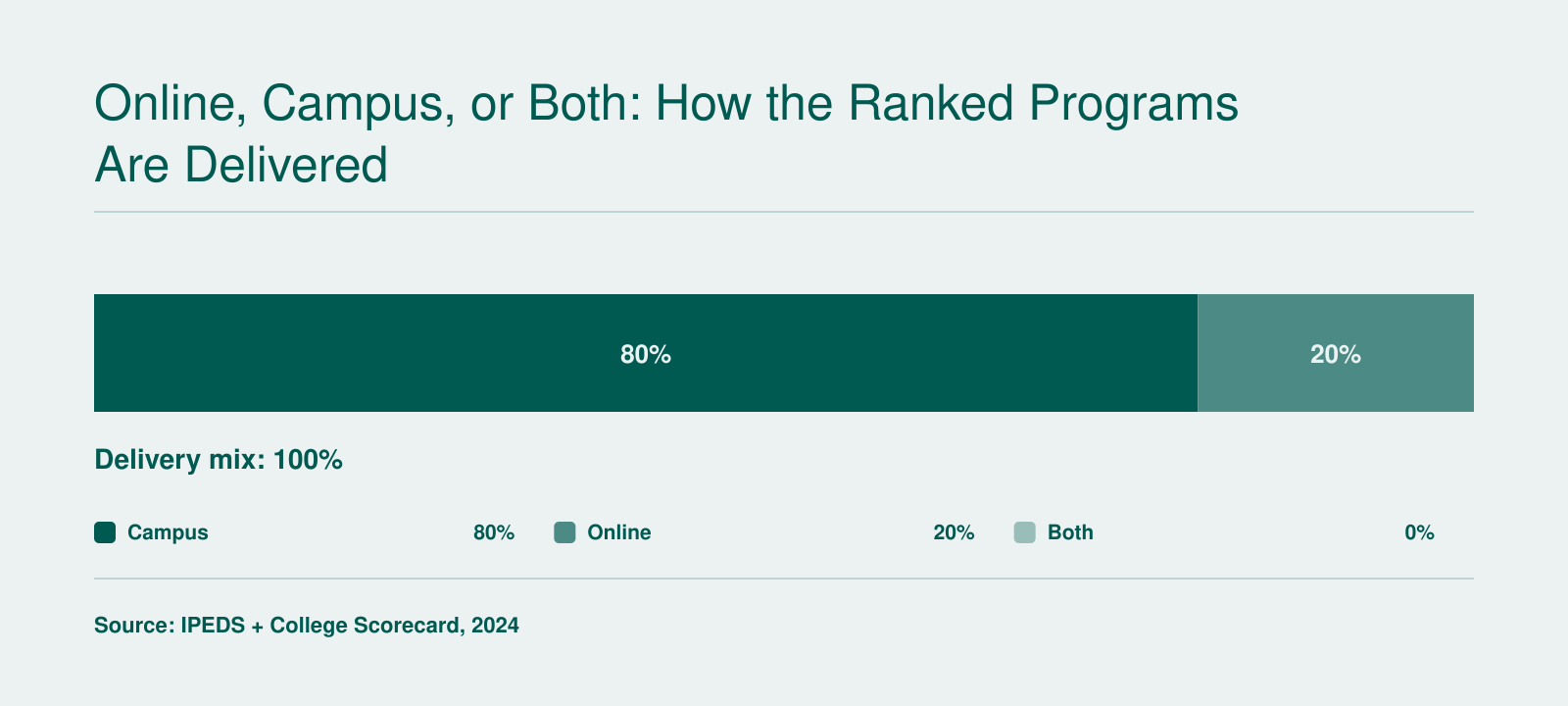
Online, Campus, or Both: How the Ranked Programs Are Delivered
Most of the ranked business law master's programs are delivered on campus, while a smaller share are fully online. The fully online options, along with flexible schedules at several campus programs, make the accelerated one-year pace more workable for full-time professionals.
Business Law programs by state
Frequently Asked Questions About Accelerated Business Law Master's
Can I practice law with a master's in business law?
Are online accelerated business law master's programs credible?
Can international students enroll in an online accelerated business law master's?
Is a business law certificate a faster alternative?
Compare Business Law programs on the data that matters
Explore more Criminal Justice & Law specializations or browse every graduate field.
All Criminal Justice & Law programs