Accelerated Master's in TESOL Programs
Compare 80+ accredited fastest TESOL & Multilingual Learners programs, with graduate earnings, cost, debt, and completion data from IPEDS and the U.S. College Scorecard.
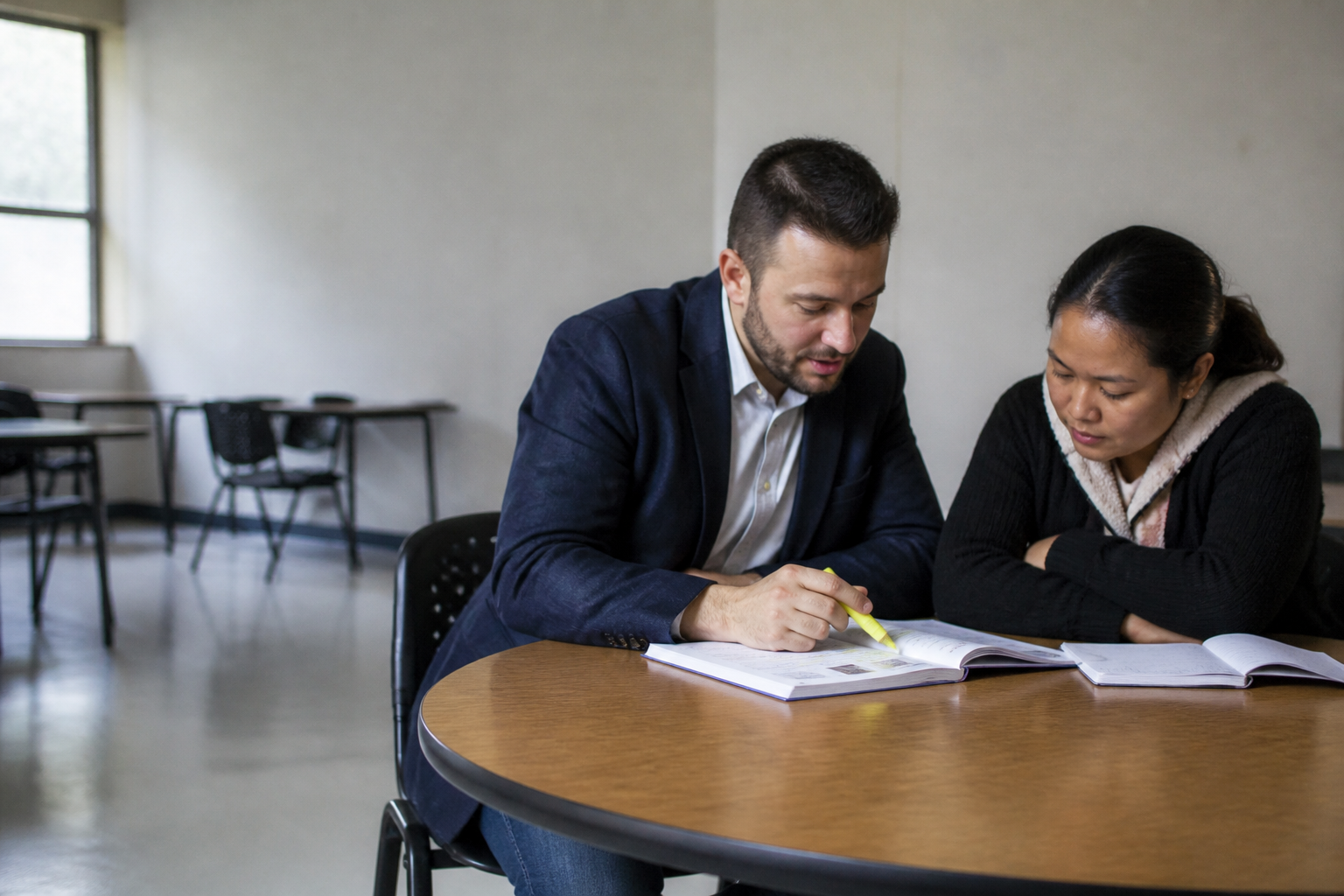
How fast can you actually finish a TESOL master's? University of Southern Maine's online MSEd advertises as few as 10 months, and 4+1 formats let undergraduate seniors count graduate credits toward both degrees, so the master's lands about a year after the bachelor's.
Speed has a price. Compressed terms mean heavier course loads, fewer electives, and less room to schedule a supervised practicum around a working day. A 12-18 credit graduate certificate near $3,750 costs far less than a 30-36 credit master's, but it rarely satisfies a K-12 ESL endorsement.
Licensure rules stay state-specific, and no accelerated format changes that.
Key Points
- University of Southern Maine offers a 10-month online MSEd in TESOL.
- Binghamton's 33-credit TESOL MA takes about one and a half years full-time.
- An online TESOL master's at $588 per credit totals near $17,640.
None of the ranked TESOL & Multilingual Learners programs match the fastest lens yet. The full ranking is at the link above.
How we rank. Each program is scored on graduate figures only: the field's master's earnings and debt, graduate tuition and the number of master's graduates, normalized across all programs in this field. Data comes from the U.S. Department of Education's IPEDS and College Scorecard; no school pays for placement.
Cost, debt & payoff
Median earnings of this field's master's graduates (4 yrs after completing) vs. their median federal loan debt · U.S. College Scorecard
Across these programs the median graduate earns about $66,234 and finishes with roughly $26,008 in debt — a ratio that clears a common rule of thumb (keep debt below first-year salary). Tuition and debt vary widely school to school, so sort the ranking by "Most affordable" or "Lowest debt" to weigh cost against outcomes.
How 4+1, +1, and 12-Month TESOL Master's Formats Work
Accelerated formats trade flexibility for speed, so the right one depends on where you are in your education right now.
- 4+1 (combined BA/MA): Seniors take graduate courses that count toward both degrees.
- +1: A fast master's for people who already hold a bachelor's.
- 12-month or cohort online: A fixed course sequence taken with a group, often built for working adults.
How credit sharing works
Binghamton's BA/MA in TESOL leads to a BA in English and a Master's in TESOL in five years. It counts up to 12 shared credits toward the 33-credit master's, requires a 3.5 GPA, and asks students to apply in third year. The University of Southern Maine's pathway is open to all majors. Students declare at about 84 completed credits, apply by January 31 (December 1 is recommended) for fall entry, and need a B- or better in EDU 561, 560, 558, and 559. Its published excerpt does not state a shared-credit cap.1
What it saves
Twelve shared credits out of 33 leave 21 to take as a graduate student, roughly one full-time semester. At an illustrative $1,000 per credit (use your school's actual rate), that is $12,000 saved.
Who each model fits
4+1 works best for current undergraduates at the same school. Career changers who already have a degree should look at 12-month or online TESOL master's programs instead.
Fastest TESOL Master's Programs Compared: Credits, Time to Degree, and Tuition
Among the programs below, the online MSEd in TESOL from University of Southern Maine advertises the fastest finish at as few as 10 months, while the 33-credit MA from Binghamton University is roughly one and a half years full-time. On published tuition, the $345 per-credit rate at Eastern Washington University yields an estimated $16,905, slightly above the estimated $15,720 at College of Mount Saint Vincent. Those two programs list fees separately, so students should compare the official cost breakdown at each institution before deciding.
| School | Format | Total Credits | Time to Degree | Cost per Credit | Est. Total Tuition | Leads to Licensure? |
|---|---|---|---|---|---|---|
| University of Southern Maine | Online | 30 required credit hours | As few as 10 months | Not reported | Not reported | Can lead to Maine Endorsement in ESOL; does not lead to initial certification for future teachers |
| College of Mount Saint Vincent | Online | 30 credit hours | 12 months | $524 per credit hour | $15,720 total tuition | Not reported |
| Eastern Washington University | Online | 49 credit hours | As few as 12 months | $345 per credit hour | $16,905 total tuition | Not reported |
| California State University, San Bernardino | Online | Minimum 30 semester units | 12 months | Not reported | Not reported | Not reported |
| Binghamton University | In-person | 33-credit program | Approximately one and a half years full-time | Not reported | Not reported | Not reported |
Will Your TESOL Master's Lead to Licensure in Your State?
Licensure Track or Not
Some TESOL programs lead to initial certification or an ESL/ESOL endorsement for K-12 classrooms. Others target adult education, higher ed, or teaching abroad and carry no licensure at all. Confirm which one you are applying to.
Portability Has Limits
The NASDTEC Interstate Agreement is a cooperation framework, not automatic reciprocity. The receiving state reviews your credentials and decides the outcome, which may be a comparable license, a temporary one, or neither. ESL endorsements usually travel with the underlying teaching license rather than on their own. Common catches include state-specific exams with English learner content, coursework gaps, and required clinical hours.
New York as an Example
New York applications run through TEACH.1 TESOL candidates need 12 semester hours in a language other than English,1 the Content Specialty Test in ESOL, DASA training, and 20 days of ESL clinical practice.2 The TESOL Advanced Certificate is built for teachers who already hold certification.3 The College of Staten Island offers a fully online route,1 while Mercy, Fordham, and Binghamton set their own prerequisites on top of state minimums.
Before enrolling in an out-of-state online program, read its state authorization disclosure and ask whether it meets your state's licensure rules.
Related Articles
Fully Online vs Hybrid TESOL Programs: How Practicum Placements Differ
Fully online TESOL master's degrees generally let you complete practicum hours near home or in your current teaching job, while hybrid programs add scheduled on-campus or regional sessions. The table below shows how the placement obligations actually differ.
| Aspect | Fully online programs | Hybrid programs |
|---|---|---|
| Program examples | Concordia University Nebraska M.Ed. TESOL; Southeast Missouri State University MA in TESOL; Grand Canyon University MA in TESOL | Pepperdine University MA in TESOL; California State University, San Bernardino MA-TESOL |
| Clinical field hours | From 40 hours (University of Southern Maine) to 110 total observational and practice hours (Grand Canyon University); Concordia requires 45 | Boston University requires one semester; Pepperdine requires a clinical teaching practicum in ESL classrooms |
| Where placements can be completed | Local or own classroom (Concordia); current workplace subject to approval (South Carolina Upstate); anywhere, including Maine, out of state, or internationally (Southern Maine) | Local institutions, community centers, and community colleges matched to interests (Boston University); Southern California language institutes, community programs, and K-12 schools (Pepperdine); school site, model schools, or International Extension Program (California State University, San Bernardino) |
| On-campus sessions or residencies | None required for Concordia, Southeast Missouri State, or Grand Canyon; South Carolina Upstate includes an in-person practicum | Pepperdine uses weekend face-to-face sessions at Malibu, Calabasas, or West Los Angeles; California State University, San Bernardino offers a partial-residency arrangement; Southern Maine blended format has some on-campus sessions |
| Required teaching site access | Grand Canyon requires access to a PreK-12 classroom with English as a second language; Concordia lets students use their own classroom | California State University, San Bernardino lets employed educators use fieldwork at their school site; pre-service teachers use model schools or the on-campus International Extension Program |
| Placement flexibility | Southern Maine setting is determined by the student and instructor, and can be completed internationally; Southeast Missouri State lets students select a site and build curriculum around learner needs | Boston University placement is matched to student interests, proficiency levels, and preferred teaching modality |
Admission Requirements for Accelerated TESOL Programs
- Degree and GPASouthern Maine accepts a 2.5 GPA; Mount Saint Vincent, Azusa Pacific, and Portland State require 3.0. Azusa Pacific reviews 2.5–2.99 provisionally; Mount Saint Vincent may review below-3.0 with a statement.
- Background and prerequisitesLiberal-arts or science majors, including non-education backgrounds, qualify at Rochester and Mount Saint Vincent with 12 non-English language credits.
- 4+1 and experienceRochester lets current undergraduates begin advanced certificate coursework, and Portland State allows up to 16 pre-admission non-degree credits. Recommendation letters and teaching experience are not widely required.
- English proficiency and GRERochester requires TOEFL 90; Azusa Pacific and Portland State require TOEFL iBT 100. Southern Maine requires no GRE, and other programs' pages do not establish one.
- DeadlinesRochester priority Nov. 1, 2026; Delaware priority Mar. 1, 2026, final July 15, 2026; Portland State Sept. 1, 2026; Southern Maine Aug. 12, 2026; Mount Saint Vincent Mar. 1, 2027.
TESOL Master's vs TESOL Certificate: Which Credential Fits Your Goal?
At $588 per credit, one online M.S. in TESOL lists a 30-36 credit total near $17,6401, a figure worth comparing with affordable TESOL master's programs, while a 12-18 credit graduate certificate at $250 per credit lands near $3,750.2 A 120-hour TEFL/TESOL certificate is the lowest-cost option at $200 to $500, can be finished in 2 to 3 months, and generally does not carry graduate academic credit.3 Admission requirements split sharply too: the master's presupposes a bachelor's degree and about a 2.5 GPA4, while the 120-hour certificate typically asks only for English fluency.3
A master's degree is the broadest credential, usually taking 10 to 24 months and often serving as the relevant minimum for college or university ESL roles.4 It does not automatically confer K-12 licensure, however; some programs lead to state-specific endorsements, while others do not. A graduate or advanced certificate works best for already licensed teachers or related master's degree holders who need focused TESOL coursework. Eastern Washington's graduate TESOL certificate does not lead to a Washington teaching certificate, so state rules and existing licensure remain decisive.
Choose the master's if you need the broadest eligibility; choose a certificate if you already hold a license or related graduate degree and need a faster, narrower specialization.
What ESL Teachers Earn
TESOL & Multilingual Learners programs by state
Frequently Asked Questions About Accelerated TESOL Programs
Can I earn a TESOL master's fully online, including the practicum?
How much does an accelerated TESOL master's cost in total, and how much can a 4+1 path save?
Is a U.S. TESOL master's recognized for teaching abroad, and does it help with work visas?
Can I get TESOL certification in New York online if I'm already a certified teacher?
Compare TESOL & Multilingual Learners programs on the data that matters
Explore more Education & Teaching specializations or browse every graduate field.
All Education & Teaching programs