Best Master's in TESOL Programs
Compare 80+ accredited TESOL & Multilingual Learners programs, with graduate earnings, cost, debt, and completion data from IPEDS and the U.S. College Scorecard.

Tuition for a TESOL master's in the programs here runs from about $10,000 a year at Ana G. Mendez University to more than $65,000 at Boston University and Vanderbilt, for degrees that often lead to the same state ESL endorsement. That gap is the central tension. The right choice depends on your budget, whether you need online, campus, or hybrid study, and where you plan to teach: U.S. K-12 classrooms, adult education, or schools abroad.
The distinction matters because K-12 work generally requires state licensure or an ESL endorsement, while many overseas and adult programs care more about the degree itself. A prestigious name does not always buy a better outcome, and public universities often cost far less.
Key Points
- In-state tuition runs from roughly $7,000 to over $65,000 per year.
- Program-level graduate earnings and debt are not yet published in College Scorecard.
- Regional accreditation matters more to employers than whether a degree is online.
10 Master's in TESOL Programs for 2027
These 10 master's in TESOL programs stand out for career preparation, affordability, and flexible paths to ESL licensure. The list spans private research universities, public teaching colleges, and fully online options, with enough detail to compare cost, time to completion, and certification outcomes. All entries draw on federal IPEDS and College Scorecard data as well as program-level details.
Vanderbilt University
#1Nashville, TN · ~$58,000/yr (est.)
Best for: Research-driven future multilingual learner educators
Vanderbilt's campus-based, one-year multilingual learner education program blends applied linguistics, language sciences, and hands-on classroom experiences. Students can choose among concentrations, optional initial teacher licensure, and an ESL endorsement, with merit scholarships available. Graduate tuition is $67,498 for in-state and out-of-state students, and schools offering this program have graduation rates of 93.5%.
- 30 credit hours; complete in as little as one academic year
- 4 concentration options available
- Rolling admissions and fall start
- Financial aid and merit-based scholarships available
- Campus-based with optional licensure and ESL endorsement
- 33 credit hours; one-year program
- Leads to initial teacher licensure and ESL endorsement
- Teacher Pathway Scholarship with 30% minimum
- Hands-on immersive experiences with learners
- Starts fall; rolling admissions available
- 30 credit hours; one-year completion
- Multiple pathways to specialize
- Merit scholarships automatically considered
- Faculty-led research in educational linguistics
- Campus-based with licensure tracks and ESL endorsement
Boston University
#2Boston, MA · $65,000 – $70,000/yr (est.)
Best for: Early and secondary ESL licensure candidates
Boston University's one-year in-person EdM in TESOL multilingual learner education offers PreK-6 and 5-12 tracks that lead to Massachusetts initial ESL licensure. Field experience in local schools and merit scholarships to over 65% of new students support the coursework. Graduate tuition is $68,102 for in-state and out-of-state students, and schools offering this program have graduation rates of 88.7%.
- One-year, in-person program
- Two tracks: PreK-6 elementary or 5-12 secondary
- Leads to Massachusetts initial ESL licensure
- Full-time and part-time options; starts fall or spring
- Merit-based scholarships to over 65% of new students
- Field experience in local schools
The College of New Jersey
#3Ewing, NJ · ~$18,000/yr (est.)
Best for: Hybrid learners seeking international school credentials
TCNJ's 30-credit hybrid MEd in teaching English as a second language combines online coursework with in-person summer sessions and awards a Certificate of Qualification recognized by international schools. It is designed for practicing teachers seeking ESL certification and offers full-time or part-time pacing. Graduate tuition is $19,632 in-state and $25,752 out-of-state, and schools offering this program have graduation rates of 85.9%. Program-level data show median earnings of $63,611 four years after entry.
- 30 credit hours, 10 total courses
- Hybrid format with online coursework and in-person summer sessions
- $714 per credit
- Full-time 1.5 to 2 years; part-time 2.5 to 3 years
- Entrance exam required: GRE or GMAT
- 2 letters of recommendation minimum
- Certificate of Qualification for international schools
- Leads to K-12, international, or supervisory roles
University at Buffalo
#4Buffalo, NY · $10,000 – $15,000/yr (est.)
University at Buffalo's campus-based TESOL MEd can be completed in two to three full-time semesters and includes a semester-long teaching practicum. It prepares graduates for college-level ESL, adult education, and international teaching settings, with interdisciplinary collaboration built into the coursework. Graduate tuition is $10,936 in-state and $31,536 out-of-state, and schools offering this program have graduation rates of 75.2%. Median earnings for graduates reach $51,565 four years after entry.
- 33 credit hours; complete in 2 to 3 full-time semesters
- Semester-long teaching practicum
- Rolling admissions; starts spring or fall
- $50 application fee
- 2 letters of recommendation minimum
- Interdisciplinary collaboration with peers
- Career focus: college ESL and adult education
State University of New York at New Paltz
#5New Paltz, NY · ~$13,000/yr (est.)
SUNY New Paltz offers a campus-based 36-credit MSed in second language education with a TESOL concentration, combining core coursework, a teaching practicum, and a required foreign language component. It leads to New York State ESOL certification for grades PreK-12 and can be completed part-time in two years. Graduate tuition is $8,572 in-state and $18,822 out-of-state, and schools offering this program have graduation rates of 71.6%. Median earnings one year after entry are $79,209.
- 36 credit hours; complete part-time in two years
- Rolling admissions; fall start
- 3.0 GPA minimum
- 3 letters of recommendation minimum
- Prerequisite: 12 hours of foreign language
- Leads to NYSED initial and professional ESOL certification
- Practicum in teaching ESL
- Capstone required
University of Missouri
#6Columbia, MO · ~$14,000/yr (est.)
Mizzou's fully online TESOL education MEd uses 33 credits and blends 21 hours of specialized TESOL coursework with core master's courses and electives. The program suits current and aspiring ESL/EFL teachers in K-12, adult education, and international contexts. Graduate tuition is $14,837 in-state and $36,056 out-of-state, and schools offering this program have graduation rates of 74.9%.
- 33 credit hours, fully online
- 21 hours of TESOL coursework, 6 core, 6 electives
- Prepares for K-12, adult education, and international ESL/EFL roles
- Part of top-ranked CEHD online degrees
- Flexible elective options
University of Arkansas
#7Fayetteville, AR · ~$12,000/yr (est.)
The University of Arkansas offers an online MEd in teaching English to speakers of other languages that covers language acquisition, instructional methods, and assessment design, with four courses required for Arkansas ESL endorsement. It suits working educators and career changers and can serve as a pathway to doctoral study. Graduate tuition is $10,104 in-state and $29,966 out-of-state, and schools offering this program have graduation rates of 70.5%.
- Fully online M.Ed. in TESOL
- Covers language acquisition, instructional methods, and assessment design
- Includes four Arkansas ESL endorsement courses
- Pathway to doctoral study
- Designed for working educators and career changers
Ana G. Mendez University
#8Orlando, FL · ~$10,000/yr (est.)
Ana G. Mendez University's fully online MEd in teaching English as a second language focuses on second language acquisition and culturally responsive instruction, preparing graduates for roles such as ESL program director, adult education ESL teacher, or ESOL instructor. Graduate tuition is $13,575 for in-state and out-of-state students.
- Fully online format
- Focus on second language acquisition and culturally responsive instruction
- Prepares for ESL leadership and instruction roles
- Career paths include program director, adult education, and ESOL instructor
- Emphasizes theory and real-world application
Furman University
#9Greenville, SC · ~$15,000/yr (est.)
Furman's campus-based 30-credit MAEd in TESOL is a two-year program built around research-based strategies, action research, and community fieldwork, with pathways to TESOL endorsement and add-on certification. It is designed to let working educators complete the degree without interrupting their teaching careers. Graduate tuition is $59,770 for in-state and out-of-state students, and schools offering this program have graduation rates of 78.8%.
- 30 credit hours; two-year program
- Research-based strategies plus action research and community fieldwork
- District partnership options for TESOL endorsement and add-on certification
- Can be completed without interrupting teaching career
- Faculty with decades of expertise
Niagara University
#10Niagara University, NY · ~$16,000/yr (est.)
Niagara University's campus-based MSed in TESOL prepares educators for PreK-12 settings through coursework in linguistics, bilingual education, and literacy. It offers separate credit pathways for certified teachers and those seeking initial certification, plus a comprehensive portfolio capstone. Graduate tuition is $39,345 for in-state and out-of-state students, and schools offering this program have graduation rates of 74.5%.
- 37 credit hours for certified teachers; 46 for initial certification
- 12 credits in a language other than English required
- Two practica for initial certification candidates
- Comprehensive portfolio capstone required
- Leads to TESOL certification PreK-12
- Aligned with national TESOL standards
Cost & outcomes by school
Federal data for the highest-earning TESOL & Multilingual Learners programs, independent of the ranking above. Earnings are this field's master's graduates four years after completing, where the Scorecard reports them.
| School | Earnings | Tuition / yr | Debt | Grads/yr | Format |
|---|---|---|---|---|---|
| CUNY Lehman College NY | $96,469 | $11,570 | — | 15 | Campus |
| CUNY Queens College NY | $87,317 | $11,612 | $19,526 | 45 | Hybrid |
| College of Staten Island CUNY NY | $86,896 | $11,650 | $20,961 | 7 | Online |
| Touro University NY | $85,537 | $14,979 | $20,063 | 33 | Hybrid |
| Molloy University NY | $84,750 | $27,520 | $33,047 | 7 | Hybrid |
| St. John's University-New York NY | $79,488 | $36,227 | $38,830 | 22 | Hybrid |
| Holy Family University PA | $69,815 | $15,900 | $26,008 | 12 | Campus |
| University of Nevada-Las Vegas NV | — | $7,413 | — | 95 | Campus |
| University of Southern Maine ME | — | $9,918 | — | 58 | Hybrid |
| University of North Carolina at Charlotte NC | — | $8,037 | — | — | Online |
| University of North Carolina at Greensboro NC | — | $8,614 | — | — | Online |
| University of Wisconsin-Oshkosh WI | — | $10,051 | — | — | Campus |
Sources: U.S. Department of Education. Tuition and graduates: IPEDS. Earnings and debt: College Scorecard, this field's master's graduates; a dash means no figure is reported.
Cost, debt & payoff
Median earnings of this field's master's graduates (4 yrs after completing) vs. their median federal loan debt · U.S. College Scorecard
Across these programs the median graduate earns about $66,234 and finishes with roughly $26,008 in debt — a ratio that clears a common rule of thumb (keep debt below first-year salary). Tuition and debt vary widely school to school, so check the per-school figures in the table above before you shortlist.
How We Rank the Best Master's in TESOL Programs
What goes into the ranking
We compare programs on figures you can check yourself, not reputation or advertising. For each school, the inputs are:
- Graduate tuition: In-state and out-of-state rates, since public universities often charge residents far less.
- Average net price: What students pay after grant aid, averaged across the institution.
- Graduation rate: The share of students who finish at the school overall.
- Delivery format: Online, hybrid, or on-campus, which affects cost, pace, and who can enroll.
- Earnings and debt: College Scorecard figures for the specific program, where they have been published.
Read the limits of the numbers
Graduation rates are institution-wide, not TESOL-specific. A school with a strong overall rate may still run a small or uneven TESOL cohort, and the reverse can be true. That figure is an institution-wide average, not a personal quote. Your own aid, residency status, and credit load will move the real figure, so treat it as a starting point and ask the program for a cost estimate.
Why program-level earnings matter
School-wide earnings blend every field, including engineering and nursing graduates who typically earn far more than language educators. For a master's degree, only program-level earnings and debt show what TESOL graduates themselves make and owe. When a program's figures are not yet published, we say so instead of substituting school averages.
What the ranking does not measure
Numbers cannot tell you whether faculty are active researchers or experienced classroom teachers, or whether the practicum places you in a strong school with good supervision. Before applying, ask about faculty backgrounds, how practicum placements are arranged (especially for online students), and whether the curriculum leads to the state licensure or certification you need.
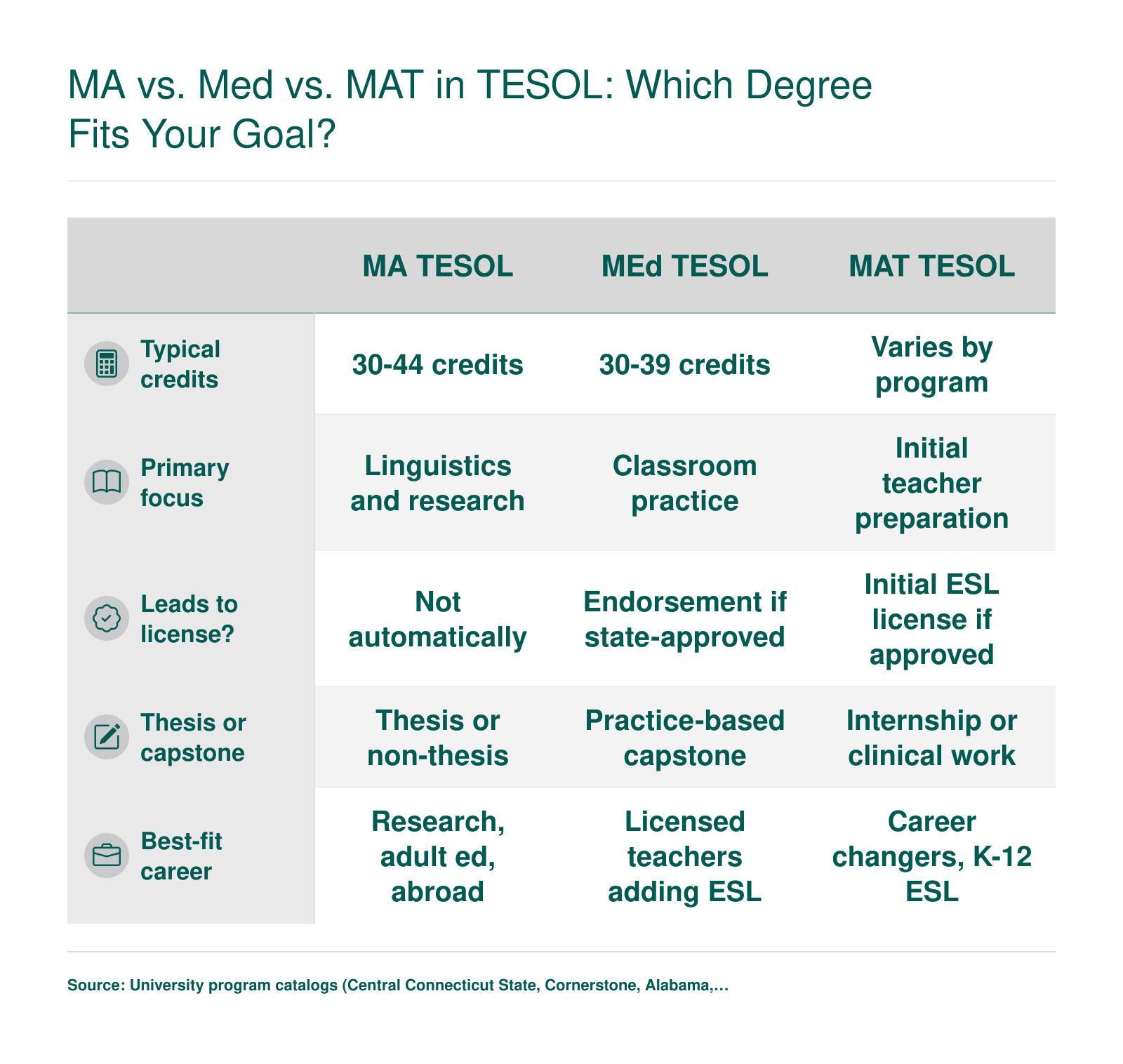
MA vs. Med vs. MAT in TESOL: Which Degree Fits Your Goal?
The three TESOL master's degrees overlap in coursework but differ in purpose. The MAT is usually the route for people without a teaching license, while the MEd often adds an ESL endorsement to an existing license. Credit ranges below are typical, and licensure outcomes depend on the program, the state, and approval for teacher preparation.
Online vs. On-Campus TESOL Master's Programs
Delivery format changes how you study more than what you can do afterward. The research we reviewed indicates that online, on-campus, and hybrid TESOL degrees lead to equivalent career outcomes, and that regional accreditation matters more to employers than delivery mode. Many of the schools ranked here offer both formats, so the better question is which one fits your schedule, your state, and your current job.
| Factor | Online TESOL Master's | On-Campus TESOL Master's |
|---|---|---|
| Pacing and flexibility | Typically asynchronous or part-time friendly, so coursework can fit around a full-time teaching job | Fixed class meetings on a set campus schedule; less flexible but more structured |
| Practicum and student teaching | Still requires a local classroom placement; confirm the program can arrange or approve placements in your state before enrolling | Placements are usually arranged through established local school partnerships near campus |
| Networking and observation access | Built through virtual cohorts, discussion boards, and faculty video meetings; in-person observation is up to you to organize locally | Easier face-to-face contact with faculty, peers, and nearby intensive English programs and schools |
| Tuition model | Often a flat per-credit online rate regardless of where you live; check for technology or program fees | Frequently tiered by residency, with in-state rates lower than out-of-state; campus fees may add to cost |
| Employer perception | Research indicates over 70 percent of employers accept online degrees; regional accreditation is the key factor | No separate on-campus acceptance figure is reported; accreditation again matters more than format |
| Edge in specific roles | Some university intensive English program positions may slightly favor on-campus graduates, though that preference is reported to be shrinking | Some university intensive English program roles may give on-campus graduates a slight edge |
| Typical career paths | ESL instructor, adult education instructor, instructional designer, curriculum specialist, English language director | K-12 teaching in public and private schools, higher education, private tutoring, government and nonprofit work, curriculum specialist |
| Best fit | Working teachers who need to keep their income and schedule, or students living far from a campus | Career changers who want structured support, in-person mentoring, and built-in placement help |
Related Articles
What Does a Master's in TESOL Cost?
The real cost question for a TESOL master's is less about which school is cheapest than about whether your residency and the format you choose qualify you for the lower rate. The same degree can cost two or three times as much depending on where you live and how you enroll.
In-State vs. Out-of-State Tuition
Among the lowest-cost public programs here, annual graduate tuition and fees for in-state students start near $8,000. UNC Charlotte lists $8,037 and UNC Greensboro $8,614, with Tennessee State ($11,188) and Middle Tennessee State ($11,718) not far behind. At the higher end of public pricing, University of Maryland-College Park charges in-state students $18,276.
Out-of-state rates change the picture. UNC Charlotte rises to $23,072 and UNC Greensboro to $23,329. University of Missouri-St Louis climbs from $15,480 to $36,792, and Maryland from $18,276 to $38,207. Private Vanderbilt charges a single $57,868 rate regardless of residency.
Why Flat-Rate Online Pricing Matters
Some online programs charge every student the same per-credit price, because remote learners don't use campus facilities that state subsidies were designed to support. Eastern Washington University's online M.Ed. in TESOL charges $335 per credit for all students, about $16,415 for the full 49-credit, 12-month program. For a student outside Washington, that total costs less than one year of out-of-state tuition at several campus-based programs. If you are searching for a one-year online MA TESOL, Eastern Washington's 12-month format is worth a close look.
USC Upstate lists $362 per credit and a total of $13,032 for its 36-credit online program. Check how the school prices out-of-state students before you assume that figure applies to you.
Net Price After Aid
After grants and scholarships, institution-wide average net prices for these schools fall roughly between $11,000 and $16,000. Treat these figures as approximate. They are averages across each school's student body, they are weighted heavily toward undergraduates, and they do not predict what a graduate student will pay. Vanderbilt's average net price of roughly $15,800 sits far below its sticker price, but graduate aid packages vary widely.
What Makes a TESOL Master's Affordable
A cheap MA TESOL online usually comes from program structure rather than weaker instruction. Look for:
- Low per-credit rates: Public universities often price online credits well below private schools.
- Residency-neutral pricing: Flat rates remove the out-of-state premium.
- Lean credit loads: Programs requiring 30 credits cost less than those requiring 40 or more.
- Workplace practicums: Completing fieldwork at your current school, as USC Upstate allows, avoids lost income.
Accreditation travels with the degree regardless of price. Middle Tennessee State and UNC Charlotte, both among the lower-cost options, hold CAEP accreditation.
Median Pay for ESL Teachers Nationwide
For a nationwide benchmark, here is what the broader occupation pays.
TESOL Master's Salary: What Graduates Earn and Owe by School
Figures below are program-level median earnings and federal debt from IPEDS and College Scorecard (2024). Among the schools shown, median earnings after finishing run from $51,565 to $79,209, while median federal debt runs from $18,750 to $24,250. The earnings-to-debt picture is generally positive, with every published median earnings figure higher than any published median debt figure, so a master's in TESOL tends to pay off for graduates who enter ESL teaching.
| School | Location | Median earnings | Time period | Median federal debt | 10-year monthly payment |
|---|---|---|---|---|---|
| State University of New York at New Paltz | New Paltz, NY | $79,209 | 1 year after finishing | $18,750 | |
| Long Island University | Brookville, NY | $73,832 | 5 years after finishing | $23,577 | $644 |
| The College of New Jersey | Ewing, NJ | $67,887 | 5 years after finishing | $23,250 | |
| University of North Carolina at Charlotte | Charlotte, NC | $59,007 | 1 year after finishing | $21,500 | |
| SUNY at Fredonia | Fredonia, NY | $58,948 | 5 years after finishing | $24,250 | |
| Sam Houston State University | Huntsville, TX | $52,024 | 4 years after finishing | $21,983 | |
| University at Buffalo | Buffalo, NY | $51,565 | 4 years after finishing | $19,000 | $319 |
Admission Requirements for Master's in TESOL Programs
Requirements vary by school, so confirm details with each program. These are the items you'll most often see.
- Bachelor's degreeAn accredited undergraduate degree is expected; the major is usually flexible.
- Minimum GPA3.0 is common (Stony Brook, UT Arlington, Canisius), though the University of Southern Maine lists 2.5 and San José State asks for a B average.
- GREUsually not required; San José State and UT Arlington don't ask for it, but Teachers College requires it for some tracks, and Canisius may ask for a GRE, GMAT or MAT if your GPA is below 3.0.
- Recommendations, statement, resumeExpect letters of recommendation, a statement of purpose, and a current resume; check each school's exact count and format.
- International applicantsNon-native English speakers typically submit TOEFL or IELTS scores, such as a TOEFL iBT of 90 at San José State (IELTS 7.0) or 100 at UT Arlington, and may need a credential evaluation of foreign transcripts.
- Language prerequisitesSome programs require prior language study or linguistics, such as 12 credits in a language other than English at Canisius or introductory linguistics at St. Cloud State.
- Transfer creditMost programs accept roughly 6 to 12 graduate credits, though limits differ by school, from 6 at Teachers College to 12 at American University.
TESOL & Multilingual Learners programs by state
Frequently Asked Questions About Master's in TESOL Degrees
These answers cover the questions prospective students ask most when comparing TESOL master's programs. Requirements and timelines vary by school, so confirm details with each admissions office before you apply.
Can I finish a master's in TESOL online in one year?
Is a master's in TESOL worth it?
Do I need a teaching license before starting a TESOL master's?
Is a TESOL master's better than a TEFL certificate for teaching abroad?
Compare TESOL & Multilingual Learners programs on the data that matters
Explore more Education & Teaching specializations or browse every graduate field.
All Education & Teaching programs