Accelerated Master's in Speech-Language Pathology Programs
Compare 430+ accredited fastest Speech Pathology programs at 330+ schools, with graduate earnings, cost, debt, and completion data from IPEDS and the U.S. College Scorecard.

How much time can you actually cut from the path to a CCC-SLP? Less than the marketing implies, because the supervised clinical hours and the 1,260-hour clinical fellowship don't shrink. What compresses is the calendar: continuous year-round terms, summer-start cohorts, or a five-year bachelor's-to-master's sequence that shares credits.
The trade-off is intensity and cost. Heavier course loads leave little room for outside work, and tuition varies widely by school.
Every program here is campus-based and CAA-accredited, so speed still depends on relocating for in-person placements.
Key Points
- University of the Pacific shows the strongest early-career earnings signal here.
- Worcester State University leaves graduates with the least debt here.
- Combined BS/MS tracks share graduate credits and shorten total time.
10 Accelerated Speech Pathology Master's Programs With the Shortest Paths to Practice
This list puts time to clinical practice first, then weighs what each school costs after aid and how its graduates fare instead of leaning on reputation. The cards below let you compare delivery format, tuition, average net price, and accreditation side by side. Use them to spot the tradeoffs that matter most for your budget and licensure timeline.
University of the Pacific
#1Stockton, CA · ~$55,000/yr (est.)
Best for: SLP majors wanting an expedited route
This campus-based program gives SLP majors a 15-month route and career changers a 24-month route, with clinical hours embedded from the start. The sequence includes at least 400 clock hours, 325 at the graduate level, and is CAA-accredited for ASHA certification and California licensure.
- 15-month path for SLP bachelor's degree holders
- 24-month path for students from other fields
- At least 400 clinical clock hours required
- 325 hours completed at graduate level
- CAA/ASHA accredited
- Meets California licensure and SLP Services Credential
Seton Hall University
#2South Orange, NJ · ~$37,000/yr (est.)
Best for: Cohort learners wanting guaranteed placements
Seton Hall's 65-credit, five-semester master's runs as a full-time cohort and places students in three guaranteed clinical settings across a network of more than 300 sites. The curriculum covers articulation, language, fluency, voice, swallowing, and neurological communication, with no thesis or capstone required. The program is CAA-accredited, and scholarships and graduate assistantships can reduce costs by up to half.
- 65 credit hours, five semesters, full-time
- Cohort-based curriculum
- Three guaranteed clinical placements
- Network of more than 300 clinical sites
- No thesis or capstone required
- Scholarships can reduce cost by 50%
- CAA/ASHA accredited
Vanderbilt University
#3Nashville, TN · ~$58,000/yr (est.)
Best for: Students seeking customizable clinical training
Vanderbilt's master's is a two-year, five-to-six-semester residential sequence that starts clinical training in the first semester. Students can choose specialty tracks and electives, with an optional thesis, and the program reports a 100% Praxis pass rate and 100% employment within a year. The program is CAA-accredited and does not require a prior SLP background.
- 2-year full-time program, 5 to 6 semesters
- Fall start, no prior SLP background required
- Clinical training begins in the first semester
- Specialty tracks, electives, and optional thesis
- 100% Praxis pass rate and 100% employment within one year
- 98% on-time completion rate
- CAA/ASHA accredited
University of Central Florida
#4Orlando, FL · ~$9,000/yr (est.)
UCF's 72-credit, two-year master's includes summer sessions and clinical training at the UCF Communication Disorders Clinic plus more than 200 practicum sites. An accelerated track is available alongside traditional and out-of-field options, and no GRE is required for admission. The program is CAA-accredited and prepares students for ASHA certification and Florida licensure.
- 72 credit hours, full-time, in-person
- Two-year sequence including summer sessions
- ASHA certification and Florida licensure preparation
- Clinical training at UCF Communication Disorders Clinic
- More than 200 practicum sites
- Accelerated track available
- No GRE required
- Fall and spring admissions
Brigham Young University
#5Provo, UT · $5,000 – $10,000/yr (est.)
BYU's master's in communication disorders typically takes six semesters, with spring and summer counting as one, and divides the curriculum evenly among coursework, clinical practicum, and a thesis. Students should plan to limit outside employment, since working can add up to a year to graduation. Current CAA status should be confirmed through ASHA EdFind.
- Typically completed in six semesters
- Spring and summer count as one semester
- Curriculum split among coursework, practicum, and thesis
- Thesis required
- Prerequisite courses required
- Prepares for ASHA CCC requirements
- Utah school license eligibility
- Advises limiting full-time work
Sacred Heart University
#6Fairfield, CT · ~$34,000/yr (est.)
Sacred Heart's residential master's includes clinical hours in audiology and aural rehabilitation at its on-campus Audiology Clinic, with an accelerated option and an online prerequisite series available. The program is CAA-accredited and also recognized by the Connecticut Office of Higher Education, with graduates prepared for national certification and state licensure.
- Residential master's program
- CAA/ASHA accredited
- Also approved by Connecticut Office of Higher Education
- Clinical hours in audiology and aural rehabilitation
- Dual degree and accelerated options
- Online prerequisite series available
- Teacher endorsement approved in Connecticut
Marywood University
#7Scranton, PA · $10,000 – $15,000/yr (est.)
Marywood offers a traditional two-year master's and a five-year accelerated option that combines the bachelor's and master's degrees. Students complete clinical practicums each semester in the on-campus Speech, Language and Audiology Clinic, with coursework covering aphasia, fluency, voice, pediatric, and adult disorders. The program is CAA-accredited and requires a 3.25 GPA.
- Traditional two-year master's path
- Five-year accelerated bachelor's and master's option
- On-campus Speech, Language and Audiology Clinic
- Clinical practicums each semester
- 3.25 GPA admission requirement
- Covers aphasia, fluency, voice, and pediatric disorders
- CAA/ASHA accredited
University of Kansas
#8Lawrence, KS · $12,000 – $27,000/yr (est.)
Kansas's accelerated master of arts lets qualified students complete a bachelor's and master's in about five years, counting up to 12 graduate credits toward both degrees during the fourth year. Admission requires a 3.0 GPA and specific prerequisite courses by the third year, with close progression monitoring. The program is CAA-accredited and meets ASHA certification standards.
- Five-year bachelor's and master's pathway
- Up to 12 graduate credits count toward both degrees
- 3.0 GPA admission requirement
- Specific prerequisite courses by third year
- Clinical practice courses and research options
- Close progression monitoring
- CAA/ASHA accredited
Saint Mary's College
#9Notre Dame, IN · ~$30,000/yr (est.)
Saint Mary's master's in speech language pathology can be completed in two years or through a 4+1 accelerated option, with clinical experience at the Judd Leighton Speech and Language Clinic and partner facilities. A bridge program is available for students from other fields, and the program is CAA-accredited.
- Two-year or 4+1 accelerated option
- Judd Leighton Speech and Language Clinic on campus
- Adult neurogenic disorders and auditory processing clinics
- SLP Bridge Program for non-majors
- NSSLHA chapter and career counseling
- CAA/ASHA accredited
Baldwin Wallace University
#10Berea, OH · ~$17,000/yr (est.)
Baldwin Wallace's five-year integrated BS/MS program lets students earn both degrees in five years, covering roughly 150 credit hours with clinical experiences at the BW Speech Clinic. The program has no GRE requirement, prepares students for the Praxis exam, and is CAA-accredited.
- Five-year integrated bachelor's and master's degrees
- Approximately 150 credit hours
- No GRE required
- Clinical experiences at BW Speech Clinic
- Prepares for Praxis exam
- Research opportunities included
- CAA/ASHA accredited
None of the ranked Speech Pathology programs match the fastest lens yet. The full ranking is at the link above.
Cost, debt & payoff
Median earnings of this field's master's graduates (4 yrs after completing) vs. their median federal loan debt · U.S. College Scorecard
Across these programs the median graduate earns about $66,866 and finishes with roughly $41,000 in debt — a ratio that clears a common rule of thumb (keep debt below first-year salary). Tuition and debt vary widely school to school, so check the per-school figures in the table above before you shortlist.
Year-Round, Summer-Start, and Combined BS/MS Tracks Side by Side
Accelerated SLP pathways compress the same clinical and academic content through different schedules. Year-round master's programs use continuous terms, summer-start tracks begin graduate coursework while undergraduates are still finishing a bachelor's, and five-year combined programs share credits between degrees. The right format depends on how early you can commit and how much of a summer break you are willing to give up.
| Year-Round Master's | Summer-Start Fast-Track BS/MS | Five-Year Combined BS/MS | |
|---|---|---|---|
| Typical length | 16 to 24 months, with some intensive year-round schedules described as roughly 12 to 18 months | Five years total; graduate coursework begins the summer after junior year (Samford University) | Five years total: B.S. plus one year and one summer of full-time graduate study (University of Rhode Island); M.A. completed in the fifth year or beyond (University of Kansas) |
| Best fit | Students able to manage summer semesters, higher course loads, year-round schedules, or intensive clinical rotations | Students seeking a combined B.S. in Communication Sciences and Disorders and M.S. in Speech-Language Pathology (Samford University) | Qualified, focused undergraduates pursuing both the B.S. in Communicative Disorders and the M.S. in Speech-Language Pathology (URI); Kansas applicants apply in spring of third year |
| Prerequisite coursework and GPA | ASHA-required courses in biological sciences, physical sciences, social/behavioral sciences, and statistics must appear on the transcript | Samford requires biological science, physical science (chemistry or physics), statistics, and social or behavioral science | URI requires a minimum 3.00 cumulative GPA and 3.20 in the major; Kansas requires major and cumulative GPA of at least 3.00 |
| Credit overlap | Timeline shortened through continuous enrollment, not shared undergraduate credits | Graduate coursework begins in the summer after junior year, compressing the undergraduate and graduate phases (Samford) | URI allows 24 specified graduate credits taken senior year to apply to the B.S., reducing the master's to 30 credits; Kansas allows up to 12 hours of 700-level or above major coursework in Year 4 to count toward both degrees |
| Scheduling demands | No summer break; intensive clinical rotations and higher course loads | Shortened summer break and limited ability to work while completing both degrees | Senior year includes graduate-level credits and at least one summer of full-time graduate study, leaving limited room for employment |
Related Articles
Online and Hybrid Speed Tracks: Where You Can Enroll and How Placements Work
Online delivery has opened speech-language pathology training to working adults, yet the clinical half of the degree still happens in person. Every school ranked here lists a campus-based format, so none is an online or hybrid option. For distance study, look at the best online speech pathology programs, such as Misericordia, NEIT, Scranton, CSUSM, USAHS, and Marymount.
State authorization comes first. An online program must be authorized where you are physically located, through state approval or NC-SARA reciprocity. NC-SARA does not override licensure rules, though it requires schools to tell you whether the program meets licensure requirements in your state. Authorization and licensure eligibility are separate questions, so check the program's state availability page before applying.
Placement models differ. USAHS works to secure externships within 75 miles of home, with travel possible. Marymount does not guarantee local placement. NEIT places students in their home community. Residencies vary too: NEIT requires two in-person weeks, Marymount two residencies in Arlington, Virginia, and USAHS three days in four of five terms. Any placement delay can stretch an accelerated timeline.
Format matters for working students. Marymount and CSUSM run mostly asynchronous coursework with a weekly synchronous session, and NEIT holds synchronous classes in the evening. Clinical weeks, though, usually mean full daytime hours, three to five days a week.
Early-Career Earnings Snapshot
For one program in this guide, the strongest early-career earnings signal comes from University of the Pacific.
Lowest-Cost Accelerated SLP Options: Tuition and Net Price
Shorter programs can lower total cost by reducing the number of semesters students pay for housing, food, and other living expenses, and by letting graduates start a paid clinical fellowship sooner. Published totals for accelerated routes are limited, but Lebanon Valley College lists $80,974 for its 67-credit program and Saint Mary's College lists $70,080 for 64 credits, with no stated shared-credit savings against a traditional six-year path. The table below shows the lowest-cost options in this comparison using in-state and out-of-state graduate tuition plus average net price.
| School | In-State Graduate Tuition | Out-of-State Graduate Tuition | Average Net Price |
|---|---|---|---|
| University of Central Florida | $8,872 | $28,657 | $10,411 |
| Auburn University at Montgomery | $9,136 | $19,558 | $13,224 |
| Worcester State University | $6,813 | $6,813 | $13,381 |
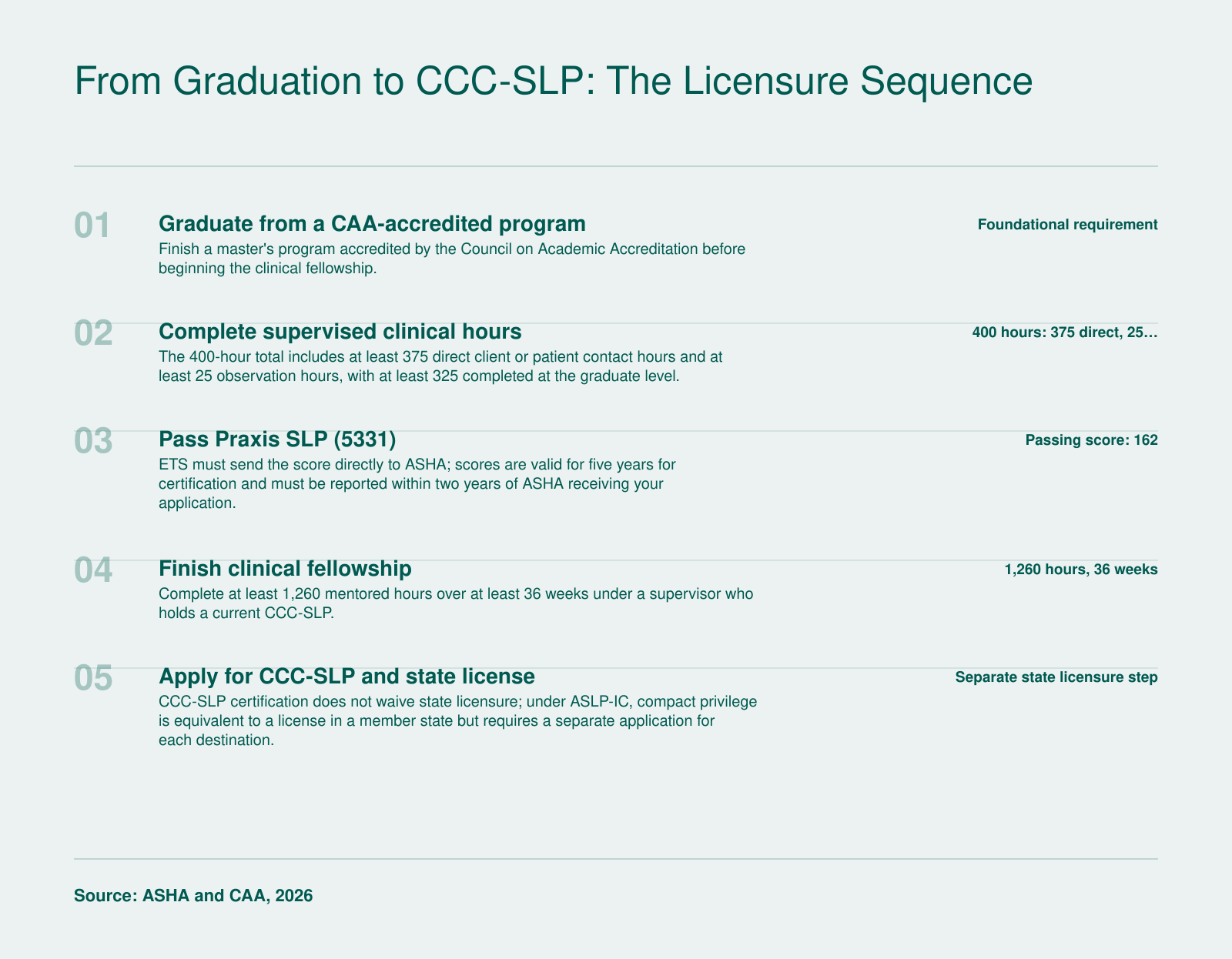
From Graduation to CCC-SLP: The Licensure Sequence
After graduation, licensure follows a fixed sequence: finish a CAA-accredited program, complete 400 supervised clock hours with at least 375 in direct client contact, pass Praxis SLP (5331) with a score of 162, and finish a 1,260-hour clinical fellowship over at least 36 weeks. CAA's benchmark is an 80% three-year Praxis pass-rate average, and published program examples run 93%-100%. CCC-SLP certification does not waive state licensure; under the ASLP-IC compact of 37 member jurisdictions in 2026, compact privilege still requires a separate application for each destination state.
Which Fast-Track Programs Leave Graduates With the Least Debt
A two-year accelerated track at a public school and a combined 4+1 degree can both get you to the CCC-SLP quickly, but they don't leave the same loan balance. Worcester State University's Master of Science in Speech-Language Pathology has the lowest program-level median federal debt here, at $21,166, or about $241 a month on a 10-year plan. Graduates earn a median of $60,795 one year after finishing.
The rest cluster much higher:
- University of Kansas: $40,180 in median federal debt, about $457 a month. Median earnings are $56,000 one year after finishing.
- Saint Mary's College: $41,000 in debt, about $466 a month. Median earnings are $56,123 one year after finishing.
- Northeastern University: $41,000 in debt, about $466 a month. Median earnings are $60,421 one year after finishing.
- Northern Arizona University: $41,255 in debt, about $469 a month. Median earnings are $68,729 one year after finishing.
The practical takeaway for students comparing accelerated tracks and online SLP programs: debt only tells part of the story. Weigh net price and monthly payment against how quickly each program puts you into a paid clinical fellowship, because an extra year of tuition and lost income can outweigh a lower sticker price.
Speech Pathology programs by state
Quick Answers on Fast-Track SLP Master's Degrees
Fast-track SLP pathways vary by prerequisite background, but common admissions questions center on time, accreditation, GPA, and leveling options. Here are direct answers grounded in published program policies.
How many months does an accelerated SLP master's usually last?
Which accelerated speech pathology programs hold ASHA (CAA) accreditation?
What undergraduate GPA do competitive accelerated SLP programs expect?
Can career changers without a CSD bachelor's enter an accelerated SLP program?
Compare Speech Pathology programs on the data that matters
Explore more Communications & Media specializations or browse every graduate field.
All Communications & Media programs