Best MBA in Accounting Programs in New York
Compare 29 accredited MBA in Accounting programs in New York at 25 schools, with graduate earnings, cost, debt, and completion data from IPEDS and the U.S. College Scorecard.

An MBA with an accounting concentration, even a specialized one like an MBA in Forensic Accounting, and a program that satisfies New York's CPA education rules are not always the same thing. The state's 150-hour route calls for 33 accounting and 36 general-business semester hours, and a standard 30-to-36-credit MBA rarely supplies both on its own.
The programs ranked here span campus, online, and hybrid formats, from SUNY schools to private universities in the city and on Long Island. Tuition, graduate earnings, and licensure alignment vary widely among them.
Credit counts, not degree titles, determine eligibility.
Key Points
- New York University graduates report $141,568 median earnings five years out, against $33,052 in median debt.
- SUNY Oswego has the lowest listed tuition, a wide gap from private schools like Fordham.
- An MBA is not automatically CPA-eligible: NYSED requires 33 accounting hours and a registered program.
Top 10 MBA in Accounting Programs in New York for 2027
These ten New York programs cover campus, hybrid, and online delivery, and several are built around the state's CPA licensure pathway. Graduation rates shown are institution-wide, and net price is an average after aid, not a quoted program price. Program earnings appear only where a figure has been published.
New York University
#1New York, NY · ~$43,000/yr (est.)
Best for: Career changers targeting finance roles
New York University's strongest metric is earnings: program graduates report median pay of about $134,000 four years after finishing, and the institution's graduation rate is roughly 88%. The campus-based MBA in Accounting centers on financial statement analysis, managerial accounting, and accounting information systems, with forensic and e-commerce accounting among the electives. Average net price after aid is about $37,000, so it is a premium option that pays off best for students aiming at finance careers.
- Campus-based in New York City
- Covers financial statement analysis and managerial accounting
- Includes forensic accounting and e-commerce accounting courses
- Coursework on accounting information systems and tax effects on strategy
- Prepares for finance careers such as asset management and corporate finance
Stony Brook University
#2Stony Brook, NY · ~$14,000/yr (est.)
Best for: Working professionals needing hybrid scheduling
Stony Brook University stands out on net price, averaging about $18,800 after aid, among the lowest on this list. The hybrid MBA in Accounting blends in-person and online courses and is designed to meet New York's CPA education requirements. Admission was suspended through Fall 2026, so confirm current status with the school before planning an application.
- Hybrid format with in-person and online courses
- 36 credits, with a 12-month pace available
- Full-time and part-time options
- Four start dates per year
- Test optional, no entrance exam required
- At least 18 undergraduate accounting prerequisite credits needed
- Capstone required
- Annual accounting job and internship fair
Fordham University
#3Bronx, NY · ~$27,000/yr (est.)
Best for: CPA candidates wanting one integrated pathway
Fordham University pairs strong earnings with a CPA-focused design: program graduates report median pay of about $127,000 four years after completion. Its Gabelli School of Business program in the Bronx totals 69 credits and blends general business education with CPA coursework. Graduation rate is about 82% institution-wide, and net price averages roughly $44,000 after aid.
- 69 total credit hours
- Combines MBA coursework with CPA-focused content
- Course waivers for business undergraduates
- No thesis or capstone required
- Internship opportunities available
- Curriculum aligned with New York licensure standards
Molloy University
#4Rockville Centre, NY · ~$28,000/yr (est.)
Molloy University leads on affordability and flexibility, with an average net price of about $24,300 after aid and online MBA courses in a hybrid format. The 30-credit program prepares students for the New York State CPA exam and ends with a capstone for a nonprofit client. Small classes and faculty mentoring are part of its pitch, and graduation rate is about 70% institution-wide.
- 30 total credit hours
- Hybrid format with online MBA courses
- Prerequisite courses required
- Capstone developing recommendations for a nonprofit client
- Prepares for the New York State CPA exam
- Small class sizes with faculty mentoring
- Career paths include audit, forensic accounting, and controller roles
State University of New York at New Paltz
#5New Paltz, NY · ~$13,000/yr (est.)
SUNY New Paltz offers one of the lowest average net prices on the list, about $18,800 after aid. Its in-person MBA in Public Accountancy is registered with the New York State Education Department as a 150-credit licensure-qualifying program. Institution-wide graduation rate is about 72%.
- 36 credits with 12 courses plus a capstone
- In-person, full-time study
- Meets New York's 150-credit CPA education requirement
- Zero-credit Business Workshop required at the start
- Foundation courses require a B or better
- Five-year dual degree option for undergraduates
St. John Fisher University
#6Rochester, NY · ~$21,000/yr (est.)
St. John Fisher University is the fully online option here, offering an online MBA with an Accounting concentration that it describes as AACSB-accredited. The school says the concentration meets New York CPA licensure requirements and reports that Big Four firms recruit its graduates. Average net price is about $28,900 after aid, and graduation rate is about 74% institution-wide.
- Fully online delivery
- One of five MBA concentration options
- Prepares for CPA licensure in New York
- School reports Big Four recruiting and a 100% employment rate for the concentration
- Access to an extensive regional alumni network
Manhattan University
#7Riverdale, NY · ~$25,000/yr (est.)
Manhattan University offers a five-year B.S./MBA in Professional Accounting for undergraduates, so it suits students who start at the school rather than those entering with a finished bachelor's degree. Program graduates report median pay of about $110,000 four years after completion. The AACSB-accredited curriculum totals 153 credits and builds in internships and international study trips.
- Five-year program, 153 credit hours
- Full-time, with a flexible schedule and online options
- AACSB-accredited
- Prepares for CPA exam eligibility in New York
- Experiential learning required
- Internships and international study trips
Niagara University
#8Niagara University, NY · ~$16,000/yr (est.)
Niagara University has the lowest average net price on this list, about $17,200 after aid. Its integrated BBA/MBA in Professional Accountancy is a campus-based, five-year path that qualifies graduates for New York CPA licensure. Institution-wide graduation rate is about 75%.
- Integrated five-year BBA/MBA
- 154 total credit hours
- BBA after four years, MBA in year five
- Qualifies graduates for New York CPA licensure
- Coursework in auditing, taxation, and business strategy
- Financial aid and scholarships available
St. Joseph's University-New York
#9Brooklyn, NY · ~$23,000/yr (est.)
St. Joseph's University-New York combines a modest average net price of about $19,000 after aid with a 36-credit MBA in Accounting taught largely by active CPAs. Program graduates report median pay of about $92,000 four years after completion. The program fulfills the credits needed for New York CPA licensure, and a five-year combined BS/MBA option is available.
- 36 total credit hours
- Eight graduate management and four graduate accounting courses
- Undergraduate prerequisites required before enrollment
- Faculty are active CPAs
- Fulfills credits needed for New York CPA licensure
- Five-year combined BS/MBA option
- Small class sizes
Adelphi University
#10Garden City, NY · ~$33,000/yr (est.)
Adelphi University offers an Accounting specialization within its MBA in Management, with program graduates reporting median pay of about $115,000 four years after completion. The degree runs 33 to 51 credits depending on prior preparation, and equivalent prerequisite coursework can be waived. Average net price is about $30,800 after aid, and graduation rate is about 67% institution-wide.
- 33 to 51 total credits depending on preparation
- Campus-based, full-time or part-time
- Admission requires at least 24 undergraduate accounting credits
- Nine accounting credits plus a three-credit elective
- Capstone required
- Prior equivalent courses with a B or higher may be waived
Cost & outcomes by school
Federal data for the highest-earning Accounting programs, independent of the ranking above. Earnings are this field's master's graduates four years after completing, where the Scorecard reports them.
| School | Earnings | Tuition / yr | Debt | Grads/yr | Format |
|---|---|---|---|---|---|
| New York University NY | $134,461 | $42,726 | $33,052 | 156 | Campus |
| Fordham University NY | $126,830 | $26,752 | $37,000 | 42 | Campus |
| Pace University NY | $115,804 | $30,770 | $20,500 | 44 | Campus |
| Adelphi University NY | $114,578 | $32,822 | — | 23 | Campus |
| St. John's University-New York NY | $109,990 | $36,227 | $22,685 | 44 | Online |
| Manhattan University NY | $109,800 | $25,485 | $20,500 | 3 | Campus |
| Hofstra University NY | $98,910 | $31,120 | $28,483 | 19 | Campus |
| Iona University NY | $98,799 | $24,904 | $33,443 | — | Campus |
| Molloy University NY | $95,984 | $27,520 | $20,500 | 5 | Hybrid |
| Utica University NY | $92,248 | $26,750 | — | 2 | Hybrid |
| St. Joseph's University-New York NY | $91,673 | $23,278 | $24,424 | 26 | Campus |
| State University of New York at Oswego NY | $84,645 | $12,580 | $20,500 | 4 | Online |
Sources: U.S. Department of Education. Tuition and graduates: IPEDS. Earnings and debt: College Scorecard, this field's master's graduates; a dash means no figure is reported.
Cost, debt & payoff
Median earnings of this field's master's graduates (4 yrs after completing) vs. their median federal loan debt · U.S. College Scorecard
Across these programs the median graduate earns about $97,392 and finishes with roughly $23,555 in debt — a ratio that clears a common rule of thumb (keep debt below first-year salary). Tuition and debt vary widely school to school, so check the per-school figures in the table above before you shortlist.
Online and Hybrid MBA in Accounting Options in New York
Flexible formats have spread across New York MBA in Accounting programs, yet the classroom still anchors most of these programs. Here is how the schools ranked here sort out:
- Fully online: fully online master's programs in New York include St. John Fisher University, which offers its accounting concentration through its online MBA. Its pages do not clearly spell out part-time or evening pacing, so confirm that with admissions.
- Hybrid: Stony Brook University combines online and in-person courses, with full- and part-time study plus winter and summer sessions, though admission is suspended through Fall 2026. Molloy University blends online MBA courses with campus classes, but its pages do not clearly describe its scheduling. New York University's Stern part-time MBA is primarily in person, with weeknight, Saturday and accelerated tracks, plus an Online + Modules option that generally alternates two weeks online with one week on campus in New York City.
- Campus-based: Fordham, Niagara, St. Joseph's, State University of New York at New Paltz (full-time) and Adelphi (full- or part-time). Manhattan University's five-year BS/MBA mentions online options, but its pages do not confirm how they apply to accounting.
Before you commit, confirm that any required on-campus residency, such as Stern's mandatory in-person weeks, fits your work calendar.
GMAT and GRE Waiver Policies at Ranked New York MBA Schools
Most ranked New York accounting MBA programs do not state a clear GMAT or GRE policy, which makes testing rules the least transparent part of the application, especially compared with No-GRE master's programs.
- Test waived or not required: No ranked MBA program confirms a blanket exemption for current applicants.
- Test optional: Stony Brook University lists the GMAT as optional for its MBA in Accounting, but admission to the program is suspended through Fall 2026.
- Waiver by petition: No ranked MBA program publishes petition criteria. New York University's published waiver rules (a 3.00 GPA and an accountancy major) apply to Stern's Master's in Accounting in New York program, not the MBA.
- Policy not published: New York University (MBA), Fordham University, Molloy University, SUNY New Paltz, St. John Fisher University, Manhattan University, Niagara University, St. Joseph's University-New York, Adelphi University.
Applying without an accounting degree
Several programs build in prerequisite paths rather than requiring an accounting major. Stony Brook, Molloy and St. Joseph's list prerequisite courses, and Adelphi sets undergraduate credit requirements for its accounting specialization while waiving courses you have already completed. Fordham waives courses for business undergraduates. Manhattan and Niagara are five-year programs that begin at the bachelor's level.
Test policies shift from one intake to the next. Before you register for an exam, confirm the rule for your exact entry term with admissions.
MBA in Accounting Admission Prerequisites and Deadlines
Requirements vary by school, so confirm current terms on each admissions page before you apply.
- Bachelor's degree and GPASt. John's University requires an accredited bachelor's degree and uses a 3.25 GPA benchmark that is not a strict cutoff. Stony Brook University sets a 3.0 minimum and may admit applicants below it conditionally.
- Prerequisite courseworkApplicants without an accounting background need foundation courses first. Stony Brook lists 18 accounting credits (financial accounting, managerial/cost accounting, auditing, U.S. federal income taxation) plus a college-level math course.
- Resume and experiencePace University asks for a resume with five years of employment history. Stony Brook does not require work experience.
- Recommendations and English proficiencyRecommendation letters and English test scores for international applicants are standard, but check each school's page for exact terms.
- DeadlinesPace's domestic deadlines are August 1 (fall) and December 1 (spring). International deadlines are June 1 and October 1. Stony Brook has suspended MBA in Accounting admission through Fall 2026. St. John's and Manhattan University publish no fixed deadline on their program pages.
Related Articles
Cost and New York Employer Demand for MBA Graduates
For students comparing the best MBA programs, an accounting MBA in New York costs far less at the SUNY campuses than at the private schools, and the gap matters more than any brand name.
What the programs cost
Program tuition is lowest at SUNY Oswego, listed at $12,580 in-state and $25,060 out-of-state. Among the private schools, Molloy University is highest at $27,520. Stony Brook University's MBA in Accounting lists approximately $23,000 in-state and $40,000 out-of-state, and SUNY New Paltz shows $12,812 versus $24,602. Those public gaps roughly double the bill for nonresidents.
For comparison:
- Stony Brook University: $635 per credit in-state or $1,120 out-of-state across 36 credits.
- Utica University: $26,750 for 33 credits.
- Canisius University: $17,370 for 33 credits.
- Molloy University: $27,520 for 30 credits.
Most of these schools do not clearly publish a per-credit rate or all-in total, so confirm both on the bursar page before budgeting.
Net price after aid is a separate, institution-wide average, not an MBA figure. It runs from about $15,900 at SUNY at Fredonia to about $24,300 at Molloy.
Why employers justify the spend
BLS-based figures put roughly 115,300 accountants and auditors in New York City, and about 89,960 financial managers across the wider metro, with a reported median wage near $221,010.1 Those metro numbers come from a secondary source, so treat them as directional. Nationally, accounting jobs are projected to grow 5% from 2025 to 2035, according to the Accountants and Auditors occupational outlook. Big Four and mid-tier firms, banks, and corporate finance teams all hire for controller and finance manager roles here.
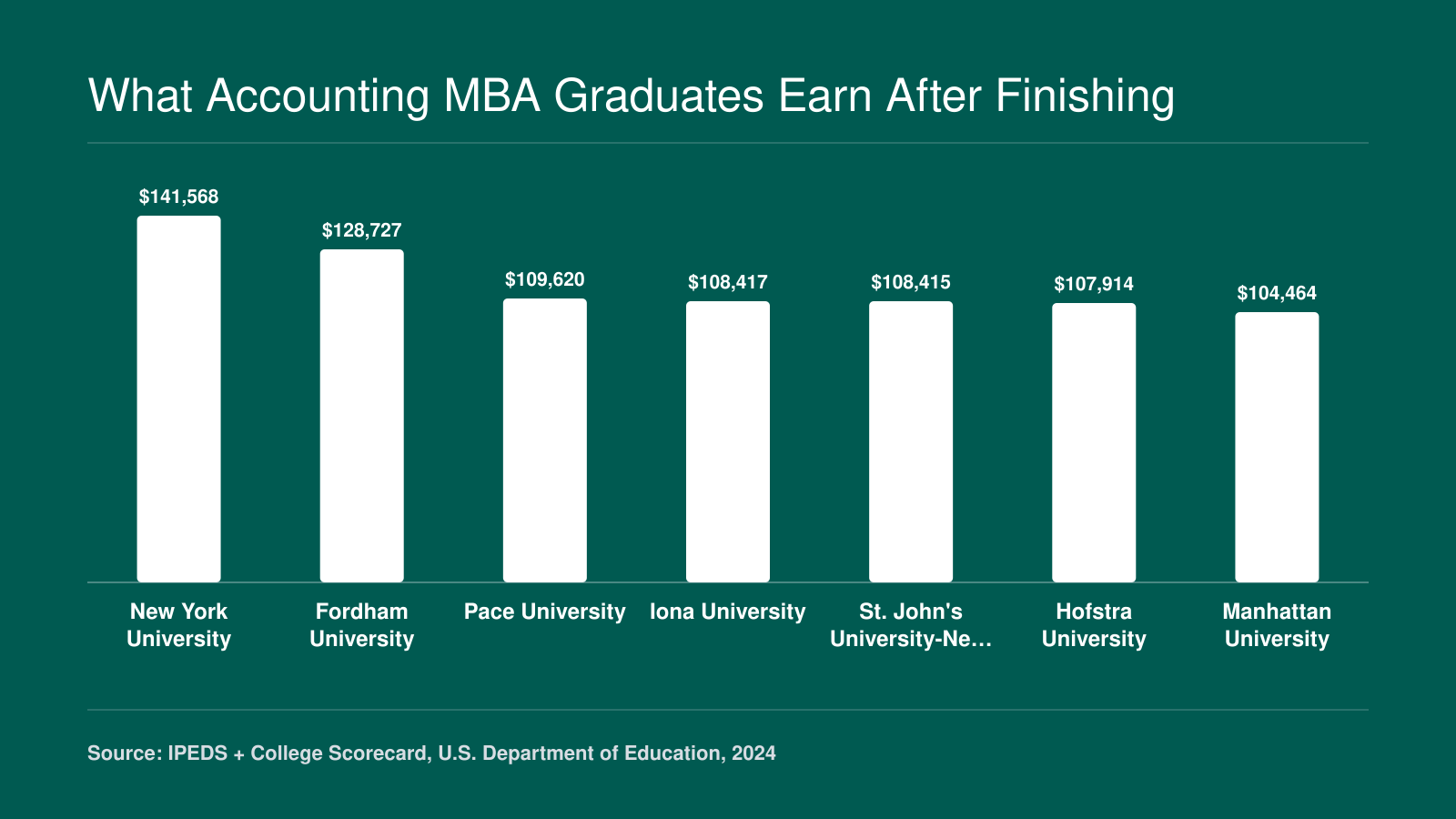
What Accounting MBA Graduates Earn After Finishing
Median program-level earnings are shown five years after completion, from federal College Scorecard data. Against median program debt, the gap is wide: New York University graduates report $141,568 against $33,052 in debt, and Fordham University reports $128,727 against $37,000, the highest debt of any school charted. Pace University ($109,620) and Manhattan University ($104,464) both carry $20,500 in median debt. Adelphi University reports only a four-year figure ($114,578) with no debt figure, so it is not charted.
New York CPA Licensing at a Glance
New York CPA Requirements and MBA Program Fit
A New York MBA in accounting is not automatically a CPA-eligible credential. NYSED requires a registered licensure-qualifying program, and the 150-hour CPA education requirement specifies 33 accounting semester hours covering financial accounting/reporting, cost or managerial accounting, taxation, and auditing/attestation. A standalone MBA concentration may add credit hours without covering the same content found in master's in accounting programs, especially for students without an undergraduate accounting background.
Among schools on this page, Alfred University says its MBA-Accounting is NYSED-registered for the 150-hour requirement, and Manhattan University's five-year B.S./MBA Professional Accounting is registered as a Professional Accounting Program. Pace University, Stony Brook University, and Daemen University state their accounting MBA programs meet the 150-hour or New York licensing requirements, but their pages do not provide the same registration detail; Stony Brook's admission is suspended through fall 2026. Other programs here do not publish a comparable CPA-eligibility claim.
No school on this page publishes NASBA CPA exam pass rates in the sourced material. Pace says graduates are prepared for Big Four roles, Manhattan notes Big Four recruiting from its New York City location, and St. John Fisher's MBA page lists Big Four recruiting among its highlights; none names a formal firm partnership.
If you lack an accounting undergraduate degree, map your transcript against NYSED content rules before enrolling.
Compare Accounting programs on the data that matters
Explore more MBA specializations or browse every graduate field.
All MBA programs