Best MBA in Forensic Accounting Programs
Compare 16 accredited MBA in Forensic Accounting programs, with graduate earnings, cost, debt, and completion data from IPEDS and the U.S. College Scorecard.

A forensic accounting MBA is a general business degree with a concentration in fraud examination, investigative accounting, and litigation support: the work of tracing embezzled funds, reconstructing financial records, and explaining losses to attorneys and courts. Employers want investigators who also understand business strategy.
Cost varies widely, as it does among affordable MBA programs. Average annual net price at these schools runs from about $9,100 at Murray State to roughly $29,600 at Touro, and most programs are online, with Touro on campus and Webber hybrid.
The degree alone does not license anyone. Most states require 150 semester hours for CPA licensure, and the CFE is earned separately through the ACFE exam.
Key Points
- Murray State's online forensic accounting MBA lists $18,180 total tuition, regardless of residency.
- Eastern Kentucky and Webber offer broader accounting concentrations with forensic content, not dedicated forensic tracks.
- Occupational fraud costs organizations about 5% of revenue, with a $104,000 median loss per case.
Top-Ranked MBA in Forensic Accounting Schools
These seven schools represent the top-ranked MBA in forensic accounting programs for 2026, spanning campus, online, and hybrid formats. Each entry emphasizes fraud detection, investigative techniques, and certification readiness, but they differ meaningfully in cost, pacing, and the depth of the forensic accounting concentration. Use the cards to compare the concentration name, delivery format, and the mix of core business and forensic coursework.
Touro University
#1New York, NY · ~$15,000/yr (est.)
Best for: International students needing STEM OPT pathway
Touro University's MBA in Forensic Accounting is a campus-based, STEM-designated program that blends core business fundamentals with investigation, prevention, and reporting skills. The 42-credit curriculum includes a capstone and digital badges in critical thinking and ethical reasoning, with a stated focus on fraud detection, legal frameworks, and AI in global business. It is structured for part-time completion over two to three years and offers 24-month STEM OPT eligibility for international students.
- 7 concentration options available
- 42 total credit hours
- Capstone required
- Fully STEM-designated MBA program
- 24-month STEM OPT extension for international students
- Opportunity to earn digital badges
- AI integrated into global business curriculum
- Typically completed part-time in two to three years
Seton Hill University
#2Greensburg, PA · ~$18,000/yr (est.)
Best for: Working accountants seeking certification prep
Seton Hill University's online MBA offers a specialization in Forensic Accounting and Fraud Examination that prepares students for fraud detection, investigation, and deterrence roles. The program emphasizes internal auditing practices, complex financial data analysis, and support for CPA, CFE, and CIA exam preparation. Admissions features rolling deadlines, no application fee, and prerequisite coursework, with expert practitioner faculty.
- Rolling admissions
- Two letters of recommendation required
- Prerequisite courses required
- No application fee
- Prepares for CPA, CFE, and CIA certifications
- Expert faculty with business experience
Carlow University
#3Pittsburgh, PA · $20,000 – $25,000/yr (est.)
Best for: Busy professionals wanting flexible online terms
Carlow University's online MBA concentration in Fraud and Forensics covers white-collar crime, fraud prevention, ethics, and financial document analysis. The IACBE-accredited program uses eight-week terms and can be completed in as few as 15 months, with 36 credit hours across 12 courses. It also aligns with Certified Fraud Examiner exam preparation for fraud examiner and forensic accountant career paths.
- IACBE accredited
- 5 concentration options available
- Complete in as few as 15 months
- 36 total credit hours
- 12 total courses
- CFE exam preparation
- Courses include White-Collar Crime and Fraud Prevention and Ethics
- 3.0 GPA minimum
Murray State University
#4Murray, KY · ~$11,000/yr (est.)
Murray State University's online MBA in Forensic Accounting is an AACSB-accredited program that combines advanced accounting with fraud detection, financial statement analysis, and investigative techniques. The program prepares students for the CPA exam and careers in forensic accounting, corporate finance, and regulatory compliance, with small class sizes averaging 20 students for personalized instruction.
- AACSB accredited
- Prepares for CPA exam
- 100 percent online delivery
- Average class size of 20 students
- Clubs and internships available
Eastern Kentucky University
#5Richmond, KY · ~$11,000/yr (est.)
Eastern Kentucky University's online MBA with a concentration in Accounting is designed for students seeking advanced accounting principles with a focus on forensic accounting and corporate taxation. The program uses eight-week intensive courses and can be completed in one year, with an interdisciplinary curriculum that includes data analytics, financial management, and ethical leadership. Admission requires a bachelor's degree with a 2.75 GPA.
- Online MBA program
- One-year completion
- Eight-week intensive courses
- 2.75 GPA requirement
- Focus on forensic accounting
- Corporate taxation courses
- AACSB-International accredited
University of North Carolina at Pembroke
#6Pembroke, NC · ~$7,000/yr (est.)
The University of North Carolina at Pembroke offers an online MBA with a dedicated Forensic Accounting concentration that can be completed in as few as 12 months. The AACSB-accredited, 36-credit program combines eight core business courses with four forensic accounting courses covering fraud examination, legal issues, and technology-based forensic analysis. The curriculum aligns with the Certified Fraud Examiner exam and supports careers in law enforcement, government, and audit or accounting firms.
- AACSB accredited
- No entrance exam required
- Complete in as few as 12 months
- 36 total credit hours
- Four concentration courses in forensic accounting
- Prepares for Certified Fraud Examiner exam
- Technology-based fraud detection techniques taught
- 100 percent online program format
Webber International University
#7Babson Park, FL · $20,000 – $25,000/yr (est.)
Webber International University's MBA with a Concentration in Accounting includes a specialized focus in Forensic Accounting and Fraud Examination, teaching investigative techniques, legal considerations, advanced financial reporting, taxation, and auditing. The 36-credit program prepares students for CPA and CMA certification and careers such as controller, internal auditor, and fraud examiner, with flexible evening, accelerated, and online course options.
- 36 total credit hours
- Forensic accounting and fraud examination focus
- Prepares for CPA and CMA certification
- Evening, accelerated, and online courses
- Case studies and applied learning
- Advanced accounting curriculum
- Taxation and tax strategy coursework
Cost & outcomes by school
Federal data for the highest-earning Forensic Accounting programs, independent of the ranking above. Earnings are this field's master's graduates four years after completing, where the Scorecard reports them.
| School | Earnings | Tuition / yr | Debt | Grads/yr | Format |
|---|---|---|---|---|---|
| Carlow University PA | $95,368 | $24,816 | $34,166 | 8 | Online |
| Southeastern Oklahoma State University OK | — | $5,220 | — | — | Online |
| Purdue University Northwest IN | — | $6,638 | — | — | Campus |
| University of North Carolina at Pembroke NC | — | $6,928 | — | — | Online |
| Tiffin University OH | — | $17,000 | — | 13 | Hybrid |
| Murray State University KY | — | $10,683 | — | — | Online |
| Salisbury University MD | — | $10,785 | — | — | Campus |
| Gardner-Webb University NC | — | $12,125 | — | — | Hybrid |
| Touro University NY | — | $14,979 | — | — | Campus |
| Lewis University IL | — | $15,800 | — | — | Campus |
| Seton Hill University PA | — | $17,714 | — | — | Online |
| Stetson University FL | — | $18,176 | — | — | Hybrid |
Sources: U.S. Department of Education. Tuition and graduates: IPEDS. Earnings and debt: College Scorecard, this field's master's graduates; a dash means no figure is reported.
How We Rank Forensic Accounting MBA Programs
Our ranking is built from federal data, not reputation surveys, press releases, or what a school says about itself in a brochure. Every program here was evaluated using figures institutions are legally required to report to the U.S. Department of Education, which means the same yardstick applies to a flagship public university and a regional private school alike.
What we measure
- Graduate tuition: The published per-year cost for master's-level study, which is what you are quoted before any aid is applied.
- Net price after aid: The average amount students pay after grants and scholarships, rather than the sticker figure.
- Graduation rate: How reliably the institution gets students to the finish line, a proxy for academic support and advising quality.
- Earnings and debt after graduation: Where federal reporting publishes them at the program level, we weigh what graduates earn against what they borrowed.
- Format flexibility: Whether the degree can be completed as an online MBA, part-time, or in a hybrid evening format alongside full-time accounting work.
Where the data falls short
Net price is reported institution-wide, not for the business school specifically, so an MBA student's real cost can differ from the campus average. Program-level earnings are not published for every forensic accounting track, because cohorts in a specialization this narrow are often too small to report without identifying individuals. When those figures are unavailable, we say so rather than substitute a guess.
How to use the ranking
Treat this as a shortlist, not a verdict. Pull three or four MBA programs that match your budget and format needs, then confirm current tuition, credit requirements, and CPA eligibility directly on each school's program page before you apply.
Forensic Accounting MBA Tuition Comparison: Sticker Price vs. Net Price
Tuition figures below are the listed graduate rates schools report to federal data, not a final bill for every MBA student. Public institutions often separate in-state and out-of-state rates, while several online programs charge one price: Murray State's 30-credit online MBA is $606 per credit ($18,180 total), and UNC Pembroke's 36-credit program is $268.11 in-state versus $615 out-of-state per credit plus a $33.05 distance fee. Net price is an institution-wide average after grants and scholarships, not a personalized aid offer for the MBA.
| School | State | Format | Grad Tuition (In-State) | Grad Tuition (Out-of-State) | Net Price |
|---|---|---|---|---|---|
| Murray State University | KY | Online | $9,900 | $19,836 | $9,096 |
| University of North Carolina at Pembroke | NC | Online | $3,648 | $7,648 | $10,260 |
| Eastern Kentucky University | KY | Online | $10,320 | $21,230 | $11,040 |
| Carlow University | PA | Online | $35,874 | $35,874 | $20,786 |
| Seton Hill University | PA | Online | $42,944 | $42,944 | $22,204 |
| Webber International University | FL | Hybrid | $33,770 | $33,770 | $29,529 |
| Touro University | NY | Campus | $22,450 | $22,450 | $29,627 |
Accreditation: AACSB vs. ACBSP vs. IACBE for Forensic Accounting MBAs
The University of North Carolina at Pembroke states on its own accreditation page that it is an accredited member of AACSB International. That kind of direct, first-party confirmation is the standard you should hold every program to, because accreditation claims on third-party ranking pages are frequently vague or out of date.
What the Three Accreditors Actually Do
- AACSB: The oldest and most selective of the three, with heavy weight on faculty research output, doctoral qualifications, and continuous improvement review. It also offers a separate, additional accounting accreditation that relatively few business schools hold, even among Master's in Accounting programs.
- ACBSP: Teaching-focused. It evaluates instructional quality and student learning in the classroom rather than faculty publication records, which suits regional and master's-level institutions.
- IACBE: Outcomes-focused. Schools demonstrate that students meet stated learning goals and career results, with flexibility in how the program gets there.
All three are recognized business accreditors. None is a substitute for institutional regional accreditation, which is what actually governs federal aid eligibility and most credit transfer.
What the Schools Here Report
Several programs in the Best Online MBA in Forensic Accounting Programs ranking advertise AACSB accreditation at the business-school level, including UNC Pembroke, Murray State University, and Eastern Kentucky University. Carlow University's fraud and forensics MBA identifies itself as IACBE accredited. For other schools listed, we did not find current, school-published confirmation of which business accreditor applies, and we have not identified any program here that carries the separate AACSB accounting accreditation. Treat blanket "100% AACSB" claims on aggregator sites skeptically until you see the school say it.
Why It Matters, and How to Check
Some Big Four campus recruiting pipelines and certain federal hiring programs screen on AACSB status, and credits from an AACSB school tend to transfer more cleanly if you later pursue a doctorate or a second graduate credential. State boards of accountancy, however, generally care about credit hours and course content, not which business accreditor signed off.
Verify it yourself: AACSB, ACBSP, and IACBE each publish a free, searchable member directory. Search the institution name, confirm the business school is listed as currently accredited, and check whether accounting appears as a separate entry.
Curriculum: How Much Forensic Accounting Is Actually in the MBA?
The MBA core and the forensic concentration
In practice, an MBA in forensic accounting is still an MBA first. The management core (finance, strategy, accounting, leadership, and usually a capstone) takes most of the credit load, while the forensic component sits on top as a concentration. UNC Pembroke's online MBA concentration in forensic accounting uses a 36-credit structure: eight core courses plus four concentration courses. Murray State's online MBA lists 21 core credits including the capstone plus nine elective credits for the forensic accounting concentration, though students should verify which electives actually center on fraud rather than general business topics. Texas A&M University-Corpus Christi's MBA in Accounting also uses a 36-credit format with eight advanced MBA courses and four accounting concentration courses.
What the forensic courses actually cover
- Fraud examination: UNC Pembroke's ACC 5550 and Murray State's ACC 607 cover fraud detection, deterrence, investigation, and occupational fraud.
- Litigation support and expert testimony: UNC Pembroke's ACC 5551 covers litigation-support services such as commercial and economic damages models, while Texas A&M-Corpus Christi's ACCT 5340 explicitly includes expert testimony, witness and suspect interviewing, and investigation-report writing.
- Forensic data analytics: UNC Pembroke's ACC 5553 uses technology-based fraud detection, including numerical and text-data analysis. Murray State's ACC 620 applies auditing tools and software to flag fraudulent transactions, financial anomalies, and suspicious practices.
- Cyber or digital forensics: Separate cyber or digital forensics courses do not appear in these curriculum descriptions. The analytics language stays focused on financial and text data, not device or network forensics.
Depth: a four-course concentration vs. a deeper technical track
For many students, a concentration of roughly four courses is enough to signal a specialty and prepare for fraud-related roles, but it is not the same as a full forensic accounting master's. An MS in accounting goes deeper into technical accounting and often builds a longer forensic sequence. An MBA trades some of that technical depth for management breadth, which makes sense if you are headed toward controller, risk management, or leadership roles. If your goal is to be the person doing complex forensic analysis day to day, compare whether the fraud, litigation support, and analytics courses are required or electives, and whether the program offers additional forensic electives beyond the core concentration.
Related Articles
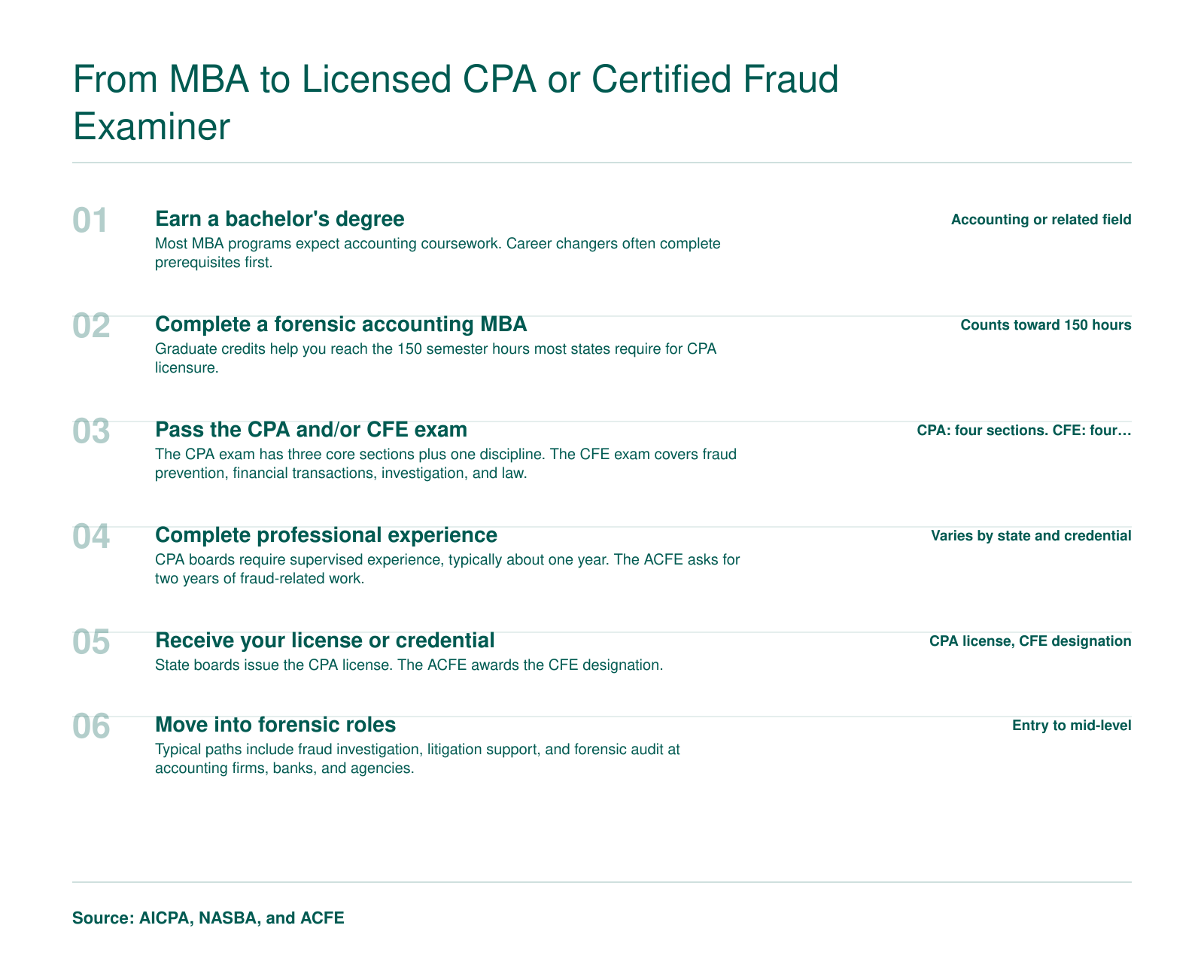
From MBA to Licensed CPA or Certified Fraud Examiner
The CPA license and the CFE credential are separate tracks, and many forensic accountants pursue both. State boards set CPA rules, so confirm your state's requirements before choosing a program.
Organizations lose an estimated 5% of annual revenue to occupational fraud, according to the ACFE's Occupational Fraud 2026: A Report to the Nations. The median loss per case was $104,000, based on 2,402 cases investigated by Certified Fraud Examiners worldwide. That is the problem forensic accountants are trained to solve.
Admission Requirements and Accounting Prerequisites
Requirements differ across the schools here, so confirm current details on each program's official admissions page before you apply.
- Bachelor's degreeA completed bachelor's degree is the baseline. UNC Pembroke's concentration prefers an accounting degree, while other schools accept other majors with prerequisites.
- Minimum GPAPublished minimums range from 2.0 at UNC Pembroke to 2.75 at Eastern Kentucky and 3.0 at Carlow. Murray State and Seton Hill do not state a numeric GPA on their official pages.
- GMAT/GRE policyAt UNC Pembroke, applicants with a GPA of 2.0–2.49 need a GMAT of 400 or GRE of 292. Higher GPAs waive testing, but the page cites both 2.5 and 2.7 as thresholds, so ask the admissions office. Murray State says qualified applicants need no GMAT waiver, without defining 'qualified'.
- Work experienceUNC Pembroke asks for one year of experience at GPAs of 2.0–2.9, and college leadership or military service may count. Other schools do not list an expectation.
- Transcripts, resume, recommendationsExpect to submit transcripts and a resume. Seton Hill asks for at least two recommendation letters.
- Prior accounting courseworkNon-accounting majors usually complete leveling work. UNC Pembroke expects Intermediate Accounting I and II, Accounting Information Systems and Auditing, or equivalents. Murray State requires two free, self-paced prerequisites in accounting and economics, which can run alongside core courses. Seton Hill requires SBU 502 MBA Orientation & Fundamentals or equivalent coursework, and suggests accounting courses through Auditing that can be finished while you start.
- Missing detailsRequirements not listed here were not found in published sources. They should not be read as absent.
Forensic Accounting programs by state
Forensic Accounting MBA FAQs
These answers cover the questions prospective students ask most often when weighing a forensic accounting MBA. Curricula, admissions rules, and licensing requirements vary by school and state, so confirm specifics with each program and your state board.
What is the difference between an MBA in forensic accounting and an MS in forensic accounting?
What jobs can you get with an MBA in forensic accounting?
Can you become a forensic accountant without an accounting undergraduate degree?
Is the CPA or CFE more valuable for forensic accounting careers?
Compare Forensic Accounting programs on the data that matters
Explore more MBA specializations or browse every graduate field.
All MBA programs