Best MBA in Accounting Programs in Pennsylvania
Compare 29 accredited MBA in Accounting programs in Pennsylvania at 24 schools, with graduate earnings, cost, debt, and completion data from IPEDS and the U.S. College Scorecard.

Pennsylvania requires 150 credit hours on one CPA licensure route, 30 more than the 120 needed to sit for the exam, and MBA programs with an accounting concentration are one of the cleaner ways to close that gap. Net price across the campus, hybrid, and online programs here runs from roughly $53,000 at University of Scranton down into the teens at the public schools.
That spread is the real tension: the stronger name does not always deliver the stronger return, and credit fit toward licensure matters as much as the degree itself.
Key Points
- Pennsylvania's 150-credit licensure route often needs coursework beyond a standard MBA, so check credit fit first.
- Keystone College publishes $600 per credit, and Commonwealth University of Pennsylvania has the lowest net price among the schools charted for earnings.
- Scranton and Drexel offer online and on-campus study, but GMAT and GRE waiver rules vary by school.
Ranked: Best MBA in Accounting Schools in Pennsylvania
Each card below shows the school's institution-wide graduation rate, which describes the whole university and not the accounting MBA alone. Net price is an approximate average after grants and scholarships, not a guaranteed quote, so confirm your own cost with the school. Where program-level earnings or debt are published by the U.S. Department of Education, we state the time window and attach them only to that program.
University of Pennsylvania
#1Philadelphia, PA · ~$48,000/yr (est.)
Best for: Full-time campus students pursuing CPA or CMA
Wharton, at the University of Pennsylvania in Philadelphia, offers an MBA with an Accounting major built around how accounting data is used by management, investors and regulators. It earns the top spot on the strength of the school's very high graduation rate, among the highest of any school on this list. Students who want CPA or CMA eligibility should meet with an Accounting Department adviser early, since state licensing rules generally ask for more coursework than the major itself requires.
- Wharton MBA with an Accounting major, delivered on campus
- Covers how management, investors and regulators use accounting data
- Flexible path for students pursuing CPA or CMA certification
- Faculty advisers help map coursework to state certification rules
- Wharton suggests an extra accounting course for students planning the CPA exam
University of Scranton
#2Scranton, PA · ~$12,000/yr (est.)
Best for: Working professionals needing online flexibility
The University of Scranton offers its MBA with an Accounting Specialization online or on campus, and it does not require the GMAT or GRE. The program is the only one on this list with published program-level earnings: graduates reported median earnings of $92,322 four years after finishing, with median debt of $30,561 among completers. Small classes, mentorship and a CPA-focused curriculum round out the case.
- 39 credit hours at $965 per credit hour, up to two years
- Available online or on campus
- No GMAT or GRE and no application fee
- 3.0 minimum undergraduate GPA; one recommendation
- Covers financial reporting, auditing, taxation, fraud detection and ethics
- AACSB-accredited program; prepares for CPA licensure
- Up to 9 transfer credits accepted
Drexel University
#3Philadelphia, PA · ~$39,000/yr (est.)
Best for: Data-focused accountants wanting STEM designation
Drexel's LeBow College of Business offers an MBA concentration in Accounting Analytics in Philadelphia. The program blends accounting with data skills and carries a STEM designation, which matters for international students seeking OPT extensions. A separate customized Professional Accounting concentration serves career changers who need enough coursework to sit for the Pennsylvania CPA exam.
- STEM-designated MBA concentration
- Nine credits across three concentration courses
- Courses include Data Analytics in Accounting and Financial Statement Analysis
- Full-time in 12 to 18 months; part-time in 24 months
- In-person, hybrid and online formats
- Graduate career services and advising offered
Immaculata University
#4Immaculata, PA · ~$13,000/yr (est.)
Immaculata University, in Immaculata, offers a 4+1 route in which students begin graduate coursework in their senior year and finish the MBA one year after the bachelor's degree. The institution-wide graduation rate is solid and the school is among the lower-priced options here. It suits undergraduates who already know they want an accounting career.
- Five-year path to a bachelor's degree plus an MBA
- Graduate coursework begins in senior year
- 3.0 minimum GPA for admission
- Foundation in accounting, taxation, auditing, business technology and economics
- Career paths in public accounting, tax, nonprofit and government
Thomas Jefferson University
#5Philadelphia, PA · ~$25,000/yr (est.)
Thomas Jefferson University in Philadelphia offers an MBA with an Accounting concentration aimed squarely at CPA preparation. It includes Becker CPA review at no extra cost and describes a scholarship covering CPA exam fees. The school states the curriculum meets Pennsylvania's 24-credit accounting coursework requirement, and no entrance exam is needed.
- Concentration built for CPA exam preparation
- Becker CPA review included at no extra cost
- CPA exam fees reimbursed through a scholarship
- 10 credit hours; can be completed in as little as one year
- Full-time and part-time options
- No entrance exam; 3.0 GPA minimum
- Prerequisite courses required; designed for students with an accounting background
Juniata College
#6Huntingdon, PA · ~$15,000/yr (est.)
Juniata College in Huntingdon delivers an online MBA with an Accounting concentration for working professionals. Courses run in eight-week terms, and full-time students can finish in as little as one year. Faculty include former chief financial and marketing officers, and the program is test optional.
- 36 credit hours in an 8-week course format
- Can be finished in as little as one year
- Test optional; no application fee
- Coursework in corporate taxation, forensic accounting and auditing
- Faculty with CFO and CMO experience; executive mentors
- Prerequisite courses required
Slippery Rock University of Pennsylvania
#7Slippery Rock, PA · ~$13,000/yr (est.)
Slippery Rock University of Pennsylvania is the lowest-priced school on this list, with a public in-state rate far below its private peers. It offers an MBA with an Accounting concentration fully online with asynchronous courses, plus a campus listing in the graduate catalog. The School of Business lists AACSB accreditation, and the GMAT is requested when the GPA falls below 3.0.
- Fully online, asynchronous courses
- 30 to 36 credits, completed in 12 to 24 months
- Four start dates a year: fall, winter, spring and summer
- 3.0 GPA minimum; two recommendations and a resume
- GMAT required when GPA is below 3.0, per the catalog
- School of Business lists AACSB accreditation
- Accounting is one of the MBA concentration tracks in the graduate catalog
- Other tracks include Finance, Human Resources, Management and Marketing
- General MBA option also offered
La Salle University
#8Philadelphia, PA · ~$29,000/yr (est.)
La Salle University in Philadelphia runs a One-Year MBA in Accounting for students who already hold an undergraduate accounting degree, with fall starts only. Published program-level data shows median earnings of $101,144 four years after finishing and median debt of $20,844 among completers. La Salle also describes a four-year BS/MBA route and notes that Pennsylvania's CPA licensure rules changed in mid-2025.
- 35.5 credits across 14 courses, completed in one year
- Fall start only
- Undergraduate accounting degree required
- GMAT or GRE required unless waived; no work experience required
- 3.0 GPA needed to graduate; integrative capstone in Competitive Strategy
- Prepares for the 150-hour CPA requirement and the exam
- Merit scholarships available for full-time students
- School states AACSB accreditation since 1995
Misericordia University
#9Dallas, PA · ~$39,000/yr (est.)
Misericordia University in Dallas, Pennsylvania offers an MBA with an Accounting concentration through its 5th Year Program. Eligible undergraduates can take up to 12 MBA credits as seniors and finish in as little as one additional year. No GMAT or GRE is needed, and the application is free.
- 5th Year Program: up to 12 MBA credits taken as a senior
- Finish in as little as one additional year
- No entrance exam and $0 application fee
- 3.0 GPA minimum; part-time available
- Alumni discount available
- Leveling courses offered through Peregrine
Lebanon Valley College
#10Annville, PA · ~$37,000/yr (est.)
Lebanon Valley College in Annville offers a 3+1 B.S./MBA in Accounting that delivers both degrees in four years and the 150 credits needed for CPA licensure eligibility. Night and online course options and paid internships make it practical for students who want to start working quickly. The program is ACBSP-accredited.
- Bachelor's and MBA completed in four years
- 150 credits for CPA eligibility
- Night and online course options (hybrid delivery)
- Paid internship opportunities
- Need-based departmental scholarships
- ACBSP accreditation
Cost & outcomes by school
Federal data for the highest-earning Accounting programs, independent of the ranking above. Earnings are this field's master's graduates four years after completing, where the Scorecard reports them.
| School | Earnings | Tuition / yr | Debt | Grads/yr | Format |
|---|---|---|---|---|---|
| La Salle University PA | $101,144 | $29,220 | $20,844 | 34 | Campus |
| Commonwealth University of Pennsylvania PA | $97,252 | $12,140 | — | 8 | Online |
| University of Scranton PA | $92,322 | $11,630 | $30,561 | 42 | Online |
| Strayer University-Pennsylvania PA | $77,493 | $15,135 | $80,164 | 5 | Online |
| Delaware Valley University PA | — | $9,003 | — | — | Online |
| Shippensburg University of Pennsylvania PA | — | $12,330 | — | — | Campus |
| Geneva College PA | — | $12,582 | — | — | Campus |
| Immaculata University PA | — | $12,780 | — | — | Online |
| Seton Hill University PA | — | $17,714 | — | — | Online or campus |
| Mount Aloysius College PA | — | $17,809 | — | — | Campus |
| Chestnut Hill College PA | — | $19,447 | — | — | Online |
| Saint Francis University PA | — | $21,940 | — | — | Online or campus |
Sources: U.S. Department of Education. Tuition and graduates: IPEDS. Earnings and debt: College Scorecard, this field's master's graduates; a dash means no figure is reported.
Cost, debt & payoff
Median earnings of this field's master's graduates (4 yrs after completing) vs. their median federal loan debt · U.S. College Scorecard
Across these programs the median graduate earns about $94,787 and finishes with roughly $30,561 in debt — a ratio that clears a common rule of thumb (keep debt below first-year salary). Tuition and debt vary widely school to school, so check the per-school figures in the table above before you shortlist.
Pennsylvania CPA Exam Requirements for MBA Accounting Graduates
Which MBA Accounting Programs in Pennsylvania Qualify for the CPA Exam? Accreditation and Credit Fit
The school that impresses a recruiter is not always the one that gets you cleanly to 150 credits, and in accounting you need both. Pennsylvania's 150-credit CPA licensure route calls for 150 total credit hours and 36 credits in accounting and related subjects1, so the practical question for any MBA in Accounting is how its concentration coursework stacks on top of what you already earned as an undergraduate.
Why AACSB matters
AACSB accreditation is the signal most large employers read first. Big Four and national firm recruiters build campus schedules around AACSB accredited MBA programs in Pennsylvania, and state boards and graduate admissions committees treat AACSB coursework as a known quantity. ACBSP and IACBE accreditation are legitimate and widely accepted for licensure purposes, but they carry less weight in competitive campus recruiting.
What the schools publish
- University of Pennsylvania: the accounting MBA curriculum allows students to take required courses toward CPA certification.2
- La Salle University: the One Year MBA in Accounting is presented as a CPA pathway taken after an accounting bachelor's degree3, and its four-year combined bachelor's/MBA route carries 38 accounting credits.4
- Other programs here: CPA credit alignment is not published. Ask admissions directly rather than assuming the concentration closes the gap.
Online and Hybrid MBA Accounting Options in Pennsylvania
An online or hybrid MBA in accounting delivers the same graduate accounting coursework without a weekly commute, and several Master's Programs in Pennsylvania offer it.
Where the formats are offered
Scranton and Drexel both offer online and on-campus study, and Drexel also lists hybrid and online formats. Slippery Rock has a fully online option with asynchronous classes. Juniata's program is listed as online with 8-week courses. Immaculata's 4+1 track is listed online, while Lebanon Valley's 3+1 accounting and MBA is hybrid with night and online courses. Penn, Jefferson, La Salle and Misericordia list campus delivery.
Slippery Rock is the only school here that states its online classes are asynchronous. Most others do not say whether live sessions or campus visits are required, so ask admissions before you apply.
Timelines for working accountants
- Scranton: 39 credits, finished in up to two years.
- Drexel: part-time MBA in 24 months; full-time in 12 to 18.
- Slippery Rock: 12 to 24 months, with four starts a year.
- Juniata: one-year program.
- Misericordia: part-time option available.
One practical tip
Before enrolling in one of these Pennsylvania accounting master's programs, confirm that online accounting courses appear on your transcript the same way campus courses do. State boards review transcripts when you apply to sit for the CPA exam.
Related Articles
Which Pennsylvania MBA Accounting Programs Waive the GMAT or GRE?
Skipping the entrance exam saves time and money, but assuming a waiver exists can leave you with an incomplete application. Most programs sort into three groups: test-optional, waiver available, and test required. Waivers usually turn on years of professional experience, undergraduate GPA, or a professional credential such as a CPA license. Some Pennsylvania programs, including Villanova's Professional MBA, have gone test-optional1, and at least one online MBA does not accept scores at all, so studying for an exam can be wasted effort.
For the schools ranked here, including Drexel and La Salle, we could not confirm a current, published test policy or waiver criteria on the admissions pages we reviewed. We are not placing any of them in a group by guesswork. Check each school's admissions page directly, and if it says nothing, email the admissions office and ask for the answer in writing.
Accounting Prerequisites
An accounting concentration can carry requirements the general MBA does not. Some programs ask for an undergraduate accounting degree, and others require foundation courses such as intermediate accounting, tax, or audit before you enroll. If your degree is in another field, ask about these courses early, since they add time and cost.
Planning Tip
Request a waiver before paying for test prep or registering for an exam. A written answer costs nothing and may save several hundred dollars.
Cost and Pennsylvania Employer Demand for MBA Graduates
The public schools here, Commonwealth University of Pennsylvania and Slippery Rock University of Pennsylvania, charge less for in-state students. The private schools charge one rate to everyone. Keystone College publishes $600 per credit over 30 credit hours, La Salle University lists 35.5 credit hours, and Mount Aloysius College lists 36, so total cost depends on program length as well as the rate. On the employer side, Pennsylvania accountants and auditors had a median wage of $79,000 in May 2025. The Philadelphia area reached $85,990 and Pittsburgh $76,940. Financial managers earned a median of $145,610 statewide, $166,920 in the Philadelphia area and $136,330 in Pittsburgh. Both metros have large finance, healthcare and professional services sectors, and major accounting firms operate in each, though we could not confirm which employers hire MBA accounting graduates specifically. A lower-cost program narrows the gap between tuition and these wages, but a degree does not guarantee them.
| School | Sector | In-State Graduate Tuition | Out-of-State Graduate Tuition | Net Price |
|---|---|---|---|---|
| Commonwealth University of Pennsylvania | Public | $12,140 | $17,000 | $15,699 |
| La Salle University | Private | $29,220 | $29,220 | $19,409 |
| Slippery Rock University of Pennsylvania | Public | $12,720 | $18,287 | $19,608 |
| Keystone College | Private | $15,700 | $15,700 | $22,051 |
| Mount Aloysius College | Private | $17,809 | $17,809 | $22,344 |
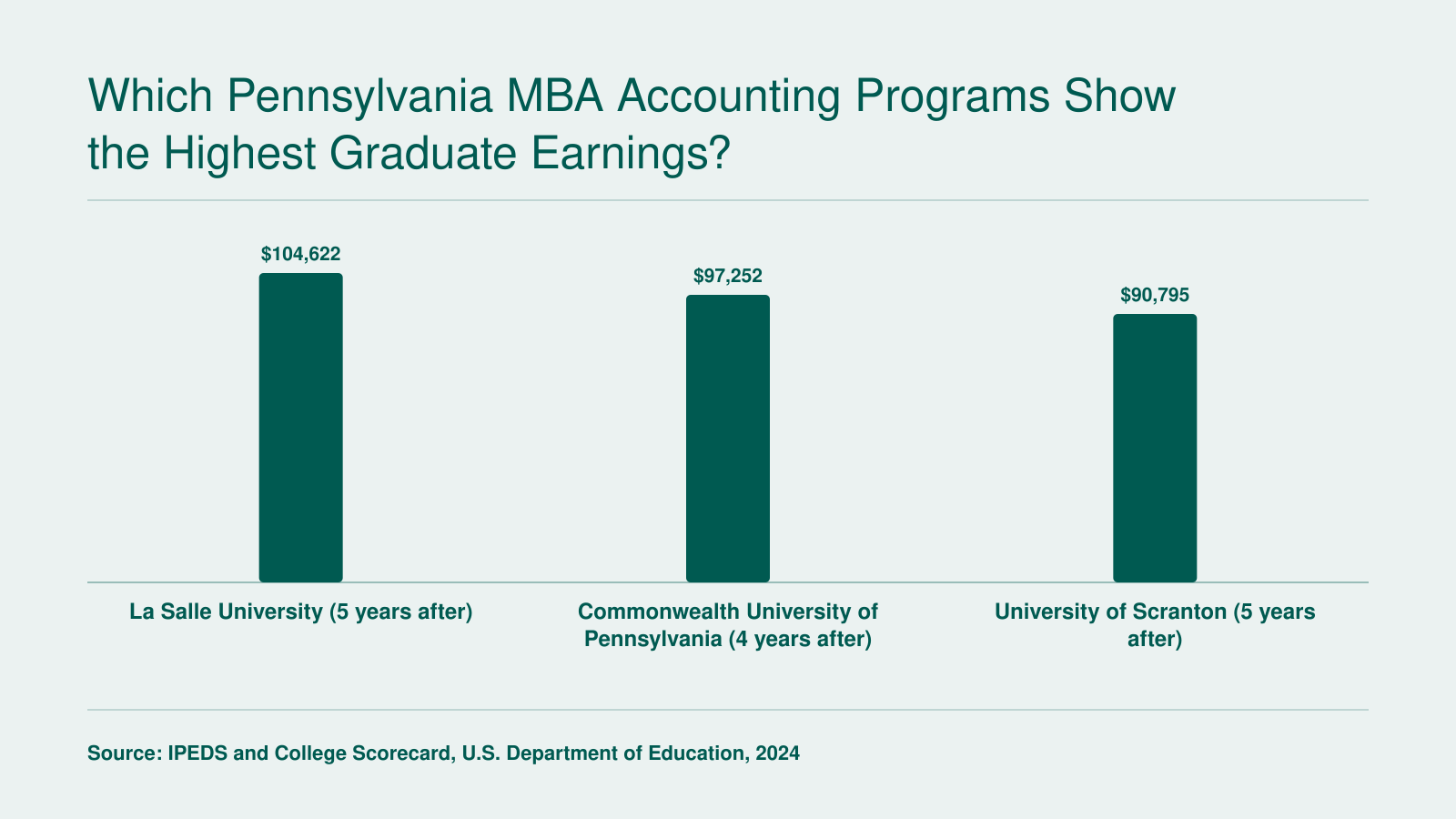
Which Pennsylvania MBA Accounting Programs Show the Highest Graduate Earnings?
Median earnings below are program-level figures for accounting graduates, with the time window after completion shown beside each school. Commonwealth University of Pennsylvania has the lowest net price of the three schools charted, at $15,699, and its four-year median of $97,252 sits close to La Salle University's five-year figure. The University of Scranton has the highest net price of the three, at $32,568, so its earnings need to be weighed against that added cost.
Frequently Asked Questions About MBA Accounting in Pennsylvania
What is the difference between an MBA in Accounting and a Master of Accounting?
Can an MBA in Accounting alone get me to 150 credits for the Pennsylvania CPA exam?
Is an online MBA in Accounting respected by Pennsylvania employers?
Compare Accounting programs on the data that matters
Explore more MBA specializations or browse every graduate field.
All MBA programs