Best MBA in Accounting Programs in North Carolina
Compare 5 accredited MBA in Accounting programs in North Carolina, with graduate earnings, cost, debt, and completion data from IPEDS and the U.S. College Scorecard.

An accounting-focused MBA in North Carolina can pair management training with credits toward the 150-hour CPA licensure requirement, but few schools offer a true accounting concentration rather than a general MBA.
In-state annual graduate tuition at the programs here runs from $6,928 to $18,700, a wide gap for the same degree type.
Price is only part of the choice. Only coursework that meets the state board's accounting requirements counts toward CPA eligibility, and the amount of that coursework varies by program.
Key Points
- UNCP's online MBA lists $11,092 total tuition for 36 credit hours.
- A 30-plus credit MBA on top of 120 bachelor's hours reaches 150.
- Exam eligibility needs 20 graduate accounting hours, not the full 150.
Best MBA in Accounting Schools in North Carolina, Ranked
This list is short because few North Carolina schools offer an MBA with an accounting concentration, as opposed to a general MBA or a separate Master of Accountancy. Graduation rates shown are institution-wide, not specific to the MBA. Program-level earnings are not yet published for these programs, so we do not show earnings figures.
University of Mount Olive
#1Mount Olive, NC · ~$19,000/yr (est.)
Best for: Working accountants seeking flexible online study
The University of Mount Olive offers a 33-credit online MBA in Accounting that pairs accounting coursework with a broader business curriculum, including financial statement analysis and strategic tax planning. It advertises ACBSP accreditation and did not appear in the AACSB results we reviewed. Federal data puts annual graduate tuition at about $18,300 for in-state and out-of-state students alike, and the institution-wide graduation rate is about 52%. The school lists no GMAT or GRE requirement.
- 33 credit hours, delivered fully online
- ACBSP accredited
- No entrance exam required
- 3.0 GPA minimum; prerequisite courses required
- No thesis or capstone required
- Covers financial statement analysis and strategic tax planning
- Positioned as preparation for CPA, CMA, CIA and CFE exams
North Carolina A & T State University
#2Greensboro, NC · ~$8,000/yr (est.)
Best for: Greensboro students wanting in-person CPA preparation
North Carolina A&T State University in Greensboro offers an on-campus MBA with an accounting concentration designed to help graduates meet CPA exam credit requirements. Its business school holds AACSB accreditation, and AACSB also lists a separate accounting accreditation for the university. Annual graduate tuition is about $5,095 in-state and $17,895 out-of-state, and the institution-wide graduation rate is about 57%. Program-level earnings are not yet published, and we found no confirmed tax, audit, or firm recruiting details.
- Campus-based program in Greensboro
- Accounting concentration within the MBA
- Prepares for the CPA examination
- AACSB accredited business school, with separate AACSB accounting accreditation
University of North Carolina at Pembroke
#3Pembroke, NC · ~$7,000/yr (est.)
Best for: Aspiring fraud examiners and forensic auditors
UNC Pembroke delivers an online MBA with a Forensic Accounting concentration, covering fraud examination, forensic analytics, and litigation support. The business school is AACSB accredited, though we could not confirm a separate accounting accreditation. Published program tuition is $11,092 for in-state students and about $23,580 for out-of-state students. The institution-wide graduation rate is about 44%, and the GMAT or GRE is not required with a 2.5 undergraduate GPA.
- 36 credit hours, finishable in as few as 12 months
- Fully online option with two 7-week terms and several start dates yearly
- Courses include Fraud Examination, Forensic Accounting and Forensic Analytics
- Requires an accounting bachelor's or specified accounting prerequisites
- GMAT/GRE not required with a 2.5 minimum undergraduate GPA
- Tuition can be paid by the course
- Pathway toward Certified Fraud Examiner preparation
Cost & outcomes by school
Federal data for the highest-earning Accounting programs, independent of the ranking above. Earnings are this field's master's graduates four years after completing, where the Scorecard reports them.
| School | Earnings | Tuition / yr | Debt | Grads/yr | Format |
|---|---|---|---|---|---|
| Strayer University-North Carolina NC | $77,493 | $15,135 | $80,164 | 6 | Hybrid |
| University of North Carolina at Pembroke NC | — | $6,928 | — | — | Online |
| Lenoir-Rhyne University NC | — | $13,020 | — | — | Campus |
| University of Mount Olive NC | — | $18,700 | — | — | Online |
| North Carolina A & T State University NC | — | $8,368 | — | 9 | Campus |
Sources: U.S. Department of Education. Tuition and graduates: IPEDS. Earnings and debt: College Scorecard, this field's master's graduates; a dash means no figure is reported.
Online and Hybrid MBA in Accounting Options in North Carolina
"Online" and "hybrid" describe how you attend class, not what you learn. A fully online MBA lets you complete coursework asynchronously from anywhere; a hybrid blends online work with scheduled campus sessions; campus formats meet in person, sometimes in evening or weekend blocks built for working professionals.
- University of Mount Olive: The MBA in Accounting is delivered online, covering 33 credit hours with no thesis or capstone requirement, so pacing depends largely on how many courses you carry per term.
- UNC Pembroke: The Forensic Accounting concentration runs 100% online across 36 credit hours, with courses in two seven-week terms per semester and students taking six to nine credits at a time. Completion in as few as 12 months is possible, though four accounting prerequisites must be satisfied first.1
- North Carolina A&T State University: The Accounting concentration is campus-based, so flexibility is more limited for accountants already working full time. A&T does not publish a detailed online or evening format for this concentration.
One practical check before enrolling: confirm with the North Carolina State Board that the specific online electives you choose count toward the accounting and business hours you still need.
Which North Carolina MBA in Accounting Programs Waive the GMAT or GRE?
Test-required versus test-free admission is the first filter many applicants use. For the master's programs in North Carolina on this list, the answer is less clear-cut than marketing suggests. None of these schools publishes an MBA class profile with an acceptance rate, average GPA or average GMAT, so selectivity has to be judged from stated minimums.
- University of Mount Olive: The online MBA in Accounting is listed as requiring no entrance exam, putting it among master's programs with no GRE required. GMAT and GRE scores still appear among accepted exams, which suggests scores are optional rather than prohibited. Applicants with a 2.5, 3.0 undergraduate GPA may be considered with a personal statement rather than automatically excluded, and must complete prerequisite courses. No separate waiver criteria are published, since no test is required.
- North Carolina A&T State University: We could not find a published GMAT or GRE policy for the MBA accounting concentration in the program materials we reviewed. Treat the requirement as unconfirmed.
- University of North Carolina at Pembroke: The online MBA with a Forensic Accounting concentration does not state a test policy in its published program overview, so its requirement is also unconfirmed.
Before you register for a test, email each admissions office. Ask in writing whether a score is required, optional or waivable based on your GPA, work experience or prior graduate degree.
Related Articles
What Does an MBA in Accounting Cost in North Carolina, and Who Is Hiring?
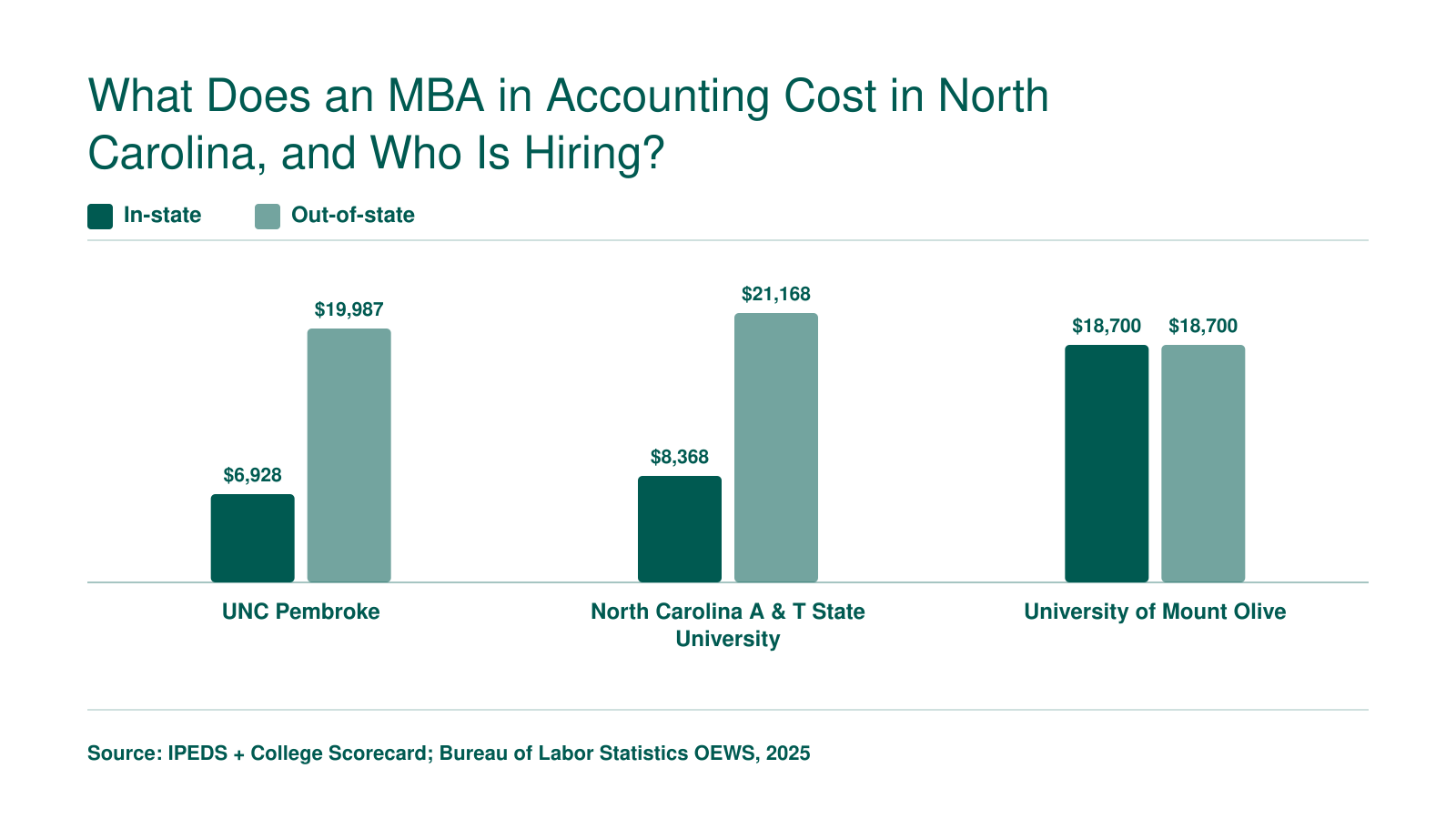
The chart shows annual graduate tuition estimates, in-state versus out-of-state, at the schools ranked here. To estimate a full program price, UNCP's online program page lists $11,092 in total tuition for 36 credit hours (roughly $308 per credit), and University of Mount Olive requires 33 credits. Per-credit rates and credit totals for North Carolina A & T State University were not confirmed in our research, so check each bursar page before budgeting. Institution-wide net price after aid is only an approximate guide, about $10,260 at UNCP, $10,846 at North Carolina A & T State University and $18,853 at University of Mount Olive, and it does not reflect MBA-specific costs. On demand, Bureau of Labor Statistics data for May 2025 show about 49,270 accountants and auditors employed in North Carolina, with a median wage of $82,050, and the banking and corporate finance employers in Charlotte and the Research Triangle are widely seen as major local hiring centers.
North Carolina CPA Licensing at a Glance
CPA Eligibility: How North Carolina MBA in Accounting Programs Meet the 150-Hour Rule
CPA eligibility in North Carolina comes down to credit hours plus the right coursework. Most bachelor's degrees carry about 120 semester hours, so adding a 30-plus credit MBA usually clears the 150-hour total the state requires as of January 1, 2026.1 But the hours alone are not enough. The board also wants 24 semester hours across at least 8 of 10 defined fields2, and an accounting concentration that meets either 30 undergraduate accounting hours (with no more than 6 in accounting principles and 3 in business law) or 20 graduate accounting hours open only to graduate students.1 A general MBA may not carry the accounting depth of a Master's in Accounting on its own.
Where the ranked programs stand
North Carolina A&T State University states that its MBA Accounting concentration is intended for students pursuing the 150 hours needed to sit for the CPA exam, and says the concentration provides sufficient credit hours for exam eligibility.3 It does not publish the number of accounting credits in the concentration, so A&T looks like the clearest CPA-oriented option here while still leaving details for you to confirm.
Before you enroll in a Master's in Accounting in North Carolina, request a transcript evaluation from the North Carolina State Board of CPA Examiners or the school so you know exactly which requirements your prior coursework already satisfies.
MBA in Accounting vs Master of Accounting in North Carolina
An MBA with an accounting concentration is a general management degree. A Master of Accounting (MAcc) is built around technical accounting content. Both can help you reach 150 credit hours, but they point toward different careers. Check each school's curriculum and your own transcript before choosing.
| Factor | MBA in Accounting | Master of Accounting (MAcc) |
|---|---|---|
| Degree scope | Broad management degree covering leadership, finance, and strategy, with an accounting concentration | Specialized degree focused on accounting, auditing, and taxation |
| Typical coursework | Several management core courses plus a smaller set of accounting electives | Mostly accounting courses. North Carolina A & T State University, for example, lists 24 of its 30 credit hours in accounting |
| Typical career target | Controller or CFO track, corporate finance, advisory, and general management roles | Public accounting, audit, tax, financial reporting, internal audit, and corporate or government accounting |
| CPA preparation | Not designed primarily as a CPA pathway. Course selection matters | Built for students pursuing CPA licensure |
| Reaching 150 hours | Can add the credits you need, but you may have to choose accounting electives deliberately | Usually packs in more accounting credits per degree, which can simplify meeting exam and licensure coursework |
| Best fit | Professionals who want a management career with financial expertise | Students who want a technical accounting career, often right after an undergraduate degree |
How We Ranked These Programs
This ranking weighs three verifiable inputs: affordability (graduate tuition and net price), outcomes (program-level earnings where College Scorecard publishes them), and institution-wide graduation rates from IPEDS. Only North Carolina schools offering an accounting concentration within MBA Programs, in campus or online formats, were eligible. Because net price and graduation rates are institution-wide figures, they may not reflect a single program's performance. Before applying, compare the ranked programs' CPA 150-hour alignment and GMAT or GRE test policies directly with each school.
Compare Accounting programs on the data that matters
Explore more MBA specializations or browse every graduate field.
All MBA programs