Best Online Master's in Organizational Leadership Programs
Compare 330+ accredited online Organizational Leadership programs, with graduate earnings, cost, debt, and completion data from IPEDS and the U.S. College Scorecard.

First-year median earnings for graduates in the organizational leadership programs that report them now span roughly $92,000 to $119,000, a wide enough spread that program choice can mean a five-figure difference in early salary. The programs below are offered fully online, though one may include live or blended components in some pathways.
That format works because most students are mid-career professionals who cannot pause a paycheck for a traditional cohort, yet they still need leadership credentials that employers recognize, not necessarily an MBA in Organizational Leadership.
Key Points
- Rankings use federal IPEDS and College Scorecard data, not advertising.
- Tuition depends on credit rate, fees, and 30 to 39 total credits.
- Admissions for 2027 online programs often waive the GRE or GMAT.
The 10 Best Fully Online Master's in Organizational Leadership Programs
These 10 degrees are all fully online; none require in-person or hybrid components. The list is ordered by a mixed quality composite rather than by any single factor such as price or salary. Each entry highlights graduate tuition, approximate net price, and the school's overall graduation rate where those figures are available.
University of Florida
#1Gainesville, FL · ~$13,000/yr (est.)
Best for: Educators targeting systems and policy leadership
The University of Florida's fully online Master of Education in Educational Leadership with a Systems Leadership focus prepares educators for leadership beyond the principal's office, emphasizing policy, research, and digital transformation. Graduate tuition is about $6,381 in-state and $28,659 out-of-state, with an approximate net price of $6,541 after aid; the school's overall graduation rate is 91%. One year after finishing, graduates earned a median of $95,217.
- Fully online option with spring, summer, and fall entry
- Focus on systems leadership, policy, and research
- Includes digital transformation and data leadership coursework
- Practicum in supervision and administration
- Does not lead to Florida school building certification
- Average class size around 10 to 15 students
Brown University
#2Providence, RI · $65,000 – $70,000/yr (est.)
Best for: Working professionals seeking executive influence
Brown's fully online MS in Organizational Leadership is a 16-month, 32-credit program built for working professionals, with asynchronous coursework and optional live sessions. Graduate tuition is about $71,412, and the approximate institution-wide net price after aid is $25,184; the school's overall graduation rate is 96%. The program includes an education leadership track for leaders in schools, districts, and policy roles.
- 16 months, 32 credit hours, 8 courses
- Mostly asynchronous with optional live sessions
- Education leadership track for schools, districts, and policy
- Merit scholarships up to 50% of tuition
- Application fee waived for early action
- Capstone project tied to a real leadership challenge
University of Georgia
#3Athens, GA · ~$11,000/yr (est.)
Best for: Mid-career professionals wanting cohort learning
The University of Georgia's fully online Master of Learning, Leadership and Organization Development uses a cohort model to prepare mid-career professionals for change management, talent development, and organizational consulting. Graduate tuition is about $11,450 in-state and $31,688 out-of-state, with an approximate net price of $13,936 after aid; the school's overall graduation rate is 90%. One year after finishing, graduates earned a median of $118,821.
- 33 credit hours and 11 courses
- Two-year cohort structure with fall start
- No campus visits required
- Capstone, portfolio, and oral exam required
- Covers adult learning, change management, and talent management
- Total program tuition listed at $21,912
West Coast University-Anaheim-Orange County
#4Anaheim, CA · ~$16,000/yr (est.)
West Coast University's online Master of Health Administration with an Organizational Leadership track prepares students to manage the business side of healthcare through 30 credits of MHA core and leadership coursework. Graduate tuition is about $22,506, with an approximate institution-wide net price after aid of $32,879; the school's overall graduation rate is 60%. Classes are fully online and asynchronous, with 8, 12, or 20-month pace options.
- 30 credit hours: 21 MHA core, 9 leadership
- Fully online asynchronous classes
- Three pace options: 8, 12, or 20 months
- 2.7 minimum GPA for admission
- Capstone required
- Alumni grant covers 20% of tuition
- Transfer up to nine credits
Rutgers University
#5New Brunswick, NJ · ~$23,000/yr (est.)
Rutgers University's online Master's in Labor and Employment Relations with the Organizational Leadership and Change specialization focuses on team leadership, organizational design, negotiation, and conflict resolution. Graduate tuition is about $17,929 in-state and $37,441 out-of-state, with an approximate net price of $24,406 after aid; the school's overall graduation rate is 84%. One year after finishing, graduates earned a median of $114,572.
- 13 total courses with five electives
- Specialization in Organizational Leadership and Change
- Can take up to three electives from MHRM program
- Covers organizational design, negotiation, globalization
- Fully online option
Manna University
#6Fayetteville, NC · ~$9,000/yr (est.)
Manna University's online Master of Arts in Christian Leadership with an Organizational Leadership concentration combines leadership theory with a biblical foundation, covering servant leadership, strategic change, and global leadership. Graduate tuition is about $9,105, with an approximate net price of $15,210 after aid; the school's overall graduation rate is 80%. The 39-semester-hour degree uses asynchronous discussion boards for working ministry and nonprofit leaders.
- 39 semester hours at $310 per credit
- Concentration in Organizational Leadership
- Fully online asynchronous discussion boards
- 2.8 minimum GPA
- Capstone project
- Up to nine transfer credits accepted
- Accredited by the Association for Biblical Higher Education
Purdue University
#7West Lafayette, IN · ~$10,000/yr (est.)
Purdue University's online MS in Organizational Leadership and Supervision is a 30-credit, roughly 24-month program with asynchronous coursework, designed for working professionals leading teams and change. Graduate tuition is about $9,992 in-state and $28,794 out-of-state, with an approximate net price of $14,600 after aid; the school's overall graduation rate is 83%. One year after finishing, graduates earned a median of $103,280.
- 30 credit hours, about 24 months
- Fully online asynchronous classes
- Three available concentrations
- 3.0 minimum GPA
- Stackable graduate certificate options
- Focus on strategic planning, human capital, and organizational behavior
Tufts University
#8Medford, MA · ~$51,000/yr (est.)
Tufts University's online Master's in Leadership with the Organizational Learning and Leadership specialization blends leadership theory, systems thinking, and equity frameworks across 30 credits. Graduate tuition is about $70,704, with an approximate net price of $39,998 after aid; the school's overall graduation rate is 94%. The program offers synchronous and asynchronous options, evening virtual classes, and fall, spring, and summer starts.
- 30 credit hours, 10 courses
- Four concentration options
- Mix of synchronous and asynchronous evening classes
- Fall, spring, and summer starts
- Full-time or part-time options
- Focus on leadership theory, systems thinking, and equity
The University of Texas at Dallas
#9Richardson, TX · ~$15,000/yr (est.)
UT Dallas's online MS in Leadership and Organizational Development pairs behavioral science with organizational change practice in a synchronous virtual classroom. Graduate tuition is about $14,644 in-state and $40,144 out-of-state, with an approximate net price of $18,267 after aid; the school's overall graduation rate is 76%. One year after finishing, graduates earned a median of $113,550.
- Fully online synchronous interactive classes
- Two-year, six-semester program
- No GRE or GMAT required
- Master's degree plus specialized certificate
- Five certificate track options
- Three start dates per year
Gonzaga University
#10Spokane, WA · ~$22,000/yr (est.)
Gonzaga University's online Master's in Organizational Leadership emphasizes ethical, people-centered leadership, with asynchronous classes and optional immersions. Graduate tuition is about $55,480, with an approximate net price of $35,119 after aid; the school's overall graduation rate is 86%. One year after finishing, graduates earned a median of $92,105.
- Asynchronous online classes
- Six concentration options
- Dozens of electives available
- Optional immersions in Spokane and study abroad
- No separate scholarship application
- Alumni network includes Boeing, Providence Health, Gates Foundation, and REI
Cost & outcomes by school
Federal data for the highest-earning Organizational Leadership programs, independent of the ranking above. Earnings are this field's master's graduates four years after completing, where the Scorecard reports them.
| School | Earnings | Tuition / yr | Debt | Grads/yr | Format |
|---|---|---|---|---|---|
| Rutgers University NJ | $155,535 | $23,241 | $50,681 | — | Online |
| University of Georgia GA | $154,042 | $11,002 | $62,722 | 285 | Online |
| Arizona State University AZ | $141,437 | $10,843 | $47,828 | 289 | Online |
| Arizona State University AZ | $141,437 | $13,587 | $47,828 | 19 | Online |
| The University of Texas at Dallas TX | $140,481 | $15,168 | $49,818 | 433 | Online |
| University of Colorado Boulder CO | $137,635 | $16,634 | $41,000 | 219 | Online |
| University of Florida FL | $137,404 | $12,737 | $38,383 | 894 | Online |
| University of Wisconsin-Eau Claire WI | $136,439 | $10,665 | $31,909 | 109 | Online |
| Purdue University IN | $132,747 | $9,992 | $41,000 | 185 | Online |
| Mississippi State University MS | $128,049 | $10,202 | $30,950 | 250 | Online |
| University of South Dakota SD | $109,366 | $7,118 | $25,845 | 104 | Hybrid |
| Southeastern Oklahoma State University OK | $105,483 | $5,220 | $25,592 | 308 | Online |
Sources: U.S. Department of Education. Tuition and graduates: IPEDS. Earnings and debt: College Scorecard, this field's master's graduates; a dash means no figure is reported.
Cost, debt & payoff
Median earnings of this field's master's graduates (4 yrs after completing) vs. their median federal loan debt · U.S. College Scorecard
Across these programs the median graduate earns about $90,981 and finishes with roughly $35,594 in debt — a ratio that clears a common rule of thumb (keep debt below first-year salary). Tuition and debt vary widely school to school, so check the per-school figures in the table above before you shortlist.
How We Rank Fully Online Organizational Leadership Programs
Many "best online master's" lists are built on advertising relationships. This one is built on federal data. Schools cannot pay for placement, and no program moves up the page because it has a marketing budget. The numbers come from IPEDS and the College Scorecard, both maintained by the U.S. Department of Education.
What Goes Into the Ranking
We start by keeping only programs delivered fully online. From there, we compare the inputs that bear most on cost and career payoff:
- Graduate tuition: the published price of study at the institution, and one cost to compare across affordable organizational leadership master's programs.
- Average net price: what students pay after grant aid is subtracted.
- Graduation and retention rates: a signal of whether students tend to finish what they start.
- Earnings and debt: program-level figures for graduates, wherever they are available.
Where the Data Falls Short
Two limits matter. Graduation rates, retention rates, and net price describe the whole institution, not the Master's in Organizational Leadership program alone. A school's overall numbers may blur differences between its master's students and its undergraduates.
Some programs also lack Scorecard earnings or debt figures. Federal reporting is suppressed when a graduating cohort is small, to protect student privacy. A missing figure says nothing about a program's quality. It only means the data is not there to compare.
How to Use the List
Treat the rankings as a shortlist, not a final verdict. Tuition changes from year to year, and admissions requirements vary by school. Before you apply, confirm each program's current tuition, fees, and admission standards on the school's own pages, and ask the admissions office for anything the federal data cannot show.
How Much Does an Online Master's in Organizational Leadership Cost?
The cost of an online master's in organizational leadership is what you pay to complete roughly 30 to 39 graduate credits: a rate for each credit, plus technology fees, books and a few one-time charges.
What the Ranked Programs Charge
Annual graduate tuition at the schools ranked here runs from $8,480 (in-state at UT Tyler) to $36,542 (out-of-state at Wayne State). If you want the cheapest online master's in organizational leadership, start with average net price. CUNY Lehman College ($3,148) and the University of Florida ($6,541) post the lowest schoolwide figures. On sticker tuition, Manna University ($9,195) and Charter Oak State College ($10,352) are the low-cost picks. Charter Oak is a public college that charges one rate whether or not you live in Connecticut.
How to Calculate Your Real Total
Multiply the per-credit rate by the required credits, then add technology or online fees, books and any graduation fee. Three examples show how this works:
- Southern New Hampshire University: $659 per credit across 36 credits comes to $23,724, before other possible fees.1
- Shenandoah University: $500 per credit for 33 credits, plus a mandatory $20 technology fee per course. The total ranges from $16,500 to $19,155 depending on electives.
- University of Oklahoma: $845 per credit, for a $25,350 total that covers tuition and fees but not books or materials.2
Watch for smaller charges, too. Champlain College adds a $150 graduation fee to its $608 per-credit rate.3
Why the Per-Credit Rate Matters More
Annual tuition assumes a full-time load. Most online students take one or two courses per term, so the yearly figure tells you little about what you'll actually pay. The per-credit rate times total credits is the number to compare, regardless of how many years you take to finish.
Paying for It
Federal graduate loans are available at accredited schools, but employer support and discounts often cut costs further:
- Employer aid: The University of Georgia supports employer reimbursement, and APU Global lets employers be billed directly.4
- Military rates: SNHU drops to $470 per credit ($16,920 total)1, Columbia Southern to $250 from $3595, and Belhaven to $375 from $6356. Belhaven's discount can't be combined with other institutional awards.6
- Alumni savings: Strayer advertises an alumni scholarship worth $4,000.
Asynchronous vs. Synchronous: How Flexible Are These Online Programs?
Flexibility and structure pull in opposite directions, and online students must choose which they need more. Asynchronous courses have no set login times: you watch lectures and submit work by deadlines. Synchronous courses meet live at scheduled hours. For a nurse on rotating shifts or a parent whose free time starts after bedtime, that difference can decide whether a program is workable at all.
Which Programs Require Live Sessions
Most of the schools here lean asynchronous. Brown, Colorado Boulder, Muskingum, and Saint Mary's University of Minnesota deliver coursework asynchronously,134 and Brown and Saint Mary's list no required live sessions.14 Boulder says it is almost always asynchronous. Oklahoma is primarily asynchronous, with optional live sessions roughly every other week that are recorded.2 Middlebury is asynchronous with no required live meetings, but its last intake was Spring 2026, so confirm whether it is enrolling.5
Manhattan University is the outlier. Its fully online option can mix asynchronous work, live sessions, and in some pathways blended or in-person elements, so ask which format your cohort follows. Oklahoma describes its program as 100% online.2 For the others, look for explicit residency language before you apply.
Pacing and Time to Finish
Term length shapes your workload more than the label does.
- 7-week terms: Colorado Boulder and Manhattan use them. Boulder students typically finish in about 19 months across five semesters at one course per term.
- 8-week courses: Oklahoma offers three starts a year and 12 to 20 months to finish, depending on how many courses you take at once.2
- Other timelines: Brown's full-time path runs about 16 months for 32 credits.1 Muskingum lists one to two years for 30 credits.3 Saint Mary's runs about 24 months with three starts a year.4
Shorter terms mean more start dates but a faster weekly pace.
A Practical Tip
"Asynchronous" describes lectures, not always teamwork. Ask admissions whether group projects need real-time coordination, such as a video call at a set hour. A program with no live classes can still require you to line up schedules with classmates in other time zones, which matters if your availability is already tight.
Related Articles
Top First-Year Earnings Among Ranked Programs
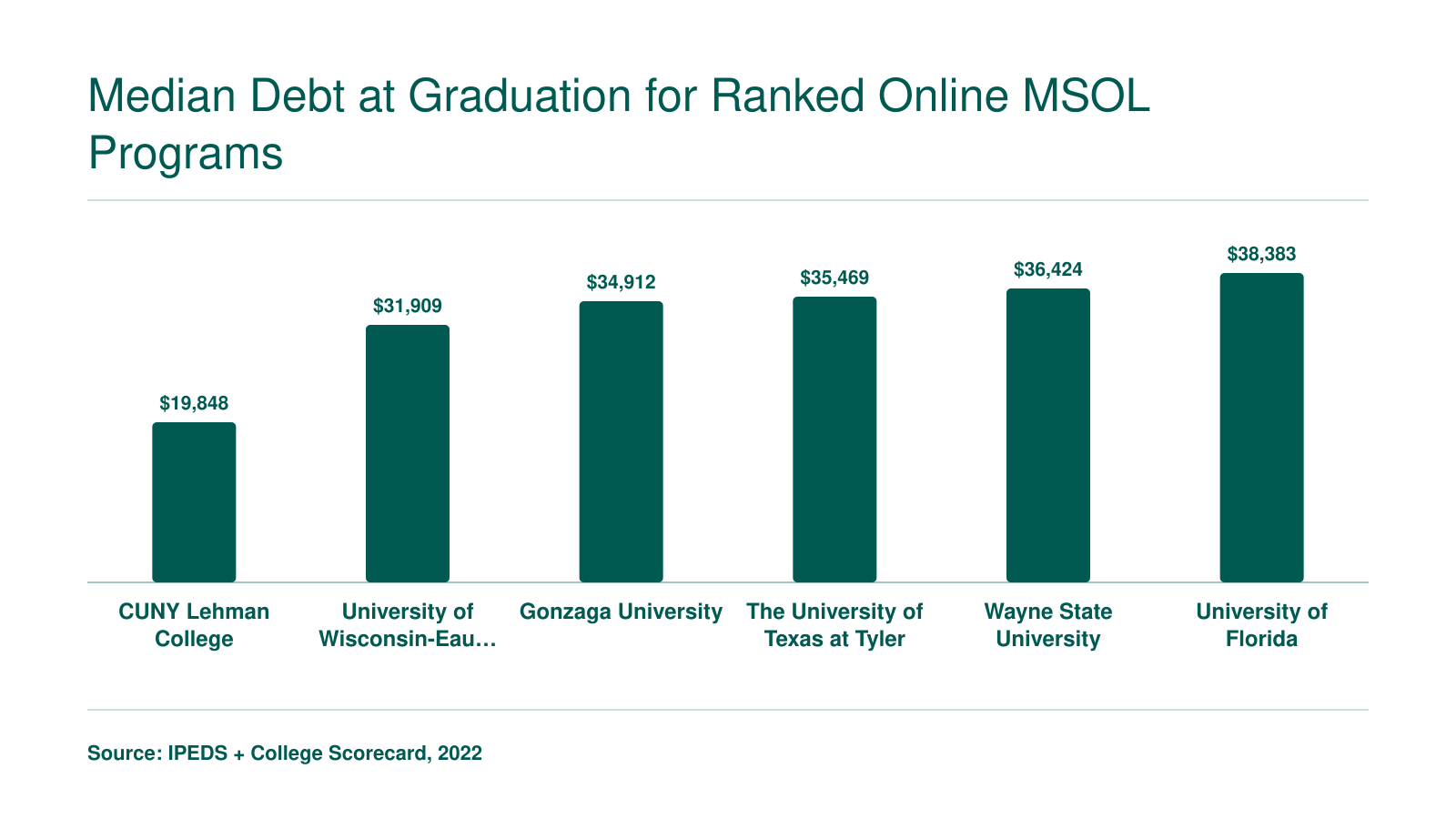
Median Debt at Graduation for Ranked Online MSOL Programs
Median federal loan debt at completion is shown for the online organizational leadership programs in this ranking that report a program-level debt figure. The median is the midpoint, so half of graduates owed less and half owed more. The typical 10-year monthly payment for these balances ranges from $226 to $437, which shows how the loan amount translates into monthly cash flow after graduation.
Gallup's State of the American Manager (2015) found that managers account for at least 70% of the variance in employee engagement scores across business units. Because a single manager can shape how engaged a whole team is, employers increasingly value formal leadership training as a direct lever on productivity and retention.
Admissions Requirements for Online Organizational Leadership Master's Programs
Admissions standards vary by school, but most online organizational leadership master's programs are built for working professionals and do not require the GRE or GMAT.
- Bachelor's degree from an accredited institutionAny major is typically accepted. Programs expect a completed bachelor's, and some schools, including Brown, welcome applicants from varied academic and professional backgrounds.
- Minimum undergraduate GPACommon floors run from 2.5 to 3.0. Saint Mary's requires 2.75, William Penn expects 3.00, and Arizona State looks for 3.00 in the last 60 credits. Colorado Christian asks for 2.5, with 2.0-2.49 considered for conditional admission.
- GRE/GMAT requirementsMost programs here do not require the GRE or GMAT. Arizona State recommends but does not require scores, and CU Boulder lists the GRE/GMAT as optional.
- Work or supervisory experienceExpectations vary. Brown requires at least three years of professional employment, and CU Boulder says successful applicants typically bring three to five years. Colorado Christian prefers about five years of combined leadership or community experience but treats it as preferred, not absolute.
- Application materialsA resume, personal statement, and letters of recommendation are standard. Brown asks for three recommendations and a 1,500-word personal statement; CU Boulder requests two letters.
- Transfer creditMany schools accept 6-9 graduate credits. Saint Mary's allows 6 semester credits with program approval, Southeastern Oklahoma State accepts up to 9, and CU Boulder allows up to 9 if regionally accredited, relevant, and completed with a B or better within five years.
Organizational Leadership programs by state
Online Organizational Leadership Master's FAQ
Choosing an online organizational leadership master's means weighing time, cost, and career fit. These answers address the questions prospective students ask most, based on current federal data and program information.
Is a master's in organizational leadership worth it?
How long does an online master's in organizational leadership take?
Master's in organizational leadership vs. MBA: which should I choose?
Can I get a master's in organizational leadership with no management experience?
Compare Organizational Leadership programs on the data that matters
Explore more Business & Management specializations or browse every graduate field.
All Business & Management programs