Best Online Master's in Music Education Programs
Compare 120+ accredited online Music Education programs, with graduate earnings, cost, debt, and completion data from IPEDS and the U.S. College Scorecard.

For most working music teachers, an online master's is a salary-schedule decision first: district pay scales typically reward a master's lane, and the degree can be earned without stepping away from a band room or choir rehearsal. Every program ranked here is 100% online, with no hybrid sessions or on-campus summer residencies.
The real tension is price against payoff. The University of Florida, for example, lists $600 per credit across 33 credits, while private options cost far more, and fees, NASM accreditation and true return can shift the math well beyond the sticker rate.
One constraint catches career changers: most of these degrees assume you already hold a teaching license, so they deepen pedagogy and lift pay but rarely grant initial K-12 certification.
Key Points
- Lamar University's 2027 online tuition is $360 per credit.
- Montana State graduates report median earnings of $74,855 five years out.
- Fully online 2027 programs generally require current teaching licenses, not initial licensure.
Top 10 Fully Online Master's in Music Education Programs for 2027
This list focuses only on fully online master's in music education programs, so hybrid and on-campus options are not included. The ten schools are ordered by a combined read of federal outcome data and online-only fit, with each card showing graduate tuition, net price, and the institution's graduation rate for quick comparison.
University of Florida
#1Gainesville, FL · ~$13,000/yr (est.)
Best for: Practicing music educators wanting self-paced study
University of Florida pairs a 33-credit online music education master's with asynchronous courses and three annual start dates. It is built for practicing educators who want to keep teaching while pursuing advanced musical study, ensemble direction, and collegiate teaching. Students can access graduate research funding and move toward leadership roles in PK-12 or collegiate settings.
- NASM and CAEP accredited program
- 33 total credit hours
- Asynchronous online classes with three start dates per year
- No GRE required for admission
- $600 per credit for graduate tuition
- Small class sizes and expert faculty
- Graduate research funding available
- Designed for practicing PK-12 and collegiate educators
Boston University
#2Boston, MA · $65,000 – $70,000/yr (est.)
Best for: Music department leaders focusing on wellbeing and technology
Boston University's online music education master's blends synchronous and asynchronous learning and can be finished in as little as 20 months. Students study the philosophical, sociological, and psychological foundations of music education while choosing electives in areas such as DEI, early childhood, music technology, popular music, and wellbeing. The program is rooted in one of the oldest degree-granting music programs in the country and is designed for working educators who want to lead change in their schools and communities.
- 20-month completion possible
- Six start dates per year
- Synchronous and asynchronous learning options
- Electives in DEI, early childhood, music technology, popular music, and wellbeing
- Nationally recognized faculty and theory-to-practice model
- Rooted in the oldest degree-granting music program in the U.S.
University of South Florida
#3Tampa, FL · ~$10,000/yr (est.)
Best for: K-12 band and choir directors seeking new methods
The University of South Florida offers a totally at-a-distance Master of Arts in Music Education built around learner-centered pedagogy and hands-on research methods. It is intended for practicing K-12 music teachers who want to balance synchronous online meetings with asynchronous coursework while transforming their classroom practice. Graduates develop action research skills to support leadership in schools and community music settings.
- Totally at-a-distance format with synchronous and asynchronous options
- Learner-centered and informal pedagogy focus
- Action research methods built into the curriculum
- Designed for practicing K-12 music teachers
- Innovative curriculum with research techniques
Auburn University
#4Auburn, AL · $13,000 – $34,000/yr (est.)
Auburn University's online music education degree offers both an MEd certification track for practicing teachers and an MS non-certification track for advanced study. Students can follow an instrumental or vocal concentration while completing 30 credit hours and a practicum in their specialization. The curriculum emphasizes research, curriculum and teaching methods, program evaluation, and music technology, preparing graduates for band director and curriculum leadership roles.
- Instrumental concentration for band and instrumental music pathways
- 30 total credit hours
- 3.3 GPA minimum for admission
- MEd certification track or MS non-certification track
- Practicum in the area of specialization
- Teaching field courses required
- Vocal concentration for vocal music educators
- Special education and diversity course included
- At least one-third of coursework in teaching field
- Online option available for working educators
University of Missouri
#5Columbia, MO · ~$14,000/yr (est.)
The University of Missouri's online Master of Music in Music Education is designed for practicing school music teachers and follows a mostly asynchronous format. The 32-credit program combines music education foundations, psychology of music instruction, music theory and history, two teaching practicums, and a research-to-practice capstone. Most students finish in about three years while continuing to teach, with faculty active in national music organizations.
- 32 total credit hours
- No entrance exam required
- Asynchronous online classes
- Two teaching practicums included
- Research-to-practice capstone required
- Designed for practicing preK-12 teachers
- Evening and summer course options
- Can pursue teacher certification concurrently
George Mason University
#6Fairfax, VA · $15,000 – $20,000/yr (est.)
George Mason University's online Master of Music in Music Education helps practicing music educators advance without leaving the classroom. The 30-credit program covers aesthetics and philosophy, psychology of music teaching and learning, analytical techniques, music history, and research methods. Students choose a thesis or non-thesis capstone, with flexible scheduling supported by experienced Mason faculty.
- 30 total credit hours
- Thesis or non-thesis capstone option
- Designed for practicing music educators
- Summer semester coursework available
- Taught by experienced Mason faculty
University of Northern Iowa
#7Cedar Falls, IA · $12,000 – $23,000/yr (est.)
The University of Northern Iowa's online Master of Music in Music Education uses a four-semester, cohort-based format with synchronous evening Zoom sessions. The 30-credit program emphasizes progressive and inclusive music education, with coursework aimed at teachers who want to pursue school music administration and leadership. No GRE is required, and current teaching licensure is expected for admission.
- 30 total credit hours
- Four-semester cohort-based structure
- Synchronous evening Zoom sessions
- No entrance exam required
- 2.8 GPA minimum for admission
- Current teaching license required
- $2,000 Online & Distance Education Scholarship
- Dedicated support team and personalized advising
Georgia College & State University
#8Milledgeville, GA · $8,000 – $28,000/yr (est.)
Georgia College & State University's online M.M.Ed. is built for certified music teachers who want to deepen pedagogy, history, theory, research, and performance. The 30-credit distance learning degree requires entrance exam scores such as GRE, Praxis, or Georgia music assessments, plus a video-recorded lesson and coordinator interview. The program supports in-service educators with conditional admission options and a liberal arts-across-the-curriculum approach.
- 30 total credit hours
- Entrance exam required, GRE or Praxis accepted
- 2.5 GPA minimum in music courses
- Three recommendation letters required
- Video-recorded lesson and coordinator interview required
- Conditional admission available up to 12 hours
Ohio University
#9Athens, OH · ~$10,000/yr (est.)
Ohio University's online Master of Music in Music Education is a 100 percent asynchronous program that can be completed in as few as 12 months. Students choose choral or instrumental emphasis and take coursework spanning music theory, history, jazz studies, applied music, and conducting. The degree is designed for practicing teachers and can support permanent certification and doctoral study, with no GRE requirement and a 15 percent tuition scholarship for eligible students.
- 12-month completion possible
- Asynchronous online classes
- Choral or instrumental emphasis options
- No entrance exam required
- Includes music theory, history, jazz, and conducting
- 15% tuition scholarship for eligible students
- Military benefits and employer reimbursement supported
East Carolina University
#10Greenville, NC · ~$8,000/yr (est.)
East Carolina University's 100 percent online Master of Music with a concentration in music education supports practicing teachers seeking advanced expertise and North Carolina graduate licensure. The program includes a capstone project and options to transfer up to six graduate credits or earn credit for National Board Certification. It is designed to help working educators advance K-12 teaching, specialized instruction, and curriculum development without leaving their classrooms.
- 100% online degree
- Capstone project required
- Leads to North Carolina graduate licensure
- Transfer up to six graduate credits
- Credit available for National Board Certification
- Pedagogical Studies concentration option
- Approved for North Carolina graduate teacher license
- Up to 3 credit hours for National Board Certification
- Capstone project integrates scholarship and practice
Cost & outcomes by school
Federal data for the highest-earning Music Education programs, independent of the ranking above. Earnings are this field's master's graduates four years after completing, where the Scorecard reports them.
| School | Earnings | Tuition / yr | Debt | Grads/yr | Format |
|---|---|---|---|---|---|
| San Diego State University CA | $82,189 | $10,252 | $13,666 | — | Hybrid |
| CUNY Hunter College NY | $79,416 | $11,398 | $24,573 | 172 | Hybrid |
| Gordon College MA | $78,374 | $8,960 | — | 29 | Hybrid |
| Rowan University NJ | $72,436 | $18,607 | $19,619 | 13 | Hybrid |
| Florida State University FL | $66,411 | $10,553 | $25,060 | 52 | Hybrid |
| Ball State University IN | $66,242 | $12,342 | $22,600 | 52 | Online |
| University of West Georgia GA | $65,853 | $6,046 | $19,037 | 33 | Online |
| Montana State University MT | $64,655 | $7,661 | $18,366 | 43 | Online |
| University of Nebraska at Kearney NE | $64,020 | $8,106 | $17,210 | 67 | Online |
| Georgia College & State University GA | $62,561 | $8,376 | $27,702 | 57 | Online |
| University of Florida FL | $62,447 | $12,737 | $29,188 | 138 | Online |
| Kent State University OH | $62,189 | $12,483 | $30,947 | 69 | Online |
Sources: U.S. Department of Education. Tuition and graduates: IPEDS. Earnings and debt: College Scorecard, this field's master's graduates; a dash means no figure is reported.
Cost, debt & payoff
Median earnings of this field's master's graduates (4 yrs after completing) vs. their median federal loan debt · U.S. College Scorecard
Across these programs the median graduate earns about $61,242 and finishes with roughly $27,702 in debt — a ratio that clears a common rule of thumb (keep debt below first-year salary). Tuition and debt vary widely school to school, so check the per-school figures in the table above before you shortlist.
Online Music Education Master's Program Cost: Tuition, Fees, and Net Price Compared
For the cheapest online master's in music education by published total, Lamar University stands out at $360 per credit for 30 credits, or $10,802. By comparison, the University of Florida lists $600 per credit for 33 credits and a published total of $20,979.75 once required fees are added, while the University of Georgia lists $664 per credit for 33 credits, or $21,912 before semester fees. The table below shows tuition and net price for the schools in this ranking; the average net price is an institution-wide figure after aid, not a program quote, and graduate students usually receive less grant aid than undergraduates.
| School | State | In-state graduate tuition | Out-of-state graduate tuition | Average net price |
|---|---|---|---|---|
| University of Florida | FL | $6,381 | $28,659 | $6,541 |
| Marshall University | WV | $9,162 | $20,342 | $7,502 |
| Oakland University | MI | $15,262 | $23,188 | $9,120 |
| University of South Florida | FL | $6,410 | $17,324 | $9,812 |
| Saint Xavier University | IL | $37,940 | $37,940 | $10,970 |
| Arkansas State University | AR | $8,090 | $14,522 | $12,366 |
| University of Memphis | TN | $10,728 | $15,384 | $12,397 |
| Middle Tennessee State University | TN | $10,266 | $31,574 | $13,359 |
| Eastern Washington University | WA | $8,586 | $25,959 | $13,886 |
| William Carey University | MS | $15,480 | $15,480 | $14,258 |
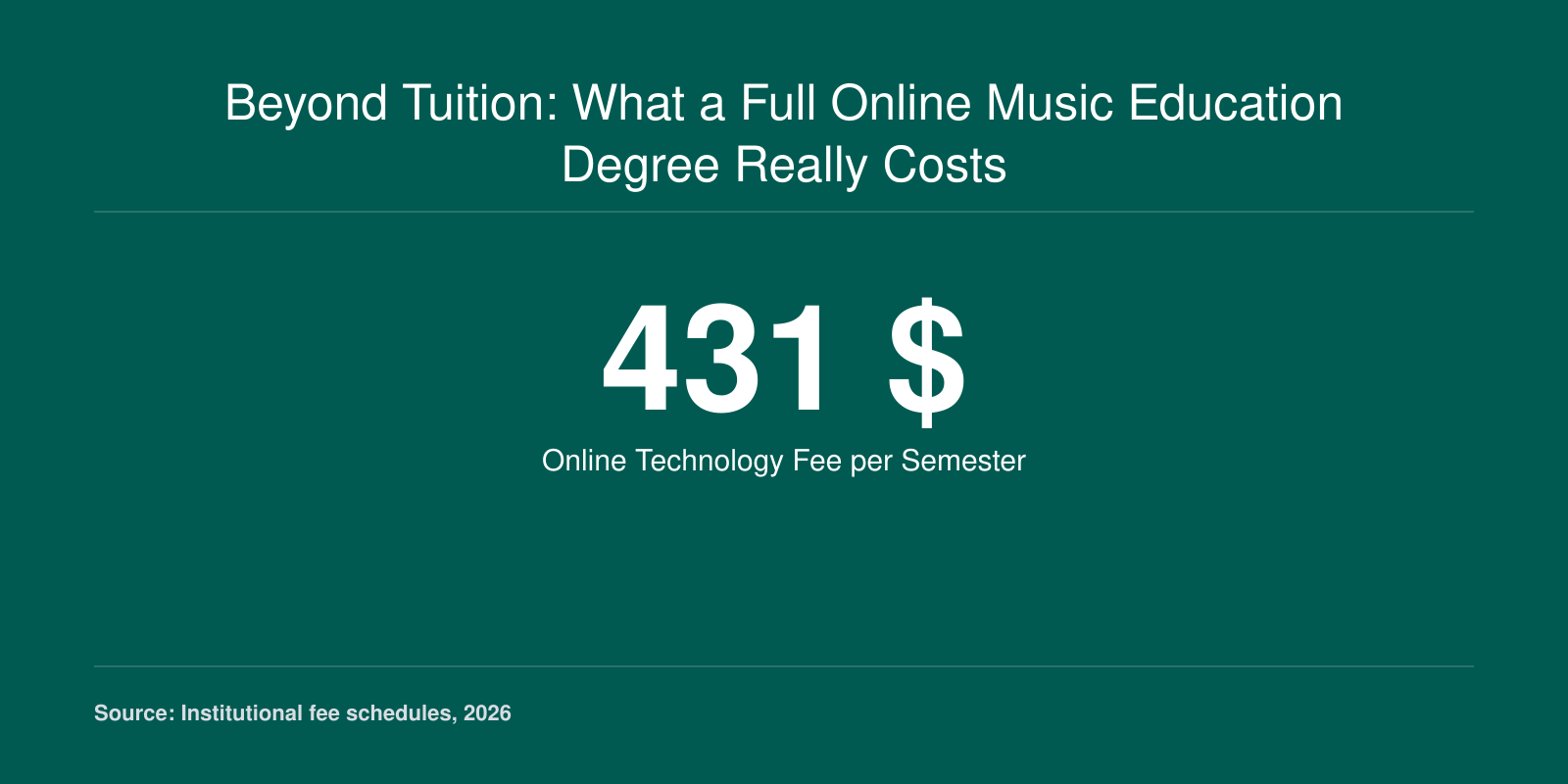
Beyond Tuition: What a Full Online Music Education Degree Really Costs
NASM Accreditation: How to Verify an Online Music Education Program
Are accredited music education master's programs offered online? Yes, the ones worth considering are. The real question is which accreditation, because two separate layers are at work.
Two Layers of Accreditation
Institutional accreditation covers the whole university. Regional accreditors such as HLC, SACSCOC, and MSCHE review it, and it is the layer that governs federal aid, credit transfer, and doctoral admission. Program-level accreditation comes from the National Association of Schools of Music (NASM), a specialized body that reviews music institutions, schools, departments, and curricular programs.1 NASM adds music-specific quality assurance. It does not replace regional accreditation.
NASM's directory lists accredited institutions and approved programs.1 We could not confirm whether NASM reviews an online graduate degree as its own listing or as part of the music unit's overall accreditation. We also could not confirm NASM's current written policy on distance delivery. Don't assume either way, and ask the school directly.
What the Schools Report
The University of Florida, Campbellsville, Georgia, Eastern Washington, Liberty, and New Mexico State all describe their online music education degrees as NASM-accredited. Lamar and Lebanon Valley College are also reported as NASM-accredited.23 Campbellsville and Liberty pair that with SACSCOC, and New Mexico State with the Higher Learning Commission. Lebanon Valley's program is primarily online but includes a short on-campus summer residency.3 These are institutional statements, not directory confirmations.
How to Check It Yourself
- Search the NASM directory: Look up the institution on NASM's website and confirm it appears as an accredited member.
- Confirm the regional accreditor: Check the university's status with HLC, SACSCOC, or MSCHE, or in the U.S. Department of Education's database.
- Ask about the online degree: Ask admissions whether the online program falls under the NASM-accredited music unit.
Why It Matters
School districts typically grant salary-schedule credit for graduate coursework based on regional accreditation. The same goes for doctoral admissions and transfer credit. NASM is the music-specific signal, and it can carry weight with employers and doctoral committees. Verify both layers before you enroll in an online master's in music education program.
Related Articles
Can You Teach K-12 Music With an Online Master's? Licensure vs. Salary Advancement
Licensure programs and salary-advancement programs can look alike in a course catalog, but they serve different people. Most fully online master's in music education programs are built for teachers who already hold a license. They do not lead to initial K-12 certification.
Who These Programs Are Built For
The admission language makes this plain:
- Brenau University's Master of Education in Music Education requires existing music education certification and is not an initial certification route.1
- The University of Georgia's online Master of Music Education expects applicants to hold, or be able to obtain, K-12 music certification.
- New Mexico State University designs its Master of Music: Music Education for licensed K-12 music teachers.
- SUNY Buffalo State asks for an initial teaching certificate or license.2
- Wayne State College states that its program does not meet Nebraska initial licensure requirements.
Routes for Career Changers
If you don't hold a teaching license, look for a program that explicitly includes initial preparation:
- Post-baccalaureate certification: coursework plus student teaching for degree holders from outside education.
- MAT-style master's programs: a graduate degree paired with supervised student teaching in your intended state.
- State alternative licensure: pathways defined state by state.
Even "fully online" licensure routes typically require in-person fieldwork, state exams and background checks.
How Current Teachers Benefit
For licensed teachers, the payoff is usually a move from the bachelor's column to the master's column on a district salary schedule. In some states the degree also counts toward license renewal or advanced certificates.
In Pennsylvania's Chambersburg Area School District, the 2026-2027 schedule puts the master's premium at $1,714 (2.7%) at the first steps.3 At the top step, it rises to $6,024 (7.7%).3
In Minneapolis, the master's lane requires a conferred, district-approved degree. Teachers who send official transcripts to HR by September 30, 2026 get the raise from the first day. Those who submit by January 31, 2027 get it in the second semester.4
Lane movement depends on district approval and the bargaining agreement, not on whether you earned the degree online.
Authorization and Reciprocity
An online program must be authorized to enroll students in your state. Authorization alone still does not guarantee licensure, an endorsement or lane credit.
The NASDTEC Interstate Agreement spans more than 50 jurisdictions and eases the transfer of an existing license. Receiving states can still require exams, coursework or background checks.
Before enrolling, ask your state education department and your district HR office to confirm that the specific program counts toward your goal.
Admission Requirements for Online Music Education Master's Programs
- Bachelor's degree and GPAExpect a bachelor's in music, music education, or a related field from a regionally accredited school. GPA floors are usually 2.75–3.00; Lamar University and Campbellsville University list 2.75, while Middle Tennessee State University, Ohio University, Liberty University, and University of Florida require around 3.00, and Florida also expects a 3.0 in undergraduate music theory, ear training, and music history.
- Teaching credential and experienceRequirements vary: Campbellsville University does not require a teaching certificate; Middle Tennessee State University expects current K-12 music teaching; University of Florida asks for professional music teaching experience, with a portfolio option for music-degree applicants. A minimum number of years is not uniformly specified.
- GRE policySeveral programs here no longer require the GRE, including Lamar University, University of Florida, and Southeastern Oklahoma State University. Confirm the policy with each school because requirements vary.
- Teaching video or auditionSome programs request a teaching demonstration rather than a conventional audition. Middle Tennessee State asks for 30 minutes, Ohio University 10 minutes, and Northwestern University up to 30 minutes with primary instrument or voice modeling. Lamar University advertises no audition.
- Letters, statement, and deadlinesLetters of recommendation typically range from one to three: Ohio University asks for one, Northwestern University and Campbellsville University two, and Middle Tennessee State University three. Plan on transcripts, a résumé, and a statement of purpose. Ohio University's summer 2026 application deadline is April 13, 2026; other deadlines vary.
What '100% Online' Really Means: Asynchronous vs. Synchronous Courses
Fully online does not mean every program runs the same way. Some courses are asynchronous, with no live class meetings, while others require weekly videoconferencing at a scheduled time. This ranking excludes any program with required on-campus summer residencies or other mandatory campus visits, so the comparison below focuses on the two main delivery patterns you will encounter online.
| Aspect | Asynchronous Coursework | Required Synchronous Sessions |
|---|---|---|
| Schedule flexibility | Finish readings, projects, and discussion posts around your school day as long as you meet weekly deadlines. Texas Tech describes its online-only classes as asynchronous with no class meetings. | Attend live videoconference classes at a set time each week. Texas Tech distance classes via videoconferencing require students to be online when classes meet. |
| Interaction | Feedback often comes through written comments, recorded responses, and discussion boards, which can be revisited but rarely offer instant back-and-forth. | Live seminars and small-group conversations create immediate discussion, live demonstrations, and real-time questions among peers and faculty. |
| Fit for working K-12 teachers | Easier to fit around rehearsals, concerts, and after-school duties because you can work late or early. | Requires a fixed weekly block, so teachers must confirm that live sessions do not overlap with classes or performance schedules. |
| Typical course uses | Common for reading, research, and written analysis; discussion posts and recorded presentations take the place of in-person conversation. | Often reserved for seminars, conducting or teaching labs, and group critique where being present together adds the most value. |
| Technology expectations | Expect to record teaching footage in your own classroom and submit through a video upload platform. Check hardware requirements before enrolling, including a video-capable device and stable upload speed. | Requires live video conferencing with a microphone and camera. Texas Tech lists MusicFirst, Google Drive, TEAMS, and Zoom as frequently used platforms. |
| Before applying | Look for phrases like "optional summer session" or "self-paced modules" and confirm the program does not require any campus visit. | Read FAQs for phrases like "live weekly class" or "required meeting time" and ask whether sessions are recorded for later viewing. |
Top Graduate Earnings at a Glance
Montana State University has the highest program-level median earnings among the ranked programs: graduates earn a median of $74,855 five years after finishing.
An online master's in music education can move you up a district salary schedule, but it does not replace initial teacher certification. Know which one you need before you compare tuition.
Music Education programs by state
Frequently Asked Questions About Online Music Education Master's Programs
Quick answers to common questions about cost, licensure, pacing, and prerequisites for online master's in music education programs.
How much does an online master's in music education cost?
Can you teach K-12 music with an online master's in music education?
How long does an online master's in music education take while teaching full time?
Can I earn a master's in music education online if my bachelor's isn't in music?
Compare Music Education programs on the data that matters
Explore more Education & Teaching specializations or browse every graduate field.
All Education & Teaching programs