Best Master's in Music Education Programs in Connecticut
Compare 7 accredited Music Education programs in Connecticut at 4 schools, with graduate earnings, cost, debt, and completion data from IPEDS and the U.S. College Scorecard.
Connecticut's Professional Educator Certificate generally requires a master's or 30 graduate credits in the subject area, which pushes many K-12 music teachers back into a classroom of their own. The degree itself comes in several forms: a Master of Music Education, a Master of Arts in Teaching, a Master of Music, or a Master of Science on a certification track, not one of the broad M.Ed. programs in Connecticut.
The field here is small, with a handful of campus and hybrid options competing for the same working teachers. Pricing runs from roughly $378 per credit at the public option to private conservatory rates several times higher.
That cost spread, not reputation, usually decides it. The right program is the one that fits your schedule, your certification timeline, and your instrument.
Key Points
- Western Connecticut State University's hybrid music master's costs $378.50 per credit.
- Hartford's Hartt School awards a NASM-accredited Master of Music Education.
- Connecticut's Professional certificate requires 50 school months, plus master's or 30 credits.
Top Connecticut Master's in Music Education Programs, Ranked
These Connecticut master's programs were ranked with graduate earnings, graduation rates, and affordability in mind. The top choices include a NASM-accredited conservatory at the Hartt School, a hybrid program at Western Connecticut State University built around working K-12 teachers, and other Connecticut options serving a range of career goals.
University of Hartford
#1West Hartford, CT · ~$16,000/yr (est.)
Best for: Music educators seeking conservatory-level specialization
University of Hartford's Hartt School offers the Master of Music Education in West Hartford, with concentrations including Choral Conducting, Kodály, Pedagogy, Research, Jazz Track, Early Childhood, Technology, and Wind Band Conducting. The campus-based program can be completed during the academic year or through the summers-only Hartt Summerterm, and the listed graduate tuition is $15,534 for both in-state and out-of-state students. Hartt is NASM accredited, and graduates of this program report median earnings of $71,057 one year after finishing. The school's overall graduation rate is 54.4%.
- Choral Conducting concentration for practicing music educators
- Conservatory-level training plus music education foundation
- Training in Kodály, Suzuki, and Orff methods
- Academic year or summers-only study via Hartt Summerterm
- Nationally recognized faculty performers and researchers
- Materials used as teacher-training models nationally
- Kodály-specific concentration with Feierabend curriculum
- American folk music and children's music literature focus
- Starts in summer, with summers-only option available
- OAKE-Endorsed Kodály certification program
- Award-winning faculty with elementary and secondary focus
- Financial aid and scholarships available
Western Connecticut State University
#2Danbury, CT · ~$15,000/yr (est.)
Best for: Connecticut K-12 teachers needing hybrid flexibility
Western Connecticut State University in Danbury offers a 30-credit Master of Music in Music Education in a hybrid format, with online fall and spring coursework and short summer residencies designed for working K-12 music educators. A separate Master of Science in Music Education is offered on campus. Graduate tuition is $8,716 in-state and $13,074 out-of-state, and the school's overall graduation rate is 51.8%. WCSU is an accredited institutional member of NASM, and the music education curriculum supports permanent Connecticut teaching certification and requires a thesis.
- 30-credit hybrid program with online fall and spring classes
- Short summer residencies on campus for working educators
- Pathway to permanent Connecticut teaching certification
- Meets National Association of Schools of Music standards
- Thesis required with advisor and committee guidance
- Requires teaching certificate or three years experience
- Campus-based Master of Science in Music Education
- Two-year, 30-credit program
- Entrance exams in music theory and history
- Transfer up to nine graduate credits
- Personalized academic advising and mentorship
Sacred Heart University
#3Fairfield, CT · ~$34,000/yr (est.)
Best for: Aspiring music teachers needing weekday evening classes
Sacred Heart University in Fairfield offers a Master of Arts in Teaching Music through the Farrington College of Education. The campus program meets on weekday evenings and can be completed full- or part-time; listed graduate tuition is $34,394 for both in-state and out-of-state students. The school's overall graduation rate is 73.5%. Eligible Hartford HealthCare employees may receive a 20% tuition discount and Masonicare employees 10%, though students should confirm eligibility for the MAT in Music.
- Full-time and part-time study options
- Graduate courses meet on weekday evenings
- Five-year BA + MAT pathway available
- Instrumental and choral ensembles open to all
- Choral, band, and orchestra opportunities
University of Bridgeport
#4Bridgeport, CT · ~$22,000/yr (est.)
University of Bridgeport offers a campus-based Master of Science in Music Education with a K-12 Certification Track. The program includes a 9-credit content area core, 4 credits of field experience or a clinical internship, and a choice of Praxis II for certification or a thesis. Listed graduate tuition is $19,096 for both in-state and out-of-state students, and the school's overall graduation rate is 41.2%.
- K-12 Certification Track on the main campus
- 9-credit content area core plus 3-credit content literacy
- 4 credits of field experience or clinical internship
- Choose Praxis II exam or thesis as final requirement
- Connecticut certification requires U.S. history survey
Cost & outcomes by school
Federal data for the highest-earning Music Education programs, independent of the ranking above. Earnings are this field's master's graduates four years after completing, where the Scorecard reports them.
| School | Earnings | Tuition / yr | Debt | Grads/yr | Format |
|---|---|---|---|---|---|
| University of Hartford CT | $70,931 | $16,129 | — | 11 | Campus |
| Western Connecticut State University CT | — | $15,039 | — | 3 | Hybrid |
| University of Bridgeport CT | — | $21,786 | — | 3 | Campus |
| Sacred Heart University CT | — | $34,394 | — | 3 | Campus |
Sources: U.S. Department of Education. Tuition and graduates: IPEDS. Earnings and debt: College Scorecard, this field's master's graduates; a dash means no figure is reported.
Online and Hybrid Master's in Music Education Options in Connecticut
Which Connecticut master's in music education can you actually complete while teaching full time? The answer depends on format.
Western Connecticut State University's Master of Music in Music Education is the hybrid option in this group. Online classes run in fall and spring, paired with short in-person summer residencies. The 30-credit program is designed to finish in about two years while working.
University of Hartford's Hartt School lets you complete its Master of Music in Music Education during the academic year or summers-only. The summers-only path typically spans three summers, combining weeklong workshops with three- and six-week core classes and part-time study for full-time teachers. Official materials point to in-person summer study, with no fully online version described.
Sacred Heart University and University of Bridgeport list campus-based music education master's formats. If you need a fully online degree, expect limited online master's programs in Connecticut: the hybrid and summers-only paths still require in-person summer attendance. Check summer schedules early, especially if your district calendar is tight.
GRE Waivers and Admissions Requirements for Connecticut Music Education Master's Programs
Most music education master's programs weigh teaching experience and musicianship over test scores. The table below shows published GRE policies and other requirements for programs on this page. Where a school does not publish a policy, that is noted as no published policy.
| School | Degree | GRE Policy | Audition/Portfolio | Teaching Experience or Certification | Deadline |
|---|---|---|---|---|---|
| University of Hartford (Hartt School) | Graduate Music Education | No published policy | Audition and interview | Not published | February 1, 2027 |
| Western Connecticut State University | Master of Music, Music Education | Not required | Interview | Conditional certificate or 3 years experience | Not published |
Related Articles
Cost, Financial Aid, and Licensure for a Master's in Music Education in Connecticut
Public and private pricing sit far apart here, and the gap shapes the whole decision.
What the programs cost
Western Connecticut State University is the cheapest option among affordable master's in music education programs. Its 2026-2027 rate is $378.50 per credit, which puts the 30-credit Master of Music/Music Education at about $11,355, assuming that rate applies to every music credit. Published graduate tuition runs $15,039 in-state and $19,397 out-of-state, so non-residents pay roughly $4,400 more. University of Hartford charges $753 per credit in 2026, with the same $16,129 tuition for residents and non-residents. Its term rates are $6,891 for the Teaching and Research track and $10,028 for Conducting and Performance. University of Bridgeport lists $21,786, and Sacred Heart University $34,394.
Aid that reaches music educators
At Hartford, full-time students can pursue assistantships with tuition remission and stipends of $1,200 to $4,800, depending on assigned hours. Hartt also considers every accepted student for scholarships, up to full tuition, and departmental awards exist too. Part-time working teachers, including those in an online master's in music education program, should ask their district about tuition reimbursement before enrolling.
Which degrees lead to certification
The programs split into two groups. WCSU is built for working K-12 music educators and requires a teaching certificate or three years of experience, then points toward permanent certification. Bridgeport's K-12 Certification Track prepares students for the Praxis II and Connecticut requirements, so it suits career changers needing an initial route. Sacred Heart's Master of Arts in Teaching Music is likewise a teaching-preparation degree, comparable to other Master of Arts in Teaching programs in Connecticut.
Connecticut Music Teacher Certification and Your Master's
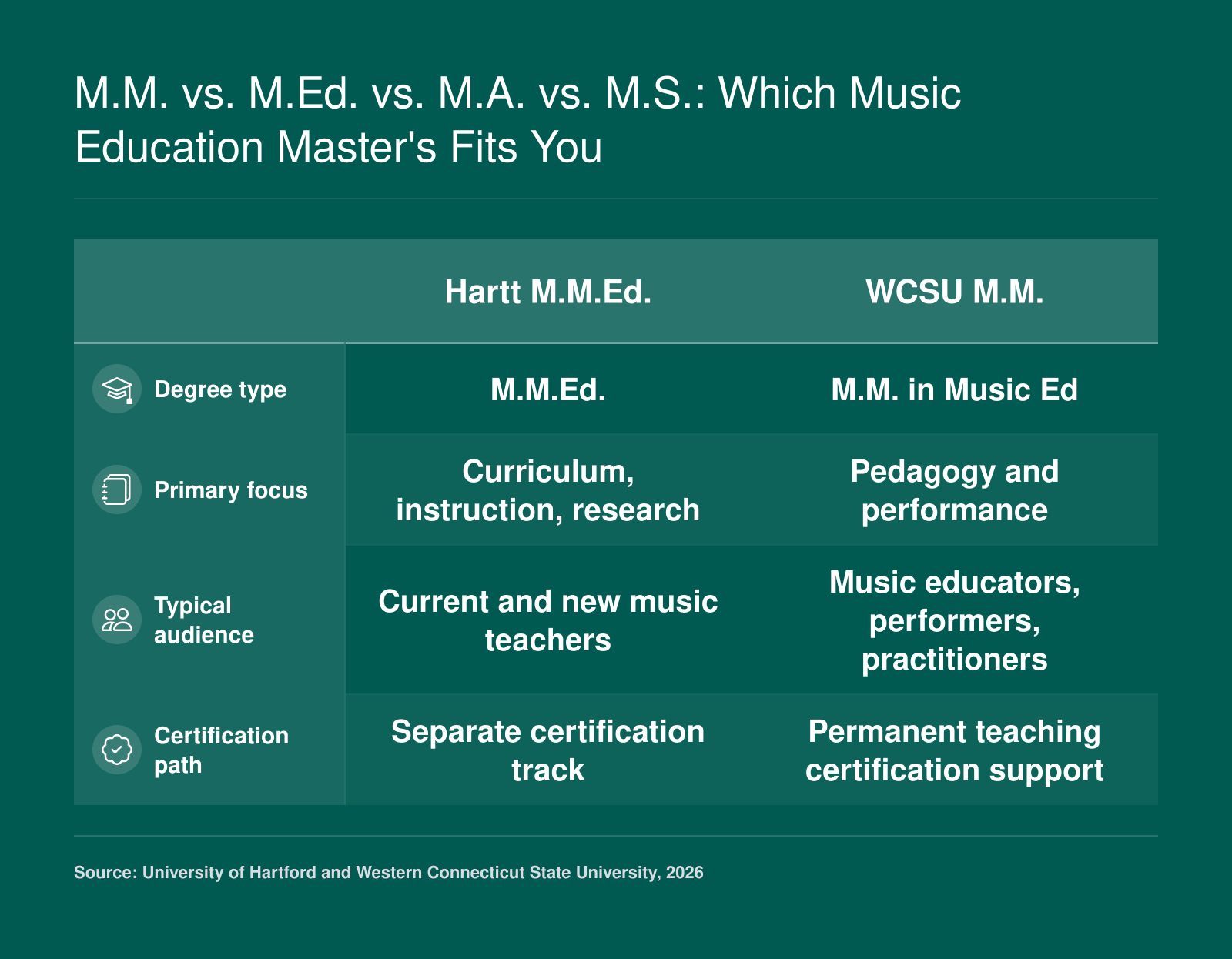
M.M. vs. M.Ed. vs. M.A. vs. M.S.: Which Music Education Master's Fits You
Search results for Connecticut music education degrees sometimes mix up M.M., M.Ed., M.A., and M.S. labels. Among the Connecticut schools ranked here, Hartford's Hartt School awards the Master of Music Education (M.M.Ed.), while Western Connecticut State University lists its music education degree as a Master of Music (M.M.). The current catalog pages reviewed do not use an M.Ed., M.A., or M.S. title. Certified teachers seeking a salary-lane master's and musicians seeking an initial path to certification may land on different programs.
Master's in Music Education in Connecticut: Common Questions
How long does it take to earn a master's in music education?
Which Connecticut music education master's programs lead to teacher certification?
Can I keep teaching full time while completing the degree part time or over summers?
Does a master's in music education raise a Connecticut teacher's salary step?
Compare Music Education programs on the data that matters
Explore more Education & Teaching specializations or browse every graduate field.
All Education & Teaching programs