Best Master's in Music Education Programs in Florida
Compare 6 accredited Music Education programs in Florida at 5 schools, with graduate earnings, cost, debt, and completion data from IPEDS and the U.S. College Scorecard.

University of Miami's music education master's expects applicants to already hold music teacher certification and typically have several years in the classroom. Others, like UF's online program, are built around working teachers' schedules. That split matters: a Florida master's in music education serves either certified teachers pursuing advancement or musicians looking for a route into teaching, and the program's purpose decides which school fits.
Campus, hybrid, and online programs appear together here, with tuition running from roughly $10,000 to over $46,000 a year.
Most of these degrees are advanced credentials, not initial-licensure routes, so verify certification pathways before applying.
Key Points
- UF's online Master of Music in Music Education costs $600 per credit for 2025-26.
- Only some schools state in writing that the GRE is waived or optional.
- Most programs advance existing teachers and aren't confirmed initial-certification tracks, so verify with each school.
Ranking the Best Master's in Music Education Schools in Florida
Florida's master's in music education options range from a fully online degree to summer-residency and traditional campus formats. Accreditation is noted only where we could confirm it, and the graduation rates cited are institution-wide, not program-specific.
University of Florida
#1Gainesville, FL · ~$13,000/yr (est.)
Best for: Online learners wanting asynchronous flexibility
The University of Florida in Gainesville offers a 33-credit online Master of Music in Music Education built for practicing teachers who want to keep working while they study. Courses are asynchronous, with three start dates a year and no entrance exam required. NASM and CAEP accreditation is confirmed for UF's music education programs, and the university's institution-wide graduation rate is about 91%. Its capstone is offered every semester, which makes the final project easier to fit around a teaching schedule.
- 33 total credit hours, typically a two-year path
- 100% online with asynchronous classes
- Three start dates a year: fall, spring, and summer
- No entrance exam required
- Generally requires a 3.0 undergraduate GPA and teaching experience
- Capstone semester offered every semester
- Covers ensemble direction, general music, and collegiate teaching
- Listed at $600 per credit hour
Florida State University
#2Tallahassee, FL · ~$11,000/yr (est.)
Best for: Full-time teachers studying only in summers
Florida State University in Tallahassee runs a summers-only Master of Music Education aimed at working educators who cannot leave their classrooms during the school year. The degree is one program with two tracks, Choral and Instrumental, sharing the same three-summer structure. The third summer is spent at FSU's Study Centre in London, a distinctive feature among Florida options. The university's institution-wide graduation rate is about 86%.
- Choral track: conducting, rehearsal strategies, and vocal technique
- Three six-week summer sessions, completed over three summers
- Two summers in Tallahassee, third at the London Study Centre
- Personalized independent study component
- Part-time enrollment available
- Instrumental track of the same summer-only degree
- Full-time and part-time options
- Coursework covers theory, history, and pedagogy
- Application deadline is March 1 for summer entry
- Designed for practicing music educators
University of South Florida
#3Tampa, FL · ~$10,000/yr (est.)
Best for: Action-research minded K-12 teachers
The University of South Florida in Tampa delivers its Master of Arts in Music Education at a distance, mixing synchronous online meetings with asynchronous coursework. It is written for practicing K-12 music teachers and emphasizes learner-centered and informal pedagogy alongside hands-on research methods. USF's institution-wide graduation rate is about 77%. It is a strong fit for teachers who want to study their own classrooms as part of the degree.
- Totally at-a-distance delivery
- Blends synchronous meetings with asynchronous coursework
- Intended for practicing K-12 music teachers
- Focus on learner-centered and informal pedagogy
- Develops action research skills through research techniques coursework
University of Miami
#4Coral Gables, FL · ~$47,000/yr (est.)
The University of Miami's Frost School of Music in Coral Gables offers an on-campus Master of Music in Music Education for experienced teachers. Students typically arrive with several years of classroom experience and music teacher certification, and the curriculum is customized to either a research or practical orientation. Miami is a private university with the highest sticker price among the ranked schools, so weigh that against its smaller, individualized format. Its institution-wide graduation rate is about 84%.
- On-campus program at the Frost School of Music
- Applicants typically hold music teacher certification
- Several years of teaching experience typical
- Research or practical focus options
- Curriculum customized to student interests
- Prepares graduates for K-12, preschool, and community music roles
University of North Florida
#5Jacksonville, FL · $10,000 – $15,000/yr (est.)
The University of North Florida in Jacksonville offers an on-campus Master of Music Education with a concentration in Pedagogy and Research. The curriculum is structured around foundation courses, a music education core, a faculty-guided cognate, and a capstone with an oral examination. UNF's institution-wide graduation rate is about 69%, the lowest of the ranked schools, so it suits students prioritizing a research-oriented, campus-based degree.
- 9-credit foundation in bibliography, music history, and music theory
- 15-credit core in music education history, philosophy, research, and psychology of music
- 3-credit cognate chosen with music education faculty
- 3-credit capstone including a comprehensive oral examination
- Graduate music history or theory courses may substitute with approval
Cost & outcomes by school
Federal data for the highest-earning Music Education programs, independent of the ranking above. Earnings are this field's master's graduates four years after completing, where the Scorecard reports them.
| School | Earnings | Tuition / yr | Debt | Grads/yr | Format |
|---|---|---|---|---|---|
| Florida State University FL | $66,411 | $10,553 | $25,060 | 52 | Hybrid |
| University of Florida FL | $62,447 | $12,737 | $29,188 | 138 | Online |
| University of South Florida FL | $57,164 | $10,428 | $36,034 | 56 | Online |
| University of North Florida FL | — | $10,364 | — | 6 | Campus |
| University of Miami FL | — | $46,870 | — | 1 | Campus |
Sources: U.S. Department of Education. Tuition and graduates: IPEDS. Earnings and debt: College Scorecard, this field's master's graduates; a dash means no figure is reported.
Cost, debt & payoff
Median earnings of this field's master's graduates (4 yrs after completing) vs. their median federal loan debt · U.S. College Scorecard
Across these programs the median graduate earns about $64,429 and finishes with roughly $27,124 in debt — a ratio that clears a common rule of thumb (keep debt below first-year salary). Tuition and debt vary widely school to school, so check the per-school figures in the table above before you shortlist.
Online and Hybrid Master's in Music Education Options in Florida
Which Florida master's in music education programs can a full-time band or chorus director actually finish without leaving the classroom? Only a few, and the delivery formats differ more than the marketing suggests.
- Fully online: Among Master's Programs in Florida, UF's online M.M. in Music Education runs 33 credits over about two years, asynchronously, with no on-campus requirement. USF's M.A. in Music Education is delivered at a distance with both synchronous and asynchronous coursework; beyond that, residency details are not spelled out in its published materials.
- Hybrid, but genuinely in person: FSU's Summer Master of Music Education is built around three six-week summer sessions, two in Tallahassee and the third in London, and includes applied lessons and conducting on site.1
- Campus-based: The programs at Miami and UNF are taught in person.
The trade-off is straightforward. Online study fits certified teachers who need to keep working. Campus and summer-residency formats put you back in front of an ensemble, in a conducting lab, and in range of graduate assistantships.
Florida Master's in Music Education Programs That Waive or Make the GRE Optional
Assuming the GRE is waived is easy, but only some schools here say so in writing, see master's programs with no GRE required for national options.
- University of Florida: Not required for the Master of Music in Music Education, on campus or online, according to the UF School of Music Music Education Graduate Admissions page. Applicants need a music or music education bachelor's degree and K-12 teaching experience.
- Florida State University: The FSU Graduate School Master's Degree Programs page says it is currently waiving the GRE for most master's and specialist programs. Its pages do not confirm whether the music education master's is covered or whether scores are optional, so contact [email protected] or (850) 644-6102.
- University of North Florida: The School of Music does not require the GRE, but the program page lists a GRE institutional code without stating a policy. That mismatch is moot for now, since the program is closed to new applicants as of Fall 2026.
- University of South Florida: Has no published GRE policy.
- University of Miami: Has no published GRE policy.
For schools without a stated policy, ask the admissions office before you apply.
Related Articles
Florida Master's in Music Education Tuition: In-State vs Out-of-State
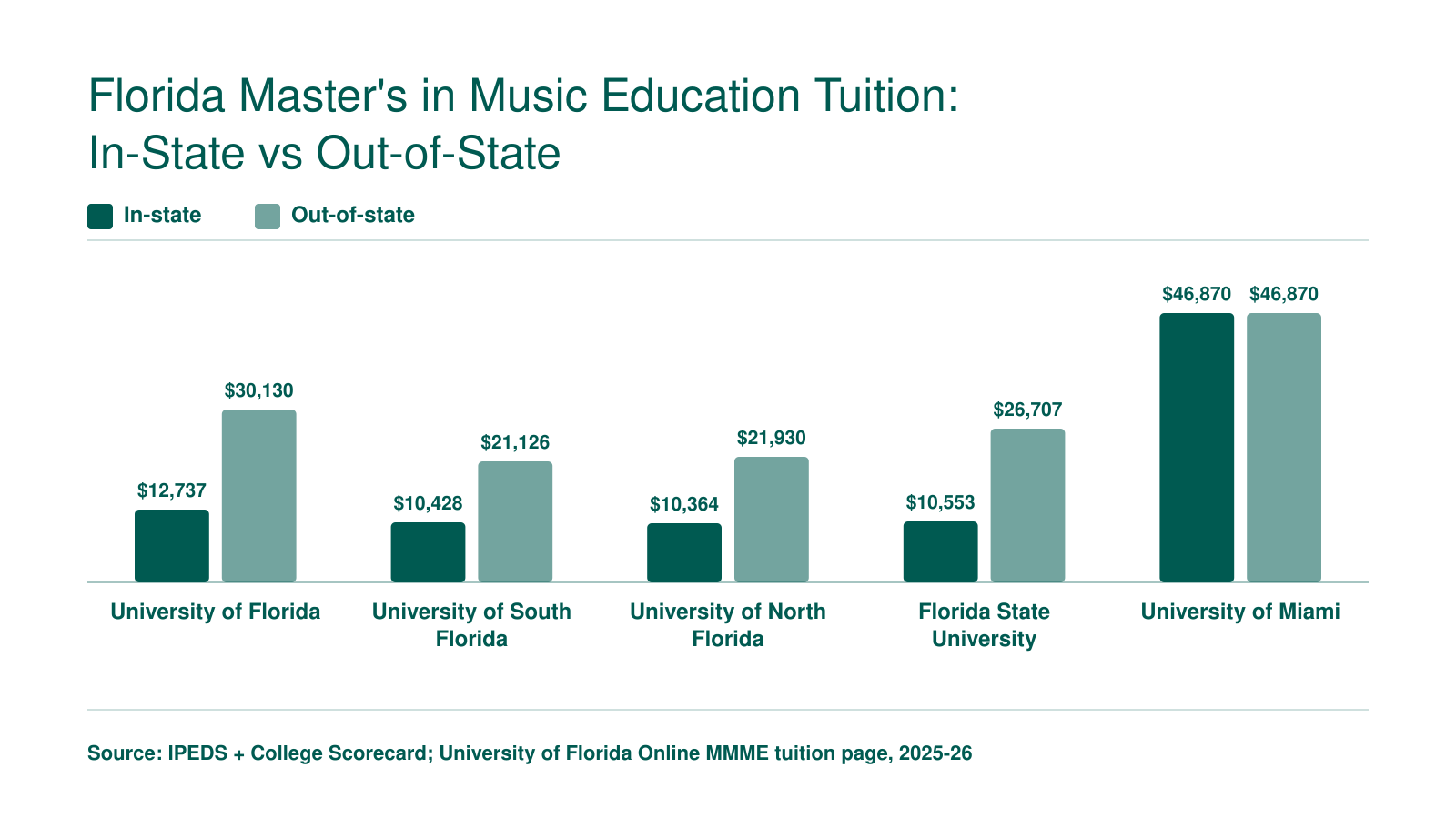
The bars show annual in-state and out-of-state tuition and fees for each school's music education master's, drawn from federal data, so treat them as estimates rather than program quotes. For 2025-26, UF's online MMME costs $600 per credit plus $35.75 in fees across 33 credits, about $20,980 in total, with no separate out-of-state rate. UF's on-campus rate is $448.73 plus $81.96 in fees per credit, about $17,489 for the same 33 credits, so online rates can differ from campus rates and some online programs charge out-of-state students a flat e-tuition rate. Net price is an institution-wide average after aid, not a program quote, and per-credit totals for the other schools should be confirmed with each bursar.
Does a Master's in Music Education Lead to Florida Teacher Certification?
Career and Salary Outcomes for Florida Music Education Master's Graduates
Program-level earnings and federal debt figures are not yet published for these master's in music education programs, so the table shows only what the U.S. Department of Education reports for each school as a whole. Treat those debt figures as institution-wide context, not as what a music education graduate borrows. Most Florida music teachers are paid on district salary schedules, and a master's degree often adds a district supplement, so your actual raise depends on the district where you teach.
| School | Program | Format | Whole-school median federal debt (context only) |
|---|---|---|---|
| University of Miami | Master of Music in Music Education (M.M.) | Campus | $17,500 |
| University of Florida | Master of Music in Music Education | Online | $15,000 |
| Florida State University | Master of Music Education (Choral) | Hybrid | $18,000 |
| University of South Florida | Master of Arts in Music Education | Online | $17,988 |
| University of North Florida | Music Education (Pedagogy and Research) | Campus | $15,531 |
Florida Master's in Music Education FAQs
How long does a master's in music education take in Florida?
Can I become a music teacher in Florida without an undergraduate music education degree?
Does earning a master's raise a Florida teacher's pay?
Can out-of-state teachers use a Florida master's toward Florida certification?
Compare Music Education programs on the data that matters
Explore more Education & Teaching specializations or browse every graduate field.
All Education & Teaching programs