Best Master's in Music Education Programs in Virginia
Compare 10 accredited Music Education programs in Virginia at 6 schools, with graduate earnings, cost, debt, and completion data from IPEDS and the U.S. College Scorecard.

Virginia licenses music teachers under two PreK-12 endorsements, Vocal/Choral and Instrumental, and many school divisions pay master's holders on a higher salary step.
The master's programs below rank campus and online options together, from George Mason University's online Master of Music to Virginia Tech's cohort-based campus track. Price spreads widely: Liberty University charges $8,730 in tuition and fees, while out-of-state students at George Mason pay $40,308.
Most of these degrees advance already-licensed teachers rather than grant a first license, which career changers should confirm before applying.
Key Points
- Liberty University is the lowest-cost option here at $8,730 in tuition and fees.
- George Mason University and Liberty University are the clear online choices among the schools ranked here.
- Most master's programs serve licensed teachers, and Virginia licensure requires a Praxis 5113 score of 160.
Best Master's in Music Education Programs in Virginia, Ranked
These six Virginia schools are ordered by what graduates earn, what the degree costs, institution-wide graduation rate, and whether you can study on campus, online, or both. Graduation rates describe the whole school, not the music education program. Programs differ sharply on licensure, so check that detail before you apply.
Virginia Polytechnic Institute and State University
#1Blacksburg, VA · ~$19,000/yr (est.)
Best for: Career changers seeking initial Virginia licensure
Virginia Tech in Blacksburg offers a campus-based M.A.Ed. in Music Education that leads to Virginia licensure in choral or instrumental music. It combines a cohort model with extensive field experiences and teaching simulations, and the school reports a five-year record of 100% job placement. Virginia Tech's institution-wide graduation rate is about 86%, the highest among these six schools. An accelerated 3+1 or 4+1 pathway also exists for students moving from undergraduate music teacher preparation.
- Prepares students for Virginia music education licensure in choral or instrumental music
- Approved by the Virginia Department of Education; CAEP accredited
- Two concentration options and a cohort-based structure
- Field experiences and teaching simulations built into the plan of study
- Virtual options available for non-local learners
- Prepares for the Praxis II; includes internship and student teaching
- Prerequisite courses and a capstone are required
George Mason University
#2Fairfax, VA · $15,000 – $20,000/yr (est.)
Best for: Working teachers needing online flexibility
George Mason University in Fairfax offers a 30-credit Master of Music in Music Education designed for practicing teachers who keep working while they study. It is the only school here with a fully online option plus hybrid Orff and Kodaly tracks that meet on campus in summers. Students can choose a thesis or non-thesis capstone. Mason's institution-wide graduation rate is about 68%.
- 30 credit hours with a thesis or capstone option
- Fully online degree for practicing music educators
- Coursework in music psychology, analytical techniques, history and research methods
- Designed and taught by Mason faculty
- Hybrid online and on-campus coursework
- On-campus portion completed over three summers
- Starts in the summer term
- Thesis and non-thesis options
- 30 credit hours, hybrid with on-campus summers
- Orff coursework spread over three summers
- Starts in the summer term
- Thesis and non-thesis options
Liberty University
#3Lynchburg, VA · ~$9,000/yr (est.)
Best for: Faith-centered students wanting a conducting track
Liberty University in Lynchburg offers a 39-credit Master of Arts in Music Education aimed at current educators, available residentially or online. Students can build the degree around Conducting, Music Studies, or Performance, and the curriculum is explicitly Christ-centered. Up to 75% of the degree can transfer in. Liberty's institution-wide graduation rate is about 65%.
- 39 credit hours; accredited by the National Association of Schools of Music
- Three concentrations: Conducting, Music Studies, Performance
- Residential or online format
- Transfer up to 75% of the degree
- Built for practicing music educators
- Scholarships available
- 39 credit hours with a thesis or capstone option
- Also available online
- Careers include K-12 educator and music education supervisor
- Financial aid and scholarships available
Hampton University
#4Hampton, VA · $10,000 – $15,000/yr (est.)
Hampton University in Hampton offers a Master of Teaching in Secondary Education in Music for PreK-12 instrumental and vocal teaching. It is a teacher-preparation degree rather than a standard music master's, so it suits career changers more than current teachers. The 150-credit total combines 30 graduate credits with 120 undergraduate credits. Hampton's institution-wide graduation rate is about 57%.
- 30 graduate credits plus 120 undergraduate credits (150 total)
- Includes a 9-credit student teaching internship in Music PK-12
- Directed practicum in secondary education
- Prepares you to direct bands, orchestras and choirs
- Coursework in classroom management, reading in content areas and assessment
Old Dominion University
#5Norfolk, VA · $15,000 – $36,000/yr (est.)
Old Dominion University in Norfolk offers a campus-based Master of Music Education with concentrations in Applied Studies, Research, and Pedagogy. It is a strong fit for teachers who already hold licensure and want advanced development, since the degree does not include Virginia teacher licensure. ODU's institution-wide graduation rate is about 46%. Multiple entry terms are listed through the year.
- 34 semester hours with a 17-credit music education core
- Concentrations: Applied Studies, Research, Pedagogy
- Does not include Virginia teacher licensure
- Requires a 3.0 GPA; no audition for the Pedagogy concentration
- Music theory placement test and written comprehensive exam required
- Declare a concentration before completing 12 credits
Norfolk State University
#6Norfolk, VA · ~$13,000/yr (est.)
Norfolk State University in Norfolk offers an in-person Master of Music with a Music Education concentration, accredited by the National Association of Schools of Music. Full-time and part-time schedules suit working professionals, and the graduate school points applicants to full-tuition graduate assistantships. NSU's institution-wide graduation rate is about 38%, so ask the department about completion in this program. Applications are due May 1 for fall and November 1 for spring.
- 36 credit hours; accredited by the National Association of Schools of Music
- Full-time and part-time options with fall and spring starts
- Full-tuition graduate assistantships available
- Hands-on work in area classrooms and rehearsal halls
- Prepares for DMA or Ph.D. study
- Music media lab and recording studio
Cost & outcomes by school
Federal data for the highest-earning Music Education programs, independent of the ranking above. Earnings are this field's master's graduates four years after completing, where the Scorecard reports them.
| School | Earnings | Tuition / yr | Debt | Grads/yr | Format |
|---|---|---|---|---|---|
| Old Dominion University VA | $65,354 | $15,390 | $20,500 | 18 | Campus |
| George Mason University VA | $61,859 | $17,964 | — | 9 | Online |
| Liberty University VA | $57,678 | $8,730 | $32,189 | 101 | Online |
| Virginia Polytechnic Institute and State University VA | $56,901 | $18,564 | — | 9 | Campus |
| Norfolk State University VA | — | $13,412 | — | — | Campus |
| Hampton University VA | — | $13,776 | — | — | Campus |
Sources: U.S. Department of Education. Tuition and graduates: IPEDS. Earnings and debt: College Scorecard, this field's master's graduates; a dash means no figure is reported.
Cost, debt & payoff
Median earnings of this field's master's graduates (4 yrs after completing) vs. their median federal loan debt · U.S. College Scorecard
Across these programs the median graduate earns about $59,769 and finishes with roughly $32,189 in debt — a ratio that clears a common rule of thumb (keep debt below first-year salary). Tuition and debt vary widely school to school, so check the per-school figures in the table above before you shortlist.
Online and Hybrid Master's in Music Education Options in Virginia
Which Virginia master's programs in music education can I actually complete online? The answer is narrow. George Mason University and Liberty University are the clear online choices among the ranked programs. George Mason's M.M. in Music Education offers thesis and non-thesis paths delivered 100% online, starting August 24, 2026. Applicants file through the university application plus SlideRoom. Mason also has hybrid Kodály, Orff, and Jazz concentrations for students wanting some on-campus work. Liberty lists full-time online and on-campus M.A. options, though its admissions pages do not specify a separate online residency component. Virginia Tech, Old Dominion University, Hampton University, and Norfolk State University appear campus-based, and their materials do not establish a fully online track for working music teachers. Norfolk State lists fall and spring starts, with application deadlines of May 1 for fall and November 1 for spring. The fully online choices in Virginia are limited, so if you need a program you can complete without relocating or leaving a teaching job, compare George Mason and Liberty before considering hybrid or on-campus alternatives.
Virginia Music Education Master's Programs That Waive the GRE
Liberty University and the University of Virginia state that the GRE is not required, and the University of Virginia lets applicants submit scores if they choose. Old Dominion University, George Mason University, and Shenandoah University do not publish a GRE policy on the admissions pages reviewed, so confirm with the program before assuming a waiver. Where requirements are published, programs lean on auditions, repertoire lists, essays, and teaching experience rather than test scores.
| School | GRE Policy | Key Requirements | Application Deadline |
|---|---|---|---|
| Liberty University (Master of Music Education) | Not required (the university states no GRE is needed for its online master's degrees) | Official college transcripts or a transcript-request form; check the Music Education program page for program-specific requirements | Not published |
| University of Virginia (Music Education master's pathway) | Not required (applicants may optionally submit scores) | Official transcripts; international applicants whose first language is not English must self-report valid TOEFL or IELTS scores | Not published |
| Old Dominion University (M.M.E.) | Not published | Bachelor's degree in music; 3.00 GPA overall and in the major; résumé; essay on current music involvement and professional aspirations; two reference letters; repertoire list for applied studies, conducting, or vocal concentrations; performance audition for the Applied Studies option | Not published |
| George Mason University (Master of Music in Music Education) | Not published | University application and School of Music SlideRoom submission; goals statement of one to two pages; Philosophy of Music Education statement; two recommendation letters; transcripts; résumé; audition registration; TOEFL for applicable international applicants | Not published |
| Shenandoah University (Master of Music Education) | Not published | Most applicants hold a bachelor's degree in music education or are licensed teachers; at least one year of elementary or secondary teaching experience; audition information provided | Not accepting applications currently |
Related Articles
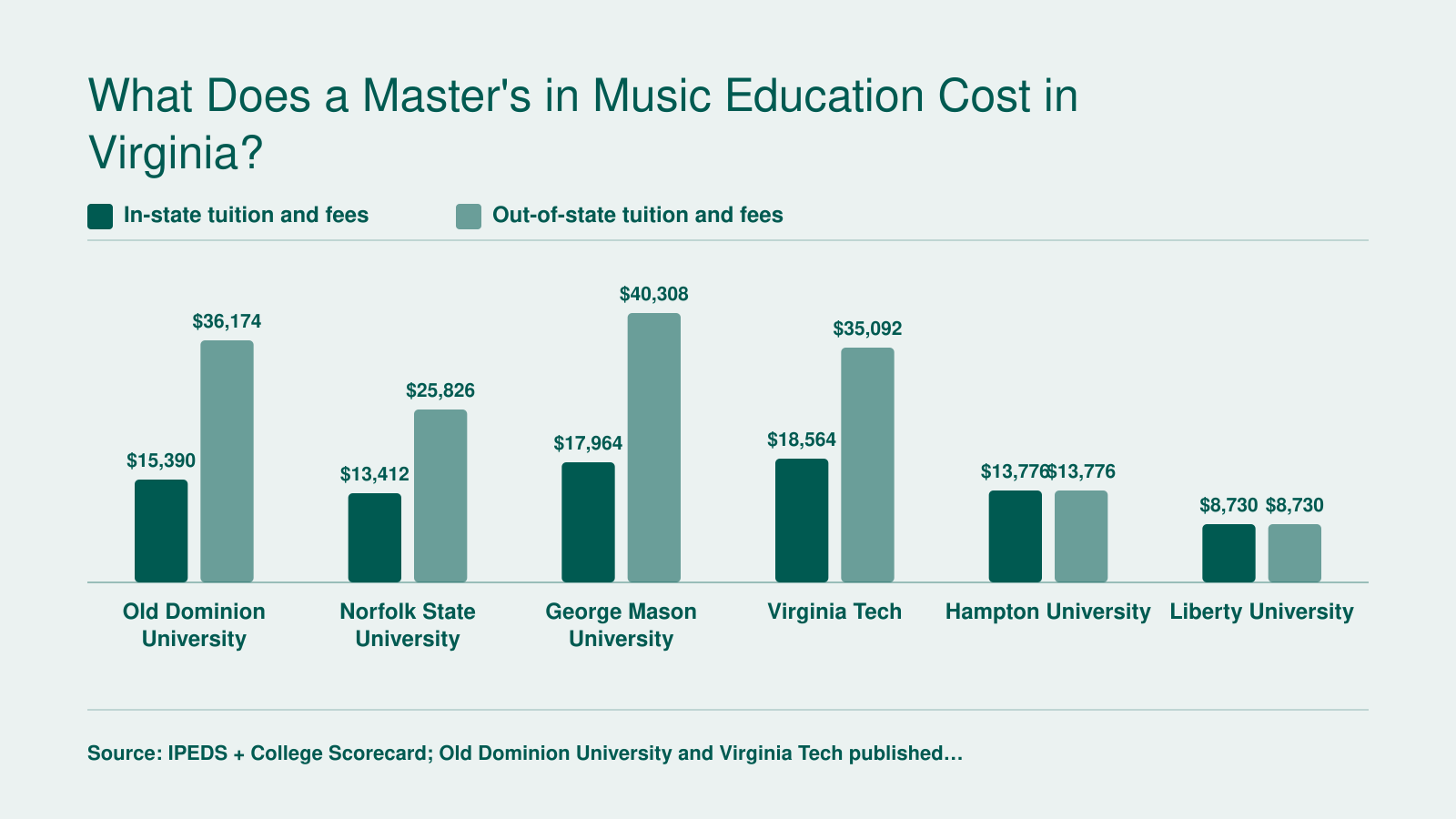
What Does a Master's in Music Education Cost in Virginia?
Liberty University is the lowest-cost option here at $8,730 in tuition and fees, and the private schools charge the same rate regardless of residency. Hampton University, also private, is $13,776, while public in-state figures run from $13,412 at Norfolk State to $18,564 at Virginia Tech. Out-of-state students at public schools pay far more, up to $40,308 at George Mason. For a total-cost estimate, use published rates. Old Dominion lists $510 per credit in-state, $1,361 out-of-state, and $662 online for a degree of at least 34 credits. That is about $17,340 in-state before fees, books, and housing, which are excluded from those rates. Virginia Tech's listed components total 39 credits, and its 2026 summer tuition is $997.75 for 1-3 credits. No required summer residency or lodging fees were confirmed for these programs. Net price in federal data is an institution-wide average after aid, not a quote for graduate students.
Virginia Music Teacher Licensure at a Glance
Does a Master's in Music Education Lead to Virginia Licensure?
Will earning a master's in music education automatically qualify you to teach in Virginia public schools? In most cases, no.
Most M.M.E. programs serve already-licensed teachers, not career changers. Old Dominion University's Master of Music Education is advanced study only and does not include Virginia licensure. Virginia Tech's M.A.Ed. in Music Education is a VDOE-approved initial licensure pathway for choral or instrumental certification and includes student teaching for applicants with a bachelor's in music.2 Virginia Tech also has 4+1 and 3+1 options leading to K-12 licensure.3 At George Mason University, initial licensure is a collaborative graduate program, not automatically the standalone master's, so confirm which pathway you enter.4
For licensed Virginia teachers, a master's can support the Postgraduate Professional License, a 10-year renewable license requiring an accredited graduate degree after the Collegiate Professional License.1 Renewal requires 270 professional development points under an individualized plan; coursework is not required.1 Many divisions pay teachers with a master's more, but that varies by district.
Out-of-state online students should check reciprocity rules before relying on a Virginia-approved pathway. Virginia program approval does not guarantee licensure elsewhere or a Virginia license by itself.4 A master's alone does not replace initial licensure requirements, endorsement exams, or assessments.1
How to Choose the Right Music Education Master's Program
Choosing among Education & Teaching Master's Programs in music education usually comes down to one tradeoff: keeping your teaching job while you study versus choosing the format and specialization that build the strongest classroom skills.
Start with accreditation. Liberty University and Norfolk State University list National Association of Schools of Music (NASM) accreditation for their music units1, and Virginia Tech's music education program notes CAEP and Virginia Department of Education educator preparation alignment. Virginia expects professional education programs to hold CAEP accreditation2, so verify both music-unit and educator-preparation status before enrolling.
Then weigh specialization and fit. Virginia Tech offers choral or instrumental concentrations, Hampton University offers PreK-12 instrumental/vocal, and Old Dominion University lists a pedagogy concentration. George Mason's online program includes summer coursework, while Virginia Tech and Old Dominion are campus-based, so a full-time teaching contract may push you toward online master's programs or summer-only options. Program-level earnings for these music education specializations are not yet published, so do not use institution-wide graduate earnings as a stand-in.
Frequently Asked Questions About Music Education Master's in Virginia
How long does a master's in music education take in Virginia?
Can I earn a master's in music education while teaching full time in Virginia?
Will a master's degree raise my pay as a Virginia music teacher?
Compare Music Education programs on the data that matters
Explore more Education & Teaching specializations or browse every graduate field.
All Education & Teaching programs