Best Master's in Music Education Programs in Texas
Compare 28 accredited Music Education programs in Texas at 16 schools, with graduate earnings, cost, debt, and completion data from IPEDS and the U.S. College Scorecard.

A master's in music education in Texas usually pairs a tuition bill with longer-term payoff: deeper pedagogy, leadership eligibility, and district salary stipends. In-state graduate tuition among these programs runs about $6,000 at UTEP to $12,000 at UT Austin; out-of-state rates often run near double that.
The sharper tradeoff is schedule. Campus cohorts, hybrid work like Texas Tech's, and EC-12 certification alignment each fit a full-time teaching load differently. For many teachers, the credential matters less than whether the format lines up with the calendar they already keep.
Key Points
- Texas Tech offers the only hybrid Master of Music Education here, with no GRE.
- In-state tuition at Texas A&M University-Kingsville and UTEP roughly halves the nonresident bill.
- Texas music certification requires passing TExES Music EC-12 (177) and PPR EC-12 (160).
Top 10 Master's in Music Education Schools in Texas
These ten Texas universities offer a master's in music education, on campus or with a hybrid option. Where our research confirmed regional and NASM accreditation, we note it on the card. Where it did not, we say so rather than assume.
The University of Texas at Austin
#1Austin, TX · ~$12,000/yr (est.)
Best for: Aspiring researchers wanting thesis-based study
UT Austin pairs a research-oriented, two-year thesis track with a flagship university whose institution-wide graduation rate is about 89%. The degree is titled Master of Music in Music and Human Learning rather than a degree named music education, so confirm it fits your certification and career goals. Its SACSCOC and NASM status are both confirmed, though NASM lists the degree under the Music and Human Learning title.
- Two-year program, 30 total credit hours
- Thesis work over two semesters (MUS 698A and 698B)
- Comprehensive exam, recital, and master's report required
- Core courses include Foundations of Music Education
- Up to three hours of coursework outside music
- Up to six graduate credits may transfer
- Full-time enrollment (9+ hours) required for assistantships and fellowships
Texas Christian University
#2Fort Worth, TX · $35,000 – $40,000/yr (est.)
Best for: Aspiring band, choir, and orchestra directors
TCU is a private university in Fort Worth with an institution-wide graduation rate of about 86%. Its Master of Music Education is built for practicing musicians and educators who want advanced specialization, with coursework in the psychology of music, music theory, and the philosophy of music education. TCU's SACSCOC and NASM status are both confirmed.
- Campus-based advanced specialization in music education
- Coursework in psychology of music, theory, and philosophy of music education
- Separate School of Music graduate application and audition process
- TCU reports 100% of its music education majors find positions
- Career paths: elementary specialist, ensemble director, private instructor
- Study with faculty and visiting guest artists
Southern Methodist University
#3Dallas, TX · ~$37,000/yr (est.)
Best for: Working teachers needing part-time scheduling
SMU's Meadows School of the Arts offers a Master of Music in Music Education with several concentrations, including Elementary Music, Choral, and Instrumental. The 30-credit degree runs four full-time semesters or part-time for working teachers, and admission requires an interview rather than an audition. Institution-wide graduation rate is about 84%. We did not confirm NASM status for this program, so verify it with the school.
- 30 credit hours, four full-time semesters or a part-time track
- No audition; interview with music education faculty
- Coursework in history, philosophy, and research design
- Reduced-tuition Master Educator plan for working educators
- Merit scholarships and graduate assistantships available
- Choral concentration within the 30-credit degree
- Assistantships and work-study available
- Prepares students for doctoral-level study
- Full-time or part-time enrollment
- Instrumental concentration within the 30-credit degree
- Admission interview required, no audition
- Pathway to doctoral studies
- Reduced tuition available for music educators
The University of Texas Rio Grande Valley
#4Edinburg, TX · $5,000 – $10,000/yr (est.)
UTRGV's Master of Music with a music education concentration is one of six concentrations in its School of Music, alongside performance, conducting, and theory-composition. The school's institution-wide graduation rate is about 51%. Curriculum and admission details are in the full degree plan, so check the catalog. We did not confirm NASM status for this program in our research.
- One of six concentrations in the School of Music
- Campus-based graduate study
- Serves K-12, community, and higher education music teaching
- Full curriculum and admission details listed in the graduate catalog
Texas Tech University
#5Lubbock, TX · $5,000 – $10,000/yr (est.)
Texas Tech offers a Master of Music Education with synchronous and asynchronous options, plus full-time in-residence study, so practicing teachers can keep working. Students choose a 30-hour thesis plan or a 36-hour non-thesis plan. Institution-wide graduation rate is about 69%. We did not confirm NASM status for this program in our research.
- 30-hour thesis or 36-hour non-thesis plan
- Synchronous and asynchronous distance options
- Five required courses plus electives
- Kodály certification elective available
- Personal interview or audition required
- Summer coursework available
- Ensemble and elementary best-practices focus
- Ten concentration options across the degree
- Thesis or capstone option
- Uses MusicFirst, Noteflight, and Google Drive
- Elective emphasis in conducting and Kodály
- Full-time in-residence program available
- Distance option for working music practitioners
- Interview or audition typically required
The University of Texas at San Antonio
#6San Antonio, TX · $10,000 – $29,000/yr (est.)
UTSA offers a campus-based Master of Music with a music education emphasis, a 33-credit degree that ends in comprehensive exams and doubles as preparation for doctoral study. The music education audition includes a teaching video and reflective essay. Institution-wide graduation rate is about 53%. SACSCOC and NASM status are both confirmed.
- 33 total credit hours with comprehensive examinations
- Audition includes a teaching video and reflective essay
- Two letters of recommendation minimum
- Work experience required
- Placement exams in theory, aural skills, and history
- Only courses with B- or higher count toward the degree
The University of Texas at El Paso
#7El Paso, TX · $5,000 – $10,000/yr (est.)
UTEP offers a 32-credit Master of Music with a concentration in education, with thesis and non-thesis tracks. Applicants need a Bachelor of Music degree, an interview with music education faculty, a written teaching philosophy, and two recommendation letters. Institution-wide graduation rate is about 50%. We did not confirm NASM status for this program in our research.
- 32 total credit hours
- Thesis or non-thesis track
- Interview with music education faculty required
- Requires a Bachelor of Music degree
- Two letters of recommendation minimum
- All courses require a B or better
- Applied lessons over two semesters
University of North Texas
#8Denton, TX · $9,000 – $16,000/yr (est.)
UNT's Master of Music Education offers a teaching emphasis for school music teachers and a research emphasis for those eyeing doctoral study or college teaching. A summers-only option lets working teachers finish in three summers. Institution-wide graduation rate is about 61%. SACSCOC and NASM status are both confirmed.
- 34 credit hours, completed in two to three years
- Built for current school music teachers
- Summers-only option for working teachers
- Full-time and part-time options
- Comprehensive exam plus thesis or project practicum
- Prepares for Ph.D. study or college teaching
- Faculty publish in peer-reviewed journals
- Applied research and psychology of music coursework
- Thesis or capstone option
Texas Woman's University
#9Denton, TX · ~$9,000/yr (est.)
Texas Woman's University in Denton offers a Master of Music in Music Education for practicing band, choir, orchestra, and general music teachers. A separate track adds EC-12 Texas teacher certification, which matters if you need a licensure route. Institution-wide graduation rate is about 49%. We did not confirm NASM status for this program in our research.
- Practical and theoretical perspectives on teaching
- Advanced study in teaching methods
- Psychological and philosophical foundations
- Serves elementary and secondary music teachers
- Leads to Texas teacher certification
- Prepares elementary music specialists
- Prepares band, orchestra, and choir directors
- Instrumental or vocal music teaching
The University of Texas at Arlington
#10Arlington, TX · ~$11,000/yr (est.)
UT Arlington's Master of Music in Music Education helps practicing teachers become more reflective practitioners, with small-program attention inside a large R-1 institution. Applicants submit three recommendation letters and a one-page philosophy of music education. Institution-wide graduation rate is about 54%. We did not confirm NASM status for this program in our research.
- Three recommendation letters required
- One-page philosophy of music education required
- Prepares for doctoral study through advanced research
- Careers: K-12 ensemble educator, fine arts administrator, adjunct instructor
- Financial aid and scholarships available
Cost & outcomes by school
Federal data for the highest-earning Music Education programs, independent of the ranking above. Earnings are this field's master's graduates four years after completing, where the Scorecard reports them.
| School | Earnings | Tuition / yr | Debt | Grads/yr | Format |
|---|---|---|---|---|---|
| The University of Texas at San Antonio TX | $61,855 | $10,116 | $34,137 | 6 | Campus |
| Texas Tech University TX | $59,564 | $9,518 | — | 30 | Hybrid |
| Texas State University TX | $59,180 | $8,997 | $25,473 | 23 | Hybrid |
| Dallas Baptist University TX | $59,160 | $25,862 | $41,448 | 9 | Online |
| Tarleton State University TX | $56,646 | $7,527 | $20,848 | 4 | Online |
| Texas Woman's University TX | — | $8,520 | — | 28 | Campus |
| The University of Texas Rio Grande Valley TX | — | $8,589 | — | 14 | Campus |
| Texas A&M University-Kingsville TX | — | $6,157 | — | 4 | Campus |
| University of North Texas TX | — | $9,091 | — | 12 | Campus |
| The University of Texas at El Paso TX | — | $7,166 | — | 3 | Campus |
| Stephen F. Austin State University TX | — | $7,829 | — | — | Online |
| Lamar University TX | — | $8,642 | — | 2 | Online |
Sources: U.S. Department of Education. Tuition and graduates: IPEDS. Earnings and debt: College Scorecard, this field's master's graduates; a dash means no figure is reported.
Cost, debt & payoff
Median earnings of this field's master's graduates (4 yrs after completing) vs. their median federal loan debt · U.S. College Scorecard
Across these programs the median graduate earns about $59,564 and finishes with roughly $29,805 in debt — a ratio that clears a common rule of thumb (keep debt below first-year salary). Tuition and debt vary widely school to school, so check the per-school figures in the table above before you shortlist.
Online and Hybrid Master's in Music Education Options in Texas
Fully online study is rare among the master's in music education programs ranked here. Texas Tech University stands alone with a hybrid format. Its Master of Music Education mixes synchronous and asynchronous coursework, includes a distance option built for working practitioners, and offers a Kodály certification elective. That structure fits Texas band, choir, and orchestra directors who can't step away from a teaching contract or move to Lubbock.
Lamar and Texas State offer online master's programs in Texas, and the campus-based programs still involve a real tradeoff, not just a scheduling headache. On-campus study gives you regular ensemble participation, podium time, and face-to-face conducting feedback that remote formats can't fully replicate.
If you need flexibility but want an in-person degree, look for schedules designed around the school year. The University of North Texas offers a summers-only option for working teachers, and Southern Methodist University has a part-time path for practicing music educators. Both let you keep your classroom while still getting live rehearsal and conducting experience.
GRE Requirements at Ranked Texas Music Education Master's Programs
Texas Tech's School of Music does not require the GRE for any graduate music degree, which covers its hybrid Master of Music Education, placing it among No-GRE master's programs.1 For 2026, the ranked programs fall into three groups:
- Not required: Texas Tech and UTSA, whose School of Music does not ask for GRE scores.2
- Optional: TCU, which lists the GRE as optional for students applying in music education.3
- No published policy: UT Arlington's catalog lists letters of recommendation, a philosophy statement, a 3.0 GPA in the last 60 undergraduate hours, and a music bachelor's or equivalent, but says nothing about the GRE. We could not confirm a current policy for UT Austin, SMU, UTRGV, UTEP, UNT, or Texas Woman's University, so contact each department before you book a test date.
Test scores rarely decide a music education admission. UTSA's music education audition includes a teaching video, Texas Tech requires a personal interview or audition, and UTEP interviews applicants with its music education faculty. Put your preparation time into those materials first.
Related Articles
Cost and Texas Licensure for a Master's in Music Education
Residency status will shape your bill more than any school's reputation. Annual graduate tuition at the more affordable public programs here roughly doubles for nonresidents:
- Texas A&M University-Kingsville: about $6,157 in-state vs. $14,560 out-of-state
- UTEP: about $7,166 vs. $16,621
- Stephen F. Austin State University: about $7,829 vs. $15,209
You'll also see average net prices after aid, such as roughly $4,831 at UT Rio Grande Valley and $9,366 at Lamar. Treat these as approximate institution-wide figures, not quotes for a graduate music student.
The Clearest Published Price
Lamar's online M.M. is easiest to budget: $360 per credit and about $10,802 total for its 30-hour program, including the distance fee. Lamar notes the total depends on transfer hours and advising and can change. Texas State charges in-state tuition for its fully online option.
Your Biggest Savings Lever
Graduate assistantships, which often pair a stipend with a tuition waiver or reduction, can cut your real cost far more than choosing the cheapest sticker price. Ask each department directly about availability.
Certification Is Usually Separate
Most of these degrees serve teachers who already hold Texas certification. Texas State expects applicants to be certified2, and Lamar's M.M. does not lead to certification (Lamar handles that through a separate Alternative Certification Program). Texas Woman's University is the exception: its initial K-12 certification option expands the degree from 36 to 45 credits with added coursework and an internship.1
Texas Music Teacher Certification at a Glance
Admission Requirements for Texas Music Education Master's Programs
Requirements vary by school, so confirm details on each department's admissions page before you apply.
- Degree and GPAExpect a bachelor's in music or an equivalent. UT Arlington asks for a 3.0 GPA over the last 60 credit hours. UTEP requires a Bachelor of Music.
- Experience and certificationUTSA lists work experience as required. Some programs expect a Texas teaching certificate or classroom experience, so ask the program advisor if your background differs.
- Audition, video, or interviewSMU requires no audition but schedules an interview. Texas Tech and UTEP use an interview, and Texas Tech also accepts an audition. UTSA's music education audition includes a teaching video. UT Arlington asks for a philosophy essay of up to two pages and three recommendation letters instead.
- Deadlines and fundingUT Arlington's Fall 2026 deadline was July 17, 2026. Check current dates for upcoming cohorts. Assistantship and scholarship consideration is often tied to admission, so apply early. UT Austin ties funding to full-time enrollment.
Career Outcomes for Texas Master's in Music Education Graduates
This table reports program-level median earnings (measured four years after finishing) and program-level median federal debt from IPEDS and College Scorecard (2024), and leaves a cell blank where no program figure is published. We do not substitute institution-wide earnings or debt figures, since those blend every graduate program at a school. Once a debt figure is available, the monthly payment on a standard 10-year repayment plan is the most practical affordability check against a music teacher's salary.
| School | Program |
|---|---|
| Southern Methodist University | Master of Music in Music Education |
| The University of Texas at Austin | Music & Human Learning (Thesis Track) |
| Trinity University | Master of Arts in Teaching, Music Education |
| Texas Christian University | Master of Music Education |
| The University of Texas at Arlington | Master of Music in Music Education |
| Texas Tech University | Master of Music Education |
| The University of Texas at San Antonio | Master of Music, Music Education |
| University of North Texas | Music Education, MMEd |
| Texas State University | Master of Music in Music Education |
| Dallas Baptist University | Master of Music Education |
How Long Does a Master's in Music Education Take?
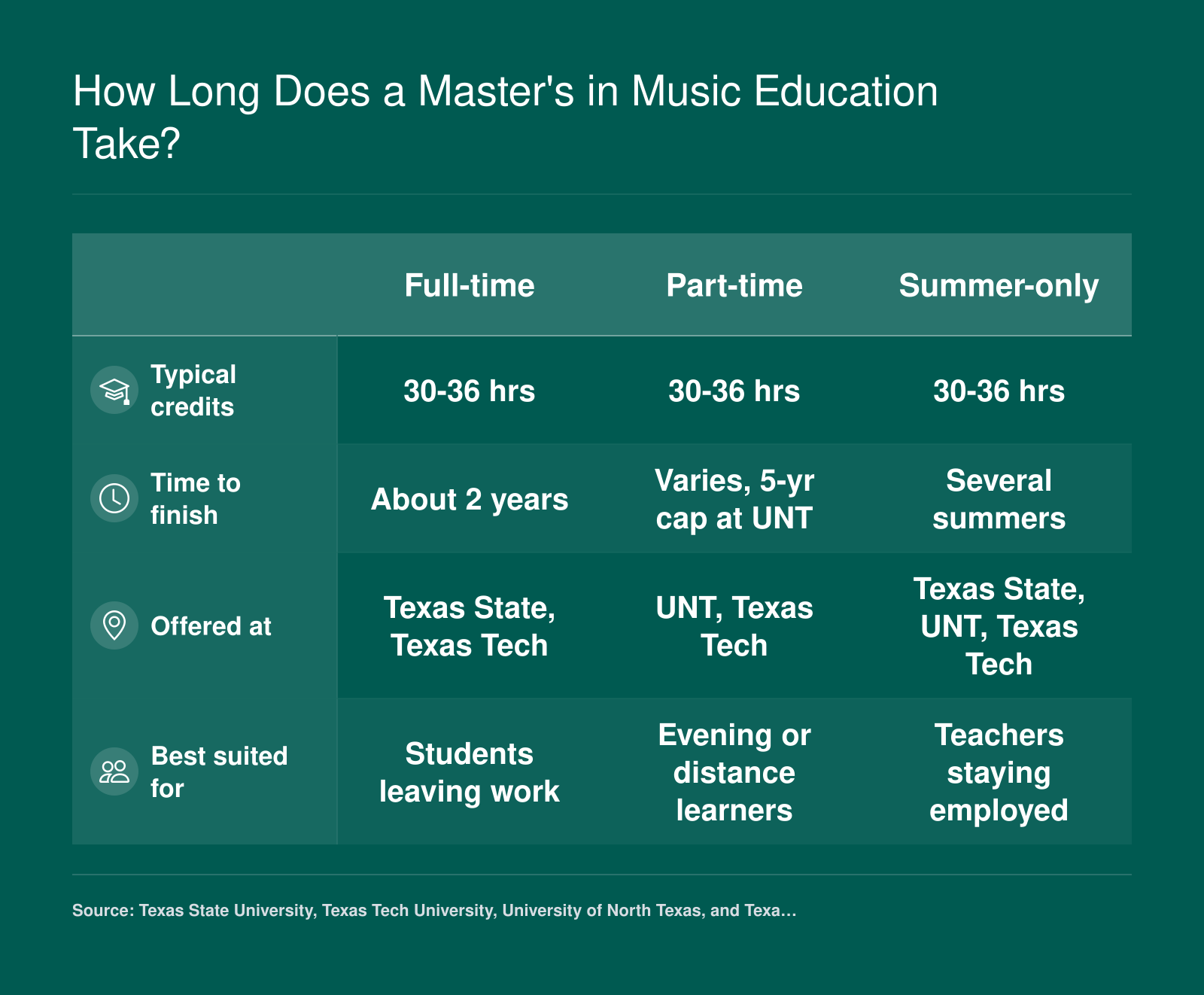
Most master's in music education programs in Texas require roughly 30 to 36 credit hours, and the format you pick sets the timeline. Texas State describes its full-time path as a 2-year Fall and Spring program, while UNT allows part-time students up to 5 years. Summer-only cohorts let working teachers finish without leaving the classroom, though the number of summers varies and you should confirm it with each program.
Compare Music Education programs on the data that matters
Explore more Education & Teaching specializations or browse every graduate field.
All Education & Teaching programs