Best Master's in Music Education Programs in North Carolina
Compare 5 accredited Music Education programs in North Carolina at 3 schools, with graduate earnings, cost, debt, and completion data from IPEDS and the U.S. College Scorecard.

North Carolina band directors and choral teachers who want advanced licensure run into the same scheduling problem: the school year does not pause for graduate seminars. The state's field of music education master's programs is small, and most delivery is built around summer terms and asynchronous coursework.
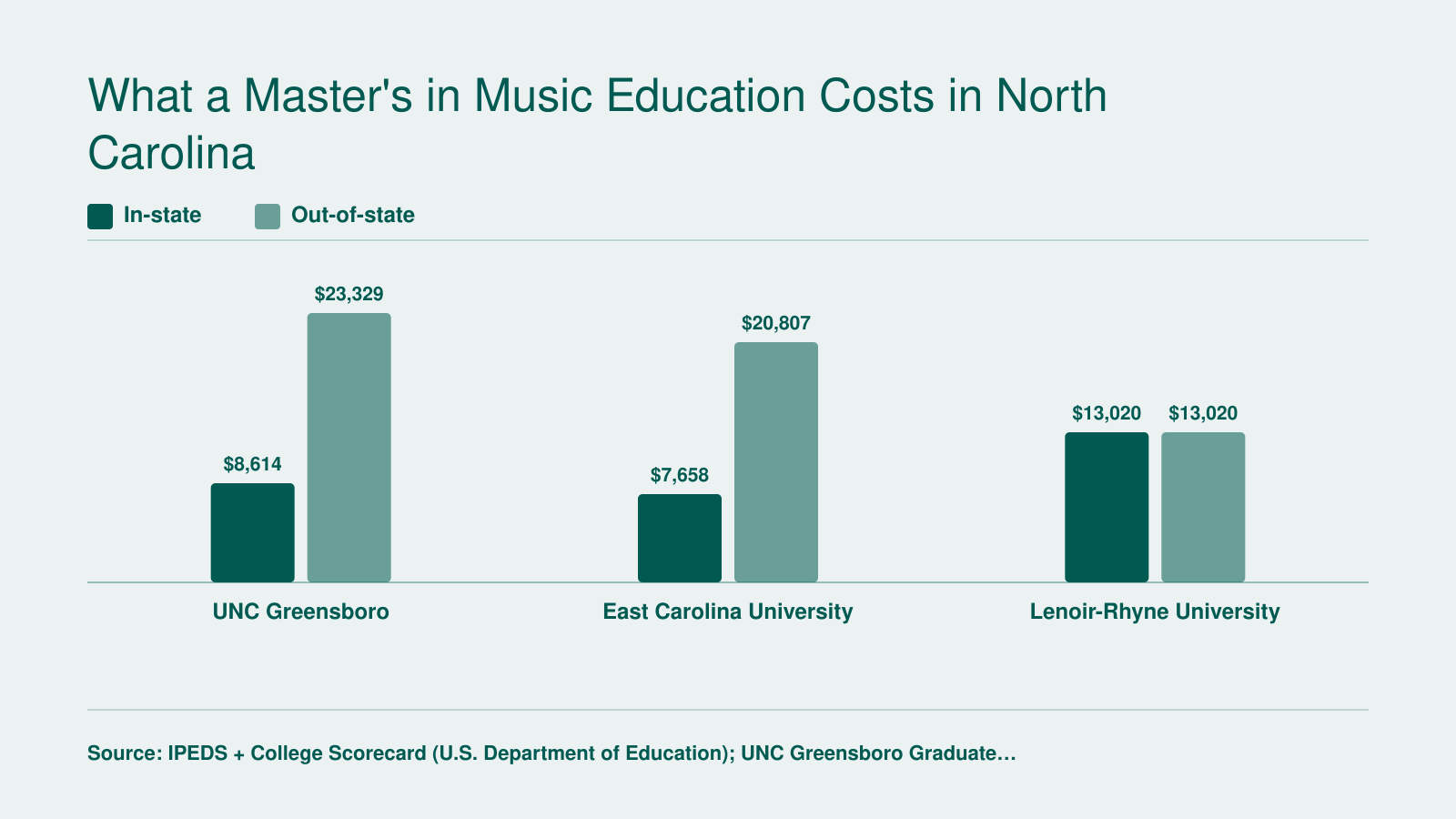
Annual graduate tuition at the programs ranked here runs from roughly $7,700 for in-state students at a public university to about $13,000 at the private option. Salary increases follow licensure level and NC DPI approval, not the degree by itself.
Key Points
- UNC Greensboro and East Carolina University both deliver music education master's degrees in formats built for working teachers.
- Advanced (M) licensure follows the degree completed through an approved program, not the master's alone.
- Program-level earnings and debt are not yet published, so compare tuition and licensure fit first.
Top Master's in Music Education Programs in North Carolina, Ranked
Three North Carolina universities in our data offer a master's in music education, and they serve different teachers. One is built for working educators who want to stay in the classroom, one offers a campus or online choice, and one leads to initial secondary licensure. Tuition and format are shown on each card, so compare those against your licensure status and schedule.
East Carolina University
#1Greenville, NC · ~$8,000/yr (est.)
Best for: Working North Carolina teachers studying online
East Carolina University in Greenville offers a Master of Music with a music education concentration that is 100% online. It is designed for practicing teachers seeking graduate licensure, and it is approved for North Carolina graduate teacher licensure. The university graduates about 63% of its students overall (an institution-wide figure, not a program completion rate). Out-of-state students should confirm that ECU is authorized to enroll in their state, which is not a concern for North Carolina residents.
- 100% online degree
- Final capstone project required
- Leads to graduate licensure and is approved for NC teacher license
- Transfer up to six graduate credits
- Credit available for National Board Certification
- Licensure route requires a valid teaching license
- Pedagogical Studies concentration within the online degree
- Approved for NC graduate teacher license
- Up to 3 semester hours for National Board Certification
- Capstone required
University of North Carolina at Greensboro
#2Greensboro, NC · ~$9,000/yr (est.)
Best for: Educators wanting campus or online flexibility
UNC Greensboro's School of Music offers a 32-credit Master of Music in Music Education for practicing educators, with a choice of in-person or online track. Campus students can study part-time or full-time, while the asynchronous online track runs mostly in summer. Graduate assistantships and limited tuition waivers are available, and applicants wanting full funding consideration should apply by January 15. The university graduates about 56% of its students overall (an institution-wide figure).
- 32 credit hours with a required capstone project
- In-person or fully online track
- Full-time study takes two years on campus
- Online track is asynchronous, over three summer sessions plus one fall or spring course
- Guidance for a National Board Certification in Music portfolio
- May qualify graduates for NC Advanced Teaching Licensure
- Graduate assistantships and limited tuition waivers available
- School of Music is a National Association of Schools of Music member
Lenoir-Rhyne University
#3Hickory, NC · ~$13,000/yr (est.)
Lenoir-Rhyne University in Hickory offers a Master of Arts in Teaching with a music education track leading to North Carolina secondary (grades 9-12) licensure. It suits people who want initial licensure rather than an advanced credential for current teachers. Two routes are available: an Integrated Master's Bridge Plan for qualified undergraduates and a 4+1 Plan for those who start after finishing a bachelor's degree. It is a private university with higher listed tuition than the two public options, and it graduates about 48% of its students overall (an institution-wide figure).
- Master of Arts in Teaching with a music education track
- Prepares for secondary (grades 9-12) licensure in North Carolina
- Integrated Master's Bridge Plan lets qualified undergraduates start early
- 4+1 Plan for students starting after a bachelor's degree
- Coursework in harmony, aural skills, conducting, and choral or instrumental methods
- Optional education practicum
- Dual credit and tuition discount through the bridge plan
Cost & outcomes by school
Federal data for the highest-earning Music Education programs, independent of the ranking above. Earnings are this field's master's graduates four years after completing, where the Scorecard reports them.
| School | Earnings | Tuition / yr | Debt | Grads/yr | Format |
|---|---|---|---|---|---|
| East Carolina University NC | $60,729 | $7,658 | $21,985 | 57 | Online |
| Lenoir-Rhyne University NC | — | $13,020 | — | — | Online |
| University of North Carolina at Greensboro NC | — | $8,614 | — | 22 | Hybrid |
Sources: U.S. Department of Education. Tuition and graduates: IPEDS. Earnings and debt: College Scorecard, this field's master's graduates; a dash means no figure is reported.
Cost, debt & payoff
Median earnings of this field's master's graduates (4 yrs after completing) vs. their median federal loan debt · U.S. College Scorecard
Across these programs the median graduate earns about $60,729 and finishes with roughly $21,985 in debt — a ratio that clears a common rule of thumb (keep debt below first-year salary). Tuition and debt vary widely school to school, so check the per-school figures in the table above before you shortlist.
Online and Hybrid Master's in Music Education Options in North Carolina
UNC Greensboro and East Carolina University deliver master's in music education degrees in formats that fit a full-time teaching schedule.
UNC Greensboro: Asynchronous, Summer-Heavy Delivery
UNCG's Master of Music in Music Education is available in person and online. Online coursework is primarily asynchronous, with three summer sessions aligned to public school calendars, plus one fall or spring course and a capstone in fall and/or spring. The online track does not require on-campus residency, and the summer institute is optional. A summer start is encouraged.
East Carolina University: Fully Online and License-Approved
ECU's Master of Music with a concentration in Music Education is described as a 100% online master's degree and approved for the NC graduate teacher license. ECU does not publish whether courses are synchronous or asynchronous, and no required on-campus residency is stated. It also does not specify part-time eligibility or formal summer-only sequencing, though an external 2026 listing suggests a typical two-year length.
Can a Working Teacher Finish?
For a full-time North Carolina teacher, UNCG's summer-heavy structure is the clearest path: you can keep your job during the year and concentrate most credits in summer. ECU's 100% online format removes commute pressure, but ask the program directly about live meeting times and part-time pacing before assuming a summer-only fit.
GRE Requirements and Waivers for North Carolina Music Education Master's Programs
Most music education admissions weigh teaching experience and musicianship more heavily than test scores. The policies below come from each school's published admissions pages as of October 2026. Confirm with the admissions office before you apply, since policies can change.
| School | GRE Policy | Notes |
|---|---|---|
| University of North Carolina at Greensboro (Master of Music in Music Education) | Not mentioned on the program page | The Graduate School requires GRE scores only when a specific program does, and it states no requirement for this degree. Listed materials: application, résumé or CV, recommendation letters, personal statement, official transcripts, and an optional teaching video for full-time applicants seeking an assistantship. |
| East Carolina University (Master of Music, Music Education concentration) | No published policy | No GRE requirement, optional policy, or waiver is published. The page lists an undergraduate music education degree or equivalent, a valid teaching license, a Graduate School application, a music-education philosophy, and documentation of superior teaching. |
| University of North Carolina at Chapel Hill (Department of Music graduate programs) | No published policy for music education | The department's statement that applicants need not take the GRE covers its M.A.-Ph.D. musicology program, not a master's in music education. |
Related Articles
What a Master's in Music Education Costs in North Carolina
The chart compares annual graduate tuition and fees for in-state and out-of-state students at each school, using federal institution-level data. These are not program quotes, so treat them as a starting point. East Carolina University lists 2025 graduate tuition of $264 per credit for residents and $994 for nonresidents. Over 32 credits, that comes to $8,448 and $31,808 before fees, but the credit total for its music education master's and its online rate are not confirmed. UNC Greensboro's M.M. requires 32 credits, and its fee sheet lists $2,687.50 per semester in standard graduate tuition with a $10,346 semester cap. Its online rates are set separately and depend on residency, so check its distance sheet. Lenoir-Rhyne is private and charges one rate. Net price figures are institution-wide averages, not program costs.
North Carolina Advanced Licensure for Music Educators
Is a Master's in Music Education Worth It in North Carolina?
The degree pays off most for teachers who keep debt low and qualify for advanced licensure pay where it applies. Program-level earnings and debt figures for the schools here are not yet published, so there is no verified salary bump or debt-to-income number to quote. The case rests on cost and licensure, not a published return.
Affordability levers
UNC Greensboro offers the clearest paths to lower costs:
- Assistantships: Admitted students are considered automatically. The listed master's stipend is $7,500, and the work is 20 hours a week, including classroom teaching and student-teaching or internship supervision. Recipients must be full-time. The school encourages music education applicants to apply by November 1, and the listed deadline is January 15.
- Tuition waivers: These may accompany an assistantship but cover tuition only, not university fees.
- Fellowships: Graduate School fellowships are competitive and faculty-nominated. The largest listed award is $24,000 per year with no work assignment, but availability is not guaranteed.
Published materials describe no teacher-specific discount at UNCG and no separate music scholarship for this degree. For East Carolina University, current assistantship, scholarship, or waiver details for its online program are not established.
The verdict
Full-time assistantships conflict with a teaching job. Working teachers are better served by UNCG's summer-based online route, which keeps the salary coming, and by keeping borrowing modest.
Admissions Checklist for North Carolina Music Education Master's Programs
Requirements below come from the UNC Greensboro and East Carolina University program pages. Confirm current details with each admissions office before applying.
- Prior degreeECU requires an undergraduate music education degree or equivalent. UNCG's published materials do not state a specific prerequisite major, so confirm with the School of Music.
- Teaching licenseECU requires a valid teaching license and an uploaded copy of the credential. UNCG does not list one for admission to the M.M., but its Advanced Licensure in Music pathway requires Initial Licensure and three or more years of teaching.
- Minimum GPANeither school's pages state a minimum GPA. UNCG accepts an unofficial transcript while your degree is in progress; ECU requires official transcripts.
- Audition, portfolio or videoECU requires a portfolio documenting superior teaching, a one-page philosophy statement, a résumé, and an article critique. UNCG lists no required audition or admission portfolio; a teaching video is optional and applies to full-time students seeking an assistantship.
- Letters and statementBoth schools require two recommendation letters. UNCG also asks for a résumé and personal statement. ECU's written statement is the philosophy statement within the portfolio.
- DeadlinesUNCG lists May 15 for summer and fall and October 1 for spring, with January 15 for assistantship consideration. Submit at least three weeks early, since processing can take three to four weeks from November through March. ECU's deadlines were not established in the available sources, so check its admissions page.
FAQ: Master's in Music Education in North Carolina
Can I complete a master's in music education while teaching full time in North Carolina?
Do I need a teaching license to apply to a music education master's program in North Carolina?
Do North Carolina public school teachers get a salary increase for earning a master's degree?
Compare Music Education programs on the data that matters
Explore more Education & Teaching specializations or browse every graduate field.
All Education & Teaching programs