Best Master's in Music Education Programs in Tennessee
Compare 9 accredited Music Education programs in Tennessee at 8 schools, with graduate earnings, cost, debt, and completion data from IPEDS and the U.S. College Scorecard.

Does a master's in music education pay off for a working Tennessee teacher? For many, the return comes through the district salary schedule, sharper rehearsal and conducting skills, or a route into a master's in educational leadership in Tennessee.
The programs here span campus, online, and hybrid formats. In-state tuition at the public schools runs from $11,110 to $11,916, while Belmont charges $27,810 and Vanderbilt $57,868.
ETSU and UT Martin both state that their degrees do not lead to licensure, so a master's here usually builds on a license you already hold.
Key Points
- The University of Memphis charges $11,628 in-state tuition; MTSU charges $11,718.
- Confirm GRE policy directly with each admissions office before you apply.
- Tennessee endorsements are Music Instrumental/General or Vocal/General K-12, plus a Praxis score.
Top Master's in Music Education Schools in Tennessee, Ranked
These seven Tennessee schools offer a master's in music education or a closely related teacher-education degree, on campus, online or hybrid. Net price is an institution-wide average after grants and scholarships, not a quote for this specific program, so confirm costs with each bursar. NASM accreditation is noted where it applies to the school's music unit; it is not always a separate listing for each concentration.
Vanderbilt University
#1Nashville, TN · ~$58,000/yr (est.)
Best for: Undergraduate musicians seeking fifth-year licensure
Vanderbilt's Peabody College pairs with the Blair School of Music in a five-year path to a Bachelor of Music and a Master of Education. It is built for Blair undergraduates, not for working teachers seeking a stand-alone graduate degree, so check eligibility before applying. The university graduates about 94% of its students, an institution-wide figure rather than a program outcome. The path ends in a General/Vocal Music K-12 or Instrumental Music K-12 endorsement.
- Earn a B.Mus and an M.Ed. in five years
- Year of graduate study runs June through May
- Two endorsement routes: General/Vocal or Instrumental Music K-12
- Three practica with at least 15 weeks of field placements
- Applicants apply to Peabody during their senior year at Blair
- Peabody partners with Metro Nashville Public Schools and nearby districts
- Program reports a 100% job placement rate
Middle Tennessee State University
#2Murfreesboro, TN · ~$12,000/yr (est.)
Best for: Working band and choral directors studying online
MTSU's Master of Music in Music Education is fully online and aimed at current K-12 teachers who want to stay in the classroom. It requires concurrent K-12 music teaching and builds skills in pedagogy, research and advocacy. The School of Music has held NASM accreditation since 1970. The university graduates about 54% of its students, an institution-wide figure.
- Fully online for practicing K-12 music educators
- Concurrent K-12 music teaching required
- 3.0 minimum GPA and three recommendation letters
- 30-minute teaching video required
- Focus on pedagogy, research and advocacy
- Prepares graduates for later doctoral study
- School of Music NASM-accredited since 1970
Belmont University
#3Nashville, TN · ~$28,000/yr (est.)
Best for: Licensed teachers wanting a hybrid summer residency
Belmont's Nashville program is a 13-month hybrid for practicing K-12 music teachers. Two online semesters keep you in your classroom, and an in-person summer session adds field-based work with faculty. You can specialize in instrumental, choral or general music, and conducting courses are available. The university graduates about 71% of its students, an institution-wide figure. Belmont is NASM-accredited as an institution.
- 13-month hybrid: two online semesters plus an in-person summer
- Instrumental, choral or general music concentrations
- Requires a valid K-12 teaching license and two years of classroom experience
- 3.0 minimum GPA and two recommendation letters
- Audition is completed online; no performance audition required
- Advanced conducting course options
- $50 application fee
East Tennessee State University
#4Johnson City, TN · ~$11,000/yr (est.)
ETSU in Johnson City offers a Master of Music in Music Education for licensed teachers, full-time during the academic year or part-time in the summer. It focuses on teaching methods, research and expanded music content. It does not lead to teacher certification, so it suits teachers who are already licensed. The music department is NASM-accredited, and the university graduates about 53% of its students, an institution-wide figure.
- Designed for practicing, licensed music educators
- Does not lead to teacher licensure
- Full-time academic-year and part-time summer options
- Covers teaching methodologies and research strategies
- Scholarships available
- NASM-accredited music department
University of Memphis
#5Memphis, TN · $10,000 – $15,000/yr (est.)
The University of Memphis delivers its 32-credit Master of Music in Music Education online for working teachers, with no campus requirement. A separate hybrid Orff Schulwerk master's is one of the oldest Orff programs in the country, combining online credits with an on-campus intensive. The School of Music is NASM-accredited, and the university graduates about 51% of its students, an institution-wide figure.
- 32 credit hours, delivered online
- Requires a valid music teaching license and two recommendation letters
- Writing sample on philosophy of music education
- Master's project and online comprehensive exam
- Summer video-conference discussions; optional Orff certification
- Experiential learning credit accepted
- 33 credit hours: 21 online and 12 on campus
- Two-week intensive Orff training
- Covers Orff Levels I to III and a Masterclass
- Credit available for prior professional training
- Taught by nationally renowned Orff trainers
The University of Tennessee-Martin
#6Martin, TN · ~$12,000/yr (est.)
UT Martin offers a hybrid Master of Music in Music Education with four emphases: general, choral conducting, instrumental conducting and leadership. The general emphasis can be finished fully online, while conducting emphases need six on-campus hours. The degree does not lead to state licensure. The university graduates about 53% of its students, an institution-wide figure.
- Four emphases: general, choral conducting, instrumental conducting, leadership
- General emphasis can be completed fully online
- Conducting emphases require six on-campus conducting hours
- Leadership emphasis draws on business, communication and education courses
- Music bachelor's, two recommendation letters and a faculty interview required
- Current program information lists a 2.75 minimum undergraduate GPA
- Does not lead to state licensure
- Diagnostic exams plus a written and oral exam
The University of Tennessee-Chattanooga
#7Chattanooga, TN · ~$11,000/yr (est.)
UTC's 31-credit hybrid program combines three summers on campus with asynchronous online courses in fall and spring. Three tracks are offered: Kodály Certification, Secondary Instrumental Pedagogy and Secondary Vocal Pedagogy. Applicants submit a letter of intent and complete a faculty interview, and the GRE and GMAT are not required. The music program is NASM-accredited, and the university graduates about 50% of its students, an institution-wide figure.
- 31 credit hours in a hybrid format
- Three summers of on-campus study plus online fall and spring terms
- Kodály Certification track for K-8 general music
- Secondary Instrumental Pedagogy and Secondary Vocal Pedagogy tracks
- Summer Pedagogy and Conducting Institutes with guest clinicians
- Letter of application and brief interview required; no GRE or GMAT
- Alternative certification accepted
Cost & outcomes by school
Federal data for the highest-earning Music Education programs, independent of the ranking above. Earnings are this field's master's graduates four years after completing, where the Scorecard reports them.
| School | Earnings | Tuition / yr | Debt | Grads/yr | Format |
|---|---|---|---|---|---|
| The University of Tennessee-Knoxville TN | $51,494 | $15,972 | $20,500 | 149 | Online or campus |
| The University of Tennessee-Chattanooga TN | — | $11,110 | — | — | Hybrid |
| University of Memphis TN | — | $11,628 | — | — | Online |
| Middle Tennessee State University TN | — | $11,718 | — | 19 | Online |
| East Tennessee State University TN | — | $11,366 | — | 4 | Campus |
| The University of Tennessee-Martin TN | — | $11,916 | — | 6 | Hybrid |
| Belmont University TN | — | $27,810 | — | 3 | Hybrid |
| Vanderbilt University TN | — | $57,868 | — | 20 | Campus |
Sources: U.S. Department of Education. Tuition and graduates: IPEDS. Earnings and debt: College Scorecard, this field's master's graduates; a dash means no figure is reported.
Online and Hybrid Master's in Music Education Programs in Tennessee
Yes, you can earn a master's in music education online in Tennessee, and the most affordable master's in music education programs cost about the same as the campus options. The University of Memphis ($11,628 in-state tuition) and Middle Tennessee State University ($11,718) are the two fully online master's in music education programs here. Memphis has no on-campus requirement and is built for practicing teachers. MTSU is aimed at current K-12 educators and asks for a 30-minute teaching video.
Hybrid and Campus-Only Formats
Belmont University, The University of Tennessee-Martin, and The University of Tennessee-Chattanooga blend formats. Belmont runs two online semesters plus an in-person summer. UT Chattanooga offers asynchronous classes but requires three summers on campus. UT Martin lists a fully online option, though it includes six on-campus conducting hours. Vanderbilt University and East Tennessee State University are campus-only.
Why Format Matters for Working Teachers
If you teach full time, daytime rehearsals and conducting labs rarely fit around a school schedule. Asynchronous coursework and summer residencies let you keep your job and still get podium time. Campus-only study suits full-time students or those with flexible hours.
Tuition by Format
Among the online-capable programs, in-state tuition runs from $11,110 at UT Chattanooga to $11,916 at UT Martin, with Belmont ($27,810) as the private-school exception. Campus-only ETSU charges $11,366, while Vanderbilt charges $57,868. Studying online does not cost you a premium among master's programs in Tennessee.
Do Tennessee Master's in Music Education Programs Require the GRE?
Don't assume either way. Music education admissions in Tennessee lean heavily on performance and teaching evidence, but we could not verify a current GRE requirement, waiver or exemption on an official admissions page for any of the schools ranked here, even those that appear on broad No-GRE master's programs lists. Treat the exam as an open question until a program confirms its policy in writing.
School-by-School GRE Status
- Vanderbilt University: No current GRE policy for Peabody's master's in Music Education could be confirmed. Ask admissions directly.
- Middle Tennessee State University: No current GRE requirement or waiver policy confirmed.
- Belmont University: No current GRE requirement or waiver policy confirmed.
- University of Memphis: No current GRE requirement or waiver policy confirmed.
- East Tennessee State University, The University of Tennessee-Martin and The University of Tennessee-Chattanooga: No GRE policy confirmed. Check both the graduate school and the music department pages, since the two sometimes list different requirements.
What Usually Carries More Weight
Where Tennessee music programs do spell out their requirements, an audition with area faculty is the recurring piece, typically paired with reference letters and official undergraduate transcripts.12 Depending on the program, you may also be asked for a conducting or teaching video, a portfolio of classroom work, a writing sample, or diagnostic exams in music theory and history.
Before you pay for a test date, email the graduate coordinator and ask two questions: is the GRE required, and if not, is that a formal exemption or a waiver you have to request?
Related Articles
What You'll Need to Apply: Deadlines and Materials
Requirements differ by school, so confirm current dates and materials on each program's admissions page. Belmont and the University of Memphis show the two main patterns: a track for working teachers and a track for recent music graduates.
- Bachelor's degree in music or music educationExpect programs to want an undergraduate music background. Ask whether a different degree can qualify through coursework or placement exams.
- Teaching license or classroom experienceBelmont requires a valid K-12 license, current in-service status, and at least two years of full-time teaching. Memphis's MAT in Music Education is built for music bachelor's holders who still need Tennessee licensure, so recent graduates can apply.
- Minimum GPA and content examsMemphis's MAT lists a 3.0 graduate GPA and a Praxis II or NES Content Knowledge exam. Those apply to the licensure track, not to every master's route.
- Recommendation lettersBelmont asks for two: one on musical ability and one on teaching.
- Statement or writing sampleBelmont requires a writing sample and liner notes. Plan on a personal statement elsewhere.
- Teaching video instead of an auditionBelmont does not require a performance audition. It asks for a prescreening teaching video of 10–15 minutes. Secondary teachers also submit a performance video of up to 10 minutes.
- Application steps and deadlinesAt Belmont, submit the Graduate Studies Application, create a BU4U account, and pay the $50 fee. Then upload your materials to Accept'd by the deadline for your intended audition date. Memphis's MAT requires a clinical-teaching application one semester before clinical teaching. Check each school for fall priority and summer-start dates.
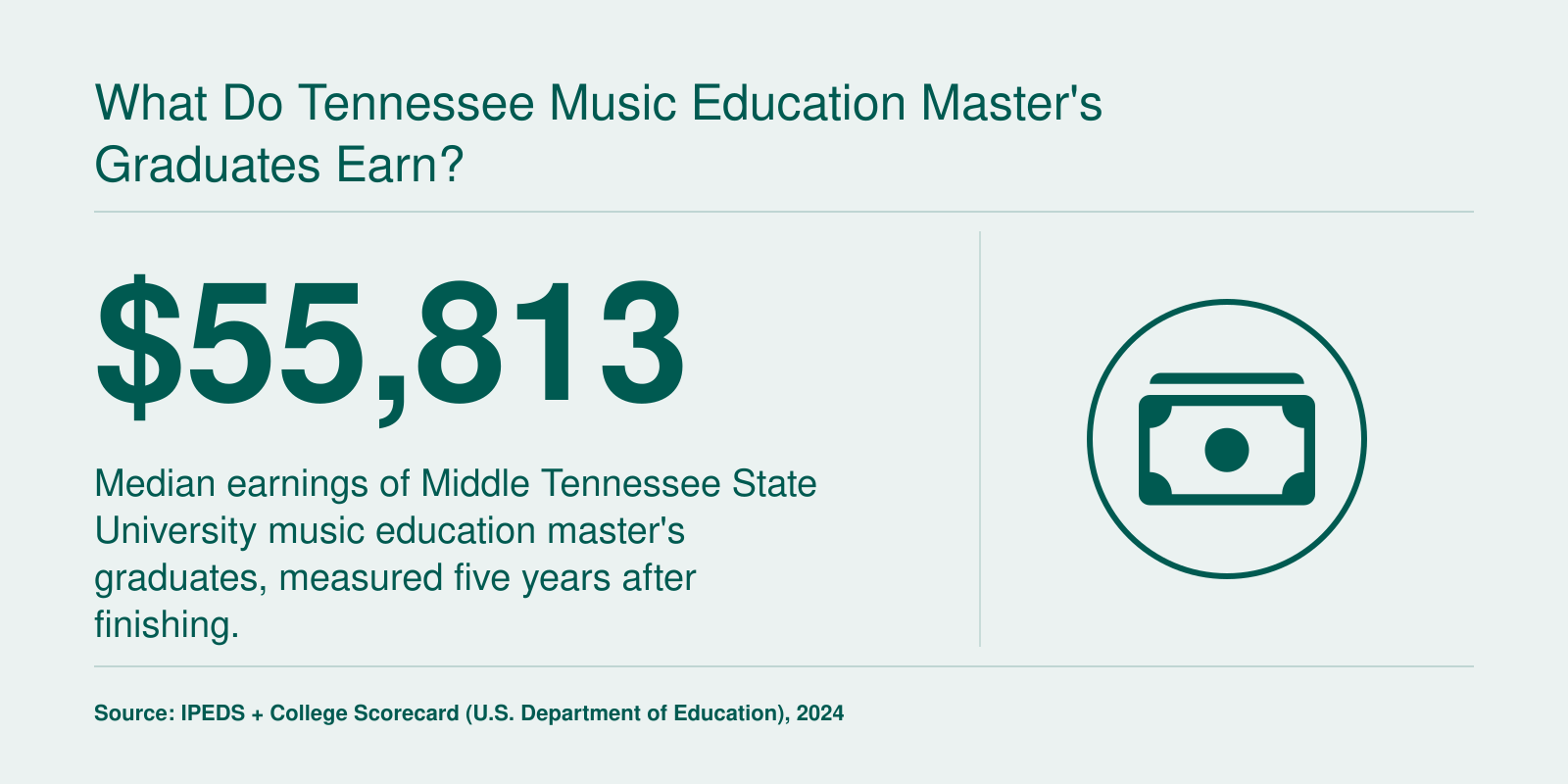
What Do Tennessee Music Education Master's Graduates Earn?
Federal program-level earnings data gives one clear benchmark for Tennessee music education master's graduates, from Middle Tennessee State University. For public school teachers, the degree often matters most through the district salary schedule, where a master's typically moves a teacher up a pay lane.
Tennessee Music Teacher Licensure at a Glance
Master's in Music Education Cost and Tennessee Licensure Pathways
Cost and licensure for a Tennessee master's in music education vary by program. The answer depends heavily on where you apply.
What You'll Pay
Among the schools ranked here, UT Martin posts the lowest in-state tuition at roughly $11,900, while Vanderbilt sits at the top near $57,900. The rest fall in between, so the overall spread runs from about $12,000 to nearly $58,000 depending on where you land.
Institution-wide net price tells a different story. This is an average across all programs at a school, not the music education figure, but it helps gauge real out-of-pocket cost after aid: UT Martin averages around $10,700, while Belmont runs near $33,100.
For online and hybrid options, per-credit rates matter more than sticker price. UT Knoxville's fully online program charges about $744 per credit across 30 credits (roughly $22,300). UT Chattanooga's 31-credit hybrid runs about $550 per credit in-state, with mandatory fees near $200 per semester. Confirm whether out-of-state online students qualify for in-state or e-rates, since published policies vary.
Licensure Pathways
- Requires an existing license: Memphis's online MMEd is built for teachers who already hold a valid music teaching license.
- Initial licensure: Memphis also offers a Master of Arts in Teaching (MAT), Music Education K-12, an initial licensure path (33 to 39 credits) requiring Praxis II or NES content exams and a 3.0 GPA.
- Non-licensure: ETSU, UT Martin, and TSU are advanced-study degrees that do not lead to licensure.
Before enrolling, confirm your district's tuition reimbursement and check how a master's moves you on its salary schedule.
Compare Music Education programs on the data that matters
Explore more Education & Teaching specializations or browse every graduate field.
All Education & Teaching programs