Best Online Care Coordination MSN Programs
Compare 6 accredited online Care Coordination programs, with graduate earnings, cost, debt, and completion data from IPEDS and the U.S. College Scorecard.

A care coordination MSN trains registered nurses to manage a patient's path across hospitals, clinics, home health, and payers, and programs typically require an active RN license and a BSN. Most applicants are working nurses who cannot leave their jobs for campus classes.
Every program here is 100% online, with no hybrid or on-campus requirement. The list is short because few schools offer a fully online care coordination MSN.
Practicum is the catch: coursework is online, but clinical hours still happen in person at an approved site.
Key Points
- Nebraska Methodist College charges $565 per credit, roughly $20,340 total tuition.
- Capella's 500-hour practicum conflicts with course pages listing 50 and 100 hours.
- West Coast and Sacred Heart accept 90 transfer credits; Wilkes accepts 9.
Top Fully Online Care Coordination MSN Schools
This list spotlights 100% online MSN programs with a care coordination or closely related case management focus, and hybrid options are excluded. The schools are ordered by a mixed quality composite that weighs outcomes like graduate earnings and the institution's graduation rate alongside cost and program fit. Each card below summarizes what makes the school a practical choice for nurses moving into care coordination.
Capella University
#1Minneapolis, MN · $15,000 – $20,000/yr (est.)
Best for: Working RNs needing self-paced scheduling
Capella University's CCNE-accredited online MSN in Care Coordination lets BSN-prepared nurses choose between the self-paced FlexPath format and the structured GuidedPath format. Graduate tuition is about $14,400, and the average net price is near $17,956. The school reports a graduation rate of 20 percent, while recent program completers had median earnings of $83,480 one year out and $93,044 four years after finishing.
- 54 total quarter credits
- 500 minimum practicum hours
- FlexPath and GuidedPath options
- BSN admission required
- 2.8 minimum GPA
- Unrestricted RN license needed
- Up to 8 transfer credits
- CCNE accredited
Stevenson University
#2Owings Mills, MD · ~$8,000/yr (est.)
Best for: Baltimore-area nurses seeking local practicum placements
Stevenson University's online Master of Science in Nursing pairs a Population-Based Care Coordination concentration with a mentored capstone and practicum. Graduate tuition is about $40,560, while the average net price is roughly $26,505. The school reports a graduation rate near 69 percent, and recent program completers had median earnings of $68,806 one year after finishing.
Nebraska Methodist College
#3Omaha, NE · ~$15,000/yr (est.)
Best for: ADN nurses pursuing an RN-to-MSN bridge
Nebraska Methodist College offers an online MSN with a Care Coordinator specialization, plus an RN-to-MSN bridge for associate-degree nurses. Tuition is about $17,885, and the average net price is around $21,863. The school reports a graduation rate of about 59.5 percent. The program includes a precepted practicum and a capstone project.
- 39 total credit hours
- $588 per credit hour
- Designed for BSN-prepared nurses
- No GRE required
- Requires BSN with 3.0 GPA
- Complete in 24 months
- Includes practicum and capstone
- Courses last 5 to 10 weeks
- 57 total credit hours
- 36-month program
- Rolling admissions
- Starts fall and spring
- 3.0 GPA minimum
- 5-week course format
- Bridge courses for associate degree RNs
- Precepted practicum with care coordinator
Post University
#4Waterbury, CT · ~$8,000/yr (est.)
Post University offers an online Master of Science in Nursing with a Case Management specialization, a closely related care-coordination pathway. The program requires 36 credit hours and typically takes 16 to 24 months. Graduate tuition is about $16,327, with an average net price near $21,634, and the school reports a graduation rate of roughly 25 percent. The curriculum follows the Case Management Society of America core curriculum and holds CCNE accreditation.
- 36 total credit hours
- 16- to 24-month completion
- 12 start dates per year
- 8-week terms in term-based track
- 16-week semesters in SIMPath track
- Self-paced SIMPath option
- Case Management Society core curriculum
- CCNE accredited
Cost & outcomes by school
Federal data for the highest-earning Care Coordination programs, independent of the ranking above. Earnings are this field's master's graduates four years after completing, where the Scorecard reports them.
| School | Earnings | Tuition / yr | Debt | Grads/yr | Format |
|---|---|---|---|---|---|
| University of Alabama at Birmingham AL | $136,395 | $8,640 | $41,000 | 74 | Hybrid |
| Capella University MN | $93,044 | $15,092 | $34,518 | 666 | Online |
| Post University CT | — | $7,955 | — | 24 | Online |
| Framingham State University MA | — | $10,965 | — | 10 | Hybrid |
| Nebraska Methodist College NE | — | $14,552 | — | 7 | Online |
Sources: U.S. Department of Education. Tuition and graduates: IPEDS. Earnings and debt: College Scorecard, this field's master's graduates; a dash means no figure is reported.
The Scoring Behind This List: Fully Online Delivery, Outcomes, and Cost
Hybrid programs and fully online programs can look identical in a brochure, but only one lets you stay home. Every school here cleared that hard filter first, so any program requiring campus visits was dropped. The remaining programs are ordered by a mixed quality composite built from IPEDS and College Scorecard data: graduation rate, net price, and program-level earnings and debt where they are published.
Two cautions apply. Graduation rates describe the whole institution, not the care coordination MSN. Net price is an average after aid, not a personal quote, so even among affordable care coordination msn programs your own bill may differ.
Federal datasets also miss practicum hours, accreditation status, and state eligibility. Confirm all three directly with each school before you apply.
What a Care Coordination MSN Covers and How RN-to-MSN and BSN-to-MSN Paths Differ
Entry-path rules for nursing master's degrees are far less standardized than program marketing suggests. Published policies range from 9 graduate transfer credits at Wilkes' online RN-to-MSN program to up to 90 total transfer credits at West Coast University's RN-to-MSN program and Sacred Heart's online RN to BSN to MSN program, and schools count different credit types, so those numbers are not comparable. Admission and transfer rules vary by program, so verify them school by school.
Where to check
- School pages: the graduate admissions page, MSN program page, curriculum worksheet, and transfer-credit policy.
- BLS.gov: role context and outlook for care coordination and case management work.
- Professional bodies: ANA, ANCC, CMSA, and CCMC for specialty and certification context.
Questions for admissions
- What are the total required credits on the RN-to-MSN path versus the BSN-to-MSN path?
- Are there bridge or undergraduate requirements before graduate courses begin?
- What is the maximum number of graduate credits accepted in transfer?
- Is the nursing program accredited?
- Who arranges clinical placement?
Do not rely on third-party summaries for official policy. Get the answers in writing from the school.
Clinical Practicum Requirements: Hours, Preceptors, and Health System Partners
Capella advertises a 500-hour minimum practicum for its online MSN in Care Coordination, but its own course pages list smaller blocks (50 and 100 hours) without reconciling them to that total. Third-party sites conflict too, so confirm hours in the current school catalog before you commit. Capella has students pick their own practicum site, with a preceptor supervising and hours logged.
Placement support varies. Walsh pairs online students with a clinical placement coordinator who handles site and preceptor approval, clearances, and deadlines. Lamar uses a placement team that matches preceptors by specialty, with sites at Texas facilities meeting ACEN standards. Walsh's published hour figures cover its NP tracks, not care coordination.
Current employers are a gray area. Walsh allows your workplace only if the preceptor is not your direct supervisor and hours fall outside paid shifts. Lamar requires an approved site. Preceptors cannot be family or friends at Walsh, and must be licensed, nationally certified, and have at least one year of experience.
No ranked school advertises a named health system partnership for this specific degree.
Start the preceptor search two to three terms before practicum begins.
Related Articles
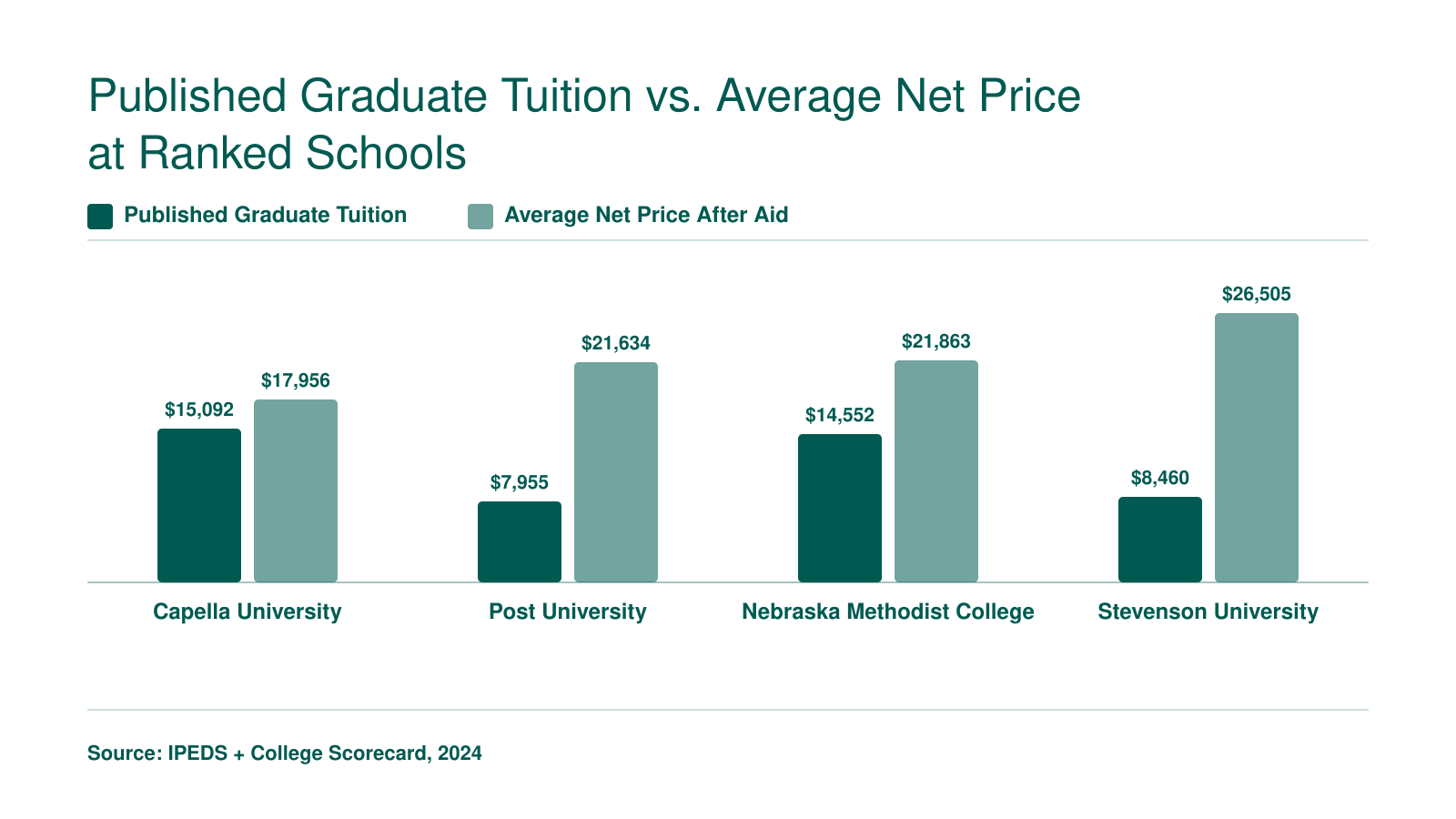
Published Graduate Tuition vs. Average Net Price at Ranked Schools
This chart compares each ranked school's published graduate tuition and fees with the average net price students pay after financial aid. Net price is an institution-wide average across all students, not a program quote, so it may include costs beyond tuition such as fees, books, and living expenses. The gap between the two figures shows how much typical aid and other factors change the actual cost, and it can be positive or negative depending on the school. Figures reflect 2024 data from IPEDS and College Scorecard.
Per-Credit Tuition, Total Cost, and Debt for Affordable Online Care Coordination MSN Programs
Nebraska Methodist College publishes $565 per credit for a minimum of 36 credit hours, which works out to about $20,340 in tuition.1 That figure excludes fees, books, and supplies, so budget above it.
Capella University charges by the quarter credit across 54 credits, including 500 practicum hours.2 Per-credit pricing runs $450 to $830, putting total tuition between roughly $24,300 and $44,820.1 Where you land depends on residency under Guided Path or on your completion pace under FlexPath. Against Nebraska Methodist's tuition, Capella's top end costs about $24,000 more. Current per-credit tuition for Stevenson University's 36-credit option is not established,2 and mandatory technology, clinical, and graduation fees are not confirmed for any of these schools, so ask each admissions office for a fee-inclusive estimate and whether out-of-state students pay the same rate.
On debt, Capella's care coordination graduates show median federal debt of $34,518, or about $393 a month over 10 years. The other schools report no program-level figure.
Many working RNs cut these totals through employer tuition reimbursement, so check your benefits before borrowing.
Care Coordination MSN Salary, Jobs, and Certifications Worth Pursuing
An MSN opens management-track titles, but it does not by itself earn you a case management credential. Typical roles include care coordination manager, transitions of care nurse lead, population health nurse manager, and nurse case manager.
For pay, look at program-level figures one year after finishing. Capella University's MSN in Care Coordination graduates reported a median of $83,480, and Stevenson University's graduates reported $68,806 (from a small cohort).
Credentials and Eligibility
- CCM (CCMC): Needs a health or human-services license and a bachelor's-level foundation. Experience is also required: 12 months supervised by a CCM, 24 months as a primary case manager, or 12 months supervising case managers. The MSN does not shorten this.
- ACM (ACMA): RNs need a current license, plus 2,080 hours of paid, full-time case management work in a health delivery system. The MSN does not reduce the hours.
- AAACN and ANCC: Confirm current experience and education rules with each issuer before planning.
Next step: pick the program whose coursework or practicum aligns with the credential you plan to pursue, and ask the school how its practicum hours fit that credential's requirements.
Care Coordination programs by state
Online Care Coordination MSN Questions, Answered
How many practicum hours does an online care coordination MSN require?
Can I complete an online care coordination MSN while working full time as an RN?
Which states allow residents to enroll in online care coordination MSN programs?
How long does an online MSN in care coordination take to finish part time?
Do hospital employers recognize a care coordination MSN the same way they recognize a case management MSN?
Compare Care Coordination programs on the data that matters
Explore more Nursing specializations or browse every graduate field.
All Nursing programs