Best Care Coordination MSN Programs
Compare 9 accredited Care Coordination programs at 7 schools, with graduate earnings, cost, debt, and completion data from IPEDS and the U.S. College Scorecard.

Fragmented care is expensive. Patients leave the hospital with a new medication list, three follow-up appointments, and no one checking whether any of it happens, and the readmission that follows lands on the health system's books. The best care coordination MSN programs train RNs to own that gap, building transition plans, chasing down specialists, and tracking outcomes across settings.
The tradeoff is that care coordination MSN programs are rare. Only a handful of accredited schools run a dedicated track, which means choosing one often involves weighing an unfamiliar name against a convenient format rather than picking from a deep field. The schools here were judged on cost and outcomes, not reputation.
CCTM certification sits downstream of the degree for nurses who want the credential to be legible to employers.
Key Points
- Stevenson University is the cheapest listed option at about $8,000 a year; VCU runs about $17,000.
- Program-level graduate earnings are unavailable, so judge schools on net price, institution-wide outcomes, and accreditation.
- Chronic Care Management reaches only 3.4% of eligible Medicare patients, which keeps demand high for MSN-prepared coordinators.
The Best Care Coordination MSN Programs, Ranked
A care coordination MSN is only worth the investment if it changes what you can earn and where you can work. The programs below earned their place by pairing CCNE accredited nursing curricula with online formats and realistic total costs. One caution up front: not every ranked school is currently accepting applications, so check the next start date before building a plan around it.
Nebraska Methodist College
#1Omaha, NE · ~$15,000/yr (est.)
Best for: Associate-degree RNs needing an online bridge
Nebraska Methodist College offers a fully online MSN with a Care Coordinator specialization, plus an RN-to-MSN bridge for associate-degree nurses. The CCNE accredited coursework emphasizes population health, healthcare systems management, and hands-on practicum experiences. As of 2026, the college is not accepting new applications for this program, so prospective students should confirm the next available start before making it their sole option.
- Fully online with 5- to 10-week courses
- 39 total credit hours at $588 per credit
- No GRE required; BSN with 3.0 GPA
- Current RN licensure required
- Includes practicum experiences and capstone project
- CCNE accredited
- 36-month bridge for associate-degree RNs
- 57 total credit hours
- Rolling admissions with fall/spring starts
- CCNE accredited
- Precepted practicum with a care coordinator
- Population health curriculum and capstone
Stevenson University
#2Owings Mills, MD · ~$8,000/yr (est.)
Best for: Care coordinators focused on population health
Stevenson University's online Master of Science in Nursing includes a Population-Based Care Coordination concentration. The CCNE accredited program is structured around 36 credits for BSN-prepared nurses, with a focus on coordinating care across populations. Recent federal outcomes data show solid early career earnings for graduates.
- Fully online population-based care coordination concentration
- 36 total credits for BSN-prepared nurses
- CCNE accredited
Capella University
#3Minneapolis, MN · $15,000 – $20,000/yr (est.)
Best for: BSN nurses wanting flexible pacing
Capella University offers a CCNE accredited online MSN in Care Coordination for BSN-prepared nurses. The program totals 54 quarter credits and requires 500 practicum hours, with FlexPath and GuidedPath formats to control pace and cost. Published 2026 total program costs range from about $20,895 to $29,850 depending on format, transfer credits, and pacing.
- Fully online with FlexPath and GuidedPath formats
- 54 total quarter credits
- 500 minimum practicum hours
- BSN admission with 2.8 GPA and unrestricted RN license
- CCNE accredited
- Total program cost about $20,895 to $29,850
- Duration roughly 19 to 27 months
- No application fee; up to 8 transfer credits
Cost & outcomes by school
Federal data for the highest-earning Care Coordination programs, independent of the ranking above. Earnings are this field's master's graduates four years after completing, where the Scorecard reports them.
| School | Earnings | Tuition / yr | Debt | Grads/yr | Format |
|---|---|---|---|---|---|
| University of Alabama at Birmingham AL | $136,395 | $8,640 | $41,000 | 74 | Hybrid |
| Capella University MN | $93,044 | $15,092 | $34,518 | 666 | Online |
| Post University CT | — | $7,955 | — | 24 | Online |
| Arizona State University AZ | — | $10,843 | — | 103 | Campus |
| Framingham State University MA | — | $10,965 | — | 10 | Hybrid |
| Arizona State University AZ | — | $13,587 | — | 2 | Campus |
| Nebraska Methodist College NE | — | $14,552 | — | 7 | Online |
Sources: U.S. Department of Education. Tuition and graduates: IPEDS. Earnings and debt: College Scorecard, this field's master's graduates; a dash means no figure is reported.
What Put These Schools on the List
Every program on this list of best MSN programs earns its place on numbers a working RN can actually verify and feel in a paycheck, not on a name that sounds impressive at a dinner party.
The Numbers That Matter
We start with the figures that affect your finances and career:
- Earnings and debt: Where the federal College Scorecard publishes program-level earnings and borrowing data, we use it. These are real numbers from graduates who finished the same degree.
- What you'll pay: Graduate tuition plus the net price after aid, so you can see the sticker figure and the likelier real cost side by side.
- Completion: The institution-wide graduation rate, a rough signal of whether students who enroll tend to finish.
- Delivery format: Online, hybrid, or on campus, because how a program fits your schedule is part of its value.
Why Prestige Sits This One Out
Reputation surveys and "best of" rankings measure what academics think of each other. They say nothing about what a care coordinator pays to earn the degree or earns after finishing it. We leave them out on purpose.
What These Numbers Can't Tell You
Be honest with yourself about the limits. Some programs enroll too few students for the Scorecard to publish earnings at all, so that line stays blank. Net price is an institution-wide average, not a personal quote; your aid package sets what you actually pay.
And no dataset can judge faculty quality or whether a program will place you at a strong practicum site. Those are questions to put directly to an admissions director before you commit.
Inside the Care Coordinator Role: Job Description and How It Differs From Case Management
A discharge is where care either holds together or falls apart, and the MSN-prepared care coordinator is the person responsible for keeping it intact. Most of the role is built around that handoff.
What the Job Looks Like Day to Day
A typical MSN care coordination job description centers on five duties:
- Care transitions: Planning moves between hospital, skilled nursing, home, and clinic so orders, medications, and records travel with the patient.
- Interdisciplinary leadership: Running huddles and care conferences with physicians, pharmacists, social workers, and therapists, a hallmark of MSN Nurse Executive Leadership programs.
- Education: Teaching patients and caregivers about medications, warning signs, and self-management.
- Post-discharge follow-up: Calls and visits in the days after discharge to catch problems before they become readmissions.
- Quality tracking: Monitoring readmissions, follow-up completion, and patient experience measures, then acting on what the numbers show, the core of an MSN in patient safety and quality.
Care Coordination vs. Case Management
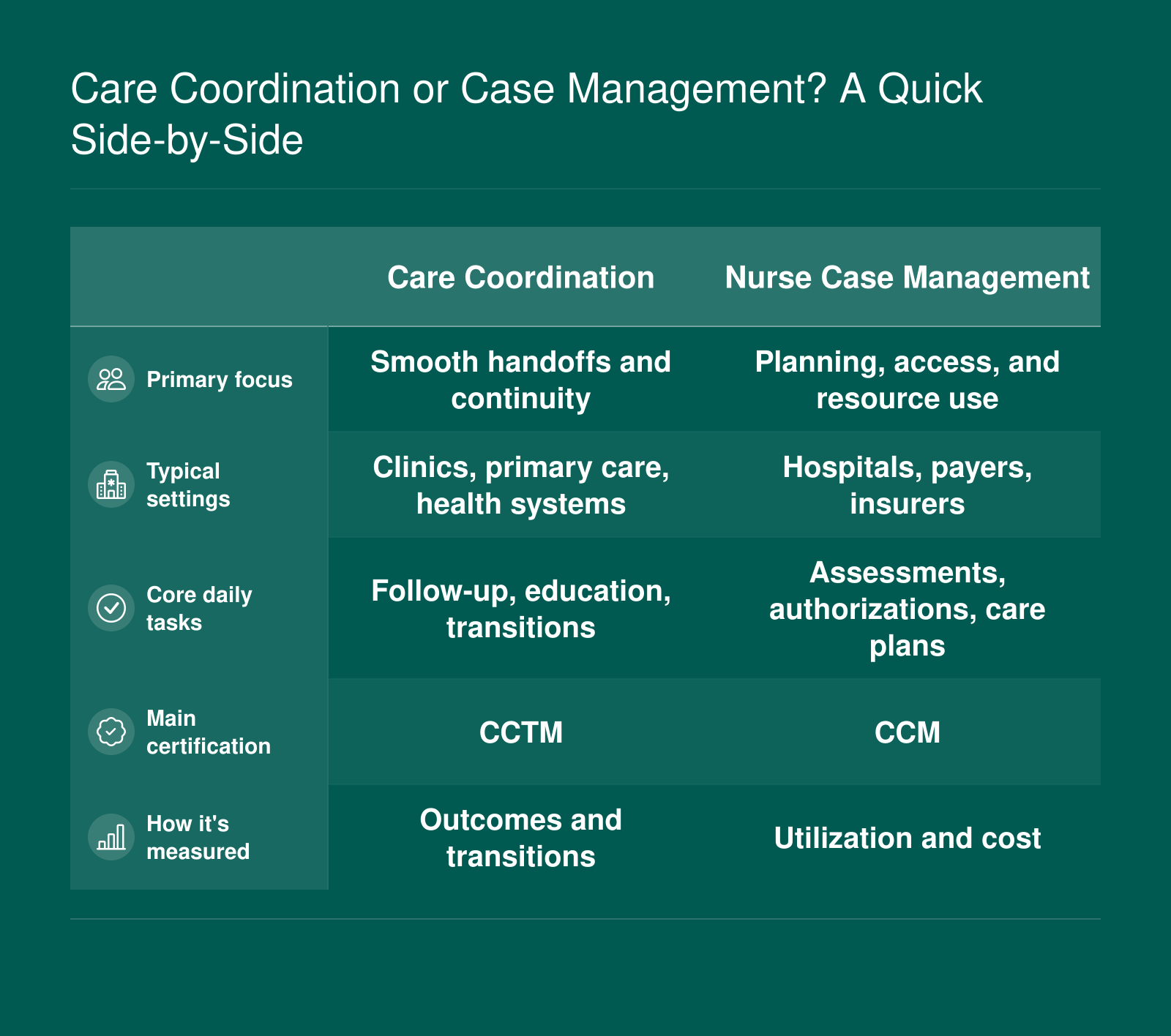
The difference between a care coordination MSN and a case management MSN comes down to emphasis. Case management centers on utilization, authorization, and resource allocation for individual cases: is the stay justified, is the service approved, where does the benefit go? Care coordination centers on continuity: does the plan follow the patient across settings and teams?
In practice the line blurs. Job postings often use the two titles interchangeably, and many roles blend both sets of duties. Read the listed responsibilities rather than the title, and notice whether the week is spent mostly with payers and criteria or with patients and care teams.
Population health sits further along the spectrum. It works at the level of a patient panel or a community, using data to find people at risk and design outreach, rather than managing one patient at a time.
Where Graduates Work
Typical employers include:
- Hospital transition-of-care teams
- Accountable care organizations
- Primary care medical homes
- Health plans and other payers
- Home health agencies
Payer roles tend to tilt toward case management duties, while clinic and hospital roles tilt toward coordination. Knowing which setting you want helps you judge which program's coursework fits.
Care Coordination or Case Management? A Quick Side-by-Side
Both roles sit on the same patient journey, but they pull in different directions. Care coordination follows the patient across handoffs, while case management guards the plan of care and its resources.
Related Articles
Sticker Price vs. Real Price: Tuition, Fees and Practicum Costs
Graduate tuition tells only part of the story, so compare per-credit cost, required credits, and net price after aid, which is an institution-wide average across all students. On a per-credit basis, Capella's GuidedPath is the lowest at $465 while Nebraska Methodist's $588 rate is offset by fewer required credits, making its tuition-only total $22,932 versus $25,110 at Capella; after aid, net price is $17,956 at Capella, $21,863 at Nebraska Methodist, and $26,505 at Stevenson. Budget for hidden costs such as technology fees, clinical and practicum fees, background checks, immersion travel, and preceptor-related charges, then ask your employer about tuition reimbursement, since most students in these programs are working RNs.
| School and program format | Unit price (per credit or billing session) | Required units | Total program cost | Net price after aid | Added costs to budget for |
|---|---|---|---|---|---|
| Capella University, GuidedPath | $465 per credit | 54 credits | $25,110 | $17,956 | Background check $33.70; resource kit $125 |
| Capella University, FlexPath | $2,985 per 12-week billing session | 27 program points | Accelerated $11,940; typical $20,895 | $17,956 | Resource kit $125 |
| Nebraska Methodist College | $588 per credit | 39 credits | Tuition-only $22,932; annual cost estimate $15,000 | $21,863 | N/A |
Online Care Coordination MSN Options and State-by-State Enrollment Limits
Delivery runs online, but the formats differ
The care coordination programs ranked here are built for working nurses and delivered online. Nebraska Methodist College runs its MSN, Care Coordinator track online in 5 to 10 week courses with practicum experiences built in, and admits students in January and August. Stevenson University's Population-Based Care Coordination concentration is 100% online across six 8-week sessions a year. Capella University's MSN in Care Coordination is also fully online with no on-site immersion, and it gives you two formats: FlexPath, which is self-paced, and GuidedPath, which follows a structured term calendar.
None of these schools clearly publishes whether every course is fully asynchronous or whether some sessions meet at fixed times. Ask admissions directly, and ask about the practicum too: Capella requires at least 500 practicum hours, and online delivery never eliminates the in-person supervised clinical requirement.
State authorization is a separate hurdle
Accreditation tells you the degree is sound. State authorization tells you whether the school is legally permitted to enroll you where you live. Most institutions join NC-SARA, which allows distance education across state lines, but NC-SARA is not nursing board approval and does not guarantee a school can accept applicants from your state. California sits outside NC-SARA in 2026 and is handled under its own process. Clinical placement is governed separately again: your practicum has to sit in a state where both you and the school are authorized.
Capella states that applicants in U.S. territories, including Puerto Rico, Guam and the U.S. Virgin Islands, cannot enroll. Beyond that, these schools do not publish a complete state-by-state exclusion list for their care coordination tracks, so do not assume restrictions reported for other nursing programs apply here.
What to do before you apply
The best care coordination MSN programs online are still only available to you if your state is covered. Pull up the school's state authorization page, confirm your state in writing with an enrollment advisor, and ask specifically about clinical placement rules. If you relocate mid-program, check again immediately: a move can disqualify you from continuing.
Getting in: RN-to-MSN and BSN-to-MSN Entry Requirements
Requirements vary by school, so confirm each program's current rules before you apply. These are the checkpoints to expect.
- Active, unencumbered RN licenseMost post-licensure programs here require it, and it should be valid in the state where your clinicals will happen. Herzing's direct-entry route is the exception: it admits applicants with a non-nursing bachelor's degree.
- BSN or ADNA BSN is the standard entry point. Wilkes accepts an ADN. CU Anschutz allows ADN entry for its indirect-care track, with an active RN license and a non-nursing bachelor's. Bridge pathways add bachelor's-level coursework and lengthen time to degree. Wilkes, for example, runs 36 months.
- Minimum GPAThresholds typically run 2.8 to 3.25. Capella sets 2.8 and recommends 3.0. Wilkes and Framingham State ask for 3.0, and Cincinnati recommends 3.25. CU Anschutz has no fixed minimum.
- Clinical work experienceCincinnati requires one year as a US RN at application. Wilkes requires one year by the time NP clinical courses begin. Nevada State prefers one year, and Duquesne requires it before clinical work starts.
- Recommendations and personal statementExpect these at most schools, though exact numbers and prompts differ.
- GRECapella, Wilkes, Walden and Herzing do not require it. CU Anschutz may ask for it if your GPA is below 3.0.
Only 3.4% of eligible Medicare fee-for-service beneficiaries with multiple chronic conditions received Chronic Care Management services in 2019, according to a 2024 peer-reviewed uptake study. Employers need MSN-prepared nurses who can actually launch and run these reimbursable care coordination programs.
Care Coordination programs by state
Compare Care Coordination programs on the data that matters
Explore more Nursing specializations or browse every graduate field.
All Nursing programs