Best Online Master's in Cybercrime Programs
Compare 14 accredited online Cybercrime programs, with graduate earnings, cost, debt, and completion data from IPEDS and the U.S. College Scorecard.

Michigan State University's 30-credit cybercrime and digital investigation master's lists $27,570 in total tuition. Ransomware, payment fraud, and digital evidence now run through ordinary caseloads, and police agencies and corporate investigation teams want staff trained at the graduate level.
Every program below is 100% online, with no hybrid or on-campus requirement. Compare ranked programs on cost, degree structure, career outcomes, and admissions requirements.
The harder call is fit. Some programs lean on criminology and law, others on forensic labs and certification prep, and that split shapes which jobs a degree prepares you for.
Key Points
- In 2027, fully online cybercrime programs blend forensics, criminal justice, and cybersecurity.
- Rankings weigh cost, graduation rates, earnings, and debt, not prestige.
- University of South Florida lists $10,428 graduate tuition, $9,812 net price.
Top 10 Best Fully Online Master's in Cybercrime Programs for 2027
These 10 fully online master's programs in cybercrime and related fields blend digital forensics, criminal justice, and cybersecurity training. The list is ordered by a mix of cost, institutional outcomes, and program details, so a strong name alone is not enough.
Michigan State University
#1East Lansing, MI · $22,000 – $42,000/yr (est.)
Best for: Aspiring federal investigators needing no experience
Michigan State University's online Master of Science in Cybercrime and Digital Investigation focuses on cyberterrorism, cyberwarfare, and the legal frameworks for prosecuting cybercrimes. Students gain hands-on experience with intelligence software and learn to collect and analyze complex data. The program is designed for both technical and nontechnical backgrounds, with no prior cybercrime work experience or GRE required, and can be completed in as few as two years.
- No entrance exam or GRE required
- $26,760 total program tuition
- $892 per credit hour
- 30 total credit hours
- Complete in as few as two years
- Part-time study available
- Faculty include former DHS and FBI practitioners
- Examines cyberterrorism and cyberwarfare
Boston University
#2Boston, MA · $65,000 – $70,000/yr (est.)
Best for: Criminal justice professionals adding digital forensics
Boston University's online Master of Science in Criminal Justice with a concentration in Cybercrime Investigation & Cybersecurity blends criminology theory with applied digital forensics. Coursework covers cybercriminology, digital evidence, risk management, and cybersecurity policy, with hands-on use of industry tools such as EnCase. The 32-credit program offers flexible full- or part-time pacing and can be completed in as few as eight months; federal data show recent graduates earning about $77,600 four years after entry.
- No GRE or entrance exam required
- 32 total credit hours
- Complete in 8 to 16 months
- Full-time and part-time options
- Dual concentration option with Crime Analysis
- Grant-supported curriculum developed with DOJ
- Hands-on use of EnCase and virtual labs
- Median earnings around $77,600 four years after entry
University of Scranton
#3Scranton, PA · ~$12,000/yr (est.)
Best for: Digital forensics aspirants seeking certification preparation
The University of Scranton's online Master of Science in Cybercrime Investigation and Cybersecurity is a 30-credit program built for working professionals and career changers. Students study cyber threat intelligence, digital forensics, ethical hacking, and computer crime law, with labs that align to the NICE Cybersecurity Workforce Framework. The program prepares students for certifications such as CEH, CHFI, and CompTIA Security+ and can be completed in as little as 12 months.
- No entrance exam required
- 30 total credit hours
- Complete in as little as 12 months
- $965 per credit
- Prepares for CEH, CHFI, and CompTIA Security+
- Aligned with NICE Cybersecurity Workforce Framework
- Ethical hacking and penetration testing labs
- 100% online with no campus visits
University of Detroit Mercy
#4Detroit, MI · ~$23,000/yr (est.)
University of Detroit Mercy's fully online Master of Science in Cybercrime sits in the Department of Criminal Justice and examines the intersection of crime, technology, and law. The curriculum includes cybercriminal behavior, digital forensics, and legal frameworks, and is designed for working adults in law enforcement, corporate security, or government. Faculty include experienced practitioners, and the program carries the university's Jesuit and Mercy emphasis on ethical leadership.
- Online master's in cybercrime
- Offered through the Department of Criminal Justice
- Studies cybercriminal behavior and digital forensics
- Faculty include experienced practitioners
- Fully online format
American Public University System
#5Charles Town, WV · $5,000 – $10,000/yr (est.)
American Public University System offers a graduate certificate in cybercrime, a focused alternative for students who want digital forensics skills without committing to a full master's degree. The 18-credit online curriculum covers cyberterrorism, cyberwarfare, stalking, and bullying, and trains students to process digital crime scenes and analyze evidence. Admission can be based on an IT background, relevant work experience, or certain certifications.
- 18 total credit hours
- Covers cyberterrorism and cyberwarfare
- Teaches digital forensics tools
- Admission possible via IT background or work experience
- Shorter alternative to a full master's degree
- Explores compliance and legal issues
Georgia Southern University
#6Statesboro, GA · $5,000 – $10,000/yr (est.)
Georgia Southern University's online Master's in Criminal Justice and Criminology offers an Executive track with a concentration in Cybercrime. The fully online program is designed for working professionals and provides direct access to faculty who research cybercrime. Courses emphasize practical skills for law enforcement, cybersecurity, and criminal justice roles.
- Executive track with cybercrime focus
- Fully online courses
- Fall and spring start dates
- Dedicated faculty contact for cybercrime
Liberty University
#7Lynchburg, VA · ~$9,000/yr (est.)
Liberty University's online Master of Science in Criminal Justice with a concentration in Cybercrime Investigation combines criminal justice theory with advanced cybercrime skills. The 36-credit program covers cybercrime law, advanced investigation techniques, computer security, and digital forensics, and includes a thesis or elective option. The program is offered fully online and allows up to 18 transfer credits.
- 36 total credit hours
- 3.0 GPA minimum
- Thesis or capstone option
- Fully online format
- Focus on cybercrime law and digital forensics
- Up to 18 transfer credits accepted
- Advanced cybercrime investigation training
University of Baltimore
#8Baltimore, MD · $17,000 – $23,000/yr (est.)
University of Baltimore's online M.S. in Cyber Forensics is a STEM-designated, 30-credit program that can be completed in 10 courses. Students gain hands-on experience with forensic investigation techniques, cybersecurity attacks, data recovery, and evidence preservation. The program offers rolling fall admission and a spring deadline, and graduates pursue roles in computer forensics, cyber analysis, and information security.
- No entrance exam required
- 30 total credit hours
- 10 total courses
- STEM-designated program
- Hands-on digital computer lab
- Rolling admissions
- Spring and fall entry
- Fully online delivery
University of New Haven
#9West Haven, CT · ~$20,000/yr (est.)
University of New Haven's online M.S. in Cyber Threat Intelligence and Financial Crimes Investigations is delivered through the Henry C. Lee College of Criminal Justice and Forensic Sciences. The 30-credit program covers the cyber threat intelligence lifecycle, attack vectors, and open-source, deep web, and dark web intelligence. Sworn officers and members of certain financial crime associations may qualify for tuition discounts, and the curriculum was built with law-enforcement input.
- 30 total credit hours
- Four start dates per year
- Fully online option available
- Complete in about ten months or up to two years
- Focus on cyber threats and financial crime investigations
- Tuition discount for sworn officers
- Training in open-source, deep web, and dark web intelligence
- Up to 6 transfer credits accepted
University of South Florida
#10Tampa, FL · ~$10,000/yr (est.)
University of South Florida's online Master of Science in Cybercrime offers two career-focused tracks: Cyber Criminology and Digital Forensic Investigations. The program requires no computer science prerequisites or GRE, and full-time students can finish in about one year. Coursework is generally asynchronous and includes access to the Cybercrime Investigation and Behavioral Research Lab.
- Two concentration options
- 100% online program
- Cybercrime Investigation and Behavioral Research Lab
- Expert faculty from law enforcement
- No computer science prerequisites or GRE
- Full-time students can finish in one year
- Courses generally asynchronous with eight-week formats
- No campus visits required
Cost & outcomes by school
Federal data for the highest-earning Cybercrime programs, independent of the ranking above. Earnings are this field's master's graduates four years after completing, where the Scorecard reports them.
| School | Earnings | Tuition / yr | Debt | Grads/yr | Format |
|---|---|---|---|---|---|
| Utica University NY | $108,561 | $26,750 | $37,746 | 21 | Online |
| University of Baltimore MD | $85,028 | $16,574 | $41,175 | 17 | Online |
| Boston University MA | $77,554 | $67,626 | $105,433 | 19 | Online |
| University of New Haven CT | $68,812 | $19,916 | $40,773 | 58 | Online |
| Georgia Southern University GA | — | $6,646 | — | — | Online |
| Liberty University VA | — | $8,730 | — | — | Online |
| American Public University System WV | — | $8,700 | — | — | Online |
| University of South Florida FL | — | $10,428 | — | — | Online |
| Lasell University MA | — | $12,150 | — | — | Online |
| Michigan State University MI | — | $21,772 | — | 31 | Online |
| University of Scranton PA | — | $11,630 | — | 19 | Online |
| Robert Morris University PA | — | $20,140 | — | 26 | Hybrid |
Sources: U.S. Department of Education. Tuition and graduates: IPEDS. Earnings and debt: College Scorecard, this field's master's graduates; a dash means no figure is reported.
Cost, debt & payoff
Median earnings of this field's master's graduates (4 yrs after completing) vs. their median federal loan debt · U.S. College Scorecard
Across these programs the median graduate earns about $81,291 and finishes with roughly $40,974 in debt — a ratio that clears a common rule of thumb (keep debt below first-year salary). Tuition and debt vary widely school to school, so check the per-school figures in the table above before you shortlist.
Most Affordable Online Cybercrime Master's Programs
Affordability depends on more than the published graduate rate. The University of South Florida reports an in-state graduate tuition of $10,428, an out-of-state rate of $21,126, and a net price of $9,812, but its online MS in Cybercrime uses a flat $575 per-credit rate for all students, so 30 credits total about $17,250 before fees. Champlain College's standard rate is $608 per credit for 30 to 36 credits, and Michigan State University lists a single online rate of $919 per credit for 30 credits. Ask about technology, lab, or proctoring fees not included in posted tuition.
| School | Program | Online Per-Credit Rate | Total Credits | Estimated Online Tuition | Residency Policy | In-State Graduate Tuition | Out-of-State Graduate Tuition | Net Price |
|---|---|---|---|---|---|---|---|---|
| University of South Florida | MS in Cybercrime | $575 | 30 | $17,250 | Flat online rate for all students | $10,428 | $21,126 | $9,812 |
| Champlain College | MS in Digital Forensic Science | $608 | 30 to 36 | $18,240 to $21,888 | One online rate listed; reduced $500 rate for alumni, servicemembers, veterans, and family members; residency not stated | N/A | N/A | N/A |
| Michigan State University | MS in Cybercrime and Digital Investigation | $919 | 30 | $27,570 | One online rate listed; flat-rate language not explicit | N/A | N/A | N/A |
How to Choose: Forensic Labs, Certifications, and Online Format
A strong online master's in cybercrime program should let you work with the same tools investigators use, not just read about them. Hands-on virtual labs build the muscle memory for imaging drives, carving deleted files, and analyzing mobile data.
Forensic tools and hands-on labs
Champlain College's digital forensic science program names FTK Imager, Autopsy, Cellebrite Physical Analyzer, and EnCase EnScript in its coursework. Huddersfield's distance MSc lists FTK Imager and Autopsy.1 Mount Aloysius College's MS in Digital Forensics and Boston University's Metropolitan College both advertise virtual labs, though published pages do not name every tool. Ask whether lab exercises are graded and whether they run in a browser or require a local virtual machine.
Certification alignment
Published program pages rarely state certification preparation directly. The programs below do not explicitly confirm GCFA, GCIH, CFCE, or EnCE exam alignment, and none of the reviewed pages list included exam vouchers. If a credential matters to you, ask whether coursework maps to specific exam objectives and whether a voucher is included.
Format and technology
Huddersfield's 2026-27 MSc is asynchronous, while Champlain structures courses in 7-week terms; confirm whether live sessions are required. The fully online options require no on-campus residency. Budget for hardware: New Haven expects Windows or a Windows VM, reliable storage, a mobile device, and one to two USB devices for extraction practice.2 Huddersfield has listed 4 Mbps internet and 4 GB RAM1; earlier pages specified Windows 10+, macOS 10.13+, or 64-bit Linux.3
Related Articles
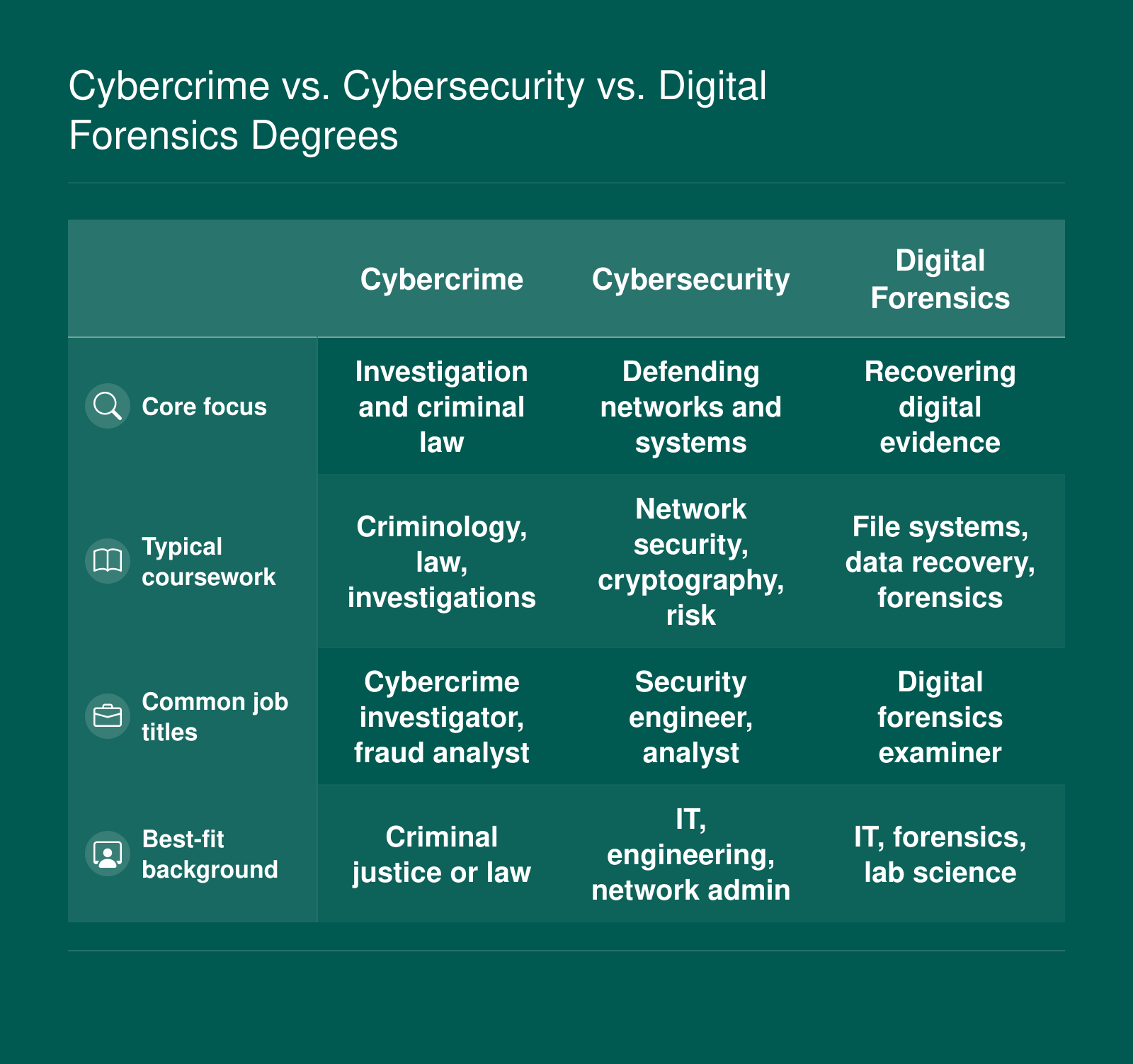
Cybercrime vs. Cybersecurity vs. Digital Forensics Degrees
A cybercrime master's blends criminology, law, and investigation. A cybersecurity master's skews technical and engineering-focused, preparing students for network defense. A digital forensics master's centers on lab-based evidence recovery and analysis.
What Can You Do With a Master's in Cybercrime?
Which jobs actually hire people with online cybercrime master's programs, and what do they pay? The degree sits at the seam between criminal justice and technology, so graduates land on both sides of it.
Common career paths
- Digital forensic examiner: Recovers and authenticates evidence from devices, drives, and cloud accounts for courtroom use.
- Cybercrime investigator or federal agent: Works fraud, intrusion, and exploitation cases for a police department, state task force, or a federal agency. Detectives and criminal investigators earned a median of $93,790 in May 2025, though employment nationally is projected to stay essentially flat through 2035, according to Cybersecurity Job Market Statistics.
- Fraud or financial crimes analyst: Traces illicit payments and account takeovers inside banks, payment processors, and insurers.
- Information security analyst: The highest-paying common destination, with a median of $129,180 in May 2025 and 21% projected growth from 2025 to 2035, roughly 14,100 openings a year, according to the Occupational Outlook Handbook: Information Security Analysts.
- Incident response specialist: Contains active breaches and reconstructs how attackers got in.
Is it worth the cost?
Five years after finishing, graduates of Boston University's criminal justice program reported median earnings of $62,236, University of New Haven's $65,802, and University of Baltimore's $83,188. Against Baltimore's in-state tuition near $10,000, that return is strong. Against a sticker price in the $50,000 range, the math depends on whether you move into the security analyst track or stay in public-sector investigation.
Admissions Requirements for Online Cybercrime Master's Programs
Admissions requirements vary by program, but online cybercrime master's degrees share several common expectations.
- Bachelor's degree and GPAA bachelor's degree from a regionally accredited school is the baseline. Several programs here list a minimum GPA around 2.5–3.0, with some allowing case-by-case review below the stated floor.
- GRE/GMATA number of programs do not require graduate admissions tests. Where a test policy is not published, confirm directly with the program before assuming it is required.
- Technical backgroundA computer science or IT degree is rarely required. Some programs expect prior knowledge in computing, digital forensics, or criminal justice, and bridge courses may be available for students without that background.
- Application documentsCommon materials include transcripts, a personal statement, a résumé or CV, and one or two recommendation letters. Law-enforcement-oriented tracks may have additional screening, so check directly.
- Deadlines and start termsFormats vary: some programs use rolling review, while others set fixed dates for fall, spring, or summer starts, often with multiple entry points per year.
Cybercrime programs by state
Online Cybercrime Master's FAQs
Quick answers about admissions, accreditation, timelines, and career moves.
Do I need a computer science background for an online cybercrime master's?
Are online cybercrime master's programs accredited?
How long does an online master's in cybercrime take?
Can a cybercrime master's help me move from patrol work into a detective or federal investigator role?
Compare Cybercrime programs on the data that matters
Explore more Criminal Justice & Law specializations or browse every graduate field.
All Criminal Justice & Law programs