Most Affordable Master's in Cybercrime Programs
Compare 16 accredited most affordable Cybercrime programs, with graduate earnings, cost, debt, and completion data from IPEDS and the U.S. College Scorecard.

Affordability in cybercrime graduate study depends on what you are comparing. Average net price runs from roughly $9,600 at American Public University to about $32,600 at the University of Scranton.
Most programs below are online or hybrid, so working investigators, analysts, and IT staff can keep earning while enrolled.
The lowest figure belongs to an 18-credit graduate certificate, not a full degree, so cost per completed credential is the fairer yardstick.
Key Points
- Michigan State's online cybercrime master's costs about $27,570 before textbooks.
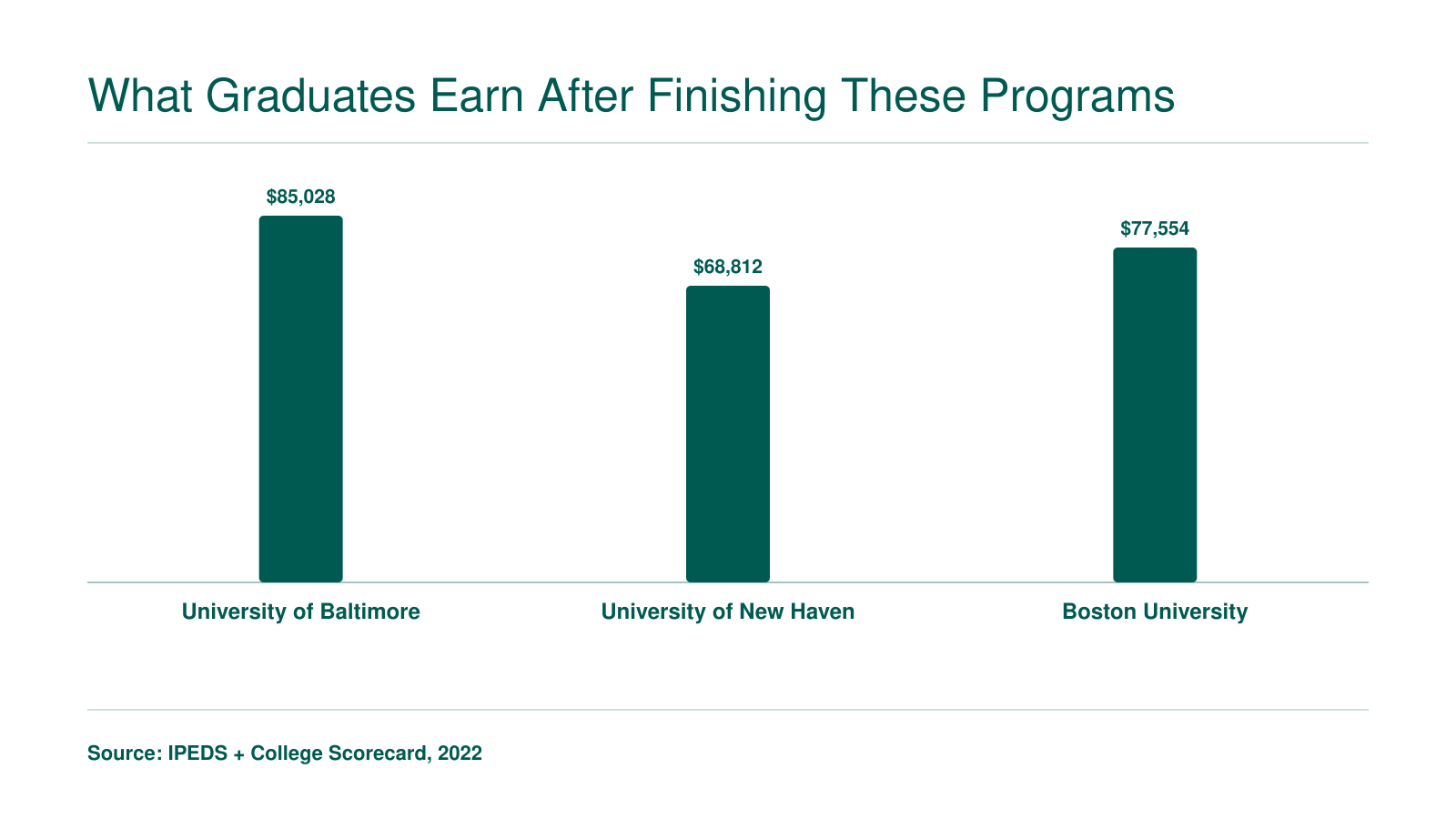
- Graduates' median earnings four years later ranged from $68,812 to $85,028.
- CyberCorps Scholarship for Service pays $37,000 annually plus tuition.
The 10 Most Affordable Master's in Cybercrime Programs for 2027
We ranked these programs with net price and financial aid as the primary screen, so the list favors schools where the graduate credential is genuinely affordable. The cards below call out delivery format, relevant concentrations, and any published per-credit or total tuition figures. A couple of shorter certificate options appear because they stack toward a master's and keep the entry cost low.
American Public University System
#1Charles Town, WV · $5,000 – $10,000/yr (est.)
Best for: Budget-focused learners needing online format
American Public University System appears here for its low-cost, 18-credit Graduate Certificate in Cybercrime, which can be completed fully online. A standard rate of $470 per credit hour is reported, with possible employer or military discounts. The school graduates 57% of students institution-wide.
- 18 total credit hours
- Covers cyber terrorism and warfare
- Teaches digital forensics tools
- No full degree commitment
- Admission via IT background or work experience
- Explores compliance and legal issues
Georgia Southern University
#2Statesboro, GA · $5,000 – $10,000/yr (est.)
Best for: Working professionals wanting flexible starts
Georgia Southern University offers an online Master's in Criminal Justice and Criminology with an Executive track concentration in Cybercrime. In-state graduate tuition is about $4,488 per year and out-of-state about $16,200, making residency a big lever. The program starts fall and spring and gives working professionals direct access to cybercrime faculty. The school graduates 55% of students institution-wide.
- Fully online executive track
- Cybercrime concentration
- Starts fall and spring
- Direct access to cybercrime faculty
- Post-bac certificate can waive GPA and fee
University of Baltimore
#3Baltimore, MD · $17,000 – $23,000/yr (est.)
Best for: STEM-oriented students avoiding entrance exams
The University of Baltimore's M.S. in Cyber Forensics is a 30-credit, fully online STEM-designated program with no entrance exam. In-state graduate tuition is about $7,590 per year and out-of-state about $21,582, though regional in-state rates may apply to selected out-of-state students. The program emphasizes hands-on digital forensics and can be completed from anywhere. The school graduates 38% of students institution-wide.
- 30 total credit hours
- 10 total courses
- Fully online delivery
- STEM-designated program
- No entrance exam required
- Hands-on digital computer lab
- Rolling fall admission
University of Detroit Mercy
#4Detroit, MI · ~$23,000/yr (est.)
University of Detroit Mercy offers an online Master of Science in Cybercrime through its Department of Criminal Justice. The curriculum explores cybercriminal behavior, digital forensics, and legal frameworks, delivered fully online for working adults. Graduate tuition is listed at $32,946 per year for both in-state and out-of-state students. The school graduates 67% of students institution-wide.
- Fully online format
- Department of Criminal Justice
- Covers cybercriminal behavior, digital forensics, and legal frameworks
- Designed for working adults
- Faculty practitioners from law enforcement
Liberty University
#5Lynchburg, VA · ~$9,000/yr (est.)
Liberty University's online Criminal Justice M.S. offers a Cybercrime Investigation concentration with 36 credit hours and a thesis or capstone option. The program blends cybercrime law, digital forensics, and advanced investigation while allowing up to 18 transfer credits. Graduate tuition is listed at $15,297 per year for both in-state and out-of-state students. The school graduates 65% of students institution-wide.
- 36 total credit hours
- 3.0 GPA minimum
- Fully online format
- Thesis or capstone option
- Focus on cybercrime law and digital forensics
- Up to 18 transfer credits
Michigan State University
#6East Lansing, MI · $22,000 – $42,000/yr (est.)
Michigan State University's online Cybercrime and Digital Investigation M.S. is a 30-credit program that can be finished in as few as two years. Published figures list $892 per credit and $26,760 total program tuition, with no entrance exam or work experience required. The school graduates 81% of students institution-wide.
- 30 total credit hours and 10 courses
- No entrance exam required
- Part-time available
- 100% online delivery
- Faculty from DHS, FBI, and DoD
- Hands-on intelligence software training
- $26,760 total program tuition
Robert Morris University
#7Moon Township, PA · ~$20,000/yr (est.)
Robert Morris University offers a hybrid M.S. in Cyber Investigations and Intelligence with on-campus lab nights and summer courses online. The 30-credit program includes a dedicated non-attributed computer lab and capstone investigation. Graduate tuition is listed at $34,360 per year for both in-state and out-of-state students, and the school graduates 66% of students institution-wide.
- 30 total credit hours
- Hybrid delivery with on-ground lab nights
- Summer courses online
- Dedicated non-attributed computer lab
- 3.0 GPA and two recommendation letters required
- Capstone investigation required
Neumann University
#8Aston, PA · ~$11,000/yr (est.)
Neumann University's online M.S. in Forensic Accounting and Cybercrime blends accounting, fraud examination, and digital forensics into 30 credits, with no GMAT or GRE required. The program can be completed in 18 months and is accredited by ACBSP. Graduate tuition is listed at $37,020 per year for both in-state and out-of-state students. The school graduates 54% of students institution-wide.
- 30 total credit hours
- Fully online delivery
- 18-month completion
- No GMAT or GRE required
- ACBSP accredited
- Faculty include former IRS and FBI agents
- Prepares for CPA exam hours
Lasell University
#9Newton, MA · ~$12,000/yr (est.)
Lasell University's online M.S. in Criminal Justice includes a Cybercrime and Cyber Criminology concentration designed for students without a technical background. Published per-credit cost is $709 for the 36-credit program, and Quinn Bill certification may boost law-enforcement pay. The school graduates 59% of students institution-wide.
- 36 total credit hours
- $709 per credit
- Fully online format
- Quinn Bill certified
- 8 or 16-week modules
- No GMAT/GRE required
- Scholarships for 3.2+ GPA
University of Scranton
#10Scranton, PA · ~$12,000/yr (est.)
The University of Scranton's online Cybercrime Investigation and Cybersecurity M.S. is a 30-credit program that can be completed in as little as 12 months. Published per-credit tuition is $965, and the curriculum aligns with the NICE Cybersecurity Workforce Framework. The school graduates 80% of students institution-wide.
- 30 total credit hours
- $965 per credit
- Complete in as little as 12 months
- No GRE required
- Aligned with NICE Cybersecurity Framework
- Prepares for CompTIA Security+ and CySA+
- Ethical hacking and penetration testing labs
Cost & outcomes by school
Federal data for the highest-earning Cybercrime programs, independent of the ranking above. Earnings are this field's master's graduates four years after completing, where the Scorecard reports them.
| School | Earnings | Tuition / yr | Debt | Grads/yr | Format |
|---|---|---|---|---|---|
| Utica University NY | $108,561 | $26,750 | $37,746 | 21 | Online |
| University of Baltimore MD | $85,028 | $16,574 | $41,175 | 17 | Online |
| Boston University MA | $77,554 | $67,626 | $105,433 | 19 | Online |
| University of New Haven CT | $68,812 | $19,916 | $40,773 | 58 | Online |
| Georgia Southern University GA | — | $6,646 | — | — | Online |
| University of Alabama at Birmingham AL | — | $8,640 | — | 10 | Campus |
| American Public University System WV | — | $8,700 | — | — | Online |
| Liberty University VA | — | $8,730 | — | — | Online |
| University of South Florida FL | — | $10,428 | — | — | Online |
| Florida State University FL | — | $10,553 | — | 30 | Campus |
| Neumann University PA | — | $11,320 | — | 3 | Online |
| University of Scranton PA | — | $11,630 | — | 19 | Online |
Sources: U.S. Department of Education. Tuition and graduates: IPEDS. Earnings and debt: College Scorecard, this field's master's graduates; a dash means no figure is reported.
Cost, debt & payoff
Median earnings of this field's master's graduates (4 yrs after completing) vs. their median federal loan debt · U.S. College Scorecard
Across these programs the median graduate earns about $81,291 and finishes with roughly $40,974 in debt — a ratio that clears a common rule of thumb (keep debt below first-year salary). Tuition and debt vary widely school to school, so check the per-school figures in the table above before you shortlist.
What a Cybercrime Master's Really Costs After Fees and Aid
Tuition alone understates the total cost of an online cybercrime master's degree. Michigan State's online program at $919 per credit works out to about $27,570 for 30 credits, yet textbooks are not included. The school also charges a $75 application fee, roughly $20 per semester in student services fees, and a recreation and wellness fee of $85 to $170 per semester. The program page lists the same rate and total, so confirm the current figure with the school.
In-State vs. Out-of-State
Residency matters at several public schools here. Georgia Southern lists $6,646 in-state against $22,414 out-of-state, and USF lists $10,428 against $21,126. UCF's online master's in digital forensics is $327.32 per credit in-state and $1,234.15 out-of-state, or about $9,820 versus $37,025 for 30 credits (another listing shows slightly different rates). Schools with one rate for everyone include UMGC at $694 per credit, about $20,820 for 30 credits before fees, and American Public University.
Net Price Is an Estimate
The net price figures for each school are institution-wide averages after grant aid. Treat them as rough guides, not a personal quote. Ask each program for a full cost sheet that itemizes technology, distance-learning, and software charges.
Online vs. Campus Cybercrime Master's: Format, Length, and Cost
Michigan State University's MS in Cybercrime and Digital Investigation is fully online, requires 30 credits, and is designed to finish in 24 months at $919 per credit, about $27,570 total. American Public University's MS in Cybersecurity Studies uses a 36-credit curriculum and accepts up to 15 transfer credits, which can shorten the time and lower the cost. Most online cybersecurity master's programs below are entirely online, though Robert Morris University's Cyber Investigations and Intelligence M.S. is hybrid and includes on-ground lab nights. A 100% online format avoids relocation and lost income, but some schools add distance learning fees, so compare the final bill rather than only the sticker tuition. Hands-on digital forensics work may still require virtual lab software or a short campus residency. Michigan State, for example, offers an optional one-week intensive elective in East Lansing, while other programs rely on remote virtual labs.
What Graduates Earn After Finishing These Programs
For the schools shown, median earnings four years after finishing ranged from $68,812 to $85,028. Median federal debt after finishing for these graduates ranged from $40,773 to $105,433.
Related Articles
Can You Earn a Cybercrime Master's for Free? Cybercorps SFS and Other Funding
CyberCorps Scholarship for Service pays a $37,000 stipend per academic year to graduate students, plus tuition and required education fees, for up to three years.1 Meal plans, housing, and parking are excluded, and extras like books, travel, and health insurance vary by school.
The catch is service. You owe one year of government cybersecurity work for each year of support, usually with a federal employer, and a summer government internship is required.2 Fail to complete the obligation and the funding can become a debt you must repay.1
Who Qualifies
- Citizenship: U.S. citizen or lawful permanent resident.1
- Enrollment: Full-time study at a participating school with a recognized cybersecurity designation.3
- Clearance: Suitability for a security clearance if the job requires one.
Awards are competitive, and each university sets its own GPA bar (Binghamton lists 3.3 for graduate students,1 UAH 3.22).
Other Options
The DoD Cyber Service Academy, formerly the DoD Cyber Scholarship Program, covers full tuition in exchange for DoD civilian service.4 Graduate stipends differ by school, from $32,000 at UAH2 to $34,000 at Augusta.4 Also check employer tuition assistance, the GI Bill, and Yellow Ribbon matching at your school.
CyberSeek's June 2025 Cybersecurity Supply and Demand Report counted 514,359 U.S. cybersecurity job postings between May 2024 and April 2025. During that period, roughly 26 percent of U.S. cybersecurity roles were vacant, which signals steady demand for trained digital investigators.
Accreditation, Admissions, and Technical Prerequisites
- Regional accreditationChoose a school that is regionally accredited by an agency such as the New England Commission of Higher Education (NECHE). Boston University holds NECHE accreditation, and regional accreditation is essential for federal aid and employer recognition.
- NSA/DHS CAE designationThe NSA/DHS National Center of Academic Excellence in Cyber Defense (CAE-CD) or Cyber Operations (CAE-CO) is a useful program-level quality signal. For example, Old Dominion University holds CAE-CD, CAE-CO, and CAE-R designations.
- GPA and GRE policiesMichigan State University lists a 3.0 minimum GPA. The GRE is not required at University of New Haven and University of South Florida, so test waivers are common in this field.
- Prerequisites and bridge coursesA bachelor’s degree is typically required. Michigan State accepts a bachelor’s degree in any field, but applicants without a computing background may need bridge coursework in networking, programming, or statistics.
- Transfer credits and deadlinesTransfer limits vary by program. Michigan State allows up to nine graduate credits with approval, and its application deadlines are March 30 (Summer), June 15 (Fall), and October 30 (Spring).
How We Ranked the Most Affordable Cybercrime Master's Programs
Cost comparisons in graduate education are only as good as the federal data behind them, and that data has real gaps. Rankings here draw on IPEDS and College Scorecard figures, weighted heavily toward net price and financial aid. Institution-wide graduation rate and program-level outcomes count as secondary factors.
Keep the limits in mind. The net price shown for each school is averaged across all students, so your own cost may run higher or lower. Graduation rates cover the whole school, not the cybercrime program specifically. Earnings appear only where Scorecard publishes program-level data.
Tuition changes yearly and varies by residency and format, so confirm current rates with each school before you apply.
Cybercrime programs by state
Frequently Asked Questions About Affordable Cybercrime Master's Programs
Is a master's in cybercrime worth it?
What is the cheapest online master's in cybersecurity?
Are there accredited online cybercrime master's programs?
What can you do with a master's in cybercrime?
Compare Cybercrime programs on the data that matters
Explore more Criminal Justice & Law specializations or browse every graduate field.
All Criminal Justice & Law programs