Best Executive MBA Programs in Massachusetts
Compare 7 accredited Executive MBA programs in Massachusetts at 5 schools, with graduate earnings, cost, debt, and completion data from IPEDS and the U.S. College Scorecard.
Executive MBA programs in Massachusetts range from MIT's 20-month weekend format to Nichols College's $20,000 total-tuition program, so the price of entry varies enormously. Boston-area names carry weight with employers, but a part-time degree taken while working has to pay back in promotions and pay.
Campus, online, and hybrid programs sit together here, compared on cost and graduate outcomes rather than brand. Suffolk University graduates report median earnings of $131,472 five years out.
Price and pay do not move in lockstep.
Key Points
- Suffolk University graduates earn a median $131,472 five years out.
- Nichols College pairs the lowest debt, $29,640, with $97,885 median earnings.
- Check each admissions page, since GMAT and GRE waivers vary by school.
Top-Ranked Executive MBA Programs in Massachusetts
Massachusetts has fewer executive MBA options than its reputation suggests. Our data returns seven program listings across five schools, so this list stops there rather than padding to ten. Where a school appears with more than one listing, the differences in format or concentration are explained on its card.
Brandeis University
#1Waltham, MA · $60,000 – $65,000/yr (est.)
Best for: Practicing physicians moving into healthcare leadership
Brandeis offers its Executive MBA through the Heller School, and it is open only to practicing physicians and dentists. The hybrid format combines online coursework with residential sessions, and the curriculum centers on health policy, economics, leadership, and operations. The school graduates 86% of its students, the second-highest rate on this list. It is a specialized choice rather than a general executive MBA.
- 16-month hybrid program built for practicing physicians
- Open to MDs, DOs, DMDs, DDSs, and DPMs
- Four 10-day residential sessions plus online coursework
- CME credits offered during on-campus sessions
- Curriculum covers health policy, economics, operations, and innovation
- Rolling admissions
Hult International Business School
#2Cambridge, MA · ~$56,000/yr (est.)
Best for: Managers wanting international residencies
Hult's Cambridge campus offers a part-time hybrid Executive MBA, though the residential weekends are held in London or Dubai rather than in Massachusetts. Hult's materials describe it as a two-year program with a capstone, electives in areas like AI and analytics, and Coursera certificates. The school graduates 67% of its students. It suits managers who want an international cohort more than a local campus experience.
- Two-year part-time hybrid format
- Study weekends in London or Dubai
- Two start dates per year, spring and fall
- Capstone project in the final term
- Coursera certificates included
- $95 application fee
- Same two-year hybrid format with a Business Analytics concentration
- Work experience required
- Capstone project in the final term
- Part-time option available
- Coursera certificates included
Suffolk University
#3Boston, MA · ~$38,000/yr (est.)
Best for: Seasoned leaders wanting small cohorts
Suffolk runs a 16-month, cohort-based Executive MBA on its Boston campus, with classes every other Friday and Saturday so students can keep working. It describes itself as New England's longest-running executive MBA. The school graduates 61% of its students, and the program is test optional.
- 16-month campus program with 45 credit hours
- Classes every other Friday and Saturday
- Cohort of 10 to 18 students
- Test optional, with rolling admissions
- Week-long travel seminars on global business and public policy
- Integrative capstone required
- Merit and need-based aid available
Nichols College
#4Dudley, MA · ~$1,000/yr (est.)
Nichols College, in Dudley, offers a fully online Executive MBA for professionals with five or more years of experience. The 10-course, 18-month cohort format is aimed at working managers who cannot relocate or attend weekend residencies. The school graduates 63% of its students. It is the most flexible format on this list and the only one that is entirely online.
- Fully online, 18-month program
- 10 total courses in a cohort structure
- Work experience required
- Employer tuition reimbursement supported
- Focus on strategic thinking, finance, and leadership
- Career coaching and job search assistance
Massachusetts Institute of Technology
#5Cambridge, MA · ~$62,000/yr (est.)
MIT Sloan's Executive MBA is a 20-month campus program for mid-career leaders, with weekend sessions every two to three weeks. It emphasizes data-driven analysis and hands-on Action Learning labs, and students can cross-register at Harvard. The school graduates 96% of its students, the highest rate here. MIT also has the most selective admissions on this list and the steepest total cost of attendance.
- 20-month campus program
- 26 weekend sessions every two to three weeks
- Four executive modules of six to eight days each
- Action Learning labs: O-Lab, GO-Lab, and IDEA Lab
- Cross-registration at Harvard and MIT
- Capstone module on leading with impact
- Targets professionals with 10 or more years of experience
Cost & outcomes by school
Federal data for the highest-earning Executive MBA programs, independent of the ranking above. Earnings are this field's master's graduates four years after completing, where the Scorecard reports them.
| School | Earnings | Tuition / yr | Debt | Grads/yr | Format |
|---|---|---|---|---|---|
| Suffolk University MA | $125,542 | $38,448 | $42,540 | 116 | Campus |
| Brandeis University MA | $102,843 | $60,153 | $48,240 | 67 | Hybrid |
| Hult International Business School MA | $98,145 | $55,570 | $73,590 | 240 | Hybrid |
| Nichols College MA | $91,050 | $1,200 | $29,640 | 85 | Online |
| Massachusetts Institute of Technology MA | — | $62,396 | — | — | Campus |
Sources: U.S. Department of Education. Tuition and graduates: IPEDS. Earnings and debt: College Scorecard, this field's master's graduates; a dash means no figure is reported.
Cost, debt & payoff
Median earnings of this field's master's graduates (4 yrs after completing) vs. their median federal loan debt · U.S. College Scorecard
Across these programs the median graduate earns about $98,145 and finishes with roughly $60,915 in debt — a ratio that clears a common rule of thumb (keep debt below first-year salary). Tuition and debt vary widely school to school, so check the per-school figures in the table above before you shortlist.
How We Rank Massachusetts Executive MBA Programs and Why AACSB Accreditation Matters
Prestige rankings lean on reputation surveys; our approach to Executive MBA programs leans on verifiable numbers. We weigh what the program costs you, how reliably students finish, and the earnings and debt that graduates actually carry, drawn from federal data rather than opinion polls. The goal is a picture of value you can act on, not a brand hierarchy.
Accreditation among the schools here
Every business school behind the Executive MBA programs on this list appears in the AACSB Accredited Schools Directory: MIT Sloan, Suffolk University's Sawyer Business School, Hult International Business School, Nichols College, and Brandeis University. AACSB is the benchmark standard for business and accounting education, and all of these institutions meet it.
Why that matters for an EMBA
For a working professional, AACSB status is practical, not cosmetic. Many employers tie tuition reimbursement to an accredited program, and credit transfer between schools often hinges on it. If your company funds part of your degree, confirm the specific policy, but an AACSB-accredited EMBA is far more likely to qualify.
Executive MBA Cost and Massachusetts Employer Demand for MBA Graduates
Rows run from lowest to highest institution-wide net price after aid, using 2024 federal data. The graduate tuition column is the figure reported in that dataset, not a quote for the full EMBA. For example, Nichols lists $20,000 total program tuition on its own program page, so its reported figure rests on a different basis. MIT is the one school here that prices the whole degree as a lump sum: $222,205 for the 20-month Class of 2028, which matriculates in September 2026, with fees included and about $20,000 of hotel costs excluded. Net price is an institution-wide average after aid, not an EMBA-specific quote, and Suffolk has paused new EMBA enrollment for Fall 2026. Massachusetts employers in finance, biotech, healthcare, and tech are known to recruit MBA-level managers, but we found no current state job-openings figure to cite, so read demand as a general pattern, not a measured number.
| School | Program | Graduate tuition (reported, federal data) | Net price after aid (institution-wide, 2024 data) | Format |
|---|---|---|---|---|
| Massachusetts Institute of Technology | MIT Executive MBA | $62,396 | $20,111 | Campus |
| Suffolk University | Executive MBA (new enrollment paused for Fall 2026) | $38,448 | $29,618 | Campus |
| Nichols College | Executive MBA | $1,200 | $33,036 | Online |
| Brandeis University | Executive MBA for Physicians | $60,153 | $35,736 | Hybrid |
| Hult International Business School | Hybrid Executive MBA | $55,570 | $45,447 | Hybrid |
Which Massachusetts Executive MBA Programs Waive the GMAT or GRE
Many executive MBA programs accept the GMAC Executive Assessment in place of the GMAT, and some drop standardized testing for experienced applicants. The table reflects what each school's official admissions page states in 2026. Where we found no policy published for the Executive MBA itself, the table says so rather than guessing, so confirm those details with the admissions office before you apply.
| School | EMBA Program | GMAT/GRE Policy | Executive Assessment Accepted | Waiver Criteria |
|---|---|---|---|---|
| Massachusetts Institute of Technology | MIT Executive MBA | Not required, but scores may be submitted | Not required, but may be submitted | No waiver needed because no test is required |
| Suffolk University | Suffolk University Executive MBA | Waivable: not required with at least seven years of professional experience | No published policy | Minimum of seven years of professional experience |
| Hult International Business School | Hult Executive MBA | No published policy for the Executive MBA (the Global One-Year MBA does not mandate scores) | No published policy | No published policy for the Executive MBA |
| Brandeis University | Brandeis Executive MBA | No published policy | No published policy | No published policy |
| Nichols College | Nichols College Executive MBA | No published policy | No published policy | No published policy |
Related Articles
Online and Hybrid Executive MBA Options in Massachusetts
An Online Executive MBA or hybrid executive MBA moves part of the coursework off campus so working managers can keep their jobs, but the amount of travel still varies a lot by school. Nichols College is listed as online, while Hult International Business School and Brandeis University (its Executive MBA for Physicians) are hybrid. MIT and Suffolk University are campus-based MBA in Massachusetts options.
Schedules and class profiles
MIT's program runs 26 weekend sessions every two to three weeks, plus four residential modules of roughly a week each and a global project. The Class of 2026 averages 17 years of work experience and age 41. Suffolk's format is classes every other Friday and Saturday, with a reported average of 15 years of experience. Its age figure of 38 comes from a 2022 survey, and the school paused new enrollment for Fall 2026. Hult describes a part-time hybrid format, and Brandeis combines in-person and online coursework over 16 months. Neither publishes a class profile.
Employer sponsorship
None of these schools publishes the share of sponsored students. Nichols notes that employer reimbursement is supported. Ask admissions whether a support letter is required.
Tip for commuters
If you live outside Boston, count the overnight stays. MIT's week-long modules and Suffolk's alternating weekends add lodging and travel costs that online delivery avoids.
Executive MBA Salary Outcomes by Massachusetts School
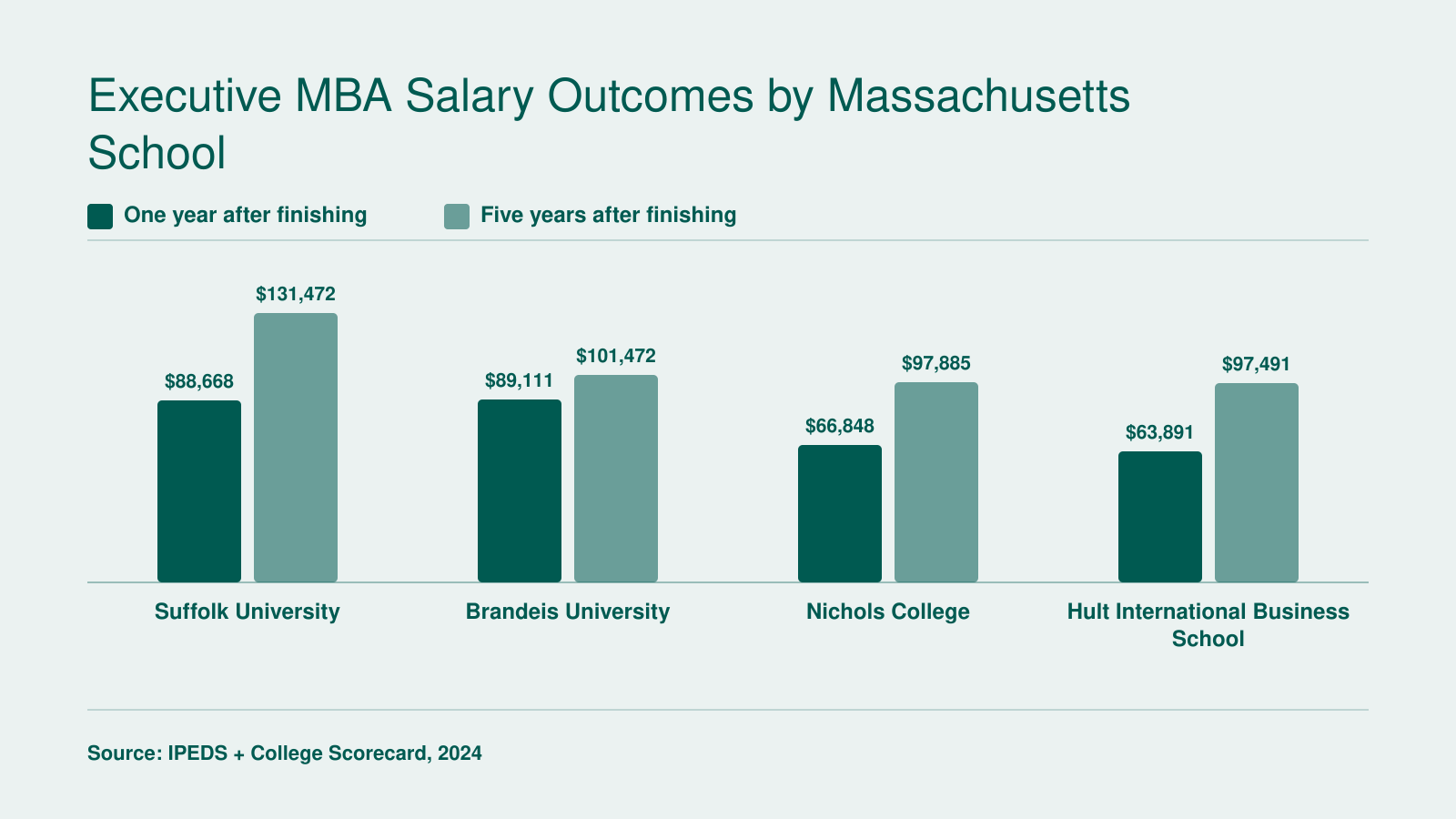
Median earnings for program graduates, one year and five years after finishing. Suffolk University leads at $131,472 five years out, with median debt of $42,540. Nichols College graduates borrow the least ($29,640) and earn $97,885, while Hult International Business School pairs the highest debt ($73,590) with the lowest five-year figure. Brandeis University's figure reflects its Executive MBA for Physicians. MIT reports no program-level earnings, so it is not plotted.
Frequently Asked Questions About Executive MBA Programs in Massachusetts
How much does an executive MBA cost in Massachusetts?
Is the MIT Executive MBA worth it?
When are application deadlines for Massachusetts executive MBA programs?
Can my employer pay for an executive MBA?
Compare Executive MBA programs on the data that matters
Explore more MBA specializations or browse every graduate field.
All MBA programs