Most Affordable Executive MBA Programs
Compare 280+ accredited most affordable Executive MBA programs at 230+ schools, with graduate earnings, cost, debt, and completion data from IPEDS and the U.S. College Scorecard.
Published in-state graduate tuition among the schools ranked here runs from $6,693 at Florida Atlantic University to $14,476 at UCLA, with out-of-state figures between $8,416 and $30,130. Compare that with the elite EMBAs that can top $200,000 in total tuition.
Program totals show the same gap. The University of Texas at El Paso lists $45,000 for its full program, and the University of Florida lists $62,807. Baruch College's all-inclusive fee comes to $86,500.
Most of these programs are public universities, and several hold AACSB accreditation. Price differences at this level usually reflect state subsidies, not weaker curricula.
Key Points
- Median earnings at the top-ranked program reach $266,651 five years after finishing.
- Residency travel can outweigh low 2027 tuition, so compare total cost.
- IRS Section 127 caps tax-free employer tuition assistance at $5,250.
10 Lowest-Cost Executive MBA Programs Ranked for 2027
Price led the scoring: each school earned its spot by keeping the post-aid bill low, then had to show solid completion and earnings numbers to stay on the list. The programs below pair modest posted tuition with institutional completion rates and graduate median earnings where available, so you can see which budget EMBA actually delivers. Use the residency and format details alongside the cost figures to compare real out-of-pocket commitment.
CUNY Bernard M Baruch College
#1New York, NY · $11,000 – $21,000/yr (est.)
Best for: NYC working professionals seeking weekend cohort
Baruch College's Saturday-only Executive MBA keeps experienced professionals on a cohort schedule with an international study tour. Institution-wide, the school graduates about 72% of students, and its average net price after aid is roughly $3,000, an institution-wide figure rather than an individual EMBA quote. The all-inclusive $86,500 fee covers textbooks and meals, and 75% of graduates are promoted within two years.
- 22-month Saturday-only cohort structure
- 48 total credit hours
- All-inclusive $86,500 fee covers textbooks and meals
- 75% of graduates promoted within two years
- International study tour included
- Average 13 years of professional experience in cohort
- 49% women in cohort
California State University-Fresno
#2Fresno, CA · ~$9,000/yr (est.)
Best for: California executives needing Saturday classes
Cal State Fresno's MBA for Executives is built for seasoned managers, requiring at least ten years of experience and three years in management. The 17-month cohort meets Saturdays on campus and includes a required 10-day international trip. The school graduates about 57% of students institution-wide, while average net price after aid runs near $7,000.
- AACSB accredited
- 17-month cohort requiring 10 years experience
- Requires 3 years in management
- Saturday on-campus classes
- 10-day international trip required
- Cohort capped at 35 executives
- 2.5 weeks of prerequisite classes
California State University-Stanislaus
#3Turlock, CA · ~$10,000/yr (est.)
Best for: Central California leaders wanting accelerated format
Stanislaus State's Executive MBA offers a compact 15-month Saturday-only format for professionals with at least five years of experience. The school graduates about 53% of students institution-wide, and average net price after aid is about $6,100. The small cohort model emphasizes real-world application and leadership.
- 15-month Saturday-only cohort
- 5+ years of work experience required
- Part-time available
- Top 6% globally accredited business school
- Small cohort-based structure
California State University-Long Beach
#4Long Beach, CA · $9,000 – $19,000/yr (est.)
Cal State Long Beach's Executive MBA provides flexibility with a 2-4 year timeline and elective-driven curriculum. The school graduates about 69% of students institution-wide, and average net price after aid is around $10,400. Small classes of 25-35 students and an annual study abroad trip strengthen the offering.
- Small class sizes of 25-35 students
- Annual study abroad trip
- Dedicated program advisors and career coaching
- Elective courses allow specialization
- Bachelor's GPA minimum of 2.8
- Fall and spring start dates
- One-on-one career coaching and alumni mentorship
University of Florida
#5Gainesville, FL · ~$13,000/yr (est.)
University of Florida's Executive MBA pairs a 21-month schedule with an AI and analytics focus, weekend classes, and a required global immersion. The school graduates about 91% of students institution-wide, and average net price after aid is around $6,500. The $62,807 total program tuition is 49% lower than comparable public options.
- $62,807 total program tuition
- 21-month, 48-credit curriculum
- No GMAT or GRE required
- Weekend classes every three weeks
- Required global immersion experience
- AI and analytics integrated curriculum
- Optional Scrum and Lean Six Sigma certifications
- Military benefits and employer reimbursement supported
Florida International University
#6Miami, FL · ~$11,000/yr (est.)
Florida International University's Professional MBA for Executives runs 16 months in a hybrid format with Saturday classes at FIU Brickell. Florida residents pay $48,000, while nonresidents pay $52,000, and the program includes an international residency. The school graduates about 74% of students institution-wide, with average net price after aid near $9,300.
- Florida residents pay $48,000 total
- Nonresidents pay $52,000 total
- 16-month hybrid format
- Week-long international residency included
- Classes Saturdays at FIU Brickell
- Minimum five years of management experience
- Top 10 ROI among U.S. schools
Florida Atlantic University
#7Boca Raton, FL · $7,000 – $18,000/yr (est.)
Florida Atlantic University's Executive MBA delivers 23 months of weekend classes every third weekend, with 10 concentration options. The school graduates about 63% of students institution-wide, and average net price after aid is about $8,800. Executive coaching and a leadership assessment are built in.
- AACSB-accredited 23-month program
- 10 concentration options
- Weekend classes every third weekend
- Class size of about 35 students
- Executive coaching and leadership assessment included
- Optional international business trip
- Average 12 years of professional experience
- August and January start dates
The University of Texas at El Paso
#8El Paso, TX · $5,000 – $10,000/yr (est.)
The University of Texas at El Paso's Executive MBA is a 16-month hybrid with small cohorts of 15-20 students and Saturday classes with virtual attendance. Total program tuition is $45,000, and early scholarships of $1,500 are available. Institution-wide, the school graduates about 50% of students, while average net price after aid is roughly $9,400.
- $45,000 total program tuition
- 16-month, 30-credit hybrid program
- Small cohorts of 15-20 students
- Saturday classes with virtual attendance option
- Individualized executive coaching included
- International travel and research engagements
- Early scholarship of $1,500 available
- Average 15 years of managerial experience among peers
Brigham Young University
#9Provo, UT · $5,000 – $10,000/yr (est.)
BYU Marriott's Executive MBA uses an in-person, cohort-based model with classes every other weekend at the BYU Salt Lake Center. The school graduates about 81% of students institution-wide, and average net price after aid is about $15,600. A five-day residency, a required foreign business excursion, and values-based leadership distinguish the program.
- 54 total credit hours
- Classes every other weekend at BYU Salt Lake Center
- Five-day residency week
- Required foreign business excursion
- Razor's Edge leadership course
- Values-based leadership education
- In-person cohort structure
University of California-Los Angeles
#10Los Angeles, CA · ~$14,000/yr (est.)
UCLA Anderson offers two executive MBA routes: a 22-month weekend program with extensive electives and coaching, and a 15-month dual-degree with NUS that delivers two MBA degrees. Institution-wide, the school graduates about 93% of students, and average net price after aid is around $12,500. Strong median graduate earnings make this a high-return option despite a larger upfront cost.
- 22-month cohort with weekend schedule
- 40+ hours of leadership curriculum
- 30+ elective classes
- 20+ hours one-on-one executive coaching
- Week-long global business residence
- 20+ international study options
- Earn two MBA degrees from UCLA and NUS
- 15-month program with six in-country segments
- 75% in-country, 25% online delivery
- 10 hours of 1:1 executive career coaching
- Global executive network from two schools
- Leadership development program
- Early-round application fee waived
Cost & outcomes by school
Federal data for the highest-earning Executive MBA programs, independent of the ranking above. Earnings are this field's master's graduates four years after completing, where the Scorecard reports them.
| School | Earnings | Tuition / yr | Debt | Grads/yr | Format |
|---|---|---|---|---|---|
| University of Pennsylvania PA | $272,321 | $47,844 | $41,420 | 486 | Hybrid |
| Columbia University in the City of New York NY | $251,708 | $57,973 | $65,229 | 49 | Campus |
| Yale University CT | $234,034 | $49,500 | $59,278 | 363 | Campus |
| New York University NY | $232,460 | $42,726 | $102,131 | 149 | Hybrid |
| Cornell University NY | $226,632 | $30,160 | $129,912 | 537 | Hybrid |
| University of Virginia VA | $224,229 | $23,526 | $71,452 | 470 | Hybrid |
| University of California-Los Angeles CA | $223,358 | $14,476 | $97,335 | 25 | Hybrid |
| University of Michigan MI | $206,293 | $28,886 | $56,932 | 853 | Hybrid |
| University of North Carolina at Chapel Hill NC | $203,447 | $12,751 | $90,800 | 7 | Hybrid |
| The University of Texas at Austin TX | $197,707 | $12,006 | $91,092 | 403 | Hybrid |
| Santa Clara University CA | $195,995 | $31,694 | $59,170 | 180 | Hybrid |
| University of Washington-Seattle Campus WA | $194,296 | $18,792 | $58,052 | 294 | Campus |
Sources: U.S. Department of Education. Tuition and graduates: IPEDS. Earnings and debt: College Scorecard, this field's master's graduates; a dash means no figure is reported.
Cost, debt & payoff
Median earnings of this field's master's graduates (4 yrs after completing) vs. their median federal loan debt · U.S. College Scorecard
Across these programs the median graduate earns about $120,934 and finishes with roughly $41,000 in debt — a ratio that clears a common rule of thumb (keep debt below first-year salary). Tuition and debt vary widely school to school, so check the per-school figures in the table above before you shortlist.
Beyond the Sticker Price: Tuition, Fees, and Residency Travel Compared
A low advertised price and a predictable final bill are not the same thing, and the gap between them usually hides in residency travel. The programs below handle bundling very differently.
What the Price Tag Covers
- Boise State ($59,990): The single figure covers tuition, textbooks, meals, parking, and lodging for both the opening and international residencies; only transportation to and from residencies is on you.1
- Drexel LeBow ($95,200): Includes books, hotels during on-campus residencies, and hotels plus meals for the 7- to 10-day global residency; international airfare is separate.2
- William & Mary ($115,000): Books, Friday lodging, and lodging and meals during domestic and global residencies are bundled; long-haul international airfare is not.3
- Minnesota Carlson ($140,400): Tuition, fees, books, meals on class days, and Immersion Week lodging are included; airfare is excluded.4
Washington University Olin lists tuition at $133,970 plus $15,530 in mandatory fees, for $149,500 total.5
Several schools exclude international airfare, and for programs with a nine- or ten-day overseas residency, that single omission can quietly add several thousand dollars to a "cheap" program.
Earnings Snapshot for Graduates of Low-Cost EMBA Schools
Median earnings at the top-ranked school here reach $266,651 five years after finishing.
Related Articles
Verifying Accreditation: AACSB, ACBSP, and IACBE Status at Budget EMBAs
Accreditation matters because it signals that a business school meets independent quality standards. For executive hiring, AACSB is the most widely recognized mark, while ACBSP and IACBE are legitimate teaching-focused alternatives. The schools shown below were verified as AACSB accredited in 2026, and current status should be confirmed directly in the appropriate accreditor's directory before applying.
| School | Business Accreditation | EMBA Format |
|---|---|---|
| University of Virginia Darden | AACSB Accredited (2026) | Hybrid; Part-Time |
| University of Maryland | AACSB Accredited (2026) | Fully face-to-face; Part-Time |
| Colorado State University | AACSB Accredited (2026) | Hybrid; Part-Time |
| University of Baltimore | AACSB Accredited (2026) | N/A |
| Michigan State University | AACSB Accredited (2026) | Fully face-to-face or Hybrid; Full-Time |
| University of Nevada, Las Vegas | AACSB Accredited (2026) | Fully face-to-face; Part-Time |
| The University of Michigan | AACSB Accredited (2026) | Fully face-to-face; Full-Time |
| University of Wisconsin-Madison | AACSB Accredited (2026) | Fully face-to-face; Part-Time |
| Grand Valley State University | AACSB Accredited (2026) | Fully face-to-face; Part-Time |
| Arizona State University | AACSB Accredited (2026) | Fully face-to-face; Part-Time |
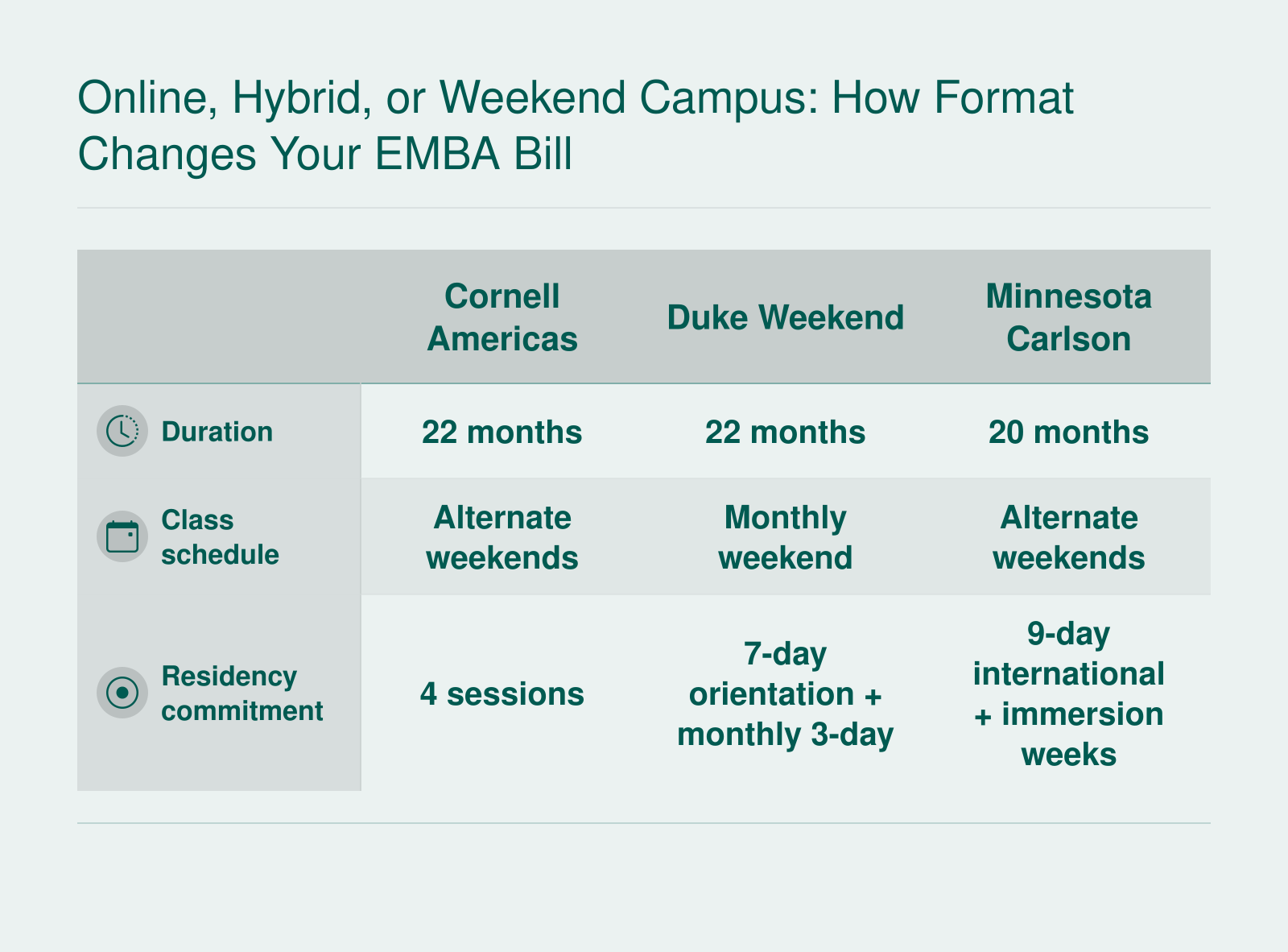
Online, Hybrid, or Weekend Campus: How Format Changes Your EMBA Bill
Format changes more than schedule: it changes travel, lodging, and time away. A program with the lowest tuition can still carry the highest travel bill if it requires frequent in-person residencies. Compare these hybrid structures to see how monthly and alternate-weekend schedules differ.
Experience Thresholds That Separate True EMBAs From Online MBAs
Executive MBA admissions are built around demonstrated professional experience rather than test scores.
- Professional and management experienceTrue EMBA minimums generally run five to ten years of professional work; management requirements range from two to seven years. ASU recommends five-plus years of management, while UW Tacoma's MBA asks for two years, a lower bar outside the EMBA category.
- Cohort averagesPublished averages run higher than minimums: 12 years at UNC, 15 at Minnesota and Georgia State, and 18–20 at Texas A&M.
- Bachelor's degree and GPAA bachelor's degree is the baseline; published minimum GPAs are rare and usually appear only for test-waiver review, such as Tampa's 3.0 threshold.
- GMAT/GRESeveral programs list no exam requirement, UT Austin, Georgia State, and Texas A&M, while others grant waivers by experience or GPA.
- Letters, employer support, and interviewsA current supervisor recommendation is often encouraged; separate employer sponsorship letters are not standard, though Wharton requires an employer acknowledgment. Interviews, résumés, and essays remain typical.
Paying for It: Employer Sponsorship, Scholarships, and Federal Loans
Writing a check yourself and splitting the bill with an employer are two very different EMBA experiences, and most students combine several funding sources rather than picking one.
Employer Sponsorship and the Section 127 Cap
Under IRS Section 127, an employer with a qualifying written plan can provide up to $5,250 per calendar year in tax-free educational assistance, covering tuition, fees, books, supplies, and even qualified student-loan payments.1 Spread across a two-year EMBA, that is roughly $10,500 excluded from your taxable income. Employers are not required to offer this, so read the fine print: sponsorship commonly carries strings. Expect repayment clauses if you leave within a set period, tenure commitments of one to three years after graduation, and coverage that may be partial rather than full.
Scholarships and Federal Loans
Many public business schools offer EMBA merit awards, plus seats earmarked for nonprofit, government, and military or veteran applicants. Eligible students can also borrow $20,500 a year through Direct Unsubsidized loans.2 Note that Grad PLUS closes to new borrowers on July 1, 2026, and aggregate limits now apply, so you cannot borrow unlimited cost of attendance.3
Practical tip: negotiate sponsorship before you apply, then submit the employer letter with your application.
Executive MBA programs by state
Quick Answers on Executive MBA Cost and Value
Executive MBA costs vary widely. These quick answers cover the cheapest option, typical totals, employer sponsorship, and how an EMBA differs from a regular MBA.
Which executive MBA program is the cheapest?
What does an executive MBA typically cost in total, from budget to elite programs?
Does a low-cost EMBA pay off financially?
How is an executive MBA different from a regular MBA?
Are there fully online executive MBA programs?
Does employer sponsorship typically cover the full EMBA bill?
Do employers view a cheaper EMBA differently?
Compare Executive MBA programs on the data that matters
Explore more MBA specializations or browse every graduate field.
All MBA programs