Best MBA in Healthcare Administration Programs in Alabama
Compare 6 accredited MBA in Healthcare Administration programs in Alabama, with graduate earnings, cost, debt, and completion data from IPEDS and the U.S. College Scorecard.

UAB's dual MBA/MSHA graduates report median earnings of $136,395 four years after finishing, while Jacksonville State's fully online MBA lists a flat $18,000 in total tuition. That spread frames the real decision. Alabama has only a few healthcare-focused MBA options, so the choice is manageable, but cost, format, and credential all differ sharply, and a wrong pick can cost years or tens of thousands of dollars.
Rankings here rest on federal cost, graduation, and earnings data. Admissions and tuition details were checked against official school pages.
Alabama's hospital systems hire administrators steadily, yet few employers pay a premium for the MBA alone without clinical or operations experience.
Key Points
- UAB's dual MBA/MSHA graduates report median earnings of $136,395 four years after finishing.
- UAB is the one school here pairing an MBA with a CAHME-accredited health administration degree.
- Compare total program cost, not annual tuition, because credit loads differ across Alabama programs.
MBA at a glance
- Common degrees
- MHA · MSHA · MS in Health Administration · MBA (Healthcare)
- Typical length
- 2 years full-time (1–3 depending on format)
- Formats
- On-campus, online, and hybrid
- Programmatic accreditation
- CAHME (the gold standard for MHA programs)
- Common concentrations
- Hospital administration, health informatics, policy, long-term care
- Typical entry
- Bachelor's degree; GRE increasingly optional
Top-Ranked MBA in Healthcare Administration Schools in Alabama
Alabama offers four healthcare-focused MBA options, spanning a hybrid dual degree in Birmingham, a campus concentration in Mobile, and two fully online programs. Net price figures on each card are approximate averages after aid, not quotes, so confirm current costs with each school. Graduation rates describe the whole university, not the MBA program itself.
University of Alabama at Birmingham
#1Birmingham, AL · ~$9,000/yr (est.)
Best for: Aspiring hospital executives wanting residency experience
UAB pairs a business degree with health administration training through a dual MBA/MSHA, built jointly around its business and health professions schools. The format blends on-campus and online study, and students complete a nine to 12 month administrative residency under experienced healthcare leaders while earning a stipend. The university graduates about 64% of its students, the highest institution-wide rate among the Alabama schools listed here, and its average net price after aid is roughly $18,700.
- 33-month, full-time dual degree
- Blended on-campus and online delivery
- Nine to 12 month residency with a senior administrator
- Stipend paid during the residency
- Work experience and a capstone are required
- Covers finance, policy development and organizational behavior
University of South Alabama
#2Mobile, AL · ~$9,000/yr (est.)
Best for: Campus students wanting medical college collaboration
The University of South Alabama delivers its healthcare track as a Healthcare Leadership concentration within the MBA, offered with the College of Medicine alongside the Mitchell College of Business. The focus is on healthcare change management, crisis leadership and strategic decision-making. The university graduates about 53% of its students, and its average net price after aid is roughly $17,600.
- Healthcare Leadership concentration of 9 credit hours
- Three specialized courses including a capstone project
- Offered with the College of Medicine
- Covers transformational change and crisis leadership
- Aimed at hospital, health system, insurance and consulting roles
Jacksonville State University
#3Jacksonville, AL · $10,000 – $15,000/yr (est.)
Best for: Working adults studying fully online
Jacksonville State offers a 100% online MBA with a Healthcare Administration concentration. It has 30 credits, a 12-month timeline and a published total tuition of $18,000. Classes are asynchronous, which suits working professionals. The university graduates about 55% of its students, and its average net price after aid is roughly $14,300, the second lowest of the four schools.
- 30 credit hours, 12-month completion
- 100% online, asynchronous classes
- $18,000 total program tuition
- Covers healthcare systems, data management and resource allocation
- Financial aid available
- Prepares for hospital administrator and medical services manager roles
University of West Alabama
#4Livingston, AL · $7,000 – $14,000/yr (est.)
The University of West Alabama runs an online MBA with a Healthcare Administration concentration. It is priced at $429 per credit for 33 credit hours, and its courses cover healthcare law, policy, insurance, economics and finance. The university reports that about 80% of students receive financial aid. UWA graduates about 35% of its students, the lowest institution-wide rate of the four, but its average net price after aid of roughly $12,700 is the lowest here.
- 33 credit hours at $429 per credit
- About one year to complete, full-time or part-time
- Fully online, asynchronous, with 8-week course terms
- Capstone required
- No application fee
- Personal success coach provided
- Scholarships and financial aid available
Cost & outcomes by school
Federal data for the highest-earning Healthcare Administration programs, independent of the ranking above. Earnings are this field's master's graduates four years after completing, where the Scorecard reports them.
| School | Earnings | Tuition / yr | Debt | Grads/yr | Format |
|---|---|---|---|---|---|
| South University-Montgomery AL | $65,167 | $16,611 | $41,000 | 1 | Hybrid |
| Strayer University-Alabama AL | $58,850 | $15,135 | $81,207 | 5 | Hybrid |
| Columbia Southern University AL | — | $3,936 | — | — | Online |
| University of West Alabama AL | — | $6,868 | — | — | Online |
| University of South Alabama AL | — | $9,360 | — | — | Campus |
| Jacksonville State University AL | — | $11,488 | — | — | Online |
Sources: U.S. Department of Education. Tuition and graduates: IPEDS. Earnings and debt: College Scorecard, this field's master's graduates; a dash means no figure is reported.
Online and Hybrid MBA in Healthcare Administration Options in Alabama
Which MBA in Healthcare Administration in Alabama can you actually finish without moving or leaving a hospital job? Delivery format varies sharply among the programs ranked here. UAB's MBA/MSHA is a hybrid that is primarily on campus, with at least half of the content delivered online and a required 9- to 12-month residency under a senior administrator. South Alabama's healthcare leadership MBA is campus-based. Jacksonville State and West Alabama offer Online MBA in Healthcare Administration Programs with asynchronous classes. West Alabama advertises $429 per credit, and Jacksonville State lists an $18,000 total program tuition. Before enrolling, confirm orientation, campus visits, or residencies directly with each school, since published pages do not always spell them out. If you work rotating hospital shifts, favor an asynchronous format like Jacksonville State's or West Alabama's so you can complete weekly work around 12-hour shifts instead of logging in for scheduled live sessions.
Related Articles
Cost and Alabama Employer Demand for Healthcare MBA Graduates
Paying by the credit hour and paying a flat program price lead to very different budgets, and healthcare MBA options among master's programs in Alabama include both.
What these programs cost
Published annual graduate tuition, in-state and out-of-state, runs from lowest to highest as follows: University of West Alabama at $6,868 and $13,546; UAB at $8,640 and $21,168; University of South Alabama at $9,360 and $18,000; Jacksonville State at $11,488 and $17,920.
UWA is the most affordable MBA in healthcare administration route to the degree. Its online MBA in Healthcare Administration is billed at $429 per credit across 33 credits, roughly $14,157 in tuition, plus a $120 technology fee each semester. Jacksonville State publishes about $18,000 in total tuition for its AACSB-accredited online healthcare administration track. UAB's online Health Services MBA is priced at $1,088 per credit over 39 credits, about $42,432.
Net price figures, by contrast, are approximate institution-wide averages across all students rather than a healthcare MBA quote, ranging from roughly $12,684 at UWA to about $18,749 at UAB.
How students pay
- Employer assistance: Large Alabama systems commonly support working managers pursuing graduate business degrees.
- Assistantships and stipends: UAB's MBA/MSHA students earn a stipend during the administrative residency.
- Federal graduate loans: Available at all four public universities; UWA charges no application fee.
Who hires in Alabama
UAB Medicine, Huntsville Hospital Health System, Ascension St. Vincent's, and Infirmary Health recruit for service line directors, clinic and practice managers, revenue cycle leaders, and operations roles.
MBA vs MHA in Alabama: Choosing the Right Healthcare Leadership Degree
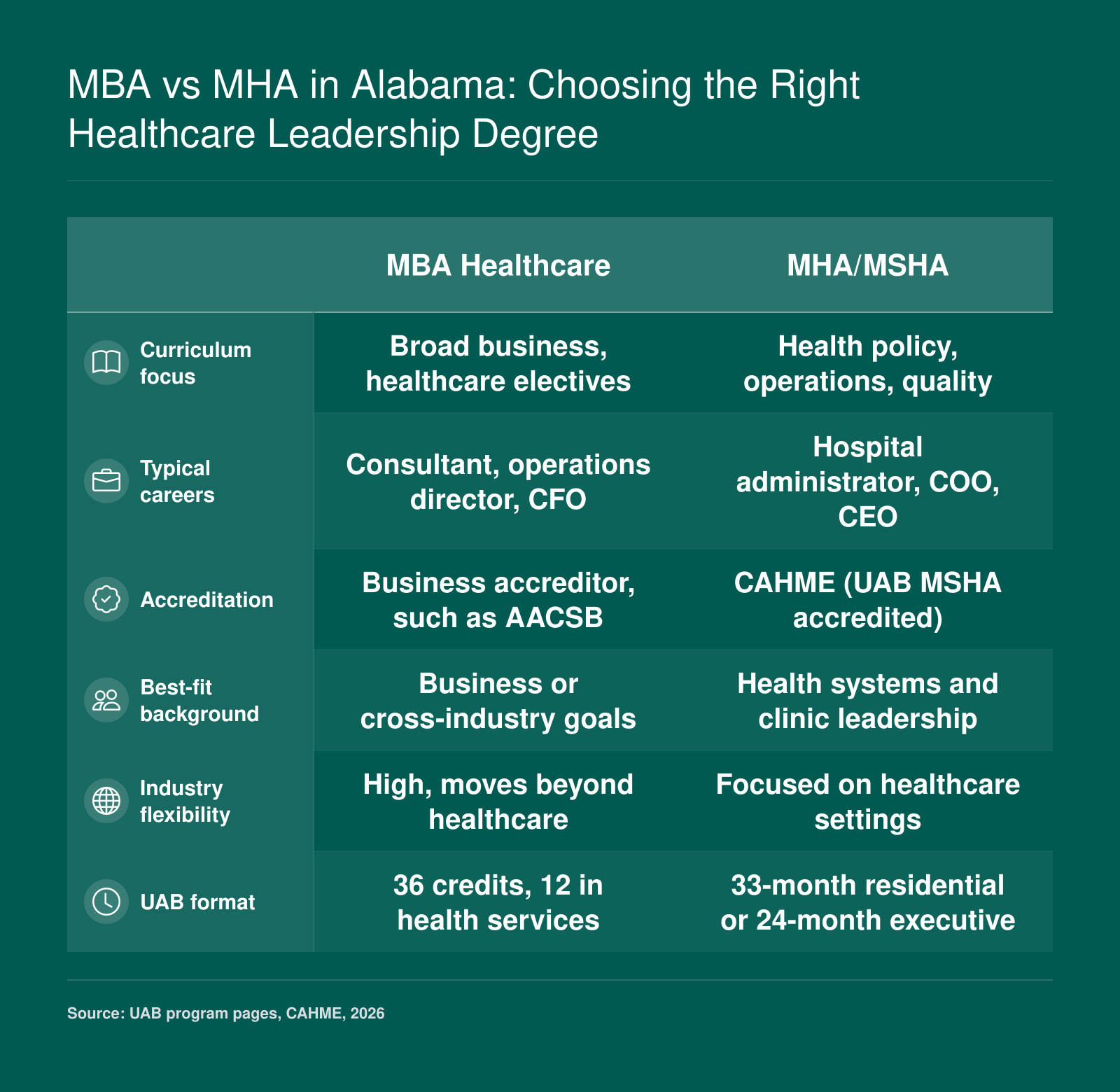
Choose the MBA for business breadth and cross-industry mobility. Choose the MHA for operations-heavy hospital administration tracks. UAB is the one school here that offers both: an MBA with a Health Services concentration and a CAHME-accredited MSHA, the health administration master's it awards in place of an MHA, plus a coordinated MBA/MSHA.
Accreditation and Quality Signals for Alabama Healthcare MBA Programs
Healthcare business education now carries two separate quality seals, and applicants often confuse them. AACSB accredits entire business schools, reviewing faculty, curriculum and outcomes across every degree. CAHME accredits individual healthcare management programs, and its directory, dominated by MHA and MSHA degrees rather than MBAs, includes the best MHA programs in Alabama.1 Neither substitutes for the other.
Is CAHME accreditation important? It matters most for MHA seekers chasing competitive hospital administrative fellowships and comparing MHA programs in Alabama. For an MBA, AACSB is the signal employers recognize.
- UAB: The Collat School of Business has held AACSB accreditation since 1982, and the MSHA half of its MBA/MSHA dual degree is CAHME-accredited, with its next review set for Fall 2029.1
- Jacksonville State: Its online healthcare MBA comes from an AACSB-accredited business school.
- South Alabama and West Alabama: Confirm current status in the AACSB directory before enrolling. If the seal is absent, weigh it alongside price and outcomes rather than treating it as a dealbreaker.
Also confirm each university's SACSCOC regional accreditation, which affects federal aid eligibility and credit transfer.
Career Outcomes and Salary Data for Alabama Healthcare MBA Graduates
The University of Alabama at Birmingham posts the strongest published graduate outcomes among MBA programs in healthcare administration in Alabama. Its dual MBA/MSHA graduates report median earnings of $136,395 four years after finishing, and $98,824 one year after finishing. Every graduate in the tracked group was employed one year out, and about 97 percent earned above the poverty-level threshold.
Debt Against Pay
Median program debt is $41,000, which works out to roughly $466 a month on a 10-year repayment plan. Against first-year pay near $99,000, that payment is manageable, and the four-year earnings figure widens the margin further.
School-Wide Context
For background only, UAB's students across all fields earn a median of $54,501 ten years after entering. That number covers the whole university, not this program, so do not read it as the MBA's result.
The Takeaway
The best value belongs to a program that pairs a hospital residency with a dual credential, as UAB's 33-month MBA/MSHA does. Buyers who want a faster, lower-priced route through Accelerated MBA in Healthcare Administration Programs should still weigh that against UAB's documented earnings return.
Frequently asked questions
Is a master's in healthcare administration worth it?
For people aiming at management and leadership in healthcare, it usually is — most director- and executive-level roles expect a graduate degree, and healthcare management is among the fastest-growing management fields. Whether a specific program is worth it depends on its cost, completion rate, and what its graduates actually earn, which is exactly what the ranking on this page compares.
MHA vs. MBA — which is better for healthcare?
An MHA goes deep on healthcare — operations, policy, financing, and the regulatory environment specific to the industry. An MBA (or MBA with a healthcare concentration) is broader business training that travels across industries. Choose the MHA if you're committed to healthcare and want role-specific depth; choose the MBA if you want general management flexibility or may work outside healthcare. Many schools offer both, and some offer a dual degree.
Can you get an MHA online?
Yes — online and hybrid MHA programs are widely available and common, since much of the coursework suits remote study. Look for the same CAHME/regional accreditation you'd want in an on-campus program. Use the "Online" filter on the ranking to see programs with an online option.
Do you need the GRE for an MHA?
Increasingly, no. A large and growing share of MHA programs have made the GRE optional or dropped it, weighting your undergraduate record and work experience instead. Requirements vary by school, so check each program.
How long does an MHA take?
Most full-time MHA programs run about two years; accelerated options can finish in roughly 12–18 months, and part-time or online formats built for working professionals may take longer. Program length and total credits are listed per school where available.
Compare Healthcare Administration programs on the data that matters
Explore more MBA specializations or browse every graduate field.
All MBA programs