Most Affordable MBA in Healthcare Administration Programs
Compare 370+ accredited most affordable MBA in Healthcare Administration programs at 360+ schools, with graduate earnings, cost, debt, and completion data from IPEDS and the U.S. College Scorecard.

Healthcare leaders need business fluency, but MBA price tags vary widely by school. In this ranking, effective net price runs from $8,752 at Florida Atlantic University to $15,563 at University of Houston-Clear Lake, a $6,811 spread before employer tuition help.
The ranked list, quick answers, cost math, accreditation checks, and salary-to-debt comparisons sort which low-price programs hold up.
Below $10,000, the bargain is rarely just tuition; accreditation and healthcare-specific coursework do the work.
Key Points
- In 2027, Florida International and other ranked schools offer online healthcare MBAs.
- Compare programs on net price, not headline sticker tuition and fees.
- Accreditation and low debt separate genuine bargains from cheap-looking risks.
MBA at a glance
- Common degrees
- MHA · MSHA · MS in Health Administration · MBA (Healthcare)
- Typical length
- 2 years full-time (1–3 depending on format)
- Formats
- On-campus, online, and hybrid
- Programmatic accreditation
- CAHME (the gold standard for MHA programs)
- Common concentrations
- Hospital administration, health informatics, policy, long-term care
- Typical entry
- Bachelor's degree; GRE increasingly optional
Ranked: 10 Best Affordable MBA in Healthcare Administration Schools
Affordability drives this list, but it is not the only filter. We looked for programs where low net price, flexible delivery, and a clear healthcare focus align with solid completion outcomes. The schools below stand out for keeping MBA debt reasonable without asking you to abandon career momentum.
Missouri Southern State University
#1Joplin, MO · ~$7,000/yr (est.)
Best for: Busy managers seeking regional affordability
Missouri Southern State University combines core business coursework with a healthcare management concentration that includes managerial epidemiology, health law, and social determinants of health. The program can be completed in as little as 12 months full-time or up to 24 part-time, and its published tuition is among the lowest in this ranking at $11,850 for in-state students. Residents of nine neighboring states automatically receive the in-state rate through the Lion Pride Tuition program.
- 30 total credit hours and 10 total courses
- GMAT or GRE required for admission
- Healthcare management concentration covers managerial epidemiology and health law
- Complete in as little as 12 months full-time or up to 24 part-time
- Automatic in-state tuition for residents of nine neighboring states
- STEM-classified data analytics specialization also available
Florida International University
#2Miami, FL · ~$11,000/yr (est.)
Best for: Clinical leaders pursuing executive healthcare roles
Florida International University offers a Healthcare MBA that pairs business management with healthcare-specific content, including Lean Six Sigma certification and coursework in marketing, finance, and healthcare law. The program carries CAHME and AACSB accreditation and prepares graduates for executive roles across hospitals and health systems. An online format is available for working professionals.
- Includes Lean Six Sigma certification
- CAHME and AACSB accredited
- Curriculum covers marketing, corporate finance, and healthcare fraud law
- Online delivery format with program residencies
- Prepares for executive positions such as CEO and CFO
Florida Atlantic University
#3Boca Raton, FL · $7,000 – $18,000/yr (est.)
Best for: Online learners needing part-time flexibility
Florida Atlantic University's Online MBA in Health Administration is a 12-credit specialization within the broader MBA, covering U.S. healthcare systems, organizational behavior, finance, and health policy. Students can choose full- or part-time pacing with synchronous and asynchronous options. The program prepares working clinicians and administrators for leadership roles in hospitals, clinics, and other healthcare settings.
- 12-credit specialization with 4 total courses
- AACSB-accredited business school
- Full-time and part-time options with synchronous or asynchronous classes
- Covers U.S. healthcare systems, healthcare finance, and health policy
University of South Florida
#4Tampa, FL · ~$10,000/yr (est.)
The University of South Florida's Executive MBA offers a Healthcare Leadership concentration that emphasizes strategic management and policy analysis for senior healthcare roles. The program provides both online and campus options with fall starts and no cohort requirement. It also includes concentrations in blue economy and personal financial planning, though healthcare leadership is the focus here.
- Healthcare Leadership concentration with strategic management and policy analysis
- Full-time and part-time options, starts in fall
- Top 10 online MBA program ranking by Fortune
- No cohort requirement
University of Nevada-Las Vegas
#5Las Vegas, NV · ~$7,000/yr (est.)
University of Nevada-Las Vegas offers a dual MBA and Master of Healthcare Administration designed for working professionals who want blended business and clinical leadership training. The program requires a capstone and covers ethical, legal, and regulatory aspects of healthcare while building broad business skills. It prepares graduates for management roles across healthcare organizations.
- Two concentration options available
- Capstone project required
- Designed for working professionals
- Covers ethical, legal, and regulatory aspects of healthcare
Delta State University
#6Cleveland, MS · ~$9,000/yr (est.)
Delta State University's Integrated MBA with a Healthcare Administration concentration is a one-year, fully online program built for working professionals and recent graduates. It requires 30 credit hours, carries no GMAT requirement, and charges a $64 per-credit-hour fee. The curriculum covers healthcare risk management, law and ethics, and management policies.
- 30 total credit hours
- One-year program length
- No GMAT requirement
- $64 per-credit-hour fee
- No out-of-state fees
- Cohort-based with one course at a time
Texas Woman's University
#7Denton, TX · ~$9,000/yr (est.)
Texas Woman's University offers a 36-credit MBA with a Healthcare Administration emphasis that can be completed in as little as 15 months for around $20,000. The 100% online program uses accelerated 7-week courses and does not require the GMAT or GRE. Coursework focuses on healthcare policy and financial analysis.
- 36 total credit hours
- Can be completed in as little as 15 months for around $20,000
- 100% online with accelerated 7-week terms
- No GMAT or GRE required
- AACSB-accredited
- Focus on healthcare policy and financial analysis
University of Houston-Clear Lake
#8Houston, TX · $5,000 – $10,000/yr (est.)
University of Houston-Clear Lake's joint MHA and MBA is a 60-credit hybrid program that can be completed in 24 months at the Texas Medical Center. It embeds two graduate certificates in Leadership and Healthcare Analytics and combines business strategy with healthcare operations. Alumni have moved into roles at MD Anderson, Houston Methodist, and Baylor College of Medicine.
- 60 total credit hours
- 24-month hybrid program at Texas Medical Center
- Embeds Leadership and Healthcare Analytics graduate certificates
- No entrance exam required
- Recent alumni at MD Anderson and Houston Methodist
- Eight-week course structure
Saint Peter's University
#9Jersey City, NJ · ~$16,000/yr (est.)
Saint Peter's University offers an MBA with a 12-credit Health Care Administration concentration through the Frank J. Guarini School of Business. The program requires core business courses before concentration work and includes a capstone in corporate strategy. Graduates are prepared for healthcare management roles in a range of clinical and administrative settings.
- 12-credit Health Care Administration concentration
- Core business courses must be completed before concentration work
- 14 concentration options available
- Includes capstone in corporate strategy
- Electives range from 3 to 6 credits
Valdosta State University
#10Valdosta, GA · $5,000 – $10,000/yr (est.)
Valdosta State University's MBA in Healthcare Administration is a 30-credit program that requires no prerequisite courses and accepts up to 6 transfer credits. Students can complete coursework online or face-to-face with fall, spring, and summer starts. Admission requires a 2.5 undergraduate GPA, and the program must be completed within seven years.
- 30 total credit hours
- No prerequisite courses required
- Transfer credit accepted up to 6 hours
- Complete online or face-to-face with fall, spring, and summer starts
- 2.5 undergraduate GPA required for admission
- AACSB-accredited business school
Cost & outcomes by school
Federal data for the highest-earning Healthcare Administration programs, independent of the ranking above. Earnings are this field's master's graduates four years after completing, where the Scorecard reports them.
| School | Earnings | Tuition / yr | Debt | Grads/yr | Format |
|---|---|---|---|---|---|
| University of Pennsylvania PA | $233,999 | $47,844 | $41,000 | 121 | Campus |
| University of California-Irvine CA | $215,277 | $14,827 | — | — | Campus |
| Western Governors University UT | $111,643 | $9,320 | $13,527 | 1,945 | Online |
| Columbia Southern University AL | — | $3,936 | — | — | Online |
| Fort Hays State University KS | — | $4,949 | — | — | Online |
| Albany State University GA | — | $5,008 | — | — | Hybrid |
| Northwestern Oklahoma State University OK | — | $5,320 | — | — | Online |
| Midway University KY | — | $5,650 | — | — | Campus |
| Chadron State College NE | — | $5,883 | — | — | Online |
| Adams State University CO | — | $5,898 | — | — | Online |
| Fitchburg State University MA | — | $6,246 | — | — | Online |
| Wheeling University WV | — | $6,260 | — | — | Online |
Sources: U.S. Department of Education. Tuition and graduates: IPEDS. Earnings and debt: College Scorecard, this field's master's graduates; a dash means no figure is reported.
Cost, debt & payoff
Median earnings of this field's master's graduates (4 yrs after completing) vs. their median federal loan debt · U.S. College Scorecard
Across these programs the median graduate earns about $83,792 and finishes with roughly $41,000 in debt — a ratio that clears a common rule of thumb (keep debt below first-year salary). Tuition and debt vary widely school to school, so check the per-school figures in the table above before you shortlist.
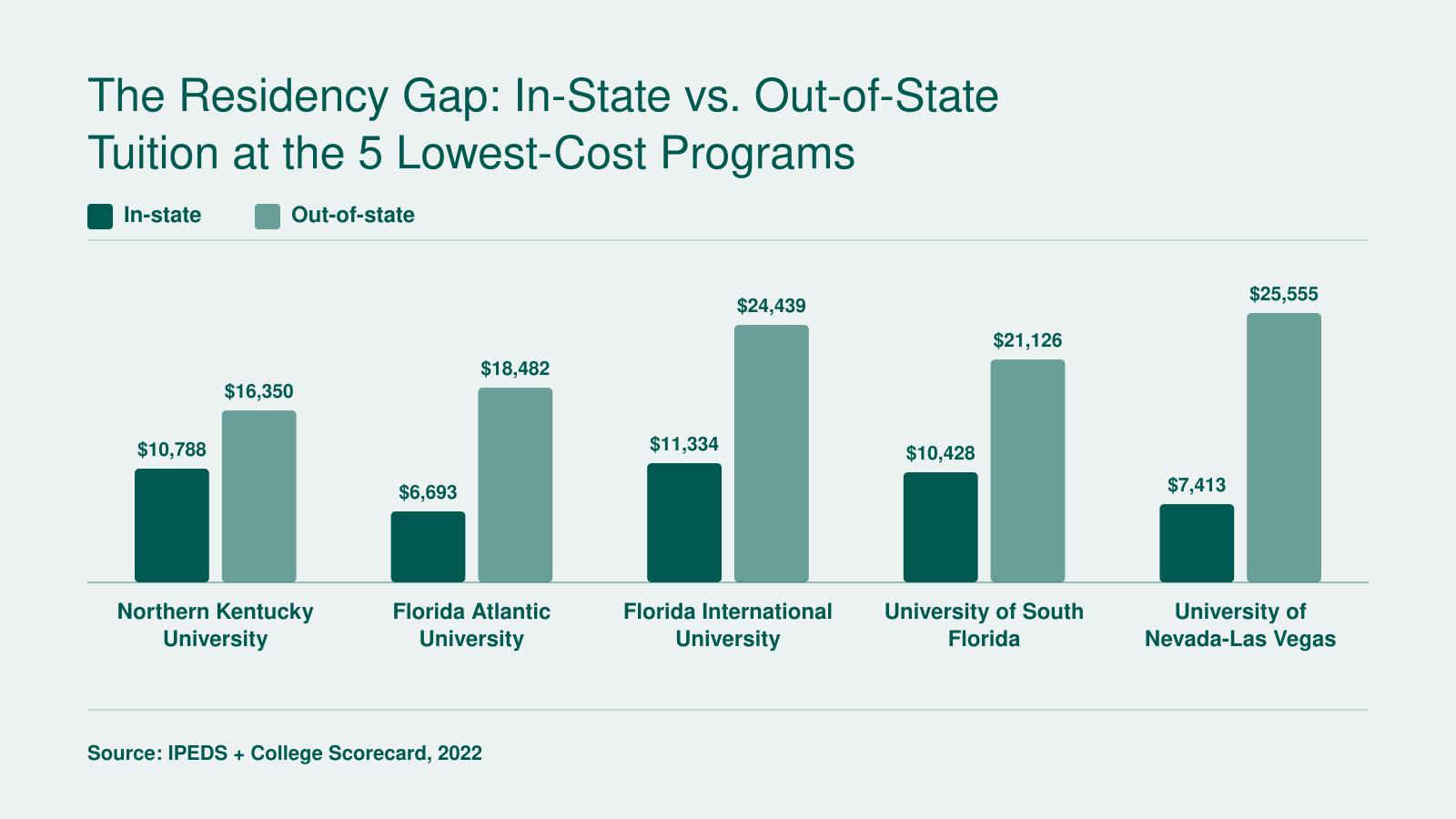
The Residency Gap: In-State vs. Out-of-State Tuition at the 5 Lowest-Cost Programs
Residency changes the true cost of a healthcare MBA. The chart compares published in-state and out-of-state tuition for the five programs with the lowest net price in this ranking. Because remote learners may qualify for a flat online rate or in-state tuition regardless of residency, the out-of-state bar may not apply to every online student; confirm directly with the school before comparing costs.
Sticker Price vs. What You'll Actually Pay
Sticker price is rarely the bill. To compare costs for an MBA in Healthcare Administration, work from total cost, not the headline rate: credits x per-credit tuition + mandatory fees - grants and scholarships - any employer assistance. Our net price figure is an institution-wide average after grants for affordable MBA programs, so treat it as a starting point, not your exact number; your aid package may be better or worse.
Employer Tuition Assistance
Under IRS Section 127, employers can exclude up to $5,250 per year from your taxable income for qualifying educational assistance, including tuition and loan payments.1 The cap is the combined total for 2025 and 2026; amounts above it are generally taxable wages unless another provision such as Section 132 applies.1 Employers are not required to offer it,3 the assistance must come through a qualifying program,2 and unused amounts cannot be carried forward.2 Hospital systems' policies vary widely: check whether the program pays upfront or reimburses, covers fees, requires a grade minimum, and links to a service commitment.
Scholarships and Net Price
ACHE's Albert W. Dent and Foster G. McGaw Graduate Student Scholarships award $5,000 each, with up to 15 given per year, for students in the final year of a healthcare management graduate program.4 Always run each school's net price calculator and ask about mandatory fees, which advertised rates often leave out.
Related Articles
AACSB, ACBSP, or Regional: Checking the Accreditation Behind a Cheap Healthcare MBA
Accreditation is simply an outside stamp confirming a school meets a published standard, and an MBA in Healthcare Administration can carry up to three layers of it. Knowing which layer a cheap program holds tells you whether the price is a bargain or a warning.
The Three Layers
- Regional (institutional): The baseline. It covers the whole university and signals that credits transfer and federal aid applies. It says nothing specific about the business school.
- AACSB: The most recognized business accreditation among employers, with a research-heavy standard that a minority of schools meet. Note that AACSB membership is not the same as AACSB accreditation; roughly 792 of the 2,037 directory members are listed as not accredited.
- ACBSP: A teaching-focused standard common at affordable, access-oriented schools.
What the Programs Here Hold
Several best MBA programs below state AACSB accreditation in their own materials, including Florida Atlantic, Texas Woman's, Houston-Clear Lake, and Valdosta State. Arkansas State's business college is also AACSB-accredited.
One caveat: CAHME applies mostly to standalone MHA degrees and rarely to MBA concentrations, so don't expect it on a healthcare MBA. The takeaway is plain: a low price only counts as value among affordable master's programs if the business accreditation holds up with employers.
MBA in Healthcare Administration Salary and ROI: 3 Standout Programs
The ROI ratio shown below is a proxy built from institution-wide median earnings divided by median graduate debt. Because it uses debt as the denominator, a low debt load can push the ratio higher even when a program's own earnings are moderate. Figures come from U.S. Department of Education IPEDS and College Scorecard (2024) data.
| Program | Median earnings one year after finishing | Median earnings four years after finishing | Median debt at completion | Estimated 10-year monthly payment | ROI ratio (institution-wide earnings to debt) |
|---|---|---|---|---|---|
| Florida International University | $53,360 | $67,431 | $51,820 | $589 | 3.65 |
| University of Houston-Clear Lake | $60,069 | $80,794 | $31,778 | $361 | 3.31 |
| Florida Atlantic University | $70,921 | $86,396 | $33,180 | $377 | 3.29 |
A low price only counts as real value when accreditation and manageable debt line up behind it; cheap on its own tells you nothing about what a degree is worth.
Is an Online Healthcare MBA Worth It? Weighing Cost Against Flexibility
The real question is not whether online costs less, but what you give up to keep your paycheck. The affordable healthcare administration master's programs ranked here split fairly evenly between fully online delivery (Florida International, Florida Atlantic, Delta State, Texas Woman's, Valdosta State) and campus or hybrid formats (South Florida, UNLV, Missouri Southern, Houston-Clear Lake, Saint Peter's).
The cost case for online MBA healthcare administration is straightforward. You skip relocation entirely, you keep a full-time clinical or administrative job while you study, and some schools charge one flat rate regardless of residency. Delta State is the clearest example: $8,605 whether you live in Mississippi or not. Texas Woman's runs asynchronous seven-week terms built around working schedules.
Campus programs buy you something different: proximity. Houston-Clear Lake sits in the Texas Medical Center and counts MD Anderson and Houston Methodist among alumni employers, the kind of pipeline that is hard to replicate through a discussion board.
A practical rule: if you already work in healthcare and want to move up, online usually delivers the better return. If you are switching into the field, pay for the campus network.
Healthcare Administration programs by state
Quick Answers on Cost, Format, and Admissions
Prospective MBA students ask the same practical questions about cost, format, and admissions. These short answers cover the details that matter when comparing affordable healthcare administration programs.
What is the most affordable MBA in healthcare administration?
Are online MBA healthcare administration programs cheaper than on-campus?
Do affordable healthcare administration MBAs require the GMAT or GRE?
Do I need healthcare work experience, and can I transfer credits in?
Compare Healthcare Administration programs on the data that matters
Explore more MBA specializations or browse every graduate field.
All MBA programs