MBA in Healthcare Administration Programs With No GMAT or GRE Required
Compare 370+ accredited no-gre MBA in Healthcare Administration programs at 360+ schools, with graduate earnings, cost, debt, and completion data from IPEDS and the U.S. College Scorecard.

A healthcare MBA is a graduate business degree built around hospital operations, health finance, and policy, and most working clinicians and managers pursuing one cannot spare months to prepare for the GMAT or GRE. Many accredited online Master's in Healthcare Administration programs with no GMAT or GRE required now drop the exam, but the rules vary widely: some waive it for everyone, others only for applicants with enough experience or a strong GPA.
The real tension is cost and credibility. A waiver saves prep time, yet tuition and accreditation still separate a degree employers respect from one they discount.
Key Points
- Some schools waive the GMAT for everyone, others only for qualified applicants.
- UT Tyler's 36-credit online healthcare MBA finishes in about 12 months.
- Net price often runs below published sticker tuition at affordable online options.
MBA at a glance
- Common degrees
- MHA · MSHA · MS in Health Administration · MBA (Healthcare)
- Typical length
- 2 years full-time (1–3 depending on format)
- Formats
- On-campus, online, and hybrid
- Programmatic accreditation
- CAHME (the gold standard for MHA programs)
- Common concentrations
- Hospital administration, health informatics, policy, long-term care
- Typical entry
- Bachelor's degree; GRE increasingly optional
10 Healthcare Administration MBA Programs That Waive the GMAT or GRE
Healthcare administration MBA programs are now common enough that working professionals can compare test-waiver pathways rather than compete on exam scores alone. The programs below appear in order of a composite that weighs student retention, completion, and institutional quality, with a moderate look at net price and graduate earnings. Because waiver terms vary, including conditional waivers based on GPA or experience, verify each school's current policy before applying.
Cornell University
#1Ithaca, NY · ~$30,000/yr (est.)
Best for: Healthcare executives seeking dual MBA/MS
Cornell delivers an Executive MBA/MS in Healthcare Leadership through a hybrid 20-month format built for full-time working professionals. The school's net price after aid averages about $28,690, and its graduation rate is 95%. With no GMAT requirement, rolling admissions, and dual degrees from Cornell, it suits experienced healthcare leaders who want a rigorous executive cohort.
- No GMAT required for admission
- 20-month hybrid with residential sessions in Ithaca and NYC
- 60 total credit hours
- Requires seven years of work experience
- Awards both MBA and MS degrees
- $200 application fee with scholarships available
University of Scranton
#2Scranton, PA · ~$12,000/yr (est.)
Best for: Working professionals balancing campus and online study
This university offers an AACSB-accredited MBA with a Healthcare Management Specialization, available online or on campus with flexible part-time pacing. The school's net price after aid averages about $32,568 and its graduation rate is 80%. No GMAT or GRE is required, and there is no application fee, which lowers the upfront hurdle for working healthcare professionals.
- AACSB-accredited business school
- 39 credit hours, about two years to complete
- $965 per credit hour
- Online or on-campus options with flexible part-time study
- No GMAT or GRE required
- No application fee and no thesis required
University of St Francis
#3Joliet, IL · ~$15,000/yr (est.)
Best for: Budget-focused students needing accelerated eight-week terms
The school's ACBSP-accredited MBA with a Health Administration concentration uses eight-week cycles and six start dates a year, with online and blended options. The school's net price after aid averages about $13,006 and its graduation rate is 67%. No GMAT is required, and locked tuition plus transfer credit options make it practical for working students.
- ACBSP-accredited, nationally ranked MBA
- 36 credit hours with eight-week course cycles
- Six start dates per year
- $820 per credit hour with locked tuition
- No GMAT required; transfer credits accepted
- Online and blended formats; 12-24 months to complete
University of North Carolina Wilmington
#4Wilmington, NC · $8,000 – $24,000/yr (est.)
The online MBA with a Healthcare Management specialization at this university is AACSB-accredited and can be finished in as few as 12 months through accelerated seven-week terms. The school's net price after aid averages about $20,109 and its graduation rate is 71%. No GMAT is required for applicants with a 3.0 GPA and two years of work experience, making it a fast path for experienced healthcare professionals.
- 100% online and AACSB-accredited
- 36 credits across 12 accelerated seven-week courses
- Complete in as few as 12 months part-time
- Six start dates with rolling admissions
- No GMAT required; 3.0 GPA and two years of work experience
- In-state total program tuition $19,920
Maryville University
#5Saint Louis, MO · ~$16,000/yr (est.)
This online MBA in Health Administration is ACBSP-accredited and can be completed in as few as 14 months, with six start dates a year. The school's net price after aid averages about $22,066 and its graduation rate is 66%. No entrance exam is required, and the $714-per-credit tuition keeps the total program cost around $27,846 for budget-conscious healthcare managers.
- ACBSP-accredited, 100% online
- 39 credit hours with 24 core, 12 concentration, 3 capstone
- Complete in as few as 14 months
- Six start dates per year
- No entrance exams required
- $714 per credit, about $27,846 total
Nebraska Methodist College
#6Omaha, NE · ~$15,000/yr (est.)
This fully online MBA in Healthcare takes 16 to 28 months and includes a capstone plus optional Lean Six Sigma certification. The school's net price after aid averages about $21,863 and its graduation rate is 60%. No GRE or GMAT is required, and rolling admission helps working nurses and healthcare staff start quickly.
- Fully online with asynchronous eight-week courses
- 36 credit hours, 16 to 28 months to complete
- No GRE or GMAT required
- Rolling admissions
- Includes capstone and Lean Six Sigma certification
- $771 per credit hour
Virginia Commonwealth University
#7Richmond, VA · ~$17,000/yr (est.)
The campus-based MBA with a Health Care Management concentration at this public university holds AACSB accreditation and offers evening classes. The school's net price after aid averages about $23,433 and its graduation rate is 63%. GMAT or GRE scores are optional, and the program's flexible single or double concentration options fit students already working in healthcare systems.
- AACSB-accredited
- 42 credit hours with evening classes
- Starts fall, spring, and summer
- Optional GMAT or GRE scores
- Single or double concentration options
- Precalculus prerequisite required
University of St Thomas
#8Houston, TX · ~$22,000/yr (est.)
At this Houston university, the AACSB-accredited MBA includes a Healthcare Administration concentration and sits near the Texas Medical Center. The school's net price after aid averages about $19,359 and its graduation rate is 69%. GMAT, GRE, LSAT, or MCAT scores are optional, though recommended for applicants below a 3.3 GPA, so waivers are conditional rather than blanket.
- AACSB-accredited, 30 credit hours
- Near Texas Medical Center and downtown Houston
- Six MBA concentrations including Healthcare Administration
- GMAT, GRE, LSAT, or MCAT optional
- Scores recommended for GPA below 3.3
- Resume with references required
Stockton University
#9Galloway, NJ · ~$17,000/yr (est.)
This AACSB-accredited Healthcare Administration and Leadership MBA offers Saturday classes at the Atlantic City campus with online, hybrid, or in-person options. The school's net price after aid averages about $20,670 and its graduation rate is 69%. The project-based curriculum suits working professionals in hospitals, insurance, or pharma, though applicants should confirm current GMAT and GRE waiver terms before applying.
- AACSB-accredited School of Business
- Saturday classes at Atlantic City campus
- Online, hybrid, or in-person options
- Project-based courses on real healthcare challenges
- GMAT or GRE scores may be optional; verify with school
- 3 letters of recommendation required
Seton Hill University
#10Greensburg, PA · ~$18,000/yr (est.)
The online MBA in Healthcare Administration at this university is ACBSP-accredited and includes healthcare-specific coursework and a capstone. The school's net price after aid averages about $22,204 and its graduation rate is 67%. No GMAT or GRE is required, and the $0 application fee plus rolling admissions keep the application process low-friction.
- ACBSP-accredited, fully online
- 36 credit hours with capstone
- $850 per credit
- No GMAT or GRE required
- Rolling admissions with $0 application fee
- Military benefits and scholarships available
Cost & outcomes by school
Federal data for the highest-earning Healthcare Administration programs, independent of the ranking above. Earnings are this field's master's graduates four years after completing, where the Scorecard reports them.
| School | Earnings | Tuition / yr | Debt | Grads/yr | Format |
|---|---|---|---|---|---|
| Western Governors University UT | $111,643 | $9,320 | $13,527 | 1,945 | Online |
| Albany State University GA | — | $5,008 | — | — | Hybrid |
| Northwestern Oklahoma State University OK | — | $5,320 | — | — | Online |
| Valdosta State University GA | — | $6,316 | — | — | Online |
| Fitchburg State University MA | — | $6,246 | — | — | Online |
| Texas A & M International University TX | — | $6,650 | — | — | Online |
| Catawba College NC | — | $7,188 | — | — | Online |
| Texas A & M University-Corpus Christi TX | — | $7,179 | — | — | Online |
| Vermont State University VT | — | $7,932 | — | — | Online |
| The University of Texas at Tyler TX | — | $8,480 | — | — | Hybrid |
| The University of Texas Rio Grande Valley TX | — | $8,589 | — | — | Online |
| Southern Utah University UT | — | $8,577 | — | — | Online |
Sources: U.S. Department of Education. Tuition and graduates: IPEDS. Earnings and debt: College Scorecard, this field's master's graduates; a dash means no figure is reported.
Cost, debt & payoff
Median earnings of this field's master's graduates (4 yrs after completing) vs. their median federal loan debt · U.S. College Scorecard
Across these programs the median graduate earns about $83,792 and finishes with roughly $41,000 in debt — a ratio that clears a common rule of thumb (keep debt below first-year salary). Tuition and debt vary widely school to school, so check the per-school figures in the table above before you shortlist.
Automatic Waiver or Earned Exemption? Reading the Fine Print on Test Policies
A school that drops the test for everyone and a school that drops it only for applicants who qualify can both advertise "no GMAT required." They do not treat you the same way.
Three Policy Types
- No test for anyone: Saint Mary's University of Minnesota asks for no test and no business background.1
- Conditional waiver: Texas A&M International University grants automatic admission without scores to applicants with an accredited business degree, an upper-level GPA of at least 3.0, a resume, and three references. Everyone else submits a GMAT or GRE taken within five years.
- Test-optional review: Campbellsville University sets a 2.5 GPA, but applicants below it may still apply and are encouraged to send scores.2
Even "no test" MBA in Healthcare Administration programs attach GPA conditions. Texas Woman's University admits business-degree holders unconditionally at 3.0 in their last 60 undergraduate hours. Applicants at 2.5 to 2.99 enter conditionally and must earn an A or B in three provisional business courses. Texas State pairs a 2.75 GPA with two years of professional experience.
Clinicians and Managers
If you hold a license such as RN, PharmD, or MD, or have several years of healthcare management experience, ask whether that counts toward a waiver. The school pages reviewed here, for Online MBA in Healthcare Administration programs, emphasize GPA and work experience rather than licenses, so do not assume it.
Policies shift between admission cycles. Confirm your waiver status with admissions before you apply.
Affordable Online Healthcare MBAs: Net Price vs. Sticker Tuition
The most affordable programs by institution-wide average net price appear below, alongside published in-state and out-of-state graduate tuition and fees. Net price is an approximate, sector-level estimate rather than a personal quote, so it can differ from what a graduate student actually pays. Many online programs charge one flat per-credit rate regardless of residency, so add technology fees, residency travel, and graduation fees to your total budget.
| School | In-State Tuition and Fees | Out-of-State Tuition and Fees | Average Net Price |
|---|---|---|---|
| Francis Marion University | $11,160 | $21,544 | $11,386 |
| Texas Woman's University | $8,640 | $18,480 | $11,963 |
| Youngstown State University | $11,113 | $11,473 | $12,767 |
Related Articles
AACSB, ACBSP, or Regional Only? Accreditation Signals Worth Checking
A test waiver changes how you apply to No-GRE master's programs, not how the school is accredited. Accreditation comes in layers, and each answers a different question.
The tiers
Institutional (regional) accreditation is the baseline. It covers the whole university and underpins federal aid and credit transfer. Campbellsville University, for example, is accredited by SACSCOC. Business-specific accreditation sits on top of that. AACSB is the most selective, and Winthrop cites it as covering roughly 5% of business programs. ACBSP and IACBE put more weight on teaching quality.
Where the ranked schools land
- AACSB: Winthrop University, Texas A&M International University, and UT Tyler.
- IACBE: Campbellsville University and Fitchburg State University.
We could not confirm ACBSP status for these schools, so check any program that claims it directly with the accreditor.
Why it matters to you
Many employers limit tuition reimbursement to accredited institutions, and some prefer AACSB accredited online MBA no GMAT programs. Receiving schools often scrutinize accreditation before accepting transfer credits. Doctoral programs may do the same with your master's degree.
The healthcare-specific layer
CAHME accredits healthcare management programs, but few MBAs hold it. One 2026 directory counts only 8 of 126 healthcare MBA programs as covered. It does not name them, so confirm CAHME status on the accreditor's own site before assuming it.
One-Year, Part-Time, or Hybrid: How Long a No-GMAT Healthcare MBA Takes
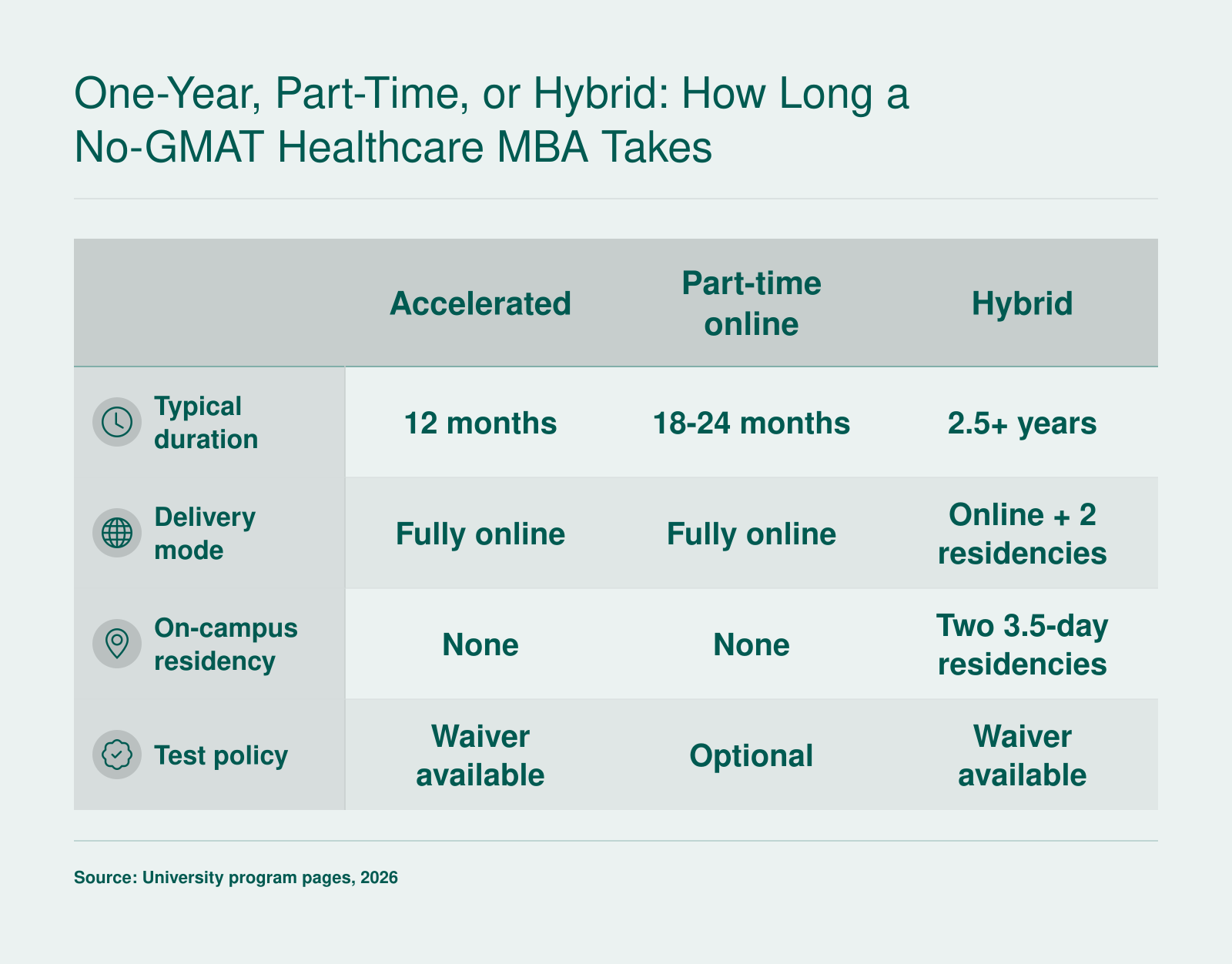
Accelerated formats such as UT Tyler's 36-credit online MBA are built to finish in about 12 months, while part-time options like Stony Brook's run 16-24 months and a hybrid program such as Case Western Reserve's takes roughly 2.5 years with two short Cleveland residencies. Most of these programs enroll several times a year, so the one-year healthcare MBA path usually depends on how many courses you take per term and whether any prior graduate credit transfers.
What Healthcare MBA Graduates Earn After Finishing
Healthcare MBA Requirements When the Test Is Off the Table
When the GMAT or GRE is off the table, these materials matter most.
- Bachelor's degreeAn accredited bachelor's degree is the standard baseline.
- Minimum GPAMinimum GPAs vary from 2.5 to 3.0, and some programs admit conditionally below the floor.
- Work experienceTexas State asks for two years of professional business experience; Eastern Washington may accept three years of verified experience in place of a higher GPA.
- Supporting materialsA statement of purpose, one to two professional references, and official transcripts are commonly required; without test scores, the essay, resume, and any interview carry more weight.
- Prerequisite courseworkSome programs require prerequisite business coursework, such as Texas Woman's University's three provisional courses for conditional admits.
- Prior healthcare experiencePrior healthcare experience is generally preferred, not required; Bushnell University accepts healthcare, business, and other backgrounds.
Healthcare Administration programs by state
Frequently asked questions
Is a master's in healthcare administration worth it?
For people aiming at management and leadership in healthcare, it usually is — most director- and executive-level roles expect a graduate degree, and healthcare management is among the fastest-growing management fields. Whether a specific program is worth it depends on its cost, completion rate, and what its graduates actually earn, which is exactly what the ranking on this page compares.
MHA vs. MBA — which is better for healthcare?
An MHA goes deep on healthcare — operations, policy, financing, and the regulatory environment specific to the industry. An MBA (or MBA with a healthcare concentration) is broader business training that travels across industries. Choose the MHA if you're committed to healthcare and want role-specific depth; choose the MBA if you want general management flexibility or may work outside healthcare. Many schools offer both, and some offer a dual degree.
Can you get an MHA online?
Yes — online and hybrid MHA programs are widely available and common, since much of the coursework suits remote study. Look for the same CAHME/regional accreditation you'd want in an on-campus program. Use the "Online" filter on the ranking to see programs with an online option.
Do you need the GRE for an MHA?
Increasingly, no. A large and growing share of MHA programs have made the GRE optional or dropped it, weighting your undergraduate record and work experience instead. Requirements vary by school, so check each program.
How long does an MHA take?
Most full-time MHA programs run about two years; accelerated options can finish in roughly 12–18 months, and part-time or online formats built for working professionals may take longer. Program length and total credits are listed per school where available.
Compare Healthcare Administration programs on the data that matters
Explore more MBA specializations or browse every graduate field.
All MBA programs