Best Master's in Educational Psychology Programs in California
Compare 31 accredited Educational Psychology programs in California at 23 schools, with graduate earnings, cost, debt, and completion data from IPEDS and the U.S. College Scorecard.

California's PPS school psychology credential requires 60 semester units in a CTC-approved program, and many master's degrees labeled "educational psychology" are really the first stage of that path.
The programs here cover campus and online formats together, compared on net price, institution-wide graduation rate, and format.
Credential tracks typically run three years, so the real cost comparison is across the full program, not one year of tuition.
Key Points
- A standalone educational psychology master's does not lead to the California PPS school psychology credential on its own.
- The PPS credential requires 60 semester units in a CTC-approved program.
- San Francisco State and Chico State do not require the GRE; CSU tuition runs far below private schools.
Top 10 Master's in Educational Psychology Programs in California
These ten California options mix standalone educational psychology master's programs with school psychology tracks that lead toward the state's PPS credential, and each description says which type it is. Graduation rates cited are institution-wide figures for the whole school, not program completion rates. Net price is an approximate average after aid, not an exact quote, so confirm your own cost with each school's financial aid office.
University of California-Riverside
#1Riverside, CA · ~$15,000/yr (est.)
Best for: Aspiring researchers eyeing a doctorate
UC Riverside offers a standalone M.A. in Educational Psychology focused on learning, development, assessment, and research methods, with a thesis or comprehensive exam option. It is not designed for school psychology licensure, and its coursework can transfer into the school's Ph.D., which suits students heading toward research careers. Institution-wide, about 76% of students graduate.
- Standalone educational psychology master's, not a licensure track
- 36 units, about 9 courses, fall start
- Thesis or comprehensive exam option
- Evening in-person classes on the Riverside campus
- Coursework transfers toward the Ph.D.
- Heavy training in quantitative and qualitative methods
San Diego State University
#2San Diego, CA · ~$10,000/yr (est.)
Best for: Aspiring school psychologists seeking integrated training
San Diego State's M.S. in School Psychology is a school psychology/PPS-oriented track that combines the master's, an Ed.S., and the PPS credential in one integrated sequence. The scientist-practitioner curriculum is aligned with NASP standards and emphasizes cultural competence and equity. About 76% of students at the university graduate.
- School psychology track combining M.S., Ed.S., and PPS credential
- 46 total credit hours
- No entrance exam required
- Minimum three letters of recommendation
- NASP-aligned, scientist-practitioner model
- Coursework includes ecobehavioral assessment and crisis intervention
California State University-Long Beach
#3Long Beach, CA · $9,000 – $19,000/yr (est.)
Best for: Data-minded educators moving into assessment work
Cal State Long Beach offers an M.A. in Education with an Option in Educational Psychology, a standalone research-oriented master's rather than a licensure path. It builds skills in statistics, measurement, and program evaluation for assessment and data analyst roles. Institution-wide, about 69% of students graduate.
- Standalone educational psychology master's
- 30 total credit hours
- Thesis or comprehensive exam option
- 3.0 GPA minimum and related bachelor's required
- Prerequisite courses required
- Training in psychometric instruments and program evaluation
Loyola Marymount University
#4Los Angeles, CA · ~$23,000/yr (est.)
Loyola Marymount pairs an M.A. in Educational Psychology with an Ed.S. in School Psychology, so this is a school psychology/PPS-oriented option. The three-year, cohort-based, NASP-accredited program offers in-person or online formats with evening classes. About 79% of students graduate institution-wide.
- School psychology-oriented, NASP accredited
- 63 credit hours over three years
- Cohort model with evening classes
- In-person or online options
- 3.0 GPA minimum, three recommendations, group interview
- California residency required
- Leads toward NCSP eligibility
- 63 credit hours, summer start
- 500 clinical hours listed
- In-person or online options
- NASP accredited, evening weekday classes
Chapman University
#5Orange, CA · ~$40,000/yr (est.)
Chapman's Attallah College offers an M.A. in Educational Psychology for students earning the Ed.S. in School Psychology, so it is a school psychology-oriented track. An emphasis in professional clinical counseling meets California Board of Behavioral Sciences educational requirements. About 82% of students graduate institution-wide.
- Companion degree for Ed.S. School Psychology students
- Meets Board of Behavioral Sciences educational requirements
- School psychology program approved by NASP and IASP
- International learning experience encouraged
- 69 total credit hours
- GRE scores required
- 3.3 GPA minimum, two recommendations
- 600-hour practicum and 1,200-hour internship
- Prepares for the Praxis in School Psychology
California State University-Chico
#6Chico, CA · ~$10,000/yr (est.)
Chico State's M.A. in Applied/School Psychology is a three-year, in-person school psychology track, and the PPS credential is available only as part of this degree. It is accredited by CTC and NASP, and no entrance exam is required. About 63% of students graduate institution-wide.
- School psychology track with PPS credential pathway
- Six graduate semesters, full-time or part-time
- No entrance exam required
- Accredited by CTC and NASP
- Small cohorts, graduate assistantships available
- Fall start, three recommendation letters
California State University-Sacramento
#7Sacramento, CA · $10,000 – $20,000/yr (est.)
Sacramento State's MA in School Psychology is a campus-based school psychology/PPS-oriented track ending in an Ed.S. degree and/or the PPS credential. It is NASP approved and CCTC accredited, and added coursework can lead toward LPCC licensure. About 56% of students graduate institution-wide.
- School psychology track, campus-based
- Culminates in Ed.S. degree and/or PPS credential
- NASP approved and CCTC accredited
- Pathway to LPCC licensure with added coursework
- Emphasis on cultural diversity and fieldwork
California State University-Fresno
#8Fresno, CA · ~$9,000/yr (est.)
Fresno State offers a three-year Ed.S. in School Psychology that prepares students for the PPS credential, so it is a school psychology-oriented track. Fieldwork builds from practicum days in the first two years to a school-site internship in year three, and admission is competitive. About 57% of students graduate institution-wide.
- School psychology track leading to PPS credential
- 76 total credit hours over three years
- At least 600 practicum hours and a 1,200-hour internship
- Full-time, built for prospective school psychologists
- Same department also offers M.A. options in other areas
San Francisco State University
#9San Francisco, CA · $5,000 – $10,000/yr (est.)
San Francisco State's M.S. in Psychology with a School Psychology concentration is a school psychology/PPS-oriented track for full-time students. The GRE has been permanently removed from admissions, and the program stresses culturally responsive practice. About 50% of students graduate institution-wide.
- School psychology concentration leading to PPS credential
- 57 credits, four semesters, plus two more for the credential
- Fall start, designed for full-time students
- Thesis or comprehensive exam
- Two semesters of practicum plus advanced practicum
- Admissions interview and child-related experience required
California State University-Monterey Bay
#10Seaside, CA · ~$9,000/yr (est.)
Cal State Monterey Bay's Ed.S. in School Psychology is a NASP-approved school psychology track with fieldwork starting in the first year. It emphasizes multilingual learners and migrant youth, and alumni have moved on to doctoral programs. About 59% of students graduate institution-wide.
- School psychology track, NASP accredited
- Prepares for the NCSP credential
- 450-hour practicum and 1,200-hour internship
- Field experience begins in the first year
- Focus on multilingual learners and migrant youth
- On-site Clinic for Educational Supports
Cost & outcomes by school
Federal data for the highest-earning Educational Psychology programs, independent of the ranking above. Earnings are this field's master's graduates four years after completing, where the Scorecard reports them.
| School | Earnings | Tuition / yr | Debt | Grads/yr | Format |
|---|---|---|---|---|---|
| Chapman University CA | $107,808 | $39,868 | — | 26 | Campus |
| California State University-Long Beach CA | $100,315 | $8,898 | $25,500 | 54 | Campus |
| Loyola Marymount University CA | $100,264 | $23,172 | — | 33 | Hybrid |
| San Francisco State University CA | $96,854 | $9,370 | — | 6 | Campus |
| Touro University Worldwide CA | $89,314 | $9,000 | $27,075 | 115 | Online |
| Alliant International University-San Diego CA | $86,459 | $19,690 | $61,500 | 121 | Hybrid |
| California State University-Northridge CA | $83,681 | $8,982 | $41,000 | 22 | Campus |
| National University CA | $78,497 | $16,416 | $28,854 | 1,098 | Hybrid |
| Azusa Pacific University CA | $70,125 | $17,015 | — | 43 | Campus |
| California Baptist University CA | $69,787 | $15,562 | $61,500 | 313 | Campus |
| Northcentral University CA | $52,083 | $17,998 | $30,160 | 153 | Online |
| California State University-East Bay CA | — | $9,107 | — | — | Hybrid |
Sources: U.S. Department of Education. Tuition and graduates: IPEDS. Earnings and debt: College Scorecard, this field's master's graduates; a dash means no figure is reported.
Cost, debt & payoff
Median earnings of this field's master's graduates (4 yrs after completing) vs. their median federal loan debt · U.S. College Scorecard
Across these programs the median graduate earns about $83,681 and finishes with roughly $41,000 in debt — a ratio that clears a common rule of thumb (keep debt below first-year salary). Tuition and debt vary widely school to school, so check the per-school figures in the table above before you shortlist.
Educational Psychology vs School Psychology Master's in California
These are two different degrees with two different destinations, and confusing them is the most expensive mistake applicants make when comparing master's programs in California.
What each degree covers
Educational Psychology is the study of learning, development, measurement, and research design. It trains people to evaluate programs, build assessments, analyze data, and go on to doctoral work. School psychology trains practitioners for K-12 service delivery and leads to the Pupil Personnel Services (PPS) School Psychology Credential issued by the California Commission on Teacher Credentialing.
Several programs here sit clearly on the research side, including the educational psychology master's at UC Riverside and the educational psychology option at Cal State Long Beach. Others are explicitly practitioner tracks: San Diego State, Sacramento State, Chico State, Fresno State, San Francisco State, and CSU Monterey Bay all point toward the PPS credential, often paired with an Ed.S. Loyola Marymount and Chapman award educational psychology master's degrees that function as part of a school psychology sequence rather than as standalone research degrees.
Fieldwork is the dividing line
A standalone educational psychology MA generally will not qualify you for the PPS credential on its own; specialist-level study adds the assessment, consultation, and supervised fieldwork the state requires. California's standards call for at least 450 practicum hours (300 in PK-12 settings) plus 1,200 field-experience hours, with at least 1,000 in schools.1 Research-track degrees typically require little or no practicum.
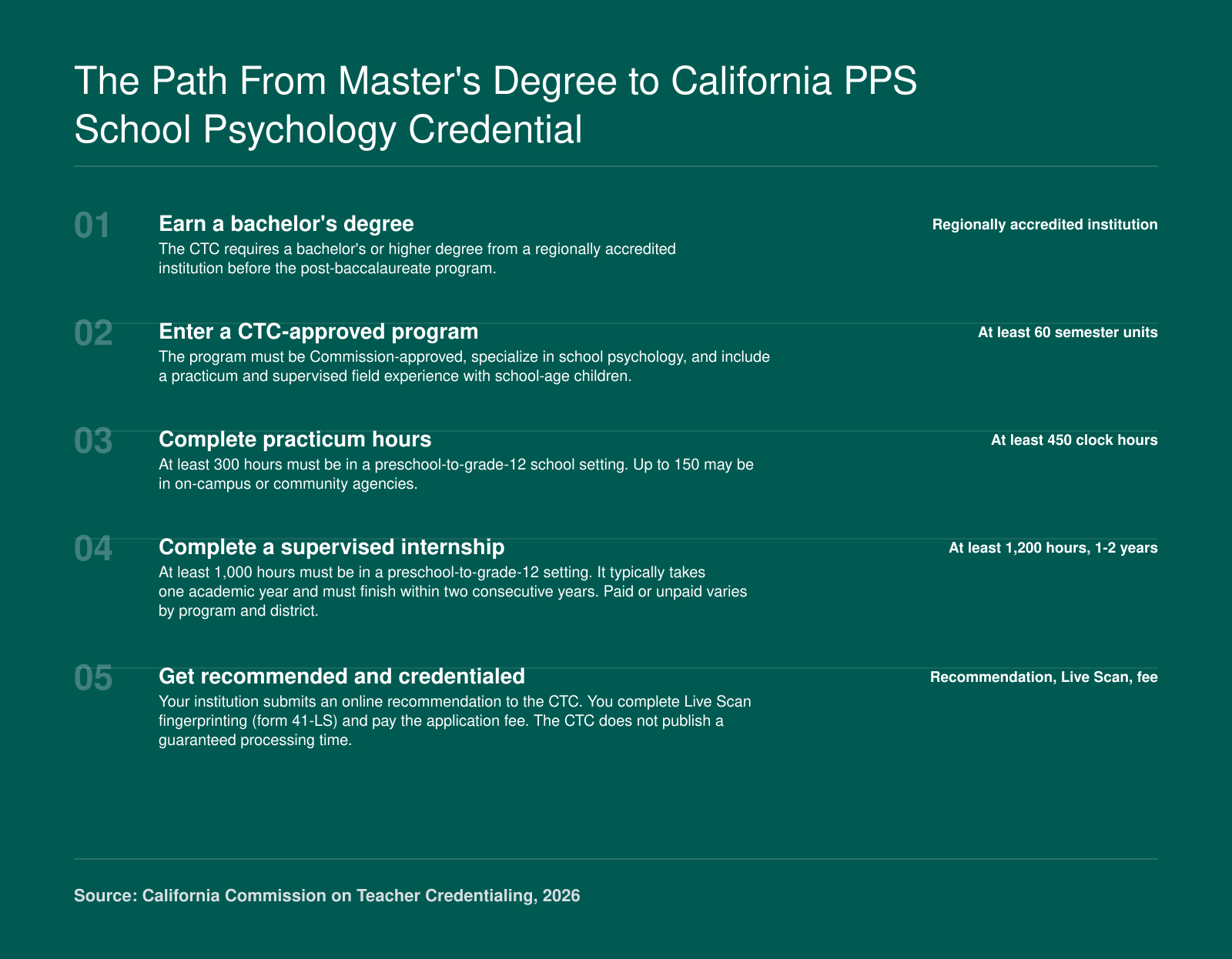
The Path From Master's Degree to California PPS School Psychology Credential
The PPS School Psychology credential is issued by the California Commission on Teacher Credentialing (CTC). These are the CTC minimums, and individual programs may set higher expectations. A standalone educational psychology master's does not lead to this credential on its own.
Online and Hybrid Master's in Educational Psychology Options in California
Loyola Marymount's three-year, 63-credit MA in Educational Psychology/EdS in School Psychology is the one listed here with both online and on-campus delivery, built as a cohort program with evening classes.1 Most other California programs on this list run fully in person, including several that state plainly that all coursework is campus-based.1
Flexibility has limits. LMU's materials indicate a California residency requirement, though the published wording does not spell out whether that applies to enrollment, fieldwork placement, or credential eligibility. Prospective out-of-state applicants should ask admissions directly before paying an application fee, and should confirm current state authorization status rather than assuming online means open to all 50 states.
The bigger constraint is clinical. The PPS pathway requires roughly 1,700 supervised clinical hours, and practicum and internship must be completed in person in California school settings under a credentialed supervisor.1 Online coursework does not change that.
Related Articles
GRE Requirements at California Educational Psychology Master's Programs
The GRE is fading from California school psychology admissions, though unevenly, with a growing number of No-GRE master's programs. San Francisco State removed it permanently and still accepts voluntary scores, as documented in its Graduate Programs, School Psychology (GRE Policy). Chico State neither requires the GRE nor considers scores if you send them.1 San Diego State lists no entrance exam. Sacramento State recommends the test but does not require it, and its FAQ says scores can only help an applicant, not hurt one.2
Fresno State is the exception. A graduate application page updated in September 2026 says no program requires the GRE3, while a department page from May 2026 says every applicant must submit scores4. Confirm with the department before skipping it.
We could not find a clearly published GRE policy for UC Riverside, Cal State Long Beach, Loyola Marymount, Chapman or CSU Monterey Bay, so ask admissions directly.
Where tests are gone, other screens carry the weight: 3.0 GPA minimums, prerequisite coursework, recommendation letters, interviews and, at SFSU, relevant work experience.
Cost of a Master's in Educational Psychology and California Credentialing
Where you study changes the math more than any ranking does. Among the programs here, public CSU and UC graduate tuition runs far below private-school pricing: in-state graduate tuition at the CSU campuses sits roughly in the $7,000 to $9,000 range per year, while a private option like Fresno Pacific charges around $800 per credit. On an average net price basis (an approximate figure after aid), the most affordable programs here land near $7,000, while the pricier end approaches $14,000.
Program-level median debt and estimated monthly loan payments have not been published for these educational psychology and school psychology programs, so budget from tuition and your expected aid instead.
Cost Depends on Your Track
Total cost follows length, and length follows the credential. A standalone research MA can finish in about two years, while PPS school psychology tracks typically run three years and require far more coursework. Loyola Marymount's California School Psychology Program lists 63 units over three years, CSU Los Angeles' MS in Counseling, School Psychology Option requires 73 units, and CSU San Bernardino's Ed.S. in School Psychology requires 63 units. More units and a full-year internship mean a higher total bill.
Two credentials follow graduation: the CTC-issued PPS credential, which authorizes work in public schools,1 and the separate Licensed Educational Psychologist (LEP) license from the California Board of Behavioral Sciences, which requires its own exam and supervised experience.2
California PPS Credential and Program Accreditation
What Can You Do With a Master's in Educational Psychology in California?
A PPS-credentialed school psychologist and a standalone educational psychology MA lead in different directions.
The credential path prepares you for school psychologist roles in K-12 districts. Programs such as Cal State East Bay's School Psychology Graduate Program or San Francisco State's MS in Psychology with a school psychology concentration build toward the California Pupil Personnel Services credential, which is required to practice as a school psychologist in public schools.
A standalone MA, like UC Riverside's educational psychology program, points toward Instructional Design & Ed Tech roles, assessment or research analyst, and student support specialist positions, or toward a PhD. UC Riverside notes its MA coursework transfers to doctoral study, a common research-oriented pathway.
When comparing options, look at whether the program embeds the PPS credential or keeps it separate. That distinction shapes your first job title, where you can work, and whether you need further study to enter schools.
Admissions Questions About California Educational Psychology Master's Programs
When are application deadlines for California educational psychology master's programs?
What GPA and prerequisites do these programs typically require?
Can I switch from a standalone educational psychology MA into a PPS school psychology program later?
Compare Educational Psychology programs on the data that matters
Explore more Psychology specializations or browse every graduate field.
All Psychology programs