Best Online Master's in Science Education Programs
Compare accredited Science master's programs by earnings, cost, and outcomes.
Sample layout — live rankings and program data appear here once the data source is connected.

A master's in science education is an advanced teaching degree that deepens content knowledge in biology, chemistry, earth science, or physics while adding classroom pedagogy, and most online master's in education programs are built for teachers who already hold a license. Annual graduate tuition runs from under $8,000 to well above $50,000, and residency alone can double the out-of-state rate.
Two questions decide the value of any program here: whether it leads to a new certification or just a higher salary lane, and what the real all-in cost comes to after fees. Most online options assume you already teach, so a career changer faces a different admissions path than a licensed teacher upgrading credentials.
Key Points
- WGU charges one tuition rate regardless of residency, unlike public universities here.
- Online science education tracks split into certification upgrades or salary lane advances.
- Emporia State and University of New England have no scheduled class times.
The 10 Best Fully Online Master's in Science Education Programs
The programs below are fully online options for working science educators who want to strengthen content knowledge, earn a certification upgrade, or move into leadership. Each entry highlights the credential path, science tracks, and tuition tradeoffs that matter most when comparing master's programs.
University of Georgia
#1Athens, GA · ~$11,000/yr (est.)
Best for: Certified secondary teachers seeking Georgia certification upgrade
The University of Georgia's online M.Ed. in Science Education is built for certified secondary science teachers who want to advance without pausing teaching. The curriculum emphasizes research-based strategies, curriculum planning, and Next Generation Science Standards integration, with electives in STEM, socio-scientific issues, and environmental science. Designed to balance with full-time work, it can lead to a Georgia certification upgrade. Students complete a professional portfolio aligned with national science-teaching standards.
- 36 total credit hours with full-time and part-time options
- Flexible start in summer, fall, or spring
- Designed for certified secondary science teachers
- Focus on Next Generation Science Standards
- Certification upgrade to T5 in Georgia
- Requires 3 letters of recommendation and $75 application fee
University of Massachusetts-Amherst
#2Amherst, MA · $15,000 – $20,000/yr (est.)
Best for: Elementary and middle school science teachers
UMass Amherst's fully online M.Ed. in Science Education covers biology, earth science, and physical sciences for practicing and aspiring teachers. The program is approved for elementary grades 1-6 and general science grades 5-8, with an interdisciplinary, hands-on approach that translates directly to classroom engagement. Its online structure supports working professionals while maintaining a collaborative learning community.
- Approved for elementary grades 1-6 and general science grades 5-8
- Covers biology, earth science, and physical sciences
- Interdisciplinary, hands-on approach
- Designed for practicing teachers and aspiring educators
- Flexible online format for working professionals
North Carolina State University at Raleigh
#3Raleigh, NC · $12,000 – $33,000/yr (est.)
Best for: Community college instructors needing advanced licensure
NC State's online M.Ed. in STEM Education offers a Science Education concentration for secondary science teachers, community college instructors, and informal educators. The 30-credit curriculum includes electives in biological science, forestry, horticulture, and chemistry, and can be completed in two years full-time or three to four part-time. It meets North Carolina advanced licensure standards and supports National Board Certification without requiring an entrance exam.
- Concentration in Science Education
- 30 total credit hours, full-time or part-time
- No entrance exam required
- 3.0 GPA minimum for admission
- Electives in biological science, forestry, horticulture, and chemistry
- Meets North Carolina DPI advanced licensure standards
- Supports National Board Certification
Western Governors University
#4Salt Lake City, UT · ~$9,000/yr (est.)
Western Governors University's M.A. in Science Education, Secondary Biology is designed for licensed teachers adding a secondary biology endorsement rather than pursuing initial certification. The 13-course program covers molecular biology, ecology, evolution, chemistry with a lab, and science methods, with a home science lab kit included. Flat per-term tuition and monthly start dates make it a flexible, asynchronous option; students finish with a multi-week Teacher Performance Assessment.
- Adds secondary biology to an existing teaching license
- 13 courses with a home science lab kit included
- Flat tuition per six-month term, starts monthly
- Asynchronous online classes
- Final assessment is a multi-week Teacher Performance Assessment
- For currently licensed teachers only, not initial licensure
- Graduates report an average salary increase of $25,614
The University of Texas at Arlington
#5Arlington, TX · ~$11,000/yr (est.)
UT Arlington's online M.Ed. in Curriculum and Instruction with a Science Education concentration is an accelerated, non-thesis option for K-12 educators. The curriculum uses problem-based and inquiry-driven teaching strategies across physical, earth, and life sciences. It requires 30 credit hours and can be finished in as few as 18 months with six start dates per year, and no initial certification is required.
- 30 total credit hours, non-thesis
- Can be completed in as few as 18 months
- Six start dates per year
- No thesis or capstone required
- Problem-based and inquiry-driven instruction
- Covers physical, earth, and life sciences
- No initial certification required
- TEACH grant up to $3,772 per year
Colorado State University-Fort Collins
#6Fort Collins, CO · ~$14,000/yr (est.)
Colorado State University's online Master of Natural Sciences Education is for current and aspiring science teachers who want to deepen content knowledge in biology, chemistry, physics, and environmental science. Students choose a coursework or research option, with hands-on science lab kits included. The 30-credit program can be completed in two years and does not require the GRE.
- 30 credit hours, can be completed in two years
- Choose coursework or research option
- Science lab kits included for home experiments
- Covers biology, chemistry, physics, and environmental science
- No GRE required
- Apply with bachelor's in science-related field and two letters
University of North Carolina at Greensboro
#7Greensboro, NC · ~$9,000/yr (est.)
UNC Greensboro's online M.Ed. in Teacher Education offers science-focused concentrations for elementary and K-12 educators. The elementary concentration engages students in citizen science, the NSF-funded HERP Project, and engineering projects in the SELF Design Studio. The K-12 concentration emphasizes curriculum, pedagogy, assessment, and research, preparing graduates for coaching and curriculum development roles. Both are authorized online in all 50 states.
- Designed for elementary teachers improving science teaching
- Citizen science, NSF-funded HERP Project, and SELF Design Studio
- Leads to K-6 science specialist or district coach roles
- Online program authorized in all 50 states
- Recognized as a best online master's in education by U.S. News
- Covers curriculum, pedagogy, assessment, and research
- Hands-on experience in local schools
- Careers include science specialist and curriculum developer
- Top graduate school of education, online format
Drake University
#8Des Moines, IA · $10,000 – $15,000/yr (est.)
Drake University's online M.S.Ed. in STEM is designed for practicing teachers who want to strengthen science, technology, engineering, and math instruction. The program tailors approaches for elementary, middle, and high school teachers, emphasizing real-world problem-solving and project design. Graduates often add endorsements in STEM, Talented & Gifted, or ESL, which can widen career paths.
- Designed for practicing teachers enhancing STEM instruction
- Add endorsements in STEM, Talented & Gifted, or ESL
- Elementary, middle, and high school emphases
- Expert faculty mentorship and supportive online environment
- Apply new strategies directly in classrooms
East Carolina University
#9Greenville, NC · ~$8,000/yr (est.)
East Carolina University's online M.A.Ed. in Science Education is a practitioner-focused degree for K-12 science educators. It covers technology in science teaching, advanced assessment, biological science for teachers, and educational research, with a one-year fast track or 21-month cohort option. The program leads to M-level licensure and supports National Board Certification, with no GMAT or GRE required.
- 100% online program with one-year fast track option
- 21-month cohort model for peer support
- No GMAT or GRE required
- Leads to M-level licensure and supports National Board Certification
- Covers technology in science teaching, assessment, and biological science
- SACS, CAEP, and NCDPI accredited
SUNY Brockport
#10Brockport, NY · ~$12,000/yr (est.)
SUNY Brockport offers fully online master's programs in biology and earth science education for certified teachers. The Biology Adolescence Education MSEd prepares grades 7-12 biology teachers for New York State professional certification, while the Earth Science Education program includes 150 clinical hours and dual certification options. Both programs provide NYSED certificate reciprocity across all 50 states and multiple start terms.
- Designed for certified biology teachers grades 7-12
- Fully online or hybrid delivery
- Leads to New York State professional certification
- NYSED certificate reciprocity across all 50 states
- Start terms in fall, spring, and summer
- Strong partnerships with local schools
- Fully online option available
- 150 clinical hours included
- Dual certification in Students with Disabilities available
- 30 Earth Science credits accepted
- Leads to New York State professional certification
None of the ranked Science programs match the online lens yet. The full ranking is at the link above.
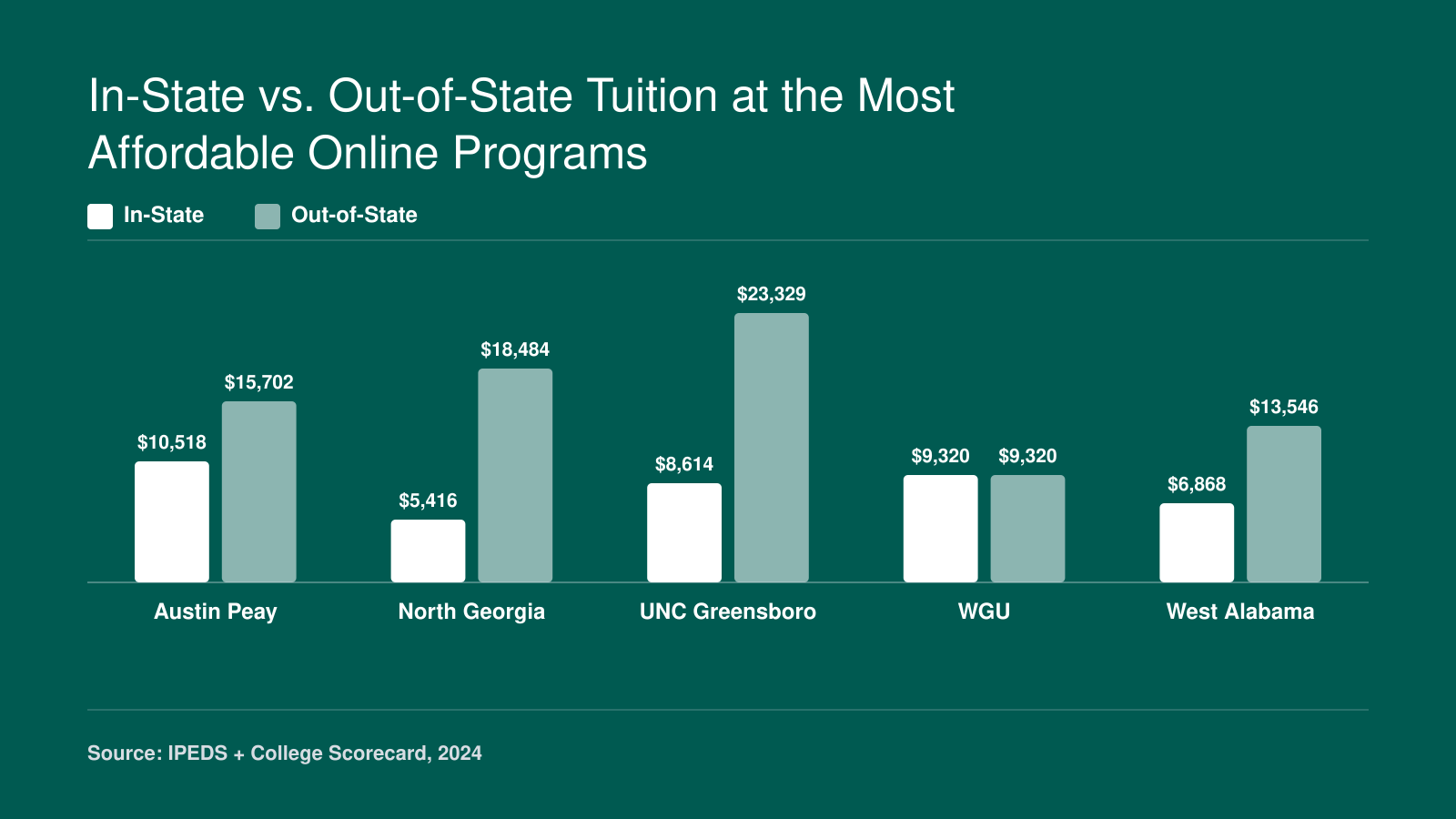
In-State vs. Out-of-State Tuition at the Most Affordable Online Programs
Tuition figures below are annual graduate tuition for the most affordable fully online science education programs on this list, using each school's published in-state and out-of-state rates. WGU charges one rate regardless of residency, while the public universities list separate rates. These totals do not include technology or distance-learning fees, and net price reflects an institution-wide average after aid rather than a program-specific quote.
Will an Online Master's Get You Certified or a Raise?
Online master's in science education programs now split into two very different tracks, and the distinction controls whether you finish with a new license or simply a higher salary lane.
Most online programs are advanced degrees for teachers who already hold a license. They deepen content or pedagogy and can support license renewal, but they do not grant initial certification. A smaller group is explicitly built as an initial licensure track and includes supervised student teaching, clinical hours, and state-required exams.2 A degree title alone is not proof of licensure eligibility.
Before You Apply, Verify State Requirements
Online delivery does not erase state rules. You must confirm the program's professional licensure disclosure page says it meets your home state's requirements in your intended science field. Disclosures list determinations as yes, no, or do not know, and a written disclosure is required when a determination is not met or is undetermined.1 NC-SARA does not approve licensure programs1, so do not assume reciprocity.
The Payoff for Licensed Teachers
For most licensed teachers, the real financial return from a master's in science education is a lane change on the district salary schedule. Schedules typically separate a master's lane from credit-based lanes such as plus 30 or plus 60.3 Some contracts add a stipend; one published schedule lists $3,650 for an in-field master's and $2,600 for an out-of-field master's4, though amounts vary by district and contract year. Check your state education department and the university's disclosure page before applying.
What Science Education Graduates Earn
Related Articles
Live Sessions, Weekly Hours, and How Long It Takes
Accelerated, asynchronous formats now dominate online teacher graduate study, but "online" still covers very different schedules.
Live vs. self-paced
Emporia State and the University of New England are asynchronous. Emporia State's online M.S. in Curriculum & Instruction has no scheduled class times, and New England sets deadlines but lets you watch live-session recordings whenever you like. University of Northern Colorado's online M.A. in Science Education is fully online, yet some courses include weekly scheduled synchronous sessions. Most other programs here do not state their format, so ask an advisor.
Weekly hours and timelines
New England is the only program here that publishes a workload: 15 to 20 study hours a week for one 3-credit course in an 8-week term, and that workload varies with your circumstances. Plan on a similar load elsewhere, but verify it.
Credit totals run from 30 to 36. Southeastern Oklahoma, Emporia, and Southern Indiana use 7-week courses, and several schools advertise finishing in as few as 12 months in accelerated science education master's programs. Part-time teachers should plan on about 24 months, which is what Georgia and UNC estimate.
Check the fine print
"Fully online" can still include classroom-based field experiences or action research in your own school. Confirm what yours requires, and whether your principal must approve it, before you enroll.
Admission Requirements: Licensed Teachers vs. Career Changers
- Bachelor's degree & GPAAn accredited bachelor's is standard; minimum GPAs usually fall between 2.75 and 3.0, with probationary or non-degree routes at some schools like UW-Stout and Montana State.
- Teaching license vs. initial licensureLicensed-teacher tracks often expect current certification, UGA asks for secondary science certification. Career-changer options may accept applicants without a license but require subject coursework.
- Science prerequisitesNew-teacher tracks spell out credits: Gwynedd Mercy lists 30 credits for grades 4–8 science, 42 for combined math/science, and 62 for secondary biology.
- GREWhere stated, the GRE is waived, Eastern Oregon, Pepperdine, Montana State, and University of New England do not require it.
- Supporting materialsExpect letters of recommendation, a statement of purpose, and a resume; Columbia also asks for a $75 fee.
Frequently Asked Questions
Is an online master's in science education worth it?
What can you do with a master's in science education?
Are online science education master's programs accredited?
How much does an online master's in science education cost?
Compare Science programs on the data that matters
Explore more Education & Teaching specializations or browse every graduate field.
All Education & Teaching programs