Best M.Ed. Programs in Alaska
Compare 13 accredited Education (M.Ed.) programs in Alaska at 4 schools, with graduate earnings, cost, debt, and completion data from IPEDS and the U.S. College Scorecard.

Geography limits M.Ed. choices in Alaska more than in most states. A teacher in a rural village school, where staffing needs run deepest, cannot commute to Anchorage, Fairbanks, or Juneau for evening seminars.
Campus, online, and hybrid M.Ed. programs appear side by side, compared on GRE policy, per-credit cost, certification alignment, and graduate outcomes. Residency still drives price: University of Alaska Fairbanks charges $13,040 in-state for its online special education M.Ed., versus $25,060 for nonresidents.
Key Points
- Some Alaska M.Ed. programs lead to initial licensure, others require current certification.
- GRE policies vary by school in 2027; UAF does not require it.
- UAS reports median earnings of $101,064 four years after finishing.
Best M.Ed. Programs in Alaska: Our 10 Top Picks
Alaska's master's in education options are compact but cover the state's distinct needs, from fully online special education to principal preparation and outdoor-focused teaching degrees. The programs below reflect a practical mix of delivery modes, tuition levels, and licensure pathways.
University of Alaska Fairbanks
#1Fairbanks, AK · ~$13,000/yr (est.)
Best for: Working K-12 educators seeking special education focus
University of Alaska Fairbanks offers three M.Ed. routes that fit working educators: a fully online special education degree, plus hybrid elementary and secondary education programs. Graduate tuition and fees run $8,736 in-state and $22,320 out-of-state. The special education program reports CAEP and Alaska Department of Education and Early Development accreditation, and the university's overall graduation rate is 38%.
- Fully online with synchronous and asynchronous course options
- CAEP and Alaska Department of Education and Early Development accredited
- Rolling admissions with summer, fall, and spring starts
- Fieldwork in local K-12 classrooms
- Designed for K-12 special education professionals
- Options to add initial certification or an endorsement
- Hybrid delivery available from anywhere in Alaska
- Holds CAEP accreditation for educator preparation
- Complete in up to six years with thesis or capstone option
- Postbaccalaureate licensure credits count toward the degree
- Emphasis on Alaska Native learning
- Hybrid delivery with distance and in-person options
- Meets CAEP educator preparation standards
- Year-long teaching internship in grades 6 through 12
- Up to 26 credits from postbaccalaureate licensure may apply
- Rolling admissions with summer, fall, and spring starts
University of Alaska Southeast
#2Juneau, AK · ~$12,000/yr (est.)
Best for: Rural teachers wanting blended and online formats
University of Alaska Southeast concentrates on preparing educators for rural and remote Alaska settings, with M.Ed. options in educational leadership, special education, and reading, plus three M.A.T. pathways. In-state graduate tuition and fees are $7,056; out-of-state students pay $20,640. Its educator preparation programs meet CAEP national standards, and the university's overall graduation rate is 28%.
- 36-credit cohort starts in summer and finishes the next year
- Summer courses on Juneau campus; fall and spring via technology
- Requires three years of teaching experience
- Portfolio aligned to NELP Building Level standards
- Application deadline April 1
- 35 credit hours with e-learning and on-site fieldwork
- One-week summer residency in Juneau
- Prepares for Alaska K-8 teaching certificate
- Praxis exam required for admission
- Includes student teaching internship and classroom research
- Fully online e-learning format with evening virtual classes
- 39 credit hours with embedded graduate certificate
- Designed for practicing teachers who hold Alaska certification
- Focus on culturally responsive services for rural and urban settings
- 100% online e-learning program
- 30 credit hours with exit portfolio required
- Prepares for Praxis Reading Specialist 5302
- National recognition by International Reading Association
- 11-month program with 34 credit hours
- Synchronous online classes plus full-time Alaska teaching internship
- Prepares for Alaska teaching certificate for grades 6 through 12
- Portfolio-based exit assessment
- 48 credit hours delivered online through e-learning
- Prepares for initial special education certification
- Requires student teaching and practicum
- Curriculum aligned with CEC standards and Alaska Native perspectives
University of Alaska Anchorage
#3Anchorage, AK · ~$11,000/yr (est.)
Best for: Aspiring school leaders needing principal preparation
University of Alaska Anchorage blends an online special education master's with a hybrid M.Ed. in educational leadership that includes a year-long principal internship. Graduate tuition and fees are $7,738 in-state and $21,322 out-of-state. The educational leadership program is CAEP-accredited and aligned with NELP standards, and UAA's overall graduation rate is 30%.
- Two-year hybrid program with online coursework and field work
- 35 credit hours with a year-long principal internship
- CAEP accredited and aligned with NELP standards
- Prepares for Alaska Type B Administrative Credential
- Cohort-based with one start date per year
- Fully online with synchronous and asynchronous options
- Approved by Alaska Department of Education
- Add a special education endorsement to a teaching credential
- Research-based strategies with an Alaska focus
Alaska Pacific University
#4Anchorage, AK · ~$21,000/yr (est.)
Alaska Pacific University takes an experiential, place-based approach through its Master of Science in Outdoor and Environmental Education and a Master of Arts in Teaching. In-state and out-of-state graduate tuition and fees are both $20,760. The university's overall graduation rate is 47%, and the outdoor education program offers a K-8 teaching certificate option.
- Cohort-based program completed in just over two years
- Thesis required
- Only program of its kind in Alaska
- Paid teaching experience through Cascadia Pathway
- K-8 teaching certificate option available
- Offered through the Education Department
- Campus-based program
- Prepares for Alaska teacher certification
Cost & outcomes by school
Federal data for the highest-earning Education (M.Ed.) programs, independent of the ranking above. Earnings are this field's master's graduates four years after completing, where the Scorecard reports them.
| School | Earnings | Tuition / yr | Debt | Grads/yr | Format |
|---|---|---|---|---|---|
| University of Alaska Anchorage AK | — | $10,532 | — | 332 | Hybrid |
| University of Alaska Southeast AK | — | $12,033 | — | 130 | Hybrid |
| University of Alaska Fairbanks AK | — | $13,040 | — | 396 | Online |
| Alaska Pacific University AK | — | $20,760 | — | 70 | Campus |
Sources: U.S. Department of Education. Tuition and graduates: IPEDS. Earnings and debt: College Scorecard, this field's master's graduates; a dash means no figure is reported.
Online and Hybrid Master's in Education Options in Alaska
An online or hybrid Master's in Education in Alaska delivers coursework through video meetings or web modules, usually paired with some in-person fieldwork. Synchronous classes meet live at set times. Asynchronous ones let you work on your own schedule.
The ranked programs differ widely:
- University of Alaska Fairbanks: The Special Education M.Ed. is listed as an online Master's in Special Education in Alaska program, with synchronous and asynchronous options. The School Counseling M.Ed. is 100% distance with weekly live videoconferencing and no campus residency. It does require an in-person practicum and a yearlong internship, generally arranged in your home community.
- University of Alaska Southeast: The Leadership M.Ed. is hybrid, pairing distance courses with two summer sessions on the Juneau campus, plus a school-year internship.1
- University of Alaska Anchorage: Delivery varies by concentration, with distance options and required field placements.
- Alaska Pacific University: Its outdoor and environmental education master's is listed as campus-based.
This matters because many rural and bush-community teachers cannot relocate, so distance delivery, available through online master's programs in Alaska, is often a practical necessity. Confirm the format on the current program page before applying.
Which Alaska Master's in Education Programs Skip the GRE?
Like many M.Ed. programs with no GRE required, test scores carry less weight in Alaska M.Ed. admissions than transcripts, essays, and classroom credentials. Policies still differ by school, so confirm with the program before applying.
- University of Alaska Fairbanks: The GRE is not required university-wide, though programs can set their own rules. Applicants submit a 4-5 page self-evaluation essay, a resume or CV, and a statement of academic goals. Check with the program for its current deadline.
- University of Alaska Anchorage: GRE policy is set by program. Expect a 3.00 GPA, a $75 fee, transcripts, a resume, references, and writing samples. Confirm the regular deadline with the program.
- University of Alaska Southeast: No GRE policy is published. It asks for a 3.00 GPA, a $60 online application, and a Bachelor of Education or equivalent plus a current teaching certificate. Deadlines are August 1, December 1, and May 1.
- Alaska Pacific University: No GRE policy is published. The Teacher Education K-8 program lists a 2.5 GPA (exceptions possible) and transcripts from all prior schools.12 2026 deadlines are May 1, August 1, November 1, and December 1.2
Related Articles
What an Alaska M.Ed. Costs and Where It Leads for Certification
Some Alaska M.Ed. programs assume you already hold a teaching certificate, while others are built to get you licensed. Knowing which kind you're applying to matters more than any sticker price.
Advanced degrees vs. licensure routes
At University of Alaska Anchorage, the M.Ed. in Teaching and Learning (30 credits) and the M.Ed. in Educational Leadership (35 credits) are advanced degrees. Leadership applicants need a current Alaska Teacher Certificate or Type C Special Services Certificate, plus three years of certificated contract experience, for the principal route. The M.Ed. in Special Education is also advanced and aimed at certificated teachers.
University of Alaska Fairbanks lists school counseling at 48 credits, community counseling at 54, and special education at 30. Those figures come from an older catalog, so reconfirm them. Fairbanks also runs post-baccalaureate licensure pathways separate from the M.Ed.
Reading the price
Per-credit tuition at the University of Alaska campuses differs for residents and nonresidents, and mandatory fees are added per credit or per semester. Multiply the current rate on the school's tuition page by the credit total, then add fees. The result will rarely match the annual IPEDS tuition in the ranking, which is an approximate, full-time-year figure. Also ask whether online master's in education programs at these campuses carry a flat rate that removes the resident gap; we could not confirm one. For University of Alaska Southeast and Alaska Pacific University, confirm credits and licensure status directly with the program.
Alaska Teacher Certification at a Glance
Curriculum & Instruction and Other Alaska M.Ed. Concentrations
The University of Alaska Anchorage's Master of Education in Educational Leadership runs 35 credit hours and leads to an Alaska administrative credential. Leadership is one of the clearest concentration pools here, and the University of Alaska Southeast offers its own 36-credit M.Ed. in the field, built for "building-level leaders for rural and urban districts." Both include a school-year internship.
Special education is the other major track. The University of Alaska Fairbanks offers an M.Ed. with fieldwork in local K-12 classrooms and training for the Alaska context, and it lists certification pathways.
Alaska Pacific University takes a different route with a thesis-based Master of Science in Outdoor & Environmental Education, described as the only program of its kind in the state. It suits careers in parks, nonprofits, and schools.
Match the M.Ed. specializations to the job: leadership for principals and administrators, special education for classroom specialists, outdoor education for field-based teaching. If you want instructional coach or curriculum specialist work, check online master's in curriculum and instruction programs and ask each admissions office which coursework covers it.
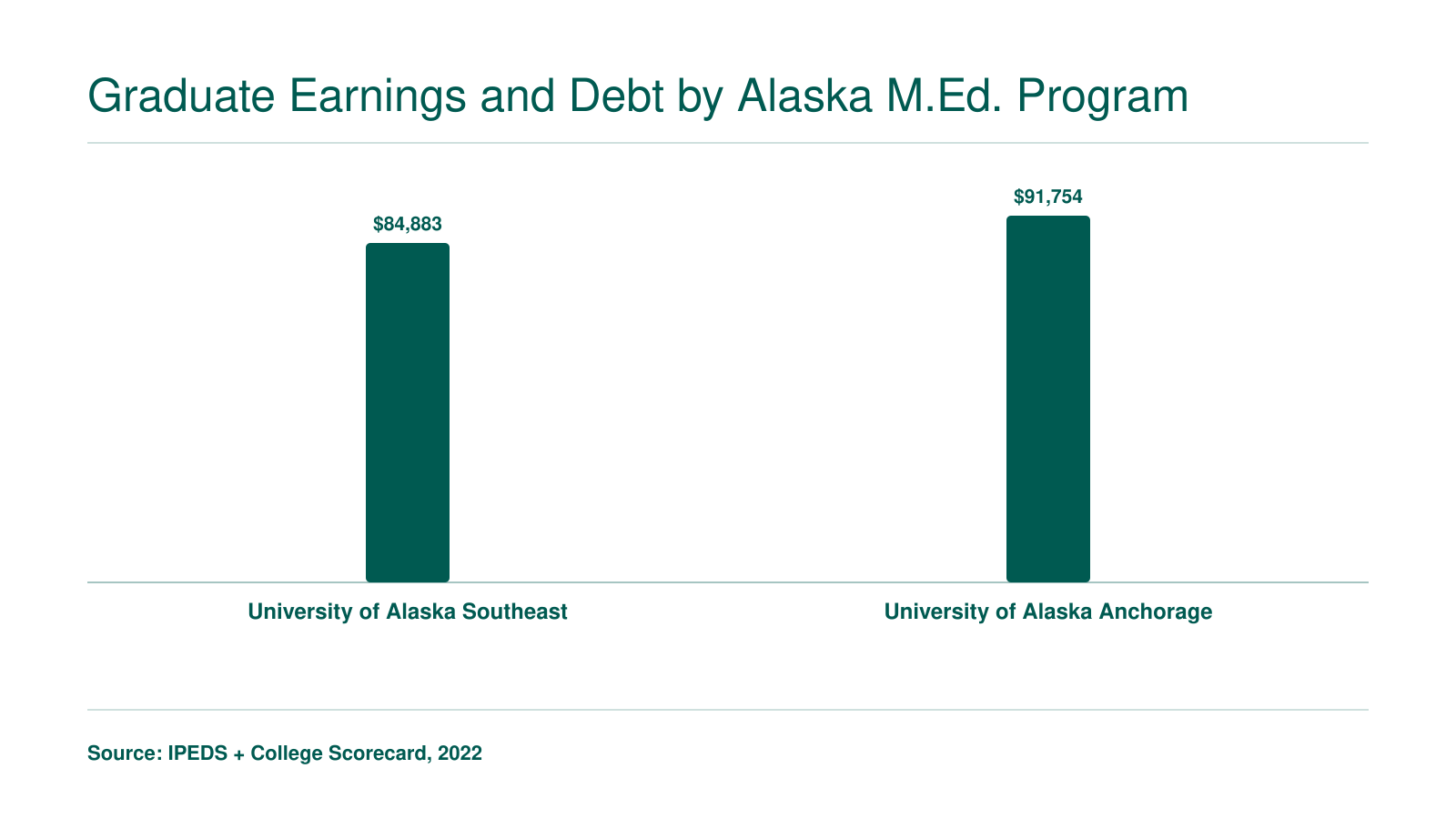
Graduate Earnings and Debt by Alaska M.Ed. Program
Among the Alaska programs here, program-level earnings are published for University of Alaska Southeast and University of Alaska Anchorage. University of Alaska Southeast reports median earnings of $84,883 one year after finishing and $101,064 four years after finishing, with median program debt of $26,860. University of Alaska Anchorage reports median earnings of $91,754 one year after finishing; Alaska Pacific University and University of Alaska Fairbanks do not publish program-level earnings or debt figures.
Matching an Alaska M.Ed. to Your Teaching Goals
The right fit among the best M.Ed. programs depends less on prestige than on where you stand in your career and where you live.
- Not yet certified: Prioritize programs that lead to initial Alaska licensure, then compare per-credit cost across the most affordable M.Ed. programs before you narrow the field. A cheaper degree that leaves you without a license helps no one.
- Already certified: Weigh an advanced or concentration-specific M.Ed. by format fit and by what the credential actually earns you, whether that is a Master Teacher Certificate or an added endorsement.
- Living outside Anchorage or Fairbanks: Filter first for fully online or low-residency delivery, then for GRE-free admission. Rural placement makes travel impractical, so delivery format should decide the shortlist before anything else.
Quick Answers on Alaska M.Ed. Programs
Which Alaska M.Ed. is strongest for curriculum and instruction?
What financial aid can Alaska M.Ed. students get?
How much does an M.Ed. program cost in Alaska?
Compare Education (M.Ed.) programs on the data that matters
Explore more MEd specializations or browse every graduate field.
All MEd programs