Best Master's in Curriculum and Instruction Programs in Connecticut
Compare 3 accredited Curriculum & Instruction programs in Connecticut, with graduate earnings, cost, debt, and completion data from IPEDS and the U.S. College Scorecard.

UConn's 30- to 40-credit Curriculum and Instruction MA, Charter Oak State College's online Master of Science, and University of Saint Joseph's cohort-based MA all target the same person: a working Connecticut teacher who needs graduate credit without leaving the classroom.
Only a few Connecticut schools make this list of best master's in curriculum and instruction programs, so the comparison is short. The harder decision is credential type. Some curriculum and instruction master's programs lead toward certification or an endorsement, and many are degree-only, which still counts on a salary schedule but won't add a license.
District contracts, not program marketing, decide what the degree is worth.
Key Points
- UConn graduates earned $60,722 five years after finishing, with median debt $29,978.
- Charter Oak State College advertises a fully online curriculum and instruction master's.
- Connecticut's Professional certificate requires 50 school months plus a master's degree.
Top Curriculum and Instruction Master's Programs in Connecticut, Ranked
Connecticut's curriculum and instruction master's options split across three distinct routes: a flagship university with certification pathways, a private university with a synchronous online cohort, and a fully online state-system program. We focused on what each one costs and what its graduates earn and owe, alongside how many students actually finish. That lens surfaces value beyond the biggest name.
University of Connecticut
#1Storrs, CT · ~$23,000/yr (est.)
Best for: Certification-bound career changers
The state's flagship education school pairs a content-focused M.A. with two entry routes: a five-year integrated bachelor's and master's for current undergraduates and an 11-month certification-and-master's option for college graduates entering teaching. Concentrations span bilingual and multicultural education, literacy specialist, and secondary content areas. The school's overall graduation rate is 83%, and published median earnings for graduates ten years after entry are about $74,000.
- 30-credit non-thesis degree ending in a culminating activity or exam
- Concentrations include bilingual/multicultural, elementary, music, literacy specialist, and secondary content areas
- Teacher Certification Program for College Graduates route for career changers
- CAEP-accredited and Connecticut State Board of Education approved
- Five-year Integrated Bachelor's/Master's option for current UConn undergraduates
University of Saint Joseph
#2West Hartford, CT · ~$18,000/yr (est.)
Best for: Synchronous online cohort seekers
This private West Hartford university's synchronous online M.A. is built as a two-year cohort, which suits working educators who want structure and peer support without relocating. The curriculum emphasizes inclusive, student-centered design for multilingual learners and students with disabilities. The school's overall graduation rate is 64%, and its net price after aid is about $27,989.
Charter Oak State College
#3New Britain, CT · $10,000 – $15,000/yr (est.)
Best for: Affordability-driven working teachers
Charter Oak State College delivers the only fully online curriculum and instruction master's within the Connecticut State Colleges and Universities system, making it a practical pick for budget-focused teachers already working in local schools. The program's capstone ties theory to an authentic professional challenge and must be completed through Charter Oak. The school's overall graduation rate is 67%, median graduate debt is about $18,683, and median earnings ten years after entry are about $64,200.
Cost & outcomes by school
Federal data for the highest-earning Curriculum & Instruction programs, independent of the ranking above. Earnings are this field's master's graduates four years after completing, where the Scorecard reports them.
| School | Earnings | Tuition / yr | Debt | Grads/yr | Format |
|---|---|---|---|---|---|
| Charter Oak State College CT | — | $10,352 | — | — | Online |
| Southern Connecticut State University CT | — | $14,930 | — | — | Hybrid |
| University of Saint Joseph CT | — | $17,604 | — | 39 | Campus |
Sources: U.S. Department of Education. Tuition and graduates: IPEDS. Earnings and debt: College Scorecard, this field's master's graduates; a dash means no figure is reported.
Online and Hybrid Master's in Curriculum and Instruction in Connecticut
Can you earn an online master's in curriculum and instruction in Connecticut without commuting to campus? Partly, depending on the school.
Which formats are on offer
Charter Oak State College is the clearest online option. It advertises 100% online coursework, completion in 18 to 24 months, and multiple start dates each year (its own page says five in one place and six in another, so confirm). It does not publish live meeting times we could verify. University of Saint Joseph is listed as campus-based in our Master's Programs in Connecticut rankings data, but its online programs page describes the M.A. as online and synchronous. Confirm which applies. UConn is classed as campus-based. Its certification route for college graduates describes a hybrid cohort based at Stamford, plus in-person cohorts at Hartford, Waterbury, and Avery Point.
What the labels mean
Asynchronous courses let you work on your own schedule within weekly deadlines. Synchronous online courses add set live sessions by video. Hybrid programs mix remote work with required nights or weekends in a classroom. Meeting days and times were not established for any of these programs, and we found no confirmed residency requirement. Certification-track routes typically include in-school clinical hours, so ask each program how those fit around a teaching job.
One practical check
Before you commit, ask whether live sessions start at 4:30 pm or later, so they fall after the school day.
Which Connecticut Master's Programs Waive or Make the GRE Optional?
For most applicants, the real question is how much of the application is published upfront and how much requires a phone call to find out, not whether a test score will sink them. Connecticut curriculum and instruction master's programs lean heavily on classroom experience rather than standardized testing, but the written policies are uneven.
University of Connecticut
UConn's curriculum and instruction master's page does not list the GRE as a requirement, and it also does not publish a formal test-optional or waiver statement. Treat the score as something to confirm with the program rather than assume either way; schools with published no-GRE policies appear among no GRE curriculum and instruction master's programs. What the program does spell out is substantial: transcripts, three letters of recommendation, a personal statement, a resume, and prior teaching experience. International applicants submit TOEFL scores. Deadlines are January 15 for fall entry and October 15 for spring.
University of Saint Joseph and Charter Oak State College
Neither school publishes a GRE policy for this field that we could verify, and the same applies to their graduate transfer credit limits and any prior learning assessment available to experienced educators. That absence is not a yes or a no. Email the graduate admissions office, ask specifically about testing, maximum transferable graduate credits, and whether years in the classroom can offset coursework.
Across the board, assume you will need official transcripts, references who can speak to your teaching, and a copy of your Connecticut certificate if you hold one.
Related Articles
Master's in Curriculum and Instruction Cost and Connecticut Certification Status
This table lists published graduate tuition, delivery format, and certification status for the curriculum and instruction programs below. Average net price is the institution-wide figure after federal, state, and institutional aid, not a per-student quote, and per-credit rates or separate online fees are not consistently reported across these schools.
| School | Format | In-State Tuition | Out-of-State Tuition | Average Net Price (After Aid) | Credits | Certification |
|---|---|---|---|---|---|---|
| Charter Oak State College | Online | $10,352 | $10,352 | $15,815 | Not reported | Not reported in available data |
| University of Connecticut | Campus | $22,872 | $44,784 | $25,097 | 30 to 40 | Initial Certification (teacher-preparation route); other routes may add endorsements |
| University of Saint Joseph | Campus | $17,604 | $17,604 | $27,989 | 30 | Not reported in available data |
Connecticut Educator Certification and Salary Lanes
What Connecticut Curriculum and Instruction Graduates Earn and Owe
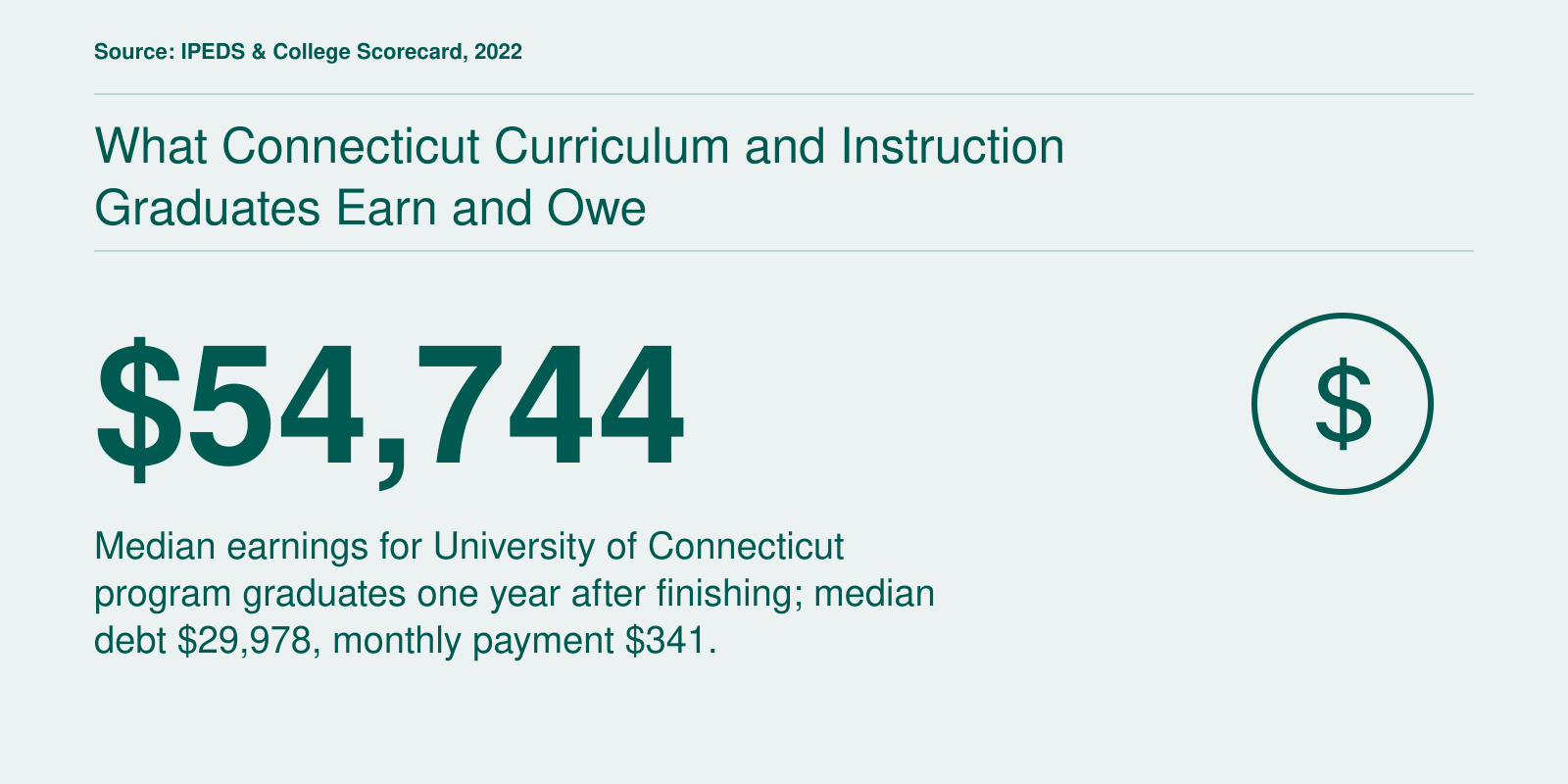
The University of Connecticut has published program-level curriculum and instruction earnings: $54,744 one year after finishing, $59,913 four years after finishing, and $60,722 five years after finishing. At the same school, median federal loan debt was $29,978, with a $341 monthly payment on the standard 10-year plan. Charter Oak State College and University of Saint Joseph have not published comparable program-level outcome figures.
Curriculum and Instruction Master's in Connecticut: Your Questions Answered
These answers address credential questions Connecticut educators often ask before enrolling in a curriculum and instruction master's program.
What is the difference between a curriculum and instruction master's that leads to certification and one that does not?
Can I earn a Connecticut teaching certification through a master's in curriculum and instruction program?
Can I add a Connecticut endorsement, such as reading or TESOL, while completing a curriculum and instruction master's?
Can graduate credits from a curriculum and instruction master's count toward a sixth-year or administrator certification later?
Compare Curriculum & Instruction programs on the data that matters
Explore more Education & Teaching specializations or browse every graduate field.
All Education & Teaching programs