Best Master's in Educational Psychology Programs in Connecticut
Compare 6 accredited Educational Psychology programs in Connecticut at 4 schools, with graduate earnings, cost, debt, and completion data from IPEDS and the U.S. College Scorecard.
A research-track master's in educational psychology and a certification-track school psychology degree can look alike on a brochure, yet they lead to different careers and different price tags. Connecticut has only a few programs in either category, so format, cost, and licensure fit matter more than prestige.
Campus, online, and hybrid options are listed together. Tuition ranges from about $13,400 at a public university to more than $58,000 at a private one.
Certification as a school psychologist in the state requires graduate work well beyond a standard two-year master's.
Key Points
- UConn does not require GRE scores in 2027 admissions.
- Tuition spans $13,438 at Southern Connecticut State to $58,350 at Fairfield.
- Connecticut school psychologists earned a median $100,600 in May 2025.
Best Master's in Educational Psychology Schools in Connecticut: Our Rankings
These four Connecticut schools offer distinct routes into educational psychology and school psychology, from research-oriented study to certification-focused clinical training. Use the rankings to compare program strengths, cost, and format side by side.
University of Connecticut
#1Storrs, CT · ~$23,000/yr (est.)
Best for: Research-minded school psychology and learning science candidates
The University of Connecticut's Neag School of Education pairs a research-focused educational psychology MA with a school psychology sequence that prepares students for Connecticut's 070 certification. The Storrs campus offers concentrated tracks in learning sciences and counseling, plus a three-year school psychology path with a 1,500-hour supervised internship. This is the strongest in-state choice for students who want research training or a route to school psychology certification at a public research university.
- Formerly Cognition, Instruction, and Learning Technology
- Offered through the Neag School of Education
- Six concentration options across the department
- Internationally renowned faculty
- Prepares researchers and education policymakers
- Counseling concentration within the educational psychology MA
- U.S. News #16 special education program
- Supports research and policy career paths
- CAEP and NASP accredited program
- 3-year sequence with 66 credit hours
- Apply by December 1 for fall entry
- 1,500-hour supervised internship
- Prepares for CT 070 school psychologist certification
- Eligible for NCSP credential after internship
- 400 clinical hours before internship
Fairfield University
#2Fairfield, CT · ~$21,000/yr (est.)
Best for: Working professionals needing evening and weekend classes
Fairfield University's campus-based MA in School Psychology is built for working students, with evening and weekend coursework and clinical placements in schools and agencies. The program uses a scientist-practitioner model with explicit training in diversity, prevention, and self-care. Full-time completion is about three years.
- $60,165 total program tuition
- $955 per credit
- Complete in about three years
- 63 total credit hours
- Evening and weekend classes
- Clinical affiliations in schools and agencies
- Scientist-practitioner training model
- Full-time and part-time options
University of Hartford
#3West Hartford, CT · ~$16,000/yr (est.)
Best for: Full-time students pursuing clinical child counseling
The University of Hartford integrates an MS and Sixth-Year Certificate in school psychology with a Clinical Child Counseling specialization. The full-time, three-year program emphasizes assessment, counseling, consultation, and a school-based internship. It is a practical path for students seeking Connecticut school psychologist certification and has no entrance exam requirement.
- No GRE required
- $793 per credit
- 3-year full-time program
- 71 total credit hours
- Combined MS and Sixth-Year Certificate
- NASP/CAEP accredited
- Fall start with January 15 priority
- One-year school-based internship
Southern Connecticut State University
#4New Haven, CT · ~$15,000/yr (est.)
Southern Connecticut State University's hybrid MS in School Psychology is a NASP-approved program designed for working students, with evening and hybrid classes. The curriculum covers psychoeducational evaluation, behavioral intervention, counseling, crisis response, and consultation. Completion of the MS plus the following Sixth-Year program is the route to Connecticut school psychology certification.
- NASP-approved through 2032
- Evening and hybrid courses
- Psychoeducational evaluations included
- Prepares for state and NCSP certification
- Covers NASP Practice Model
- Faculty awarded CASP citation
- 8% projected job growth
Cost & outcomes by school
Federal data for the highest-earning Educational Psychology programs, independent of the ranking above. Earnings are this field's master's graduates four years after completing, where the Scorecard reports them.
| School | Earnings | Tuition / yr | Debt | Grads/yr | Format |
|---|---|---|---|---|---|
| Fairfield University CT | $76,998 | $21,448 | — | 21 | Campus |
| Southern Connecticut State University CT | $61,570 | $14,930 | — | 35 | Hybrid |
| University of Connecticut CT | $60,973 | $22,872 | $36,904 | 15 | Campus |
| University of Hartford CT | $57,727 | $16,129 | — | 99 | Campus |
Sources: U.S. Department of Education. Tuition and graduates: IPEDS. Earnings and debt: College Scorecard, this field's master's graduates; a dash means no figure is reported.
Cost, debt & payoff
Median earnings of this field's master's graduates (4 yrs after completing) vs. their median federal loan debt · U.S. College Scorecard
Across these programs the median graduate earns about $60,973 and finishes with roughly $36,904 in debt — a ratio that clears a common rule of thumb (keep debt below first-year salary). Tuition and debt vary widely school to school, so check the per-school figures in the table above before you shortlist.
Online and Hybrid Master's in Educational Psychology Programs in Connecticut
School psychology training has moved toward blended delivery in recent years, but the field's practicum and internship requirements keep masters in school psychology programs anchored to physical classrooms and districts. The Master's Programs in Connecticut on this list split into two format groups.
- Hybrid: Southern Connecticut State University's M.S. in School Psychology combines evening courses with web-based work, mixing synchronous and asynchronous instruction.1 It runs full-time over 12 months, including full-time summer study, and some coursework (notably assessment and intervention) is held in person.1 Its Sixth Year Certificate follows the same hybrid, evening format.
- Campus: The University of Hartford's M.S. and Sixth Year Certificate in School Psychology runs on campus as a full-time three-year sequence built around site-based practicum and professional seminars.
Even where lectures move online, certification tracks demand in-person fieldwork in Connecticut schools. Southern's Sixth Year path requires a 700-hour practicum and a 1,200-hour, 10-month internship;1 Hartford pairs a 600-hour practicum with a 1,200-hour internship. No program here leads to Connecticut school psychologist certification fully online.
Which Connecticut Master's Programs Make the GRE Optional or Waive It?
Connecticut's master's in educational psychology programs lean away from the GRE, but only some say so clearly.
- UConn: The GRE is not required, though the page also says scores may be considered, so submitting strong ones can't hurt. Three letters are needed, and an interview is conditional.1
- University of Hartford: No GRE required, though submitted scores may be reviewed. Expect a B average, three letters, and an interview only after faculty review.2
- Southern Connecticut State University: The portal lists Praxis Core, SAT, ACT, or GRE scores as the required exam options, so applicants can satisfy the requirement with a test other than the GRE. Three letters, an essay, a resume, and a $50 fee apply. The 3.0 GPA is a graduation standard, not an admission cutoff.
- Fairfield University: No GRE or letters policy is published in the material available. Applicants who pass initial review are invited to an in-person group interview. The 3.50 GPA applies only to those entering with a related master's.3
None of these pages list a teaching license or classroom experience as a requirement. Before paying for the test, email admissions, because policies for master's in educational psychology programs with no GRE required change each cycle.
Related Articles
Cost of a Master's in Educational Psychology in Connecticut
The clearest measure of educational psychology master's degree cost is published in-state graduate tuition, which runs from $13,438 at Southern Connecticut State University to $21,044 at the University of Connecticut, then jumps sharply at the private institutions: $49,075 at the University of Hartford and $58,350 at Fairfield University. The public-private gap is the biggest lever here. At the state universities, Connecticut residents pay well under half what the private programs charge, and out-of-state students at Southern benefit from a NEBHE reduced rate starting Fall 2026.
Per-credit rates and total credit hours matter as much as the sticker tuition. Hartford lists $793 per credit across 71 credits, and Fairfield lists $955 per credit across 63 credits, with roughly $60,165 in total program tuition. Southern's School Psychology M.S. requires 32 credits, while its Sixth Year Certificate adds 49 more. School psychology tracks that lead to certification often run 60-plus credits combined, which raises the full-degree total considerably.
Aid and net price
Institution-wide net price after average aid (all students, not graduate-specific) sits near $20,857 at Southern, $25,097 at UConn, $30,282 at Hartford, and $48,095 at Fairfield, a pattern consistent with the Most Affordable Master's in Educational Psychology Programs nationally. Ask each program about graduate assistantships, and check whether your employing district offers tuition reimbursement.
Connecticut School Psychologist Certification at a Glance
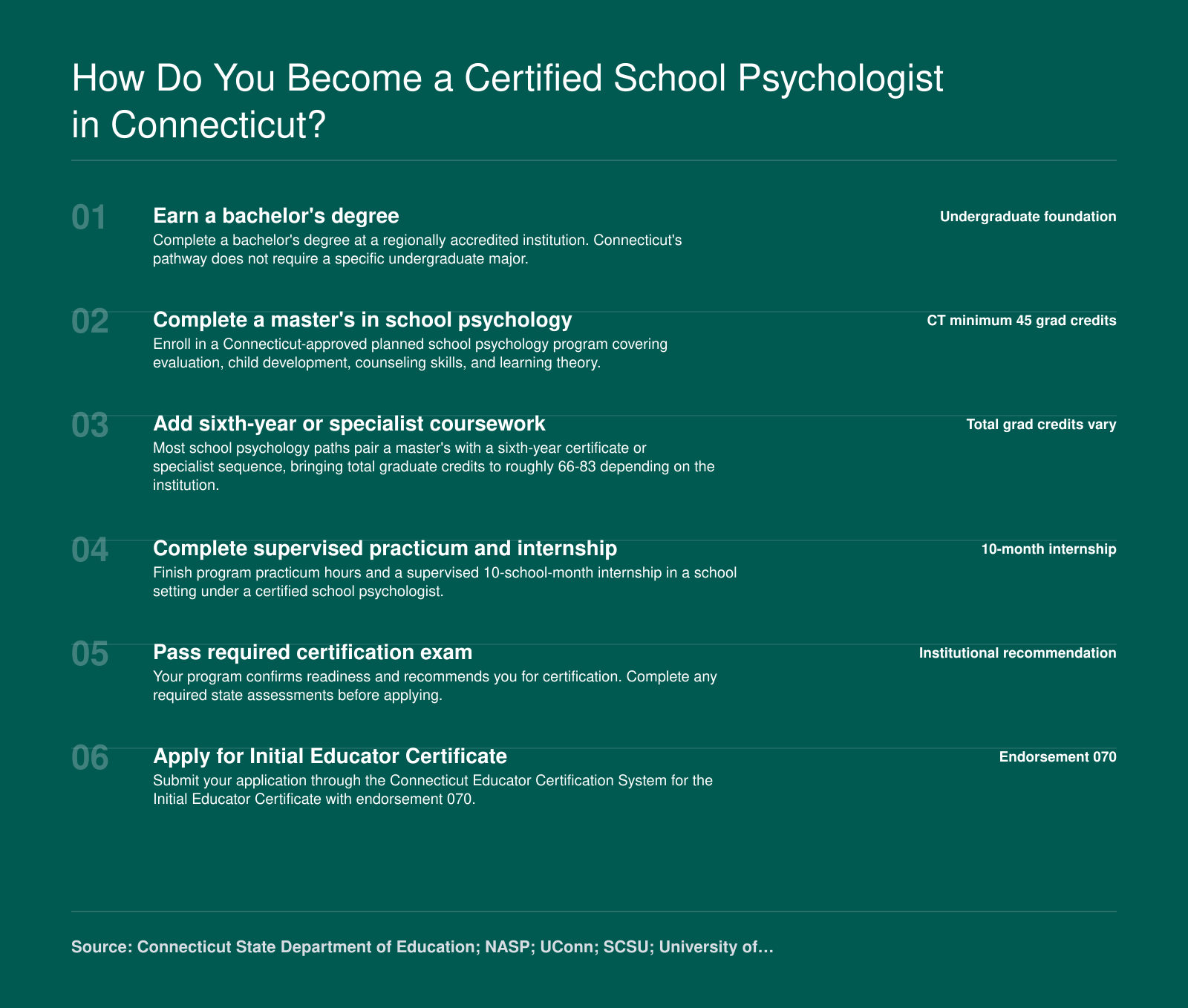
How Do You Become a Certified School Psychologist in Connecticut?
Connecticut's Initial Educator Certificate for school psychologists (endorsement 070) is a graduate credential, not an entry-level license. The steps below reflect the typical approved program sequence, including a master's plus sixth-year or specialist coursework and a supervised 10-month internship. General educational psychology degrees without a school psychology concentration lead to non-certified roles rather than this certificate.
What Can You Do With a Master's in Educational Psychology in Connecticut?
Among psychology graduate programs in Connecticut, school psychologists earned a median annual wage of $100,600 as of May 2025, above the national median of $95,990, with roughly 1,140 employed statewide. That figure applies to the certified track: practitioners hired by public school districts and educational agencies to run psychoeducational evaluations, consultation, and intervention.
The second track needs no state certificate. Graduates move into instructional design, learning specialist work, assessment and program evaluation, research roles at colleges and universities, educational publishing, and ed-tech.
Program-level earnings back both paths up. Graduates of the University of Connecticut's educational psychology master's reported median earnings of $55,022 one year after completion, rising to $68,299 by year five. Fairfield University's school psychology graduates reported a $76,998 median four years out, and Southern Connecticut State University's $61,570.
One limit worth knowing: a master's does not qualify you for licensed clinical psychologist roles in Connecticut, even a master's in counseling psychology in Connecticut. That credential requires a doctorate.
How to Choose a Connecticut Educational Psychology Program
Accreditation should be the first filter, because it decides whether a degree leads to certification. NASP approval matters most for school psychology: it eases certification portability when you move to another state. Fairfield, Southern Connecticut State, and Hartford show specialist-level full NASP status.1 UConn's record is mixed, with one NASP listing showing conditional accreditation1 and its detailed record and catalog showing approval2, so confirm it directly. UConn also cites CAEP accreditation and state board approval.3
Next, match the program to your goal. Certification seekers need a school psychology track, while research or instructional roles fit a general educational psychology degree. Then weigh format and total cost.
Before enrolling, ask each program for its internship placement rate and Praxis pass rate. Strong programs share both readily.
Connecticut Educational Psychology Master's FAQs
Do you need a teaching license to enter an educational psychology master's program in Connecticut?
Are there NASP-approved school psychology programs in Connecticut?
Can you become a school psychologist in Connecticut with an online master's?
Compare Educational Psychology programs on the data that matters
Explore more Psychology specializations or browse every graduate field.
All Psychology programs