Best Master's in Curriculum and Instruction Programs in North Carolina
Compare 15 accredited Curriculum & Instruction programs in North Carolina at 7 schools, with graduate earnings, cost, debt, and completion data from IPEDS and the U.S. College Scorecard.

In-state graduate tuition for a master's in curriculum and instruction in North Carolina runs from about $7,700 at East Carolina University to about $16,300 at Campbell University, a gap of about $8,600 for degrees of just 30 to 33 credit hours.
For a licensed teacher choosing among in-state options, format, entrance-exam rules, and licensure fit matter as much as price.
Price shows up on a tuition sheet. Licensure fit often doesn't, yet it decides whether the degree moves you up the state salary schedule.
Key Points
- Out-of-state students at NC public universities pay roughly $13,000 to $20,800 more in graduate tuition and fees.
- A master's degree alone does not earn M licensure; the program must be NC-approved.
- UNC Chapel Hill says the GRE is not required, and ECU lists no entrance exam.
The 5 Best Master's in Curriculum and Instruction Programs in North Carolina
Each program earned its spot on a blend of what it costs, how many students finish at the school, and how flexibly working teachers can enroll. Graduation rates below describe the whole institution, not the individual program, and accreditation notes appear only where we could verify them.
North Carolina State University at Raleigh
#1Raleigh, NC · $12,000 – $33,000/yr (est.)
Best for: Practicing educators choosing among five concentrations
NC State graduates about 85% of its students school-wide, the highest rate among these schools. Its former Curriculum and Instruction degree now sits under Teaching, Learning, and Curriculum, with concentrations ranging from curriculum development to educational psychology and elementary math and science. The on-campus track and the online track differ in admission rules, so check the entrance exam requirement for your concentration. Accreditation: SACSCOC institutional accreditation, CAEP accreditation for its teacher-education programs (2022 to 2029), and NCDPI approval as a 2025-2026 provider.
- 30 credit hours with a 3.0 GPA minimum
- Offered on campus, online, or hybrid
- MAT exam, interview, and statement of professional goals required
- Specializations include educational psychology and new literacies
- Teaching assistantships, scholarships, and financial aid available
- Competitive admission with limited spaces
- 30 credit hours, fully online option available
- Five concentrations built for practicing K-12 educators
- GRE not required for most concentrations
- Three letters of recommendation, 3.0 GPA minimum
- No thesis or capstone required
- Not a teacher licensure program
- Career paths: instructional coaching and curriculum development
- 30 credit hours, online
- GRE required for this concentration
- Three letters of recommendation, 3.0 GPA minimum
- Not an educator preparation program
- 30 credit hours, online with video lectures
- No entrance exam required
- Requires an NC teaching license or equivalent
- Prior K-6 teaching experience preferred
- Not an initial licensure program
University of North Carolina at Charlotte
#2Charlotte, NC · $5,000 – $10,000/yr (est.)
Best for: Licensed teachers needing asynchronous scheduling
UNC Charlotte curriculum and instruction pairs asynchronous online delivery with grade-band concentrations for already-licensed teachers. The school graduates about 69% of its students. Program materials cite NCDPI approval and CAEP accreditation, and the degree leads to an advanced (M-level) teaching license. A separate Curriculum Leadership for Independent Schools concentration runs as a two-year cohort that enrolls roughly every other year, which is unusual in the state.
- 30 credit hours, finished in five semesters
- 100% online and asynchronous, no set class times
- Three start dates per year: spring, summer, fall
- Requires a teaching license; leads to an Advanced license
- Capstone portfolio or research project required
- 3.0 GPA and three letters of recommendation
- 30 credit hours, leads to an M-level license
- Online or cohort format
- Designed for experienced licensed teachers
- Classes combine middle grades and secondary teachers
- Grant writing skill development; prepares for doctoral study
- 30 credit hours, totally online or cohort format
- Shares classes with the middle grades concentration
- Education Career Fair held each spring
- Scholarships and financial aid available
East Carolina University
#3Greenville, NC · ~$8,000/yr (est.)
Best for: Applicants wanting no entrance exam
East Carolina University offers its online MAEd in Curriculum and Instruction in three concentrations aimed at licensed teachers. The school graduates about 63% of its students. The program lists no entrance exam requirement, and the Birth-Kindergarten track is test optional and points toward advanced licensure. Accreditation: CAEP accreditation for educator preparation (2022 to 2029) and NCDPI approval of its licensure programs.
- 33 credit hours, finished in two to three years
- Full-time and part-time options
- No entrance exam required
- Teacher Action Research Project and capstone
- 100% online with some face-to-face options
- Graduate study abroad program available
- 33 credit hours, two to three years
- No entrance exam required
- Capstone and Teacher Action Research Project
- 100% online with face-to-face options
- Full-time and part-time enrollment
- 33 credit hours, test optional
- Eligibility for advanced licensure
- Graduate assistantships available
- Capstone and Teacher Action Research Project
- 100% online with face-to-face options
Campbell University
#4Buies Creek, NC · ~$16,000/yr (est.)
Campbell University is a private school that graduates about 61% of its students. Its on-campus Master of Education in Curriculum and Instruction is tied closely to North Carolina PK-12 schools and leads to licensure as a Curriculum Instruction Specialist. Field experiences run through agreements with local school districts, which gives students hands-on practice in the region. Tuition is the same for in-state and out-of-state students, so out-of-state applicants face no residency premium.
- 33 credit hours with three concentration options
- Leads to NC Curriculum Instruction Specialist licensure
- Field experiences through district partnership agreements
- Focus on equity and diversity in standards-based curriculum
- Coursework in data analysis for program effectiveness
- Option for focused study such as national teaching standards
- Delivered on campus
University of North Carolina Wilmington
#5Wilmington, NC · $8,000 – $24,000/yr (est.)
UNC Wilmington offers a 30-credit M.Ed. specialization in Curriculum and Instruction that looks beyond the K-12 classroom. The curriculum supports leadership roles in PreK-12, higher education, military, and nonprofit settings. The school graduates about 71% of its students. An integrative capstone project and an exit requirement round out the degree.
- 30 credit hours with an integrative capstone
- Must pass CUR 597 as the exit requirement
- Bachelor's degree and statement of purpose required
- Two recommendations from professionally relevant roles
- Transcripts from all institutions; published application deadline
- Fits PreK-12, higher ed, military, and nonprofit roles
Cost & outcomes by school
Federal data for the highest-earning Curriculum & Instruction programs, independent of the ranking above. Earnings are this field's master's graduates four years after completing, where the Scorecard reports them.
| School | Earnings | Tuition / yr | Debt | Grads/yr | Format |
|---|---|---|---|---|---|
| University of North Carolina at Charlotte NC | $63,987 | $8,037 | $23,800 | 27 | Online |
| North Carolina State University at Raleigh NC | $59,518 | $12,101 | $26,000 | 6 | Online |
| Carolina University NC | — | $12,550 | — | — | Online or campus |
| East Carolina University NC | — | $7,658 | — | 3 | Online |
| University of North Carolina Wilmington NC | — | $8,112 | — | 4 | Online |
| Queens University of Charlotte NC | — | $15,526 | — | — | Campus |
| Campbell University NC | — | $16,347 | — | — | Campus |
Sources: U.S. Department of Education. Tuition and graduates: IPEDS. Earnings and debt: College Scorecard, this field's master's graduates; a dash means no figure is reported.
Cost, debt & payoff
Median earnings of this field's master's graduates (4 yrs after completing) vs. their median federal loan debt · U.S. College Scorecard
Across these programs the median graduate earns about $59,518 and finishes with roughly $26,000 in debt — a ratio that clears a common rule of thumb (keep debt below first-year salary). Tuition and debt vary widely school to school, so check the per-school figures in the table above before you shortlist.
Online and Hybrid Master's in Curriculum and Instruction Options in North Carolina
For working teachers weighing a master's in curriculum and instruction in North Carolina online or hybrid, the practical tradeoff is schedule: asynchronous work protects your teaching job, while any campus component needs to fit the school year.
- NC State's Teaching, Learning and Curriculum master's is the most flexible format option below: on-campus, fully online, or hybrid with combined online and campus work. It starts in Fall, Summer 1, and Summer 2, with an April 1 application deadline.
- UNC Charlotte's M.Ed. curriculum and instruction program is 100% online and asynchronous, with three start dates per year (spring, summer, and fall), designed for licensed teachers.
- East Carolina's MAEd in Curriculum and Instruction is fully online; current deadline and start-term details are not clearly published.
- UNC Wilmington's online M.Ed. in Curriculum and Instruction uses rolling admission and advertises six start terms annually. Published deadlines include September 26, 2026 for an October 19, 2026 start, and December 12, 2026 for a January 11, 2027 start.
- Campbell University's Curriculum & Instruction is campus-based, with field experiences tied to local districts.
Related Articles
Which Ranked North Carolina Programs Waive or Skip the GRE
Some schools offer No-GRE master's programs, while others leave testing requirements to individual programs. UNC Chapel Hill says it is not required, so nothing needs waiving.1 ECU lists no entrance exam for its M.Ed. UNC Charlotte says most programs require no test, but a rule specific to curriculum and instruction was not confirmed.2 NC State requires the GRE only for Educational Psychology, though its Education & Teaching Master's Programs listing mentions an entrance exam. UNC Pembroke may waive an exam, where one is required, for applicants with a master's or higher.3 NC Central wants scores only if a program requires them.4 Campbell and UNCW do not publish a test policy in the information we reviewed.
On transfer credit, NC State and UNC Pembroke each accept up to 12 graduate credits with a B or better.53 NC State excludes credits from a prior master's, and Pembroke requires program director and Graduate Dean approval.53 UNC Chapel Hill decides case by case.1 Limits at the other schools were not established, and no source confirmed that licensure renewal credits shorten a degree.
One practical tip: confirm policy by concentration, since waivers can differ between tracks at the same school.
Master's in Curriculum and Instruction Cost and North Carolina Licensure
The cost of a master's in curriculum and instruction in North Carolina is not just a sticker-price question. It is whether lower tuition now still positions you for the advanced licensure and pay benefits you are counting on later.
Tuition by Residency
Published in-state graduate rates among ranked programs range from $288.82 to $568 per credit; where out-of-state rates are listed, they run from $1,020.05 to $1,751 per credit. That gap can add $20,000 or more over a 30-credit degree. UNC Charlotte's online M.Ed. is the lowest published total among programs that provide a C&I-specific cost, at about $8,665. NC State, by contrast, lists $568 in-state and $1,751 out-of-state for online graduate education courses.
Do not assume an online format means in-state pricing. Several online programs in this list still separate in-state and out-of-state rates. Use the institution-wide average net price after aid only as a rough affordability signal; it is not a quote for this degree.
Licensure and Pay
For curriculum and instruction licensure in North Carolina, the master's must be completed through an NC-approved educator preparation program. Advanced master's-level (M) licensure is a separate application, not automatic. As of 2026, NCDPI has not published clear guidance confirming that new C&I completers automatically qualify for a master's pay supplement, so verify that step directly before budgeting for a raise.
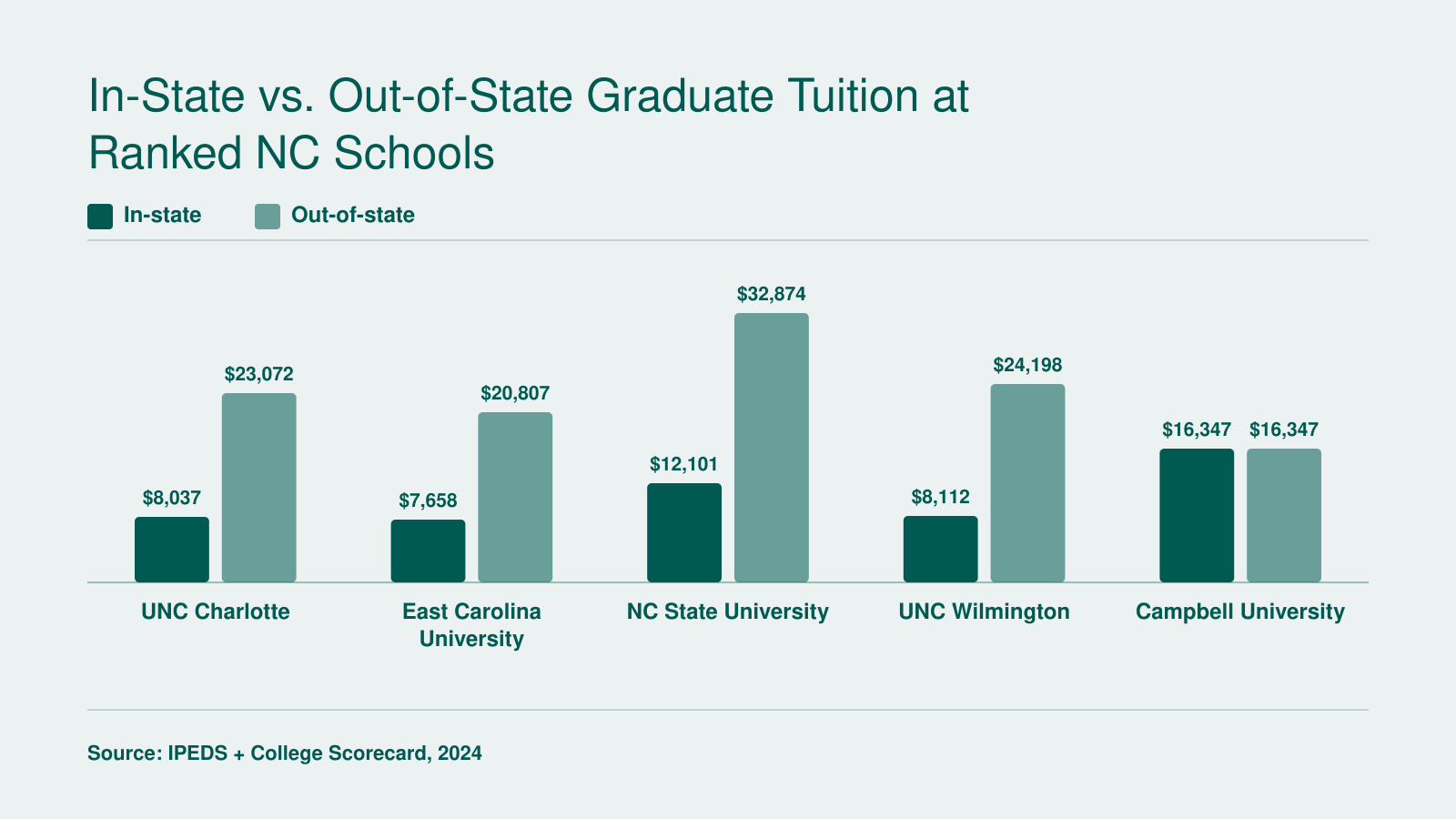
In-State vs. Out-of-State Graduate Tuition at Ranked NC Schools
At the public universities here, out-of-state students pay roughly $13,000 to $20,800 more in graduate tuition and fees than North Carolina residents. Campbell University, a private school, charges one rate regardless of residency. These are graduate tuition-plus-fees figures, not net price, so scholarships and assistantships will lower what you actually pay.
North Carolina Advanced Licensure at a Glance
Quick Answers Before You Compare Programs
Do you need a teaching license to start a curriculum and instruction master's in North Carolina?
Is an M.Ed. or an M.A./M.S. in curriculum and instruction the better fit for North Carolina teachers?
What can you do with a master's in curriculum and instruction?
Compare Curriculum & Instruction programs on the data that matters
Explore more Education & Teaching specializations or browse every graduate field.
All Education & Teaching programs