Best MFA Programs in North Carolina
Compare 5 accredited Fine Arts (MFA) programs in North Carolina, with graduate earnings, cost, debt, and completion data from IPEDS and the U.S. College Scorecard.

Funding, not sticker tuition, now separates affordable MFAs from expensive ones. Each program here is a 60-credit terminal degree lasting two to three years, with published in-state tuition from about $7,700 to $12,800.
This page ranks only the programs in our dataset and covers campus and online formats together. The practical question is which are worth applying to, and what each costs after assistantships and aid.
Teaching posts that MFA graduates compete for remain competitive, so debt matters.
Key Points
- No ranked North Carolina MFA program requires the GRE; your portfolio or manuscript carries the application.
- Out-of-state tuition runs roughly $10,700 to $18,700 above in-state rates, widest at UNC Chapel Hill.
- UNC Chapel Hill states that all accepted Studio Art students receive full funding, so compare offers, not sticker prices.
Best MFA Schools in North Carolina: The Ranked List
Four North Carolina universities make this list, each offering an on-campus studio MFA with its own cohort size, funding model, and facilities. Graduation rates cited below describe each university as a whole, not its MFA program. Read the program details closely, because cohort size and teaching opportunities vary widely.
University of North Carolina at Chapel Hill
#1Chapel Hill, NC · ~$13,000/yr (est.)
Best for: Artists seeking a very small cohort
UNC Chapel Hill runs one of the smallest and most selective studio MFA cohorts in the state, with an average of 5 to 6 openings each year and fall entry only. The university graduates about 91% of its students overall. Students get dedicated studio space, close faculty contact, and a thesis exhibition at the Ackland Art Museum. Applicants who finish their application by December 15, 2026 are considered for merit and other fellowships.
- Two-year, 60-credit program with fall entry only
- Average of 5 to 6 openings each year
- No entrance exam required
- 26 credits of independent study and critique with faculty or visiting artists
- Faculty-to-student ratio of 1:1.5
- Studio space provided for each student
- Thesis exhibition at the Ackland Art Museum
- Portfolio of up to 12 items; final deadline January 12, 2027
East Carolina University
#2Greenville, NC · ~$8,000/yr (est.)
Best for: Craft-minded makers working in glass or metal
East Carolina University offers a three-year, 60-hour terminal MFA in Art for students who want room to explore across media. Course options span ceramics, glass, metal design, textile design, painting, printmaking, photography, sculpture, and graphic design. The university graduates about 63% of its students overall. Students are guaranteed studio space in the 142,000-square-foot Jenkins Fine Arts Center.
- Three-year, 60 semester-hour terminal studio degree
- On-campus program; no entrance exam required
- Concentration options include ceramics, glass, metal design, and textile design
- Also offers painting, printmaking, photography, sculpture, and graphic design
- Guaranteed studio space in the Jenkins Fine Arts Center
- Instructor-of-record teaching experience
- Admission uses a portfolio, references, and a virtual interview
- Ends with a solo thesis exhibition and thesis defense
Western Carolina University
#3Cullowhee, NC · ~$8,000/yr (est.)
Best for: Visual arts majors wanting residential study
Western Carolina University offers a residential, three-year, 60-credit MFA in Fine Arts built around a 24-hour studio core and a studio critique seminar. The university graduates about 60% of its students overall. Facilities cover ceramics, sculpture, photography, printmaking, and painting and drawing. Applicants do not need GRE scores, and a campus visit is recommended before applying.
- Residential three-year, 60-credit program
- GRE not required; test optional
- 3.00 GPA expected in an undergraduate visual arts major
- 36 hours of required courses, including 18 of studio critique seminar
- 24-hour studio core of your choosing
- 3-credit teaching practicum and 6-credit thesis exhibition
- Portfolio of 15 to 20 images and a one-page statement of purpose
- Campus visit recommended; three recommendation letters required
University of North Carolina at Greensboro
#4Greensboro, NC · ~$9,000/yr (est.)
UNC Greensboro offers a two-year, 60-credit studio MFA that emphasizes interdisciplinary research and professional practice, with enrollment capped at 20 students. Nearly all students receive graduate assistantships that include tuition waivers and stipends. The university graduates about 56% of its students overall. Students have round-the-clock studio access and can collaborate with dance, music, and theatre peers.
- Two-year, 60-credit in-person residency
- Enrollment capped at 20 students
- Nearly all students receive assistantships with tuition waivers and stipends
- 24/7 access to individual studios
- Woodshop, sculpture foundry, ceramics, photo wet lab, and printmaking
- Exhibitions at Greensboro Project Space
- Final-year students may teach as Instructor of Record
- Annual fall entry; program page lists a February 1 deadline
Cost & outcomes by school
Federal data for the highest-earning Fine Arts (MFA) programs, independent of the ranking above. Earnings are this field's master's graduates four years after completing, where the Scorecard reports them.
| School | Earnings | Tuition / yr | Debt | Grads/yr | Format |
|---|---|---|---|---|---|
| University of North Carolina at Chapel Hill NC | — | $12,751 | — | 5,344 | Campus |
| East Carolina University NC | — | $7,658 | — | 2,772 | Campus |
| University of North Carolina at Greensboro NC | — | $8,614 | — | 1,912 | Campus |
| Western Carolina University NC | — | $7,876 | — | 1,150 | Campus |
| Duke University NC | — | $66,523 | — | 7,432 | Campus |
Sources: U.S. Department of Education. Tuition and graduates: IPEDS. Earnings and debt: College Scorecard, this field's master's graduates; a dash means no figure is reported.
Online and Hybrid MFA Options in North Carolina
Full-residency on campus versus low-residency with trips home is the real split among the best MFA programs ranked here, and it decides whether this degree fits around a job.
UNC Chapel Hill, East Carolina, Western Carolina, and UNC Greensboro all run full-residency studio art MFAs.1 These expect you on campus for the duration: UNCG and UNC Chapel Hill over two years, East Carolina and Western Carolina over three.1 Studio space, faculty critique, and teaching assistantships are built around physical presence.
None of the programs ranked here is fully online, and that matters.1 For working adults, a full-residency MFA usually means relocating or stepping back from employment. Western Carolina's lower in-state tuition softens the cost, but not the time commitment.
If you need flexibility, weigh whether you can restructure work around on-campus semesters before applying. The payoff is daily access to studios, faculty, and peers that remote study cannot replicate.
Which Ranked NC Master's in Fine Arts Programs Waive the GRE?
The GRE is a standardized graduate entrance exam, and the good news for applicants here is simple: none of these MFA programs require it. As with many No-GRE master's programs, what matters far more is your writing sample or studio portfolio. Here is where each North Carolina program stands, based on its published admissions page.
- UNC-Chapel Hill (Studio Art): No GRE. Submit up to 12 portfolio items with brief titles and descriptions (75 words or fewer each) plus a roughly 500-word artist statement. Recommended deadline January 12, 2027.
- UNC Greensboro (Creative Writing): Not required; scores are only considered if you have already taken the test, since some scholarships may use them. Fiction samples run to 30 pages, poetry to 10. Priority deadline December 15, final January 15.
- NC State (Creative Writing): Not required and not considered. Fiction runs 25 to 40 pages; poetry asks for 10 to 12 poems. Deadline February 1, which also governs aid consideration.
- UNC Wilmington (Creative Writing): Not required, and submitted scores will not factor in. Samples run 30 pages in fiction or creative nonfiction, 10 in poetry. Deadline January 15, 2027.
In-State vs. Out-of-State MFA Tuition in North Carolina
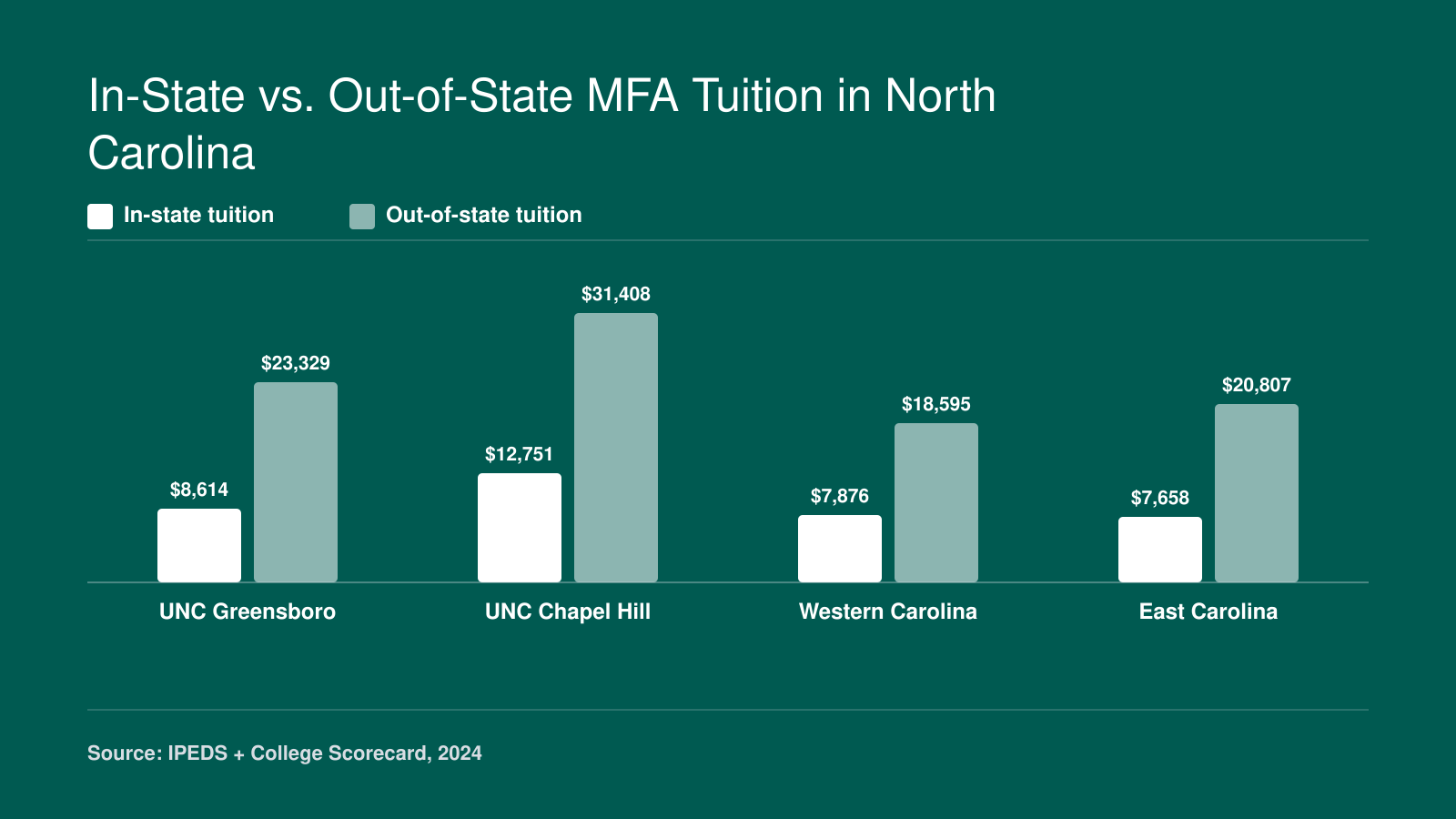
Published graduate tuition at these public schools splits sharply by residency. Out-of-state rates run roughly $10,700 to $18,700 higher than in-state rates, and the widest gap is at the University of North Carolina at Chapel Hill. Treat these as sticker figures, not what funded MFA students actually pay, because assistantships and scholarships, where offered, can lower the real bill.
Cost, Funding, and North Carolina Licensure for MFA Graduates
Are there fully funded MFA programs in North Carolina? Yes, and funding should weigh more heavily than sticker tuition when you compare these programs.
What Funding Actually Covers
UNC-Chapel Hill states that all accepted Studio Art students receive full funding. Graduate teaching assistantships carry tuition remission plus a $10,000 stipend per semester; additional graduate assistantships pay $6,000 per semester for roughly 10 hours of work a week. East Carolina reports that most accepted students receive some assistantship support, with full-time positions currently funded at $14,000 per academic year for 20 hours weekly, plus out-of-state tuition remission in the first year (students can apply for NC residency after one full year).1
Sticker tuition tells a different story than real cost. In-state tuition at ECU is $8,000 a year, but after an assistantship the figure you actually pay drops sharply. Institution-wide, the average net price at these public campuses sits in the low-to-mid five figures before program funding is applied.
Licensure
North Carolina issues no "MFA license." The degree is the standard terminal credential for college teaching. To teach art in K-12 public schools, you need an educator license through the NC Department of Public Instruction, built on a state-approved master's in art education north carolina and the Praxis II exam, not the MFA alone.2
Always confirm funding is guaranteed for every year, not just the first.
Related Articles
Studio Art vs. Creative Writing: Choosing Your MFA Discipline in North Carolina
Studio practice and manuscript work pull in different directions, and that choice shapes your daily routine more than the school's name does. The programs ranked here lean heavily toward studio art: UNC Chapel Hill and UNC Greensboro both offer a Master of Fine Arts in Studio Art, East Carolina offers a 60-credit terminal MFA in Art spanning disciplines like ceramics, painting, printmaking, and sculpture, and Western Carolina offers a studio-based Fine Arts MFA.
All of these schools hold institutional accreditation. Studio art programs may also carry NASAD accreditation, the specialized art-and-design standard that East Carolina and UNC Greensboro note; creative writing has no equivalent specialized accreditor.
Expect the disciplines to feel distinct: a writing path centers on workshops and a final manuscript, while studio tracks revolve around independent studio time, critique, and a thesis exhibition.
Facilities, Faculty, and Career Outcomes: What Sets These MFA Schools Apart
Each program here offers one asset that deserves weight alongside its price.
- UNC Greensboro: In the studio art MFA, nearly all students receive support through graduate assistantships, and two outstanding applicants receive $5,000 scholarships in each year of the two-year program. The School of Art directs scholarship funding toward reducing longstanding inequities in higher education and arts access.
- UNC Chapel Hill: Studio space is provided, the faculty-to-student ratio is 1:1.5, and thesis work is shown at the Ackland Art Museum. Federal data puts median earnings for its fine arts master's graduates at $51,978 four years after finishing.
- East Carolina University: Studio space is guaranteed within the 142,000-square-foot Jenkins Fine Arts Center, and each student mounts a solo thesis exhibition before graduating.
- Western Carolina University: Students get studio access 24/7 year-round, a Visiting Artist Program, and assistantships for every student, in a small cohort of 12 to 15 graduates.
If you plan to teach at the college level, look closely at the teaching experience each program offers, since that is what departments cite most often when describing Master's in Higher Education in North Carolina graduate destinations.
How We Ranked North Carolina MFA Programs
Federal data on master's outcomes remains thinner than most applicants expect, so we used what is verifiable. Our inputs come from the College Scorecard and IPEDS: tuition, average net price, institution-wide graduation rates, and program-level outcomes wherever they are published.
Both campus and online formats were eligible, but only North Carolina schools that offer an MFA were considered.
Two limits matter. Graduation rates describe the whole institution, not the MFA cohort; use them only as a rough signal of student support. Net price is an approximate average across students, and your own cost will depend on aid and assistantships.
Common Questions About MFA Programs in North Carolina
How much does an MFA cost in North Carolina?
What is the acceptance rate for MFA programs in North Carolina?
How long does an MFA in North Carolina take to complete?
Compare Fine Arts (MFA) programs on the data that matters
Explore more MFA specializations or browse every graduate field.
All MFA programs