Most Affordable MFA Programs
Compare 180+ accredited most affordable Fine Arts (MFA) programs, with graduate earnings, cost, debt, and completion data from IPEDS and the U.S. College Scorecard.

An MFA is a terminal studio or writing degree, and it rarely leads to high starting pay, so what you pay to earn it matters more than in most fields.
At the schools ranked here, the institution-wide average net price after aid runs from $2,984 at CUNY Hunter College to $7,021 at CSUN. That is a campus-wide figure, not a program quote, and individual costs vary with funding.
CUNY and Cal State campuses fill most of the list.
Key Points
- Median MFA earnings here range from about $44,000 to $65,800.
- Fully funded MFAs remain most common in creative writing.
- What you actually pay after funding matters most.
The 10 Most Affordable MFA Programs in 2027
These 10 MFA programs stand out for their combination of low net price, strong studio resources, and clear career preparation. Each entry highlights what makes the program distinctive, from specialized facilities to teaching assistantships, so you can weigh the real cost against the experience you would receive.
CUNY Hunter College
#1New York, NY · ~$11,000/yr (est.)
Best for: New York residents wanting Tribeca studio space
Hunter College's MFA in Studio Art is a three-year, 48-credit program housed in Tribeca, with six studio concentrations and a required thesis exhibition. Hunter's in-state tuition makes it one of the most affordable residential MFA options in New York City, though out-of-state students pay a notably higher rate. The program emphasizes group and individual critiques and culminates in a public show at 205 Hudson Gallery.
- Three-year, 48-credit studio art degree
- Six concentrations including Painting, Sculpture, and Photography
- Studios at 205 Hudson Street in Tribeca
- Thesis exhibition in campus gallery
- Late applications considered on rolling basis
- Minimum 3.0 undergraduate GPA
- Portfolio, two recommendations, and statement of purpose required
CUNY Brooklyn College
#2Brooklyn, NY · $10,000 – $15,000/yr (est.)
Best for: Artists prioritizing private sky-lit studios
Brooklyn College offers a 48-credit M.F.A. in Art with five studio concentrations, private sky-lit studios, and digital and printmaking facilities. The program requires a portfolio and culminates in a thesis exhibition in Manhattan and Brooklyn galleries. Priority and regular deadlines fall in January and February.
- 48 total credit hours
- Five concentration options including digital art and printmaking
- Private sky-lit studios plus digital labs and printmaking suite
- Portfolio of up to 20 images required
- Priority deadline January 19, regular deadline February 15
- No spring admission
- Thesis show in Manhattan and Brooklyn galleries
- Scholarships available
CUNY City College
#3New York, NY · ~$11,000/yr (est.)
Best for: Future college art teachers needing studio space
City College's MFA in Studio Art is a two-year, 60-credit program that gives every student their own studio space and includes a solo thesis exhibition. The curriculum adds professional development and college-level teaching coursework, and City College is a nominating school for the Joan Mitchell MFA Grant.
- Two-year, 60 total credit hours
- Students have their own studio space
- Solo thesis exhibition in department gallery
- Course in teaching art at college level
- Two graduate Art History courses
- Nominating school for Joan Mitchell MFA Grant
- Financial aid and merit scholarships available
CUNY Queens College
#4Queens, NY · ~$12,000/yr (est.)
Queens College's MFA in Studio Art is known for its private studio workspaces and an on-site bronze foundry, unique within CUNY. The program offers fall and spring starts, six concentration options, and access to wood, metal, plaster, ceramic, printmaking, and digital facilities.
- Private studio workspace for every MFA candidate
- On-site bronze foundry unique within CUNY
- Access to wood, metal, plaster, ceramic, and printmaking facilities
- Six concentration options
- Fall and spring starts
- Three letters of recommendation required
- Prepares graduates to teach studio art in college
California State University-Fullerton
#5Fullerton, CA · $9,000 – $19,000/yr (est.)
Cal State Fullerton's MFA in Art features an Illustration concentration within a 60-unit program. Admission weighs the portfolio most heavily and requires artist and purpose statements. Nonresident students face higher fees than California residents.
- 60 total credit hours
- Illustration concentration includes 24 units
- Portfolio is the key admission element
- Artist statement and statement of purpose required
- Minimum 3.0 GPA and B in concentration courses
- BA or BFA in Art preferred
- Art history electives: 9 units
- Culminating experience: 9 units
California State University-Los Angeles
#6Los Angeles, CA · ~$9,000/yr (est.)
Cal State LA's MFA in Art offers two tracks: Design, with graphic design and animation, and Studio Arts, with painting, photography, ceramics, sculpture, and new genres. The program admits once yearly in fall, with applications due February 15.
- 60 total credit hours
- Two options: Design and Studio Arts
- Design includes graphic design and animation
- Studio Arts includes painting, photography, ceramics, sculpture, and new genres
- Fall admission only, one start per year
- Applications open October 1 on CalStateApply
- February 15 application deadline
- Late or incomplete applications not considered
The University of Texas Rio Grande Valley
#7Edinburg, TX · $5,000 – $10,000/yr (est.)
UTRGV's MFA in Art offers three concentrations in Design, 2D Studio Art, and 3D Studio Art, with studio work across drawing, ceramics, painting, printmaking, sculpture, jewelry, photography, installation, performance, and mixed media. A graduate scholarship of up to $1,000 is available.
- Three concentrations: Design, 2D Studio Art, 3D Studio Art
- Studio work in drawing, ceramics, painting, printmaking, and sculpture
- Also covers installation, performance, jewelry, photography, and mixed media
- Prepares for college-level teaching and professional art careers
- Graduate scholarship up to $1,000 available
- Careers include art director, creative director, and museum curator
CUNY Lehman College
#8Bronx, NY · ~$12,000/yr (est.)
Lehman College's MFA in Art is delivered in a hybrid format and assigns each student a faculty advisor to help with course choices and degree planning. It sits alongside the college's MA in Art and MA in Art Teacher, both also hybrid.
- Hybrid delivery format
- Dedicated coordinator and faculty advisor
- Advisor helps with course choices and degree planning
- MFA award in the field of Art
California State University-San Bernardino
#9San Bernardino, CA · ~$10,000/yr (est.)
Cal State San Bernardino's MFA in Studio Art is a 60-unit program with graduate teaching assistantships and paid teaching associate opportunities. The curriculum includes critical theory, contemporary art seminars, and a culminating public exhibition. Admission is fall-only with a January 15 secondary deadline.
- 60 total credit hours
- Fall entry only, apply by January 15
- Graduate Teaching Assistantships available
- Paid Teaching Associate positions in years 2 and 3
- Portfolio of 15 artwork images required
- 500-word Statement of Purpose required
- Culminating Master's Project with public exhibition
- Nine elective units tailored to student's goals
California State University-Northridge
#10Northridge, CA · ~$9,000/yr (est.)
CSUN's MFA in Visual Arts is a 60-unit terminal degree for practicing artists. Students are encouraged to register full time and take at least nine units per semester, with coursework spanning art media, critical thinking, and cultural contexts.
- 60 total credit hours
- Terminal degree for practicing artists
- Full-time registration encouraged
- Minimum 9 units per semester
- Covers art media, concepts, and methodologies
- Individual and collaborative work
- Visual, oral, and written communication formats
- Historical and contemporary cultural contexts
Cost & outcomes by school
Federal data for the highest-earning Fine Arts (MFA) programs, independent of the ranking above. Earnings are this field's master's graduates four years after completing, where the Scorecard reports them.
| School | Earnings | Tuition / yr | Debt | Grads/yr | Format |
|---|---|---|---|---|---|
| Columbia College Chicago IL | — | $2,544 | — | 196 | Campus |
| Fort Hays State University KS | — | $4,949 | — | 1,544 | Hybrid |
| New Mexico State University NM | — | $6,605 | — | 1,424 | Campus |
| Georgia Southern University GA | — | $6,646 | — | 2,464 | Campus |
| Florida Atlantic University FL | — | $6,693 | — | 3,718 | Campus |
| University of Nevada-Reno NV | — | $7,032 | — | 1,932 | Campus |
| Texas A & M University-Corpus Christi TX | — | $7,179 | — | 2,582 | Campus |
| East Texas A&M University TX | — | $7,338 | — | 3,020 | Campus |
| University of Nevada-Las Vegas NV | — | $7,413 | — | 2,582 | Campus |
| East Carolina University NC | — | $7,658 | — | 2,772 | Campus |
| Utah State University UT | — | $7,828 | — | 2,050 | Campus |
| Wichita State University KS | — | $7,986 | — | 3,056 | Campus |
Sources: U.S. Department of Education. Tuition and graduates: IPEDS. Earnings and debt: College Scorecard, this field's master's graduates; a dash means no figure is reported.
Fully Funded vs. Low Tuition: What 'Affordable' Really Means
Yes, fully funded MFA programs exist, and they are most common in creative writing. But among affordable master's programs, a full tuition waiver with a stipend is a different thing from a program that simply charges less. Low sticker tuition still leaves you paying the bill. Funding pays you to attend.
Guarantees and Renewal
Minnesota commits to three years of support, contingent on available funding.1 Brown's first-year fellowship carries a $39,149 stipend for 2026-2027 with no teaching, but the second-year award requires good standing and a workshop each semester.2 Renewal usually rests on good standing and teaching evaluations, so ask whether support is guaranteed or reappointed yearly.
Workload, Insurance, and Fees
Teaching loads typically run one class per semester, as at Minnesota and LSU.13 LSU describes its assistantships as 20 hours a week.3 Tulane requires first-year students to teach both semesters.4 Health coverage varies: Tulane covers premiums fully for stipend recipients, while LSU pays 75% and students pay the rest.43
Fees are the common gap. Tulane waives tuition but not mandatory student fees, and Georgia College does the same with full remission but a stipend of only $8,600 a year.45 Compare the stipend against local living costs, not just the waiver.
Affordable Online and Low-Residency MFA Options: The Hidden Costs
Low per-credit prices are drawing more MFA applicants to remote study, but the sticker price rarely tells the whole story. Online MFA programs can be fully remote, with no campus requirement. A low-residency program pairs remote coursework with short on-campus stays, often one or two a year.
Residencies add real money. West Virginia Wesleyan's cost formula uses $600 in room and board for each of five residencies, and its $26,670 estimate still leaves out books and travel.1 Alma College charges a residency fee of $3,000 for domestic students and $6,000 for international students, with five 10-day residencies over two years.2 Travel to each session comes on top, and amounts vary by where you live.
Fees that stack up
- Technology and access: University of Georgia's online program fee for the Low-Residency MFA in Narrative Nonfiction is $431 per semester over five semesters, about $2,155 in all. St. Joseph's adds $603, and Pacific Lutheran charges $290 per year.4
- Per-course and graduation: Eastern Oregon adds $75 per course.5 Converse charges $725 for its graduating residency.6
Budget separately for thesis or exhibition costs.
Low-residency programs rarely offer assistantships, so a modest tuition rate may still mean paying nearly all of it yourself. In the rankings above, check each school's delivery format; Lehman College lists a hybrid option.
Related Articles
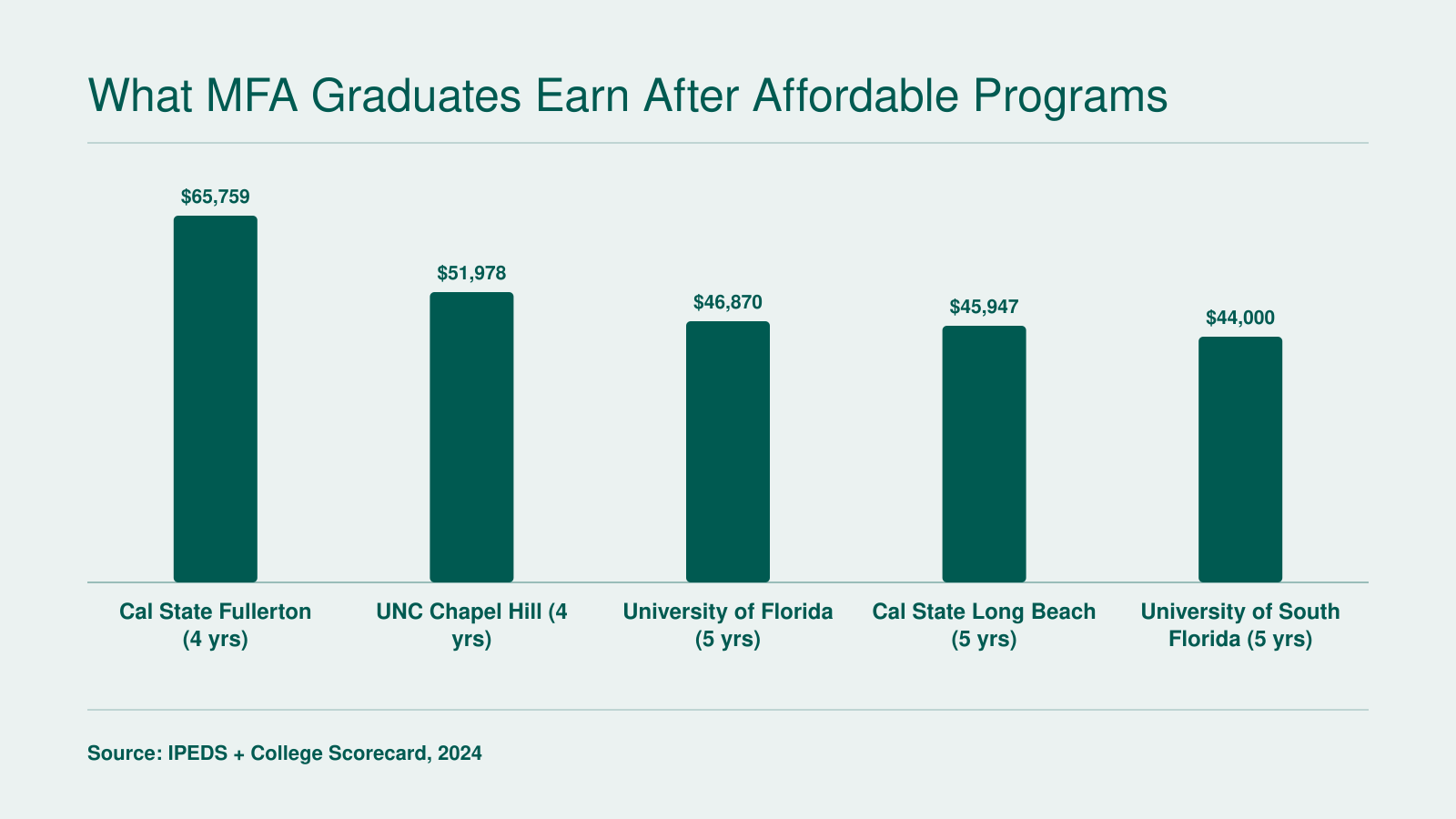
What MFA Graduates Earn After Affordable Programs
Median MFA earnings at these schools range from about $44,000 to $65,800, depending on the program and whether earnings are measured four or five years after finishing. Those are modest salaries, so low debt matters as much as low tuition: a lower monthly loan payment preserves more of the salary you do earn.
Affordable MFA Programs by Discipline: Studio Art, Creative Writing, Film, and Design
Funding for MFA students has never been evenly distributed across disciplines, and the gap is widening as programs shift more material and production costs onto students. Creative writing remains the most likely to offer fully funded packages, while studio art, film, and design fund students less often and tend to attach support to specific assistantship, teaching, or production roles.
Studio art and design
At Illinois, most students in the MFA Studio Art Program are funded through assistantships that include a full tuition waiver, a partial fee waiver, and a monthly stipend. UT Austin waives the nonresident tuition portion for out-of-state and international students.1 Michigan State's MFA design program carries a three-year funding package with tuition waivers valued at $52,000 plus an annual stipend of $20,000 to $22,000 and health and dental coverage.2 Still, studio materials, lab fees, and final-show costs often fall to the student. Ask whether free studio space or equipment checkout is part of the assistantship before committing.
Film and theater
Florida State's MFA Film Production Program covers project equipment, vehicles, expendables, insurance, meals, and discretionary production through tuition. By contrast, UCF film students typically fund their own thesis projects, with budgets commonly ranging from $5,000 to $25,000 and a $90 per-semester equipment fee.3 Theater MFAs frequently tie support to production or teaching roles; Tennessee's MFA Theatre Design Program offers full tuition waivers, a $26,000 annual stipend, $1,500 in travel funding, and Adobe Suite and Vectorworks at no cost.
Design students should ask about software licenses, film students should clarify thesis budget ceilings, and studio artists should secure equipment checkout before accepting.
The number that matters is what you actually pay after funding, not the tuition a program advertises. A fully funded MFA with a modest stipend can cost less over three years than a low-sticker program that offers nothing, and an MFA is one of the few degrees where that gap decides whether the work gets made at all.
Accreditation and Admissions Checklist for Low-Cost MFA Programs
- Confirm regional accreditationVerify the institution holds regional accreditation; it affects federal aid eligibility and many teaching jobs.
- Check NASAD for art and designFor studio art and design MFAs, also look for NASAD accreditation. Check both; no equivalent specialized accreditor covers all creative-writing MFAs.
- Prepare the portfolio or writing sampleRequirements vary. Examples: Washington University asks 20 portfolio samples; UC San Diego asks 30–40 pages of prose, or 15–20 for poetry; the University of Florida asks 6,000 words or 6–10 poems; Bard asks 15–20 pages.
- Assemble statements and recommendationsA bachelor's degree is standard. Statement lengths range from 500 words to 2,500 words; three recommendation letters are common, but some programs ask two to four.
- Check fees, waivers, and GREApplication fees in recent examples range from $40 to $155; ask programs about fee waivers. GRE scores are rarely required, but confirm each program's current policy.
Fine Arts (MFA) programs by state
Frequently Asked Questions About Affordable MFA Programs
What is the cheapest MFA program in the US?
How much does an MFA cost on average?
Do affordable MFA programs charge out-of-state students more, even online?
Can international students get a fully funded MFA?
Are affordable MFA programs worth it?
Compare Fine Arts (MFA) programs on the data that matters
Explore more MFA specializations or browse every graduate field.
All MFA programs