Best MFA Programs in Massachusetts
Compare 6 accredited Fine Arts (MFA) programs in Massachusetts, with graduate earnings, cost, debt, and completion data from IPEDS and the U.S. College Scorecard.

MassArt's low-residency MFA lists tuition at $15,400 in-state, while Clark's Visual Arts MFA lists $58,867. That gap of more than $43,000 is the central tension for anyone weighing a master's in fine arts in Massachusetts.
The state's strongest MFA programs sit in a compact region, mostly in and around Boston, with UMass Amherst anchoring the west. Funding, residency format, and what graduates earn matter more than a school's name.
So which program is worth the cost? For most applicants, the answer depends on whether a stipend or a salary offsets the price.
Key Points
- MassArt ($15,400 in-state) and UMass Amherst ($17,772) cost far less than Clark or Wheaton.
- UMass Amherst funded positions waive tuition and pay a stipend of at least $6,205.40 per semester.
- An MFA alone does not license you to teach art in Massachusetts public schools.
Best MFA Schools in Massachusetts, Ranked and Compared
Massachusetts offers a small but varied set of master's programs in the fine arts, from a funded, full-time studio residency in Amherst to low-residency options built for working artists. Tuition, net price, and graduation figures below describe each institution as a whole, not the MFA alone, so treat them as a starting point and confirm program costs with the school. One listing, at Wheaton, is a Master of Arts in Creative Industries rather than an MFA, so we place it last and flag the difference.
University of Massachusetts-Amherst
#1Amherst, MA · $15,000 – $20,000/yr (est.)
Best for: Full-time artists wanting interdisciplinary studio freedom
UMass Amherst runs a 60-credit, three-year on-campus MFA in Studio Art that admits students across all disciplines rather than into a single track. Only about five to six students are accepted each year, and teaching assistantships go to all accepted students. Listed tuition and fees are about $17,772 for in-state and $40,449 for out-of-state students, and the institution-wide average net price is about $22,383 (an average, not a quote). The university graduates roughly 83% of its students and is accredited by NECHE. NASAD accreditation is listed for its B.A. and M.A. programs, but an MFA-specific NASAD status is not established.
- 60 credits over three years, on-campus residency
- Interdisciplinary: students are not admitted to one discipline
- Final year includes an 18-credit master's thesis
- Teaching assistantships awarded to all accepted students
- About five to six students admitted per year
- 24-hour access to studios, equipment, and facilities
- Five College consortium courses at Amherst, Hampshire, Mount Holyoke, Smith
- Fall start only; 2026-27 window runs Nov. 1 to Dec. 1, 2026
Clark University
#2Worcester, MA · ~$51,000/yr (est.)
Best for: Working artists drawn to museum-based residencies
Clark University in Worcester offers a low-residency MFA in Visual Arts that pairs one-on-one artist-mentor supervision with five intensive residencies. The January residency is held at MASS MoCA in North Adams, and the June residency is on Clark's campus. Listed tuition and fees are about $58,867 for both in-state and out-of-state students, and the institution-wide average net price is about $28,714 (an average, not a quote). Clark graduates about 77% of its students and is accredited by NECHE. Applicants submit a portfolio, and the school does not require standardized test scores.
- Low-residency terminal MFA over four academic semesters
- Five intensive residencies, four before academic semesters
- 16 units: 4 residency, 6 studio, 6 academic/research
- One-on-one faculty and artist-mentor supervision
- Thesis residency includes a master's portfolio presentation
- January residency at MASS MoCA, June residency in Worcester
- Portfolio of 15 to 20 works; no test scores required
- Career paths: college and K-12 teaching, nonprofit arts leadership
Massachusetts College of Art and Design
#3Boston, MA · ~$27,000/yr (est.)
Best for: Boston educators wanting local one-on-one mentorship
Massachusetts College of Art and Design is a public art school in Boston, and its Low Residency MFA in Fine Arts is built for working artists and educators. Students spend three seven-week summer residencies in Boston studios and take online research, writing, and theory courses during the year. Listed tuition and fees are about $15,400 in-state and $43,400 out-of-state, and the institution-wide average net price is about $24,100 (an average, not a quote). MassArt graduates about 69% of its students and is accredited by NECHE. The 2026 priority deadline is January 12, with a portfolio required.
- 60-credit terminal degree in two academic years
- Three on-campus summer residencies, seven weeks each
- Online courses in research, writing, history, and theory
- Local mentors work one-on-one with students in fall and spring
- Two-week intensive workshops and winter remote colloquium
- Final residency centers on a curated thesis exhibition and artist talks
- Portfolio required; priority deadline January 12, 2026 cycle
Wheaton College (Massachusetts)
#4Norton, MA
Wheaton College in Norton offers a 4+1 Master of Arts in Creative Industries, which is not an MFA and is open only to current Wheaton students. It suits students who want business and media skills alongside creative work, with concentrations in Creative Industries or Arts Management. Listed tuition and fees are about $63,960, and the institution-wide average net price is about $29,822 (an average, not a quote). Wheaton graduates about 73% of its students and is accredited by NECHE.
- Not an MFA: a fifth-year master's after the bachelor's
- Concentrations in Creative Industries or Arts Management
- Eight courses, 32 credits, with a two-part media capstone
- Asynchronous online classes plus an on-campus summer residency
- Fall or spring start; current Wheaton students only
- Coursework covers grant writing and non-profit management
Cost & outcomes by school
Federal data for the highest-earning Fine Arts (MFA) programs, independent of the ranking above. Earnings are this field's master's graduates four years after completing, where the Scorecard reports them.
| School | Earnings | Tuition / yr | Debt | Grads/yr | Format |
|---|---|---|---|---|---|
| University of Massachusetts-Amherst MA | — | $17,410 | — | 4,554 | Campus |
| Wheaton College (Massachusetts) MA | — | — | — | — | Hybrid |
| University of Massachusetts-Dartmouth MA | — | $17,269 | — | 1,024 | Campus |
| Massachusetts College of Art and Design MA | — | $26,550 | — | 90 | Hybrid |
| Tufts University MA | — | $50,798 | — | 2,820 | Campus |
| Clark University MA | — | $50,975 | — | 1,752 | Hybrid |
Sources: U.S. Department of Education. Tuition and graduates: IPEDS. Earnings and debt: College Scorecard, this field's master's graduates; a dash means no figure is reported.
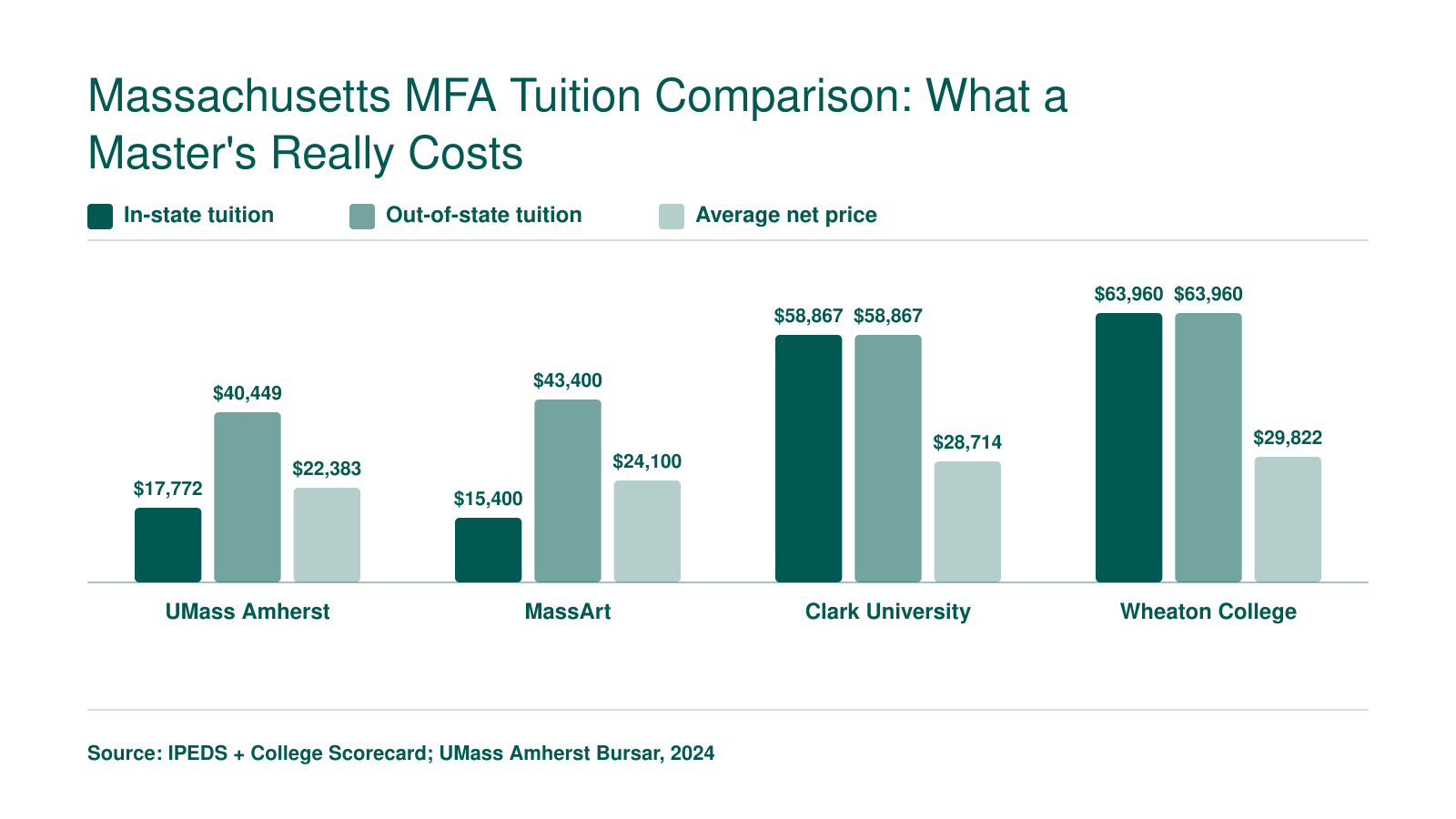
Massachusetts MFA Tuition Comparison: What a Master's Really Costs
Public and private sticker prices sit far apart: MassArt ($15,400 in-state) and UMass Amherst ($17,772) versus Clark ($58,867) and Wheaton ($63,960), a spread of about $48,560 from cheapest to most expensive. UMass Amherst's newer 2026-27 graduate bursar schedule lists $2,741 per credit with fees and an annual tuition and fees figure of $18,548, so treat the chart as a baseline, since per-credit rates and fees vary. Net price is an institution-wide average after aid, so funded MFA students, such as UMass Amherst Art students who all receive teaching assistantships, may pay far less.
MFA Programs With Assistantships and Full Funding in Massachusetts
Funding is the biggest cost lever you have across Master's Programs in Massachusetts, yet most schools here say little about fully funded MFA programs publicly. UMass Amherst is the exception. Its funded positions carry a tuition and curriculum-fee waiver plus a stipend of at least $6,205.40 per semester. The Writing Program Teaching Associateship, the funding offered at admission, pays about $29,556 for 2025-26 and $31,342.40 from September 2026. It also covers 95% of health-insurance cost, in exchange for teaching three college writing courses a year, and can run up to six semesters. Other UMass pages cite lower figures, about $23,050 a year for renewable three-section appointments, so confirm which appointment type applies to you.
For studio art, the department aims, budget permitting, to offer assistantships and sustain funding for three years. That is an aim, not a guarantee.
Clark University, Wheaton College, and MassArt do not publish MFA assistantship, fellowship, or stipend details in the sources reviewed, so assume nothing about aid there until admissions confirms it in writing.
One practical tip: ask whether funding is guaranteed for every year or renewed annually.
Related Articles
Online, Hybrid, and Low-Residency MFA Options in Massachusetts
A campus MFA puts you in the studio daily, while a low-residency degree trades that for short, intense stretches on campus and mentored work at home. UMass Amherst is campus-only, with 24-hour studio access for its Studio Art MFA. Clark University and MassArt are the hybrid and low-residency options here.
MassArt's low-residency Fine Arts MFA runs two years and 60 credits. It includes three seven-week summer residencies on the Boston campus. In fall and spring you work with local mentors and take online research and theory courses, and a winter colloquium meets remotely. Clark's Visual Arts MFA is hybrid, built around five intensive residencies and one-on-one artist-mentor supervision.
Be realistic: a fully online studio-art MFA is rare, since studio work and critique depend on in-person time. Writing and interdisciplinary practices adapt to remote formats more easily. Wheaton's online-heavy Creative Industries master's is open to current Wheaton students only.
Budget for travel and lodging during residencies, especially seven weeks in Boston. Confirm 2026 residency dates with each school.
Which Massachusetts MFA Programs Waive or Make the GRE Optional?
Policies below come from official admissions pages and should be re-checked against the current cycle before you apply.
- GRE policyUMass Amherst's MFA for Poets and Writers does not require the GRE. We could not confirm a GRE policy for UMass Amherst Studio Arts, Clark, MassArt, or Wheaton's creative industries program, so ask each admissions office directly.
- Portfolio or writing sampleUMass Amherst Studio Arts asks for 20 images. The Poets and Writers program wants up to 10 poetry pages or 20-25 prose pages, plus a separate academic writing sample of at least 1,500 words.
- Statements, letters, transcriptsStudio Arts applicants submit a 600-word personal statement and a 600-word creative work statement. Poets and Writers letters are due with the application. Expect transcripts at every school.
- Deadlines and selectivityStudio Arts opens November 1 and closes December 1, 2026. Poets and Writers closes December 15, 2026. It enrolls about 20 writers a year from roughly 450 applicants, but publishes no acceptance rate; enrollment is not the same as admission.
Career Outcomes and Earnings After a Master's in Fine Arts in Massachusetts
What do MFA graduates in Massachusetts actually earn, and can they repay what they borrow? Where program-level figures are published, the answer is modest but workable.
MassArt's low-residency Fine Arts graduates earned a median of $54,719 one year after finishing and $50,875 five years after finishing. Their median debt was $41,000, about $466 a month on a 10-year repayment plan, or roughly a tenth of first-year earnings. UMass Amherst's studio art graduates earned a median of $46,477 four years after finishing. Both graduating cohorts are small, so read these numbers as signals rather than promises.
MFA graduates typically build careers from several of these paths:
- Teaching: adjunct and tenure-track college positions, which are competitive.
- Studio practice: working artists selling, exhibiting and taking commissions.
- Arts administration: galleries, museums and nonprofits.
- Publishing and editing: catalog, editorial and content roles.
- Creative industries: design and related commercial work.
Debt is the one variable you control most. A funded seat, such as one in UMass Amherst's small, aid-supported cohort, will shape your long-term finances more than any school's name.
Massachusetts Licensure for MFA Graduates Who Want to Teach Art
Frequently Asked Questions About MFA Programs in Massachusetts
What is the best MFA program in Massachusetts?
How much does an MFA cost in Massachusetts?
Can you get a fully funded MFA in Massachusetts?
Is a low-residency MFA respected for college teaching jobs?
Compare Fine Arts (MFA) programs on the data that matters
Explore more MFA specializations or browse every graduate field.
All MFA programs