Best Online MFA Programs
Compare 18 accredited online Fine Arts (MFA) programs, with graduate earnings, cost, debt, and completion data from IPEDS and the U.S. College Scorecard.

The MFA is a studio degree built on workshop critique and sustained mentorship, so "online" rarely means staying home. Most programs still require on-campus intensives: MassArt runs three seven-week summer residencies, and the School of the Art Institute of Chicago schedules three six-week summer sessions between its remote coursework.
Because genuinely remote MFAs are scarce, the ranking here includes both online and hybrid or low-residency formats. The real decision is the residency schedule: it often adds travel and housing costs that sticker tuition never shows, and MFA earnings tend to stay modest after graduation, which makes affordable MFA programs worth prioritizing.
Key Points
- Tuition ranges $5,920 to $66,436, with residency fees adding thousands.
- Most applications emphasize the creative portfolio or writing sample over test scores.
- Federal aid requires institutional accreditation checkable through DAPIP or CHEA.
Top Online & Hybrid MFA Programs for 2027
Few MFA programs are offered entirely online, so this list mixes online and hybrid or low-residency options that include required in-person components. The programs below are ordered by a mixed quality composite that weighs student outcomes, affordability, and program strength rather than any single ranking factor. Use the residency notes in each card to see how much on-campus time a program actually requires.
CUNY Lehman College
#1Bronx, NY · ~$12,000/yr (est.)
Best for: New York artists seeking public-university affordability
Lehman College's MFA in Art is a public-university hybrid that combines graduate studio work with an assigned faculty advisor. The program spans concentrations such as ceramics, digital media, printmaking, graphics, painting, and sculpture. Students also have access to related MA options in Art and Art Teacher Visual Arts.
- Hybrid structure with on-campus and online components
- Concentrations include ceramics, digital media, printmaking, graphics, painting, and sculpture
- Assigned graduate coordinator and faculty advisor
- Related MA tracks available in Art and Art Teacher Visual Arts
Clark University
#2Worcester, MA · ~$51,000/yr (est.)
Best for: Working artists seeking intensive studio residencies
Clark University's low-residency MFA in Visual Arts is a four-semester, 16-unit terminal degree built around five intensive residencies. Students complete studio work and academic research under one-on-one faculty and artist-mentor supervision, with a thesis residency that includes a portfolio presentation. Graduates prepare for college teaching, K-12 arts roles, and nonprofit arts leadership.
- Four academic semesters with five intensive residencies
- 16 units: 4 residency, 6 studio, 6 academic and research
- One-on-one faculty and artist-mentor supervision
- Thesis residency includes master's portfolio presentation
Massachusetts College of Art and Design
#3Boston, MA · ~$27,000/yr (est.)
Best for: Educators needing summer-intensive studio time
MassArt's Low Residency MFA in Fine Arts is a 60-credit, two-year program designed for working artists and educators. Three seven-week summer residencies on the Boston campus provide studio time and two-week intensive workshops, while fall and spring courses in research, writing, history, and theory are online. The program ends with a public thesis exhibition and artist talk.
- 60-credit terminal degree over two academic years
- Three seven-week on-campus summer residencies in Boston
- Online coursework in research, writing, history, and theory
- Third residency focuses on thesis work and curated exhibition
- Two-week intensive workshops during summer residencies
Fort Hays State University
#4Hays, KS · ~$5,000/yr (est.)
Fort Hays State University offers a flexible MFA in Art & Design with eight studio concentrations, including drawing, painting, sculpture, graphic design, photography, printmaking, ceramics, and intermedia. The 60-hour degree requires a thesis exhibition and two oral examinations. Online or low-residency options are available in some areas, and a limited number of graduate assistantships support students.
- 60 graduate credit hours required
- Eight studio concentrations from drawing to intermedia
- Thesis exhibition at Moss-Thorns Gallery
- Two oral examinations required
- Online or low-residency options in some areas
- Graduate assistantships limited to two years
Bard College
#5Annandale-On-Hudson, NY · $40,000 – $45,000/yr (est.)
Bard College's Milton Avery Graduate School of the Arts awards an MFA across three years. Summer sessions are residential and include one-to-one faculty conferences, while fall and spring work is remote with independent study, seminars, and writing workshops. The final summer requires a master's project, and transfer credits are not accepted.
- 60 graduate credits across Year 1, Year 2, and Year 3
- Residential summer sessions with one-to-one faculty conferences
- Remote fall and spring independent study and seminars
- Master's project required in final summer
- Transfer credits not accepted
School of the Art Institute of Chicago
#6Chicago, IL · ~$50,000/yr (est.)
SAIC's Low-Residency MFA is a 60-credit, seven-semester terminal degree centered on three consecutive six-week summer residencies in Chicago. Fall and spring work happens remotely from home studios with online courses and advising through a poetics framework. The final summer includes a public MFA thesis exhibition and open studios.
- 60 credits over seven semesters
- Three six-week summer residencies in Chicago
- Online fall and spring courses and advising
- Curriculum follows a poetics framework
- Final summer includes public thesis exhibition and open studios
- F-1 and J-1 students may study in person only during summer
University of Northern Colorado
#7Greeley, CO · ~$15,000/yr (est.)
University of Northern Colorado offers a 30-credit hybrid Art and Design MA that can be completed in 21 months. Most coursework is online, with a required two-week summer intensive on the Greeley campus. The same $695 per-credit tuition applies for in-state and out-of-state students, with no student or technology fees.
- 30 credits completed in about 21 months
- Mostly online with a two-week summer intensive in Greeley
- Same $695 per-credit tuition in-state and out-of-state
- No student or technology fees
- Test optional with no entrance exam required
Vermont State University
#8Randolph, VT · $5,000 – $10,000/yr (est.)
Vermont State University's MFA in Art offers two concentrations: studio arts and interdisciplinary arts. Students complete 40 credits of studio work plus 12 credits in Contemporary Art and Interaction, choosing from campus-based, low-residency, remote, or combined formats. Graduate credit residencies are available at the Vermont Studio Center, and the program culminates in a solo thesis exhibition and public lecture.
- Two concentrations: studio arts and interdisciplinary arts
- 40 studio credits plus 12 in Contemporary Art and Interaction
- Campus, low-residency, remote, or combined format
- Residency credit at the Vermont Studio Center
- Solo thesis exhibition, digital portfolio, and public lecture
Teachers College at Columbia University
#9New York, NY · $35,000 – $40,000/yr (est.)
Teachers College at Columbia University offers a hybrid M.A. in Studio Practice for Art Educators that integrates online coursework with immersive summer residencies in New York City. Students complete 32 credits, including six-week on-campus summer residencies, and finish with a capstone exhibition at the Macy Art Gallery. Full-time students can finish in as little as 14 months, but international applicants are not eligible.
- 32 credits, full-time finish in as little as 14 months
- Six-week on-campus summer residencies in New York City
- Online coursework combined with summer residencies
- Capstone exhibition at the Macy Art Gallery
- International applicants not eligible
- Requires academic writing sample and digital portfolio
Wheaton College (Massachusetts)
#10Norton, MA
Wheaton College's 4+1 MA in Creative Industries is a fast-track option for current Wheaton undergraduates. Students finish a bachelor's degree, then complete eight courses and 32 credits in a fifth year, choosing a concentration in Creative Industries or Arts Management. Asynchronous online fall and spring coursework is paired with a required summer campus residency.
- Two concentrations: Creative Industries or Arts Management
- 32 credits completed in a fifth year after bachelor's
- Asynchronous online classes in fall and spring
- On-campus summer residency for experiential learning
- Capstone and creative portfolio required
Cost & outcomes by school
Federal data for the highest-earning Fine Arts (MFA) programs, independent of the ranking above. Earnings are this field's master's graduates four years after completing, where the Scorecard reports them.
| School | Earnings | Tuition / yr | Debt | Grads/yr | Format |
|---|---|---|---|---|---|
| Southern New Hampshire University NH | — | $21,387 | — | 19,416 | Online |
| Fort Hays State University KS | — | $4,949 | — | 1,544 | Hybrid |
Sources: U.S. Department of Education. Tuition and graduates: IPEDS. Earnings and debt: College Scorecard, this field's master's graduates; a dash means no figure is reported.
No-Residency vs. Low-Residency MFAs: What 'Online' Really Means
An online MFA comes in two shapes, and the difference decides whether you need to book flights. A low-residency MFA is mostly remote mentorship with a faculty advisor, punctuated by short on-campus intensives of about a week, once or twice a year. A no-residency MFA keeps everything (coursework, workshops, critiques, thesis review) online.
Why residencies persist
Residency weeks exist because some parts of the degree are hard to replicate on a screen: live critique, public readings, studio or equipment access, and the cohort bonds that outlast the degree. Schedules vary widely. Vermont College of Fine Arts runs nine-day residencies, Warren Wilson ten days, and New England College holds two a year running roughly six to eleven days. In visual arts, Clark University's low-residency structure requires five ten-day residencies alongside remote advising.
Where true no-residency programs cluster
Fully online options are rarer among best MFA programs and cluster in creative writing, design, and digital media. Southern New Hampshire University's 36-credit online MFA requires no residency, as does Concordia University St. Paul's. The University of Nebraska Omaha can be completed fully online across five semesters, with overseas residencies offered as an option rather than a requirement.
Verify before you apply
Read the program handbook, not the marketing page. Confirm mandatory residency dates, how many you owe over the degree, and whether travel, lodging, and meals sit inside tuition or add to the total cost of a master's degree.
What an Online MFA Really Costs Beyond Tuition
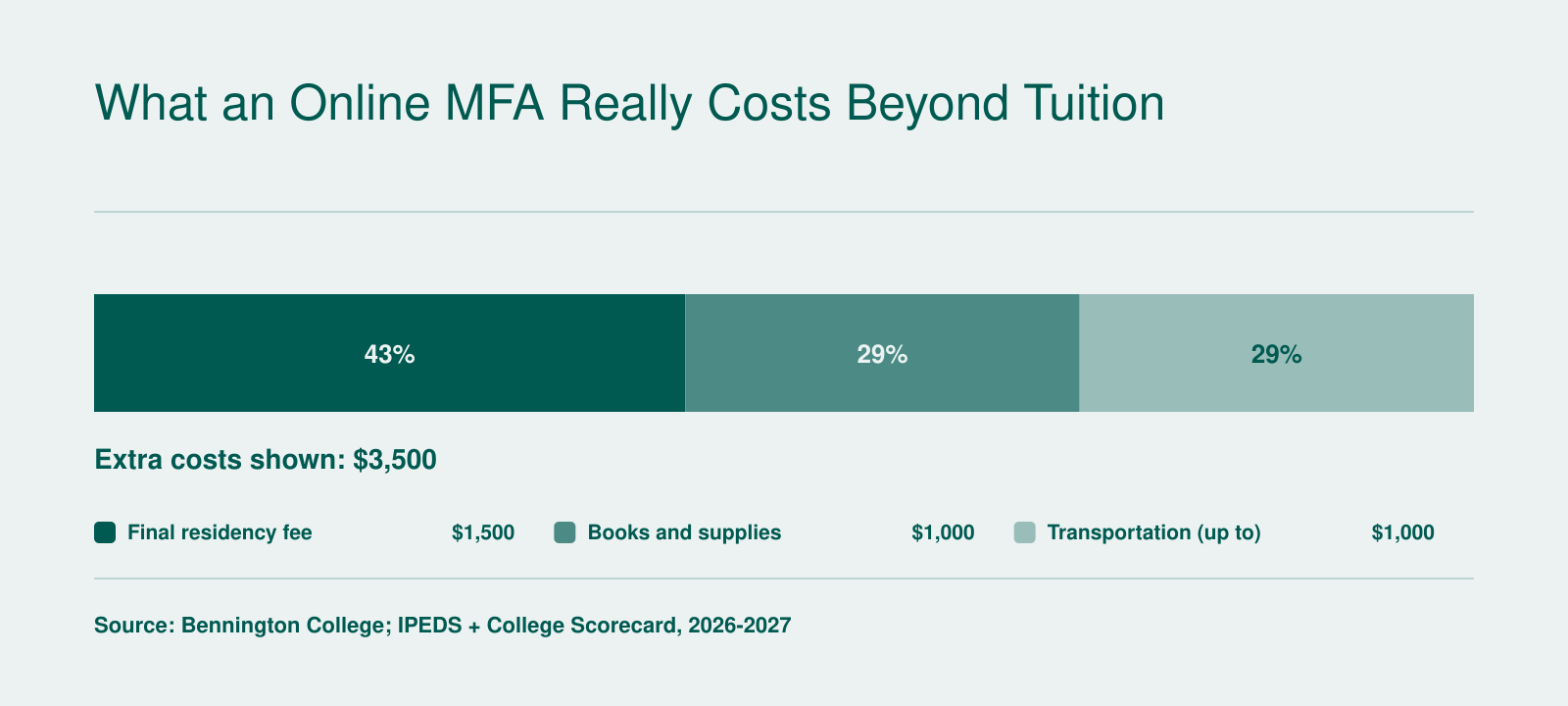
Sticker tuition in the programs here runs from about $5,920 to $66,436, but fees and travel add up fast. At one low-residency MFA, the final residency fee alone is $1,500, with roughly $1,000 for books and supplies and up to $1,000 for transportation. Once residency travel and lodging are added, the true cost can be several thousand dollars above sticker tuition, and net price is an institution-wide average, not a quote for any individual student.
Related Articles
Online MFA Portfolio and Writing Sample Requirements
Most online and low-residency MFA applications center on the creative sample or portfolio rather than test scores.
- Bachelor's degreeTypically required, but the major usually does not need to match your MFA concentration.
- Statement of purposeCommonly 500 to 1,200 words covering your background, goals, and why you fit the program.
- Recommendation lettersUsually two or three letters from instructors, mentors, or editors; some programs require none.
- Creative writing manuscriptTypically 15 to 30 pages, though programs vary from 7 to 10 pages up to 30 to 40 for prose.
- Visual arts portfolioOften 15 to 20 images, sometimes with time-based media samples or 20 images total.
- GRE and deadlinesThe GRE is rarely required; deadlines cluster from December to May priority/final, and some programs use rolling admission.
Earnings and Debt for MFA Graduates at Ranked Schools
The table below pairs median graduate earnings, measured at different points after entry, with median program debt and the estimated monthly payment on a standard 10-year repayment plan. MFA earnings tend to be modest, so keeping debt low matters more in this field than in many others.
| School | Median earnings | Earnings timing | Median program debt | Monthly payment (10-year) |
|---|---|---|---|---|
| Bard College | $63,491 | 4 years after entry | $41,000 | $466 |
| Massachusetts College of Art and Design | $50,875 | 5 years after entry | $41,000 | $466 |
| University of Northern Colorado | $49,389 | 1 year after entry | ||
| Maine College of Art & Design | $49,053 | 4 years after entry | $83,358 | $948 |
| School of the Art Institute of Chicago | $48,963 | 5 years after entry | $69,783 | $794 |
Fine Arts (MFA) programs by state
Online MFA FAQs: Funding, Length, and Concentrations
Can you get a fully funded online MFA?
How long does it take to complete an online MFA?
Which MFA concentrations can you study online?
Are there any 100% online MFA programs with no campus visits?
Compare Fine Arts (MFA) programs on the data that matters
Explore more MFA specializations or browse every graduate field.
All MFA programs