Best School Counseling Master's Programs in North Carolina
Compare 15 accredited School Counseling programs in North Carolina, with graduate earnings, cost, debt, and completion data from IPEDS and the U.S. College Scorecard.

Nearly every school counseling master's in North Carolina runs 60 credit hours, a bar set by state licensure rules and CACREP standards. Price is where these programs diverge sharply: in-state tuition at the publics sits in the single-digit thousands a year, while private options cost several times that, a spread also visible among the most affordable clinical mental health counseling master's programs. Early earnings stay tight, roughly $40,000 to $50,000 in the first year out.
Campus, hybrid, and fully online programs are ranked together here. Format changes your schedule, not the supervised K-12 internship every North Carolina license requires.
Key Points
- Wake Forest and Salem College are listed as online options, and NC State offers online and on-campus versions of its M.Ed.
- Many programs here have dropped the GRE, so your transcript and statement carry more weight.
- Federal earnings, debt, and net price data decide each spot, not name recognition.
The 10 Best School Counseling Master's Programs in North Carolina
North Carolina's school counseling master's programs range from low-cost public university cohorts to private, online options. This list covers campus, hybrid, and online formats side by side, so you can compare tuition, net price, and outcomes in one place. Graduation rates cited below describe each institution as a whole, not the counseling program alone.
University of North Carolina at Chapel Hill
#1Chapel Hill, NC · ~$13,000/yr (est.)
Best for: Full-time students wanting year-long school fieldwork
UNC Chapel Hill in Chapel Hill pairs a 14-month, cohort-based M.Ed. with a full year of school-based fieldwork. In-state tuition and fees are listed at $8,994 with an average net price of $11,655, and the school graduates 91% of its students. Graduates of the CACREP-accredited program have a median first-year salary near $48,600, rising to roughly $56,600 four years out.
- 14-month accelerated, cohort-based format
- 60 credit hours with year-long school-based fieldwork
- CACREP accredited since 1984
- Leads to K-12 school counselor licensure in North Carolina
- Eligible for LCHMC licensure after 2 years of supervised experience
- Aligned with the ASCA National Model, culturally responsive focus
Wake Forest University
#2Winston-Salem, NC · $35,000 – $40,000/yr (est.)
Best for: Working professionals needing online study
Wake Forest University in Winston-Salem delivers its Master of Arts in Counseling (School Counseling concentration) online for working professionals. Listed in-state tuition and fees are $67,642 and average net price is $28,719, the highest sticker price on this list. The school graduates 89% of its students, and program graduates report median earnings around $58,000 four years out.
- Online format designed for working professionals
- 60 credit hours with a capstone and 600 internship hours in schools
- CACREP accredited since 2012
- Fall, spring, and summer start terms
- Part-time path can be completed in about three years
- Prepares for the National Counselor Exam and NC school counseling licensure
North Carolina State University at Raleigh
#3Raleigh, NC · $12,000 – $33,000/yr (est.)
Best for: Students wanting small classes and close advising
NC State in Raleigh offers its CACREP-accredited School Counseling M.Ed. on campus, online, or hybrid. In-state tuition and fees are listed at $8,799 with an average net price of $17,303, and the school graduates 85% of its students. The program does not require the GRE, and program graduates report median earnings of about $50,100 in the first year.
- 60 credit hours with a 600-hour K-12 internship
- CACREP accredited through 2030
- On-campus, online, and hybrid delivery
- No GRE required; 3.0 GPA minimum and three recommendations
- Small classes of 20 to 25 and a 1:10 faculty advising ratio
- Prepares for the NCE and Praxis for NC licensure
University of North Carolina at Charlotte
#4Charlotte, NC · $5,000 – $10,000/yr (est.)
UNC Charlotte's M.A. in School Counseling builds toward licensure with a focus on social justice, leadership, and system change in urban school communities. In-state tuition and fees are listed at $7,239 with an average net price of $15,435. The school graduates 69% of its students, and program graduates report median earnings of about $47,600 in the first year.
- CACREP accredited
- Focus on multicultural competence and social justice advocacy
- Emphasis on comprehensive developmental counseling programs
- Strong ties to the urban school community
- Prepares licensed K-12 professional school counselors
East Carolina University
#5Greenville, NC · ~$8,000/yr (est.)
East Carolina University in Greenville offers a CACREP-accredited M.S. in Counselor Education with a School Counseling concentration, described as 100% online with required residencies. In-state tuition and fees are listed at $7,361 with an average net price of $15,739. The school graduates 63% of its students, and program graduates report median earnings near $58,900 four years out.
- CACREP accredited; program history dates to 1951
- 100% online with residencies held virtually
- Approved by NC DPI for the school counselor license
- Prepares for the National Counselor Examination
- Flexible elective study design
- Three concentration options in the department
Appalachian State University
#6Boone, NC · $9,000 – $25,000/yr (est.)
Appalachian State University in Boone offers a campus-based M.A. in Professional School Counseling built around North Carolina K-12 licensure. In-state tuition and fees are listed at $7,579 with an average net price of $16,836. The school graduates 75% of its students, and program graduates report a median of about $27,900 in debt, the lowest among programs on this list with debt data.
- CACREP accredited; 60 credit hours
- 700 clinical hours including practicum and internship
- All courses taught on campus
- Electives such as equine-assisted therapy and play therapy
- CPCE exam and Praxis School Counseling required for licensure
- Criminal background check required
Western Carolina University
#7Cullowhee, NC · ~$8,000/yr (est.)
Western Carolina University in Cullowhee has the lowest listed in-state tuition and fees on this list at $4,630, with an average net price of $13,315. The campus-based M.A.Ed. adds coursework in addictions and crisis intervention. The school graduates 60% of its students, and program graduates report median earnings of about $51,600 four years out.
- CACREP accredited; 60 credit hours
- Practicum, internship, and comprehensive exam required
- 3.0 GPA minimum or GRE scores accepted in its place
- Courses in addictions, crisis intervention, and cross-cultural counseling
- Focus on school counseling program development
Campbell University
#8Buies Creek, NC · ~$16,000/yr (est.)
Campbell University in Buies Creek offers a Master of Education in school counseling through its School of Education & Human Sciences, established in 1985. Listed tuition and fees are $41,600 with an average net price of $24,516. The school graduates 61% of its students.
- Offered through the School of Education & Human Sciences
- Campus-based delivery in Buies Creek
- School established in 1985
North Carolina A & T State University
#9Greensboro, NC · ~$8,000/yr (est.)
North Carolina A&T State University in Greensboro, an HBCU, offers a CACREP-accredited M.S. in School Counseling with a flexible evening schedule. In-state tuition and fees are listed at $6,813 with an average net price of $10,846, the lowest net price on this list. The school graduates 57% of its students, and program graduates report median earnings near $59,900 four years out.
- CACREP accredited; covers eight core counseling areas
- Flexible evening schedule
- Full-time and part-time options
- Individualized pace of progress
- Prepares for elementary and secondary school counseling roles
Salem College
#10Winston-Salem, NC · ~$7,000/yr (est.)
Salem College in Winston-Salem offers an online M.Ed. in School Counseling that combines online classes with two weekend residencies on campus. Listed tuition and fees are $33,848 with an average net price of $18,277. The school graduates 57% of its students, and program graduates report median earnings near $61,500 four years out.
- Online format with two weekend residencies on campus
- 700 clinical hours of practicum and internship in K-12 schools
- Complete in two or three years; fall start
- 3.0 GPA minimum and two recommendations
- Prepares for NC licensure and the Praxis School Counselor exam
- Criminal background check and two writing prompts required
Cost & outcomes by school
Federal data for the highest-earning School Counseling programs, independent of the ranking above. Earnings are this field's master's graduates four years after completing, where the Scorecard reports them.
| School | Earnings | Tuition / yr | Debt | Grads/yr | Format |
|---|---|---|---|---|---|
| Salem College NC | $61,499 | $6,600 | $51,305 | 9 | Online |
| North Carolina A & T State University NC | $59,911 | $8,368 | $59,448 | 39 | Campus |
| East Carolina University NC | $58,919 | $7,658 | $41,000 | — | Campus |
| North Carolina State University at Raleigh NC | $58,010 | $12,101 | $43,000 | 40 | Online |
| Wake Forest University NC | $57,982 | $39,141 | $76,591 | 111 | Online |
| North Carolina Central University NC | $57,412 | $7,638 | $80,750 | 10 | Online |
| University of North Carolina at Greensboro NC | $56,709 | $8,614 | $31,791 | 32 | Campus |
| University of North Carolina at Chapel Hill NC | $56,624 | $12,751 | $31,460 | 16 | Campus |
| Appalachian State University NC | $55,225 | $8,570 | $27,879 | 53 | Campus |
| University of North Carolina at Pembroke NC | $55,200 | $6,928 | $57,500 | 36 | Hybrid |
| University of North Carolina at Charlotte NC | $54,098 | $8,037 | $41,000 | 74 | Campus |
| Western Carolina University NC | $51,558 | $7,876 | $41,000 | 43 | Campus |
Sources: U.S. Department of Education. Tuition and graduates: IPEDS. Earnings and debt: College Scorecard, this field's master's graduates; a dash means no figure is reported.
Cost, debt & payoff
Median earnings of this field's master's graduates (4 yrs after completing) vs. their median federal loan debt · U.S. College Scorecard
Across these programs the median graduate earns about $57,061 and finishes with roughly $42,000 in debt — a ratio that clears a common rule of thumb (keep debt below first-year salary). Tuition and debt vary widely school to school, so check the per-school figures in the table above before you shortlist.
Behind the List: Earnings, Debt, and Net Price Set Every Spot
Prestige or payoff? On this page, a program in North Carolina earns its place by what it costs and what its graduates go on to earn, not by the reputation of its name.
The figures behind each spot come from federal data: earnings and debt figures (program-specific where available, otherwise institution-wide), the school's net price, and completion rates. Net price is an average across the whole institution after grants and scholarships. The graduation rate is also school-wide. Treat both as context rather than a price quote or success rate for the school counseling master's itself.
What the numbers can't tell you is fit: faculty mentorship, cohort size, or where practicum and internship placements land you. For format and admissions, see the online and hybrid section and the GRE breakdown below.
Online and Hybrid School Counseling Master's Options in North Carolina
An online or hybrid school counseling master's moves coursework off campus, but the training itself still happens inside K-12 schools. Wake Forest and Salem College are listed as online, NC State offers online and on-campus versions of its 60-credit M.Ed., and UNC Pembroke runs a hybrid M.A. East Carolina's program is described as online with virtual residencies, though its main listing reads campus. Chapel Hill, Charlotte, Appalachian State, Western Carolina, Campbell, and North Carolina A&T list campus delivery.
The CACREP directory confirms Wake Forest, NC State (through March 31, 2030), East Carolina, and Pembroke. Salem College does not appear there, so verify its accreditation status directly before applying.
Online students still complete supervised practicum and internship hours in person at schools. NC State lists 600 clinical hours, and Salem lists 700 plus two weekend residencies on its campus. Residency requirements for the other programs could not be confirmed.
Takeaway for working teachers: ask each program whether you can complete placements at your own school, and whether campus visits fall on weekends. A hybrid adds travel but builds in-person cohort contact; fully online suits those far from campus.
GRE Policies at Each Ranked NC School Counseling Master's Program
The GRE used to be a gatekeeper for counseling admissions; today it rarely is. Several of the programs below have dropped the test entirely, aligning with the wider shift toward no-GRE master's programs and lowering the cost and time of applying while shifting weight onto your transcript and statement. Where a program's admissions page says nothing about testing, we list it as policy not published rather than guess.
- UNC Greensboro: GRE not required. No fixed minimum GPA; applicants at or below 2.75 must add a contextual statement.
- NC State: GRE and MAT no longer required. Expects an undergraduate GPA of 3.0 or higher.
- UNC Charlotte: GRE or MAT not required (scores accepted if you want to submit them). Overall GPA of 3.0, with occasional exceptions.
- UNC Pembroke: Policy not published on the admissions page. Minimum undergraduate GPA of 2.7.
- UNC Chapel Hill: GRE optional; any scores submitted must be valid within the last five years. No minimum GPA is published.
For the remaining ranked programs, the admissions pages do not publish a current GRE policy, so confirm directly before applying.
Related Articles
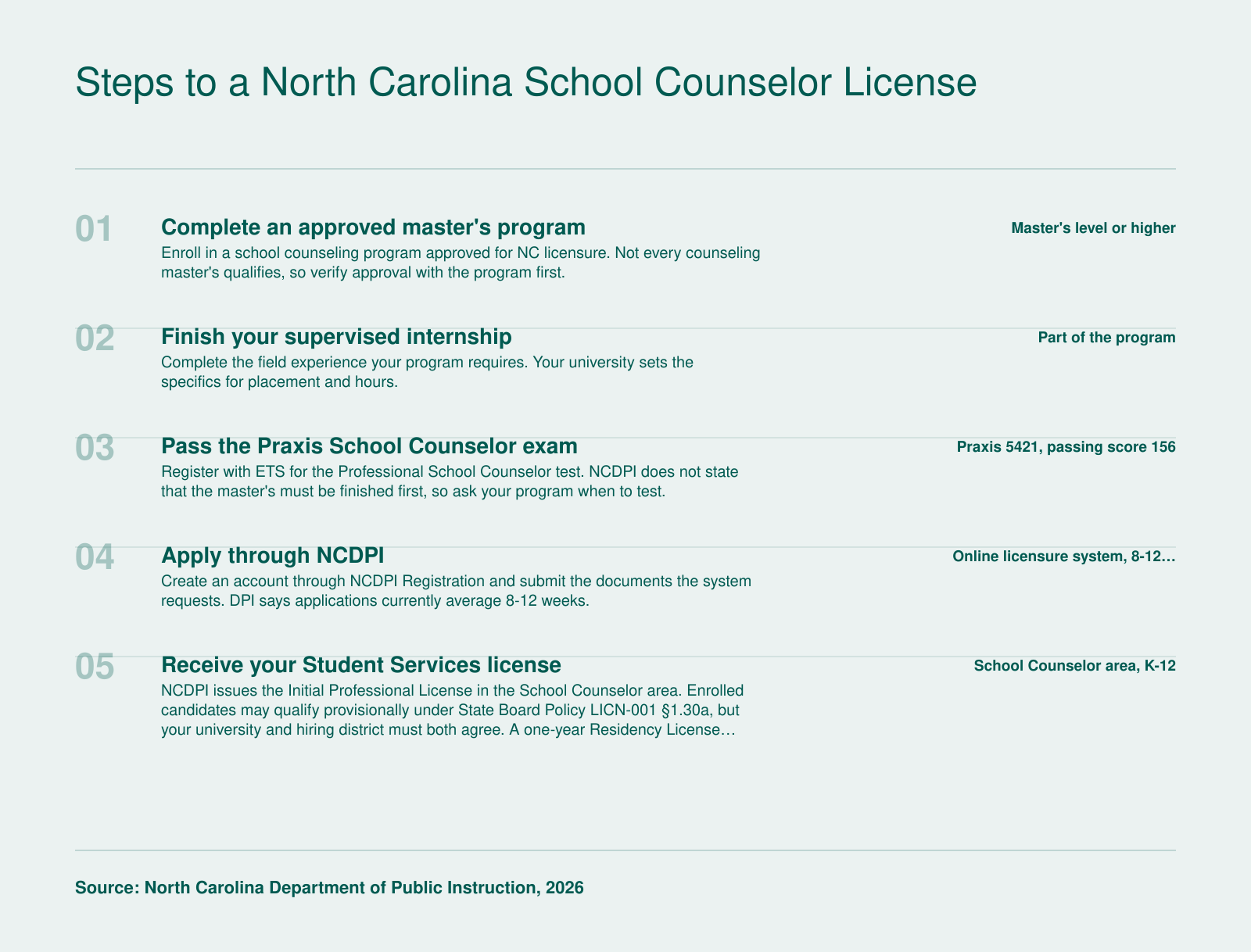
Steps to a North Carolina School Counselor License
North Carolina public schools require a license specifically in school counseling. Choosing a state-approved program, ideally one accredited by CACREP, keeps your coursework aligned with licensure rules, so confirm that your chosen program leads to the NC school counselor license before you enroll.
North Carolina School Counselor Pay at a Glance
School Counseling Master's in NC: Your Questions Answered
Which school counseling master's program in North Carolina is best for my situation?
How do I become a school counselor in NC, step by step?
When do NC school counseling master's programs set their application deadlines?
Do I need a teaching license or classroom experience before applying?
How many practicum and internship hours will I complete?
Can I start working in a school before I finish the degree?
What application materials do ranked programs typically ask for (letters, statement, interview)?
Compare School Counseling programs on the data that matters
Explore more Counseling specializations or browse every graduate field.
All Counseling programs