
Johns Hopkins University Master's Programs
Johns Hopkins conferred 8,648 master's degrees in 2025, 71 percent of every credential it awarded that year, per IPEDS federal completions data. Nine divisions produce that volume, and each sets its own tuition, deadlines, and admission bar.
Three questions decide most applications: what is offered, what it costs, and what graduates earn. At Hopkins those answers move by division. College Scorecard figures put computer science master's graduates at $176,945 in median earnings four years out against $26,126 in federal debt; nursing graduates at $111,325 against $106,371. The $64,730 school-wide graduate tuition average is a benchmark, never a quote.
Key Points
- Hopkins awarded 8,648 master's degrees in 2025, 71% of all degrees conferred.
- School-wide average graduate tuition and fees reached $64,730 for a full-time year.
- Median earnings four years out range from $73,350 to $176,945 by field.
Master's programs at Johns Hopkins University
Arts & Design All programs in this field →
Business & Management All programs in this field →
Communications & Media All programs in this field →
Computers & IT All programs in this field →
Counseling All programs in this field →
Criminal Justice & Law All programs in this field →
Education & Teaching All programs in this field →
Healthcare All programs in this field →
Nursing All programs in this field →
Psychology All programs in this field →
Science & Engineering All programs in this field →
In the 2025 IPEDS completions data, Johns Hopkins University awarded 8,648 master's degrees across 112 fields of study in 23 subject areas. Business & Management accounts for the most, 1,471 (17%), led by Business Statistics with 663. 53% of graduates were women and 39% were international students. That is down 2% from 8,840 in 2023.
Business & Management 1,471 degrees · 17%
- Business Statistics 66348% women
- Management Science 42357% women
- Management Sciences and Quantitative Methods, Other 20650% women
- Real Estate 7632% women
- Organizational Leadership 6354% women
- Research and Development Management 2065% women
- Non-Profit/Public/Organizational Management 1979% women
- Operations Management and Supervision 1100% women
- Also reported, no graduates in 2025: Business Administration and Management, General; Business Administration, Management and Operations, Other; Business/Commerce, General; Finance, General; Marketing/Marketing Management, General
Biological & Biomedical Sciences 1,397 degrees · 16%
- Biomedical Sciences, General 61173% women
- Biotechnology 50065% women
- Epidemiology 6180% women
- Molecular Biology 5070% women
- Biochemistry 4949% women
- Genome Sciences/Genomics 4480% women
- Cell/Cellular Biology and Anatomical Sciences, Other 2669% women
- Biostatistics 1765% women
- Cell/Cellular and Molecular Biology 1776% women
- Neuroscience 1164% women
- Environmental Toxicology 3100% women
- Anatomy 2100% women
- Biology/Biological Sciences, General 250% women
- Cell/Cellular Biology and Histology 250% women
- Human/Medical Genetics 10% women
- Pharmacology 1100% women
- Also reported, no graduates in 2025: Bioinformatics; Biophysics; Pathology/Experimental Pathology
Engineering 1,283 degrees · 15%
- Bioengineering and Biomedical Engineering 25254% women
- Systems Engineering 25231% women
- Electrical and Electronics Engineering 24316% women
- Mechanical Engineering 17624% women
- Aerospace, Aeronautical, and Astronautical/Space Engineering, General 16129% women
- Environmental/Environmental Health Engineering 5565% women
- Materials Engineering 4340% women
- Mechatronics, Robotics, and Automation Engineering 4221% women
- Chemical Engineering 4045% women
- Civil Engineering, General 1947% women
- Also reported, no graduates in 2025: Engineering, General; Engineering, Other; Industrial Engineering
Social Sciences 1,158 degrees · 13%
- International Relations and Affairs 66649% women
- Econometrics and Quantitative Economics 29952% women
- Political Science and Government, Other 5431% women
- National Security Policy Studies 5036% women
- Political Science and Government, General 4053% women
- Demography and Population Studies 27100% women
- Anthropology, General 838% women
- Sociology, General 850% women
- Geographic Information Science and Cartography 560% women
- Research Methodology and Quantitative Methods 1100% women
- Also reported, no graduates in 2025: Economics, General
Computer & Information Sciences 609 degrees · 7%
- Computer and Information Sciences, General 34027% women
- Computer and Information Systems Security/Auditing/Information Assurance 8330% women
- Computer Systems Networking and Telecommunications 7137% women
- Artificial Intelligence 6813% women
- Information Science/Studies 4738% women
- Also reported, no graduates in 2025: Computer Science
Health Professions 578 degrees · 7%
- Registered Nursing/Registered Nurse 25384% women
- Health/Health Care Administration/Management 17875% women
- Mental and Social Health Services and Allied Professions, Other 4274% women
- Environmental Health 2770% women
- Public Health, General 26100% women
- Bioethics/Medical Ethics 1457% women
- Pharmacoeconomics/Pharmaceutical Economics 1267% women
- Medical Illustration/Medical Illustrator 7100% women
- Genetic Counseling/Counselor 580% women
- Medical Informatics 425% women
- Health/Medical Physics 30% women
- Health Professions and Related Clinical Sciences, Other 250% women
- International Public Health/International Health 2100% women
- Orthotist/Prosthetist 2100% women
- Occupational Health and Industrial Hygiene 10% women
- Also reported, no graduates in 2025: Health Services Administration; Maternal and Child Health; Mental Health Counseling/Counselor; Public Health Education and Promotion; Public Health, Other
Mathematics & Statistics 436 degrees · 5%
- Statistics, General 16739% women
- Applied Mathematics, General 11834% women
- Mathematics, General 8041% women
- Applied Statistics, General 4749% women
- Financial Mathematics 2421% women
- Also reported, no graduates in 2025: Mathematics and Statistics, Other
Education 396 degrees · 5%
- Education, General 29168% women
- Education, Other 6459% women
- Educational/Instructional Technology 1283% women
- Education/Teaching of Individuals with Multiple Disabilities 978% women
- Music Teacher Education 757% women
- Education/Teaching of Individuals with Specific Learning Disabilities 683% women
- Education/Teaching of the Gifted and Talented 683% women
- Educational Leadership and Administration, General 1100% women
- Also reported, no graduates in 2025: Counselor Education/School Counseling and Guidance Services; Education/Teaching of Individuals in Early Childhood Special Education Programs; Elementary Education and Teaching; Reading Teacher Education; Secondary Education and Teaching; Special Education and Teaching, General; Teacher Education, Multiple Levels; Teaching English as a Second or Foreign Language/ESL Language Instructor
Communication & Journalism 212 degrees · 2%
- Speech Communication and Rhetoric 21275% women
Physical Sciences 205 degrees · 2%
- Physical Sciences, Other 8861% women
- Physics, Other 6522% women
- Physics, General 2446% women
- Chemistry, General 2241% women
- Chemistry, Other 450% women
- Geology/Earth Science, General 20% women
Engineering Technology 165 degrees · 2%
- Engineering/Industrial Management 16525% women
- Also reported, no graduates in 2025: Engineering/Engineering-Related Technologies/Technicians, Other
Visual & Performing Arts 156 degrees · 2%
- Music Performance, General 10856% women
- Film/Cinema/Media Studies 2868% women
- Music Theory and Composition 1331% women
- Music, Other 540% women
- Art History, Criticism and Conservation 10% women
- Music History, Literature, and Theory 1100% women
- Also reported, no graduates in 2025: Drama and Dramatics/Theatre Arts, General
Public Administration & Social Work 136 degrees · 2%
- Public Administration 6346% women
- Public Policy Analysis, General 4753% women
- Education Policy Analysis 2692% women
English 119 degrees · 1%
- Creative Writing 7169% women
- Professional, Technical, Business, and Scientific Writing 4582% women
- English Language and Literature, General 367% women
Interdisciplinary Studies 116 degrees · 1%
- Museology/Museum Studies 7580% women
- Sustainability Studies 2259% women
- Cultural Resource Management and Policy Analysis 1275% women
- Cognitive Science, General 757% women
Psychology 101 degrees · 1%
- Developmental and Child Psychology 9177% women
- Experimental Psychology 1080% women
- Also reported, no graduates in 2025: Counseling Psychology; Psychology, General; Psychology, Other
Liberal Arts & Humanities 42 degrees · 0%
- Liberal Arts and Sciences/Liberal Studies 4168% women
- Humanities/Humanistic Studies 10% women
- Also reported, no graduates in 2025: Liberal Arts and Sciences, General Studies and Humanities, Other
Military Science 38 degrees · 0%
- Intelligence, General 2642% women
- Signal/Geospatial Intelligence 1233% women
Communications Technology 13 degrees · 0%
- Recording Arts Technology/Technician 1323% women
History 10 degrees · 0%
- History, General 1060% women
- Also reported, no graduates in 2025: History and Philosophy of Science and Technology
Languages & Linguistics 4 degrees · 0%
- Classics and Classical Languages, Literatures, and Linguistics, General 450% women
- Also reported, no graduates in 2025: French Language and Literature; German Language and Literature; Romance Languages, Literatures, and Linguistics, General
Philosophy & Religious Studies 2 degrees · 0%
- Philosophy 2100% women
Area, Ethnic & Gender Studies 1 degree · 0%
- Near and Middle Eastern Studies 10% women
Architecture & Planning 0 degrees
- Also reported, no graduates in 2025: City/Urban, Community, and Regional Planning
Criminal Justice & Homeland Security 0 degrees
- Also reported, no graduates in 2025: Terrorism and Counterterrorism Operations
Natural Resources & Conservation 0 degrees
- Also reported, no graduates in 2025: Environmental Studies
Source: U.S. Department of Education, IPEDS completions 2025, master's degrees, first majors, by the field the school reports (CIP code). Programs we have verified and profiled are under Popular programs.
Graduate cost and enrollment at Johns Hopkins University
| Average graduate tuition and fees, full-time, per year | $64,730 |
|---|---|
| Graduate students (12-month enrollment) | 29,973 |
| Studying fully online | 55% |
| Taking some online courses | 16% |
| Master's degrees awarded (2025) | 8,648 |
| Share of all degrees and certificates the school awards | 71% |
Source: U.S. Department of Education, IPEDS 2024. Tuition is the school-wide average a full-time graduate student is charged; each program sets its own rate, so check the program page.
Graduate outcomes by field
Master's degrees Johns Hopkins University awards each year by field, with the median earnings of its graduates four years after completing and their median federal debt, where the Scorecard reports them.
| Field | Degrees / yr | Median earnings | Median debt |
|---|---|---|---|
| Machine Learning | 408 | $176,945 | $26,126 |
|
Direct Entry MSN (MENP), Public Health Figures for the whole field: Registered Nursing, Nursing Administration, Nursing Research and Clinical Nursing |
253 | $111,325 | $106,371 |
|
Healthcare Administration, Healthcare Management, Clinical Research Management, Health Administration Figures for the whole field: Health and Medical Administrative Services |
178 | $118,011 | $55,801 |
| Creative Writing | 116 | $79,084 | $33,763 |
|
Management, Organizational Leadership, Executive MBA Figures for the whole field: Business Administration, Management and Operations |
103 | $152,108 | $38,612 |
| Developmental Psychology | 101 | — | — |
| Information Security & Assurance | 83 | $148,833 | — |
| Mathematics Education | 80 | — | — |
| Public Policy | 73 | $107,692 | $32,114 |
| Public Administration | 63 | $122,517 | $39,301 |
|
MBA/MPH, Health Education, Public Health Figures for the whole field: Public Health |
59 | $99,605 | $65,952 |
| Clinical Mental Health Counseling | 47 | $66,778 | $59,000 |
| Sustainability | 22 | — | — |
|
Gifted Education, Special Education Figures for the whole field: Special Education and Teaching |
21 | $64,658 | — |
| Educational Technology | 12 | $71,213 | — |
Source: U.S. Department of Education — IPEDS completions (master's level) and College Scorecard field-of-study data.
Accreditation
Johns Hopkins University is institutionally accredited by the Middle States Commission on Higher Education.
- Professional Psychology (IPSY) - Predoctoral internship programs — American Psychological Association, Commission on Accreditation
- Health Services Administration (HSA) - Graduate programs in health services administration — Commission on Accreditation of Healthcare Management Education
- Nursing (CNDNP) - Nursing education programs at the doctorate degree levels — Commission on Collegiate Nursing Education
- Nursing (CNURED) - Nursing education programs at the graduate degree levels — Commission on Collegiate Nursing Education
- Nurse Anesthesia (ANEST) - Institutions and programs at the master's degree, post master's certificate or doctoral degree levels — Council on Accreditation of Nurse Anesthesia Educational Programs
- Public Health (PHG) - Graduate level school of public health — Council on Education for Public Health
- Medicine (MED) - Programs leading to the M.D. degree — Liaison Committee on Medical Education
- Institutional Accreditation — Middle States Commission on Higher Education
- Teacher Education (TED) - Baccalaureate and graduate programs for the preparation of teachers and other professional personnel for elementary and secondary schools — National Council for Accreditation of Teacher Education
Nine Divisions, 8,648 Master's Degrees: Hopkins at Graduate Scale
Johns Hopkins runs one of the largest master's-degree operations in American higher education, and the scale is not an accident of general institutional size. In 2025 the university conferred 8,648 master's degrees, counted as first majors in IPEDS completions data, and that one credential accounted for 71% of the 12,221 degrees and certificates Hopkins granted at every level that year, from bachelor's through doctorates. A master's is not a side business here. It is the main line.
Nine Divisions, One Credential
Those degrees are spread across nine academic divisions: the Carey Business School, the Whiting School of Engineering, the Krieger School of Arts & Sciences and its Advanced Academic Programs unit, the School of Education, the School of Nursing, the Bloomberg School of Public Health, the School of Medicine, the School of Advanced International Studies (SAIS), and the Peabody Institute. Each division hires its own faculty, runs its own admissions, sets its own tuition, and administers its own aid. That is why two Hopkins master's degrees can carry very different price tags, calendars, and aid rules even though the diploma says the same university. The program directory records the division behind each entry. Representative examples include the online Master of Science in Finance at Carey, the online MS in Information Systems and Artificial Intelligence for Business, and the Master of Science in Public Health (MSPH) at the Bloomberg School.
Where the Degrees Cluster
Volume concentrates in a handful of fields. By master's degrees awarded in 2025:
- Management Sciences and Quantitative Methods: 1,292
- International Relations and National Security Studies: 716
- Biology, General: 613
- Biotechnology: 500
- Computer and Information Sciences, General: 408
- Economics: 299
- Education, General: 291
Those seven fields together account for just under half of all master's degrees Hopkins awarded, which tells you where the faculty depth, the alumni network, and the employer recruiting relationships actually sit. Applied and professional fields dominate; the traditional academic disciplines appear, but they are not what drives the volume.
Graduate Study Is the Main Campus
Headcount confirms the pattern. IPEDS counted 29,973 graduate students enrolled in 2024 against 5,693 undergraduates, per IPEDS / U.S. Department of Education College Scorecard. Graduate students outnumber undergraduates by more than five to one. Whatever you conclude about Hopkins as an undergraduate destination, its master's programs hold the largest student body and the widest spread in cost. This is the part of the university where your choice of program, not the name on the diploma, does most of the work.
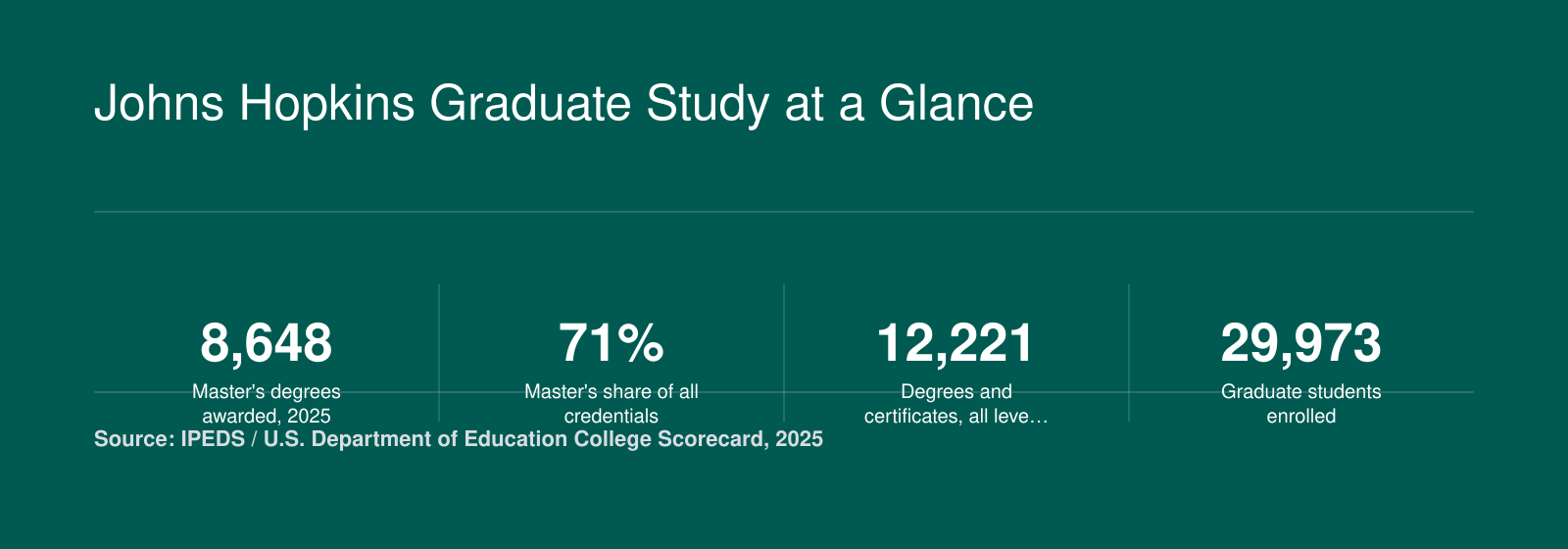
Johns Hopkins Graduate Study at a Glance
These figures frame graduate study at Johns Hopkins in one view, from degree volume to how students attend. The $64,730 tuition number is a school-wide average across all graduate programs; individual programs set their own rates.
Online, Hybrid, or Baltimore: How You'd Actually Attend
Fifty-five percent of Johns Hopkins graduate students, 16,375 of 29,973, took courses exclusively online in 2024, according to IPEDS / U.S. Department of Education College Scorecard data. Another 4,660 took some online courses; 8,938 took none. Online study is now the majority graduate experience for online master's programs, and delivery format shapes your weekly schedule, your travel and sometimes your residency obligations.
One Name, Many Campuses
Johns Hopkins is not one campus. Homewood sits in north Baltimore. The East Baltimore medical campus and the Bloomberg School anchor a separate cluster nearby. SAIS and the Advanced Academic Programs (AAP) operate in Washington, DC. Peabody is in Mount Vernon. A format tag tells you how coursework is delivered, not where its administrative home is. Check both the delivery mode and the location before you plan a move or a commute. A degree housed at AAP may meet in Washington, while a Bloomberg School program may sit blocks from the medical campus.
Three Delivery Formats
Among the Hopkins master's listings we verified, 38 are on-campus, 12 hybrid, and 10 fully online. The labels reflect real differences in how you would spend your week:
- Fully online: the part-time MS in Finance, the MS in Information Systems and Artificial Intelligence for Business, and Data Analytics Engineering.
- Hybrid: the MS in Environmental Sciences and Policy, the Executive MBA, and the MA in Communication.
- On campus: the MSN Entry into Nursing and the MHS in Clinical Investigation.
Confirm the Fine Print
Online at Hopkins is not a single experience. It ranges from asynchronous part-time study to scheduled live cohorts, and hybrid programs can carry short on-site residencies. AAP's MS in Environmental Sciences and Policy requires a residency or immersion, though most coursework may be completed online and a field course can satisfy the requirement. The part-time online MS in Finance is a 36-credit, 24-month program; older materials described a mix of synchronous and asynchronous work, but current pages do not confirm every operational detail. Some programs are built for working adults who log in after hours; others keep a weekly live seminar. Ask each program directly about live sessions, residency weekends, and travel before you apply. The format tag is a starting point, not a contract.
What a Johns Hopkins Master's Costs, Division by Division
$64,730 is the school-wide average graduate tuition and fees for a full-time year, per IPEDS 2024 figures reported to the U.S. Department of Education. Treat it as a benchmark rather than a quote: Johns Hopkins prices each division, and often each program, on its own schedule, so no single number describes what you will actually pay.
The published 2025-2026 rates look like this:
- Carey Business School: $1,985 per credit for part-time master's study. The fully online 12-credit certificates list $2,060 per credit, or $24,720 for the credential, plus a $100 application fee.
- School of Education: $1,140 per credit.
- School of Nursing: $1,995 per credit, unchanged for the MSN Entry into Nursing program.
- Bloomberg School of Public Health: $1,429 per credit, with $1,111 for the online MPH and $880 for Online Programs for Applied Learning.
- School of Medicine: $1,387 per credit in the main category, alongside a separate $2,219.33 line the same document does not tie to a named program.
- SAIS: a 16-credit certificate totals $24,940 at the four-credit course rate.
Turning Rates Into a Real Bill
To estimate a full program, multiply the per-credit rate by the credits the degree requires. Hopkins publishes that credit count for some credentials (SAIS's 16-credit certificate is the clearest example) and leaves it to individual program pages elsewhere. Mandatory health, technology, and activity fees sit outside per-credit tuition, and part-time or online enrollment can carry a different rate than a full-time campus seat, which is exactly what the Public Health tiers show: the same school, three prices.
Which Divisions Publish Straightforward Pricing
Carey and the School of Education give the cleanest per-credit answers, and Carey's online certificates go further by publishing a total program cost. The Bloomberg School and the School of Medicine lean on program-level or cohort pricing instead of one campus-wide rate. For Advanced Academic Programs and the Whiting School of Engineering, confirm the current rate on the individual program page before you budget; rates are set degree by degree.
Earnings, Debt, and ROI: Four-Year Outcomes by Field
Prospective students now weigh what a master's degree costs to earn as heavily as what it pays, and Johns Hopkins publishes enough federal outcome data to test both field by field.
Four years after completion, graduates in Computer and Information Sciences report median earnings of $176,945 against median federal debt of $26,126, according to IPEDS and U.S. Department of Education College Scorecard figures. Education, General graduates report $73,350 against $40,412. Those two fields bracket a distribution whose middle is far more instructive than either pole.
The Middle of the Range
- Public Health: $99,605 in median earnings, $65,952 in median debt
- International Relations and National Security Studies: $114,716 against $51,455
- Biomedical/Medical Engineering: $115,950 against $32,108
- Health and Medical Administrative Services: $118,011 against $55,801
- Biotechnology: $123,994 against $41,000
- Economics: $138,425 against $35,445
Earnings and debt do not move together down that list. Engineering and economics graduates carry roughly half the debt of public health graduates while earning more.
The Standouts on Each End
Business/Commerce, General posts $158,699 in median earnings with $61,449 in debt, the strongest absolute pay outside computing. Registered Nursing sits at $111,325 in earnings against $106,371 in debt, near parity between what a graduate earns and what a graduate owes; no other field here comes close to that ratio.
Why the Ratio Beats the Salary
Two caveats before you weigh any of this. These are median federal loan balances for program completers, not tuition sticker prices, and they exclude private borrowing and any tuition an employer paid. A funded student, or a nurse whose hospital reimburses tuition, may owe far less than the figure shown.
That is why debt-to-earnings is the better test. Biotechnology graduates owe about a third of one year's earnings; nursing graduates owe just under a full year's. The two salaries are roughly $13,000 apart, but the financial bets are not close. Ask what you will owe, then ask what you will earn.
What Hopkins Expects: Degrees, Experience, and the GRE Question
There is no university-wide Johns Hopkins admission standard for master's programs. Each division sets its own bar, and the GRE question is settled program by program, as it is for many master's programs with no GRE required.
The GRE question, answered plainly
Some Hopkins master's programs still require a test score. Many have made it optional, and some have dropped it entirely. The MSE in Computer Science lists the GRE as optional and charges no application fee. The MSN Entry into Nursing program accepts a GRE score but does not require one. Advanced Academic Programs states that most of its master's degrees do not require the GRE while telling applicants to check each program, and not to submit a score unless the program asks. In the School of Education, a GRE that is used must be dated within five years of your intended start term. None of this adds up to a single policy, so the program page for your admission cycle is the only answer that counts.
The floor, then the differences
Every applicant needs a bachelor's degree from an accredited institution. Past that, expectations split by field.
- Engineering and public health: quantitative and science preparation carries real weight. The MSE in Computer Science expects prior study equivalent to a CS bachelor's, including C++, Java, data structures, computer systems, and math foundations.
- Carey Business School: the resume and professional trajectory do much of the arguing, read alongside transcripts and essays.
- SAIS: economics coursework and foreign-language readiness are practical prerequisites, not electives you add later.
- Education and Nursing: field experience or a specific undergraduate background. MSN Entry into Nursing requires a non-nursing bachelor's, a 3.0 GPA, and 17 to 21 credits of prerequisite coursework at B- or better.
The 3.0 that keeps appearing
Education, Engineering for Professionals, Advanced Academic Programs, and both nursing tracks publish a 3.0 minimum. Advanced Academic Programs is explicit that clearing 3.0 does not guarantee admission, and Engineering for Professionals describes 3.0 as typical of admitted students, weighted toward the final two undergraduate years.
What you actually send
Professional schools lean on resumes, essays, and interviews. Research-oriented programs expect a statement of purpose and academic references who can speak to your work. Selectivity figures for individual master's programs are not published consistently, and undergraduate acceptance rates say nothing about graduate admission, so ignore them.
Ask, in writing, and keep the reply. Hopkins's divisions publish on separate sites, and that email is your record if a requirement shifts mid-cycle.
Deadlines and Test Requirements, Program by Program
Johns Hopkins has no single graduate application deadline. Each division runs its own calendar, and the programs below show the spread: Carey Business School uses multiple rounds with some rolling decision release, while the Bloomberg School of Public Health sets fixed dates. Round structure usually tracks scholarship consideration, so a final-round application can cost real money in aid; treat these published 2026 cycle dates as planning benchmarks and reconfirm them on each program's own page before you apply.
| Program / Division | Application Deadline(s) | GRE / GMAT Policy | Other Requirements |
|---|---|---|---|
| MS in Management (part-time), Carey Business School | Round 1: Feb 4, 2026; Round 2: Mar 4, 2026; Round 3: Apr 15, 2026; decisions released on a rolling basis | GMAT or GRE optional | N/A |
| MS in Information Systems and AI for Business (full-time), Carey Business School | Round 1: Oct 8, 2025; Round 2: Jan 14, 2026; Round 3: Mar 11, 2026; Round 4: May 20, 2026; decisions Dec 3, 2025, Feb 25, 2026, Apr 22, 2026, then rolling for Round 4 | GMAT or GRE optional | N/A |
| MS in Health Care Management (part-time), Carey Business School | Round 1: Feb 4, 2026; Round 2: Mar 4, 2026; Round 3: Apr 15, 2026; decisions released on a rolling basis | GMAT or GRE optional | N/A |
| MS in Business Analytics and Artificial Intelligence (full-time), Carey Business School | Round 1: Oct 8, 2025; Round 2: Jan 14, 2026; Round 3: Mar 11, 2026; Round 4: May 20, 2026; decisions Dec 3, 2025, Feb 25, 2026, Apr 22, 2026, then rolling for Round 4 | GMAT or GRE required | Official transcripts required |
| MS in Health Care Management (full-time), Carey Business School | Round 1: Oct 8, 2025; Round 2: Jan 14, 2026; Round 3: Mar 11, 2026; Round 4: May 20, 2026; decisions Dec 3, 2025, Feb 25, 2026, Apr 22, 2026, then rolling for Round 4 | GMAT or GRE optional | N/A |
| MS in Real Estate and Infrastructure (part-time), Carey Business School | Round 1: Feb 4, 2026; Round 2: Mar 4, 2026; Round 3: Apr 15, 2026; decisions released on a rolling basis | GMAT or GRE optional | N/A |
| MHS/ScM in Epidemiology, Bloomberg School of Public Health | January 15, 2026 | GRE not required | N/A |
The $64,730 average graduate tuition figure is a university-wide number, and it is a starting point rather than a price tag: each Johns Hopkins division sets its own tuition for its own master's degrees.
Paying for It: Scholarships, Assistantships, and Employer Tuition Benefits
The sharpest split in Johns Hopkins funding is not between schools. It runs by degree level: PhD admits are typically funded, master's admits usually are not. The university's doctoral package language, a 12-month stipend plus full tuition and health insurance, is written for full-time PhD students. Master's aid is a patchwork of merit scholarships, partial tuition remission, and hourly work, and it varies program by program rather than by any single policy.
Merit Awards, Division by Division
- Whiting School of Engineering: The Dean's Master's Fellowship covers half tuition for Johns Hopkins undergraduate alumni, one full-time residential fall or spring semester at a time. Summers, intersessions, and Engineering for Professionals coursework are excluded. Assistantships exist but are limited for terminal master's students, with no standard stipend or remission percentage. MSE students who finish non-research coursework in good standing may qualify for a Master's Research Scholarship.
- Bloomberg School of Public Health: The Master's Tuition Scholarship is program-specific and typically covers 75% of second-year tuition in an eight-term program. Some programs split it 25% in year one and 50% in year two, and that distribution cannot be changed afterward.
- School of Education: Bloomberg Scholars supports outstanding adult part-time master's students on a competitive basis. Counseling merit awards are partial, considered automatically at admission, and renewable for up to three years in good standing.
- Carey and Nursing: These schools administer their own awards at the school level, with amounts that track the strength of the application, so ask each program directly what a typical package looks like.
The Employer Channel
For Hopkins's part-time and online population, 16,375 graduate students studying exclusively online in 2024, per IPEDS, an employer benefit is often the largest single source of money. Eligibility is set by the employer, not by Hopkins. The university demonstrates its own version: benefits-eligible faculty and staff can claim up to $10,000 a year in graduate tuition assistance at any accredited institution, requested through EdAssist from 90 days before a term starts to 30 days after. It is reimbursement, so you pay first. Johns Hopkins Medicine states up to $15,000 per fiscal year with a post-course work commitment. Third-party payment is accepted, meaning an employer can be billed directly. Federal aid still runs through the FAFSA.
Three Questions to Ask in Writing
- Are master's students in this program eligible for assistantships, and what did they actually receive last year?
- Is the merit award renewable, and what GPA or credit load keeps it?
- What was the typical award size last year, not the maximum?
$111,325 in Earnings Against $106,371 in Debt: Nursing's Thin Margin
Accreditation, Licensure, and STEM Designation: Verify Before You Enroll
Institutional accreditation and specialized accreditation answer different questions. Johns Hopkins is accredited by the Middle States Commission on Higher Education, the institutional accreditor that federal financial aid and credit transfer rest on. That seal says the university meets broad standards. It does not tell a state nursing board, a school district, or an employer's tuition-reimbursement office that your particular master's program qualifies.
The Seal to Look For, Field by Field
Specialized accreditors review programs, not whole universities. The ones to check:
- Engineering: ABET. Hopkins confirms ABET for the M.S. in Occupational and Environmental Hygiene and ABET/EAC for the M.S.E. in Systems Engineering on its Johns Hopkins Engineering Accreditation page; that does not establish ABET status for every engineering master's.
- Nursing: CCNE or ACEN.
- Public health: CEPH.
- Education: CAEP.
- Business: AACSB.
- Counseling: CACREP.
- Public policy: NASPAA.
Ask the department which specialized body accredits the exact program, then verify it in that body's public directory. A school-level page can be accurate and still not cover your degree.
Licensure and Reimbursement
State licensure is the practical test. Nursing boards, school counseling licensure, and teaching certification all review program accreditation, coursework, and supervised hours. Employer tuition benefits often follow the same logic: many policies pay only for programs with specialized accreditation. If you enroll in a program that lacks it, you can finish with a credential that does not lead to the license or reimbursement you expected.
STEM Designation Is Program-Specific
STEM designation follows a program's CIP code, not the university's name. Hopkins publishes designations at the program level. The Bloomberg School identifies the Master of Public Health (MPH) and MPH/MBA as STEM-designated for students graduating May 2023 and after, along with several MHS, ScM, and MSPH programs on its STEM-Designated Programs page. The School of Education lists the M.S. in Education and M.S. in Counseling as STEM-designated and eligible for the 24-month OPT extension. Computer science, data analytics engineering, and bioinformatics-adjacent programs often qualify, while some management and policy programs do not. A technical-sounding name is not proof; the CIP code decides, and Hopkins publishes no single university-wide list.
The 24-month extension sits beyond the initial 12 months of post-completion OPT. It also depends on F-1 status, qualifying employment, employer responsibilities, and the Form I-983 Instructions. International applicants should get the CIP code and STEM status in writing from the program before paying a deposit.
Fifteen minutes on an accreditor's or program's site can prevent a credential that does not license you.
Common Questions About Johns Hopkins Master's Programs
Hopkins sets no single rule for every master's program. Requirements, deadlines, and tuition are set division by division, and sometimes program by program. These answers cover the common questions and point you to the cost table, deadline matrix, and format section for detail.
Does Johns Hopkins require the GRE for master's programs?
What is the application deadline for Johns Hopkins master's programs?
How much do Johns Hopkins master's programs cost?
Does Johns Hopkins offer online master's programs?
Which Johns Hopkins master's programs are best for engineering or computer science?
Compare Johns Hopkins University against every school in its field
Every ranking scores programs on graduate earnings, graduate tuition, debt and completion data from IPEDS and the College Scorecard.
Master's programs in Maryland Browse all fields