Maryland now requires 60 graduate semester credits for LCPC licensure, and Johns Hopkins built its clinical mental health counseling master's to clear that bar exactly. The program sits in Baltimore at a private nonprofit research university accredited by the Middle States Commission on Higher Education, and it runs alongside Hopkins' other counseling offerings. The practical tension is cost: graduate tuition and fees average $64,730 a year institution-wide per IPEDS 2024, while Hopkins graduates in this field family report median earnings of $66,778 four years out. A 60-credit degree, a 600-hour internship, and a licensure exam sit between those two numbers.
Key Points
Sixty graduate credits, CACREP accredited, full-time in about two and a half to three years.
Johns Hopkins counseling graduates report median earnings of $66,778 four years after completion.
Maryland LCPCs need 60 graduate credits, the NCE, and post-master's supervised hours.
The program
Master of Science in Counseling Master'sCampus
Concentration: Clinical Mental Health Counseling
Johns Hopkins University's School of Education offers a Master of Science in Counseling with a Clinical Mental Health Counseling concentration. The 60-credit program runs three to five years, full-time or part-time, in person, and starts in fall. Applications are due January 21, 2027. Coursework covers professional orientation and ethical practice, social and cultural diversity, human growth and development, career development, helping relationships, group work, assessment, and research and program evaluation. Students complete a practicum and internship in a clinical mental health setting and graduate ready to begin the licensure process in Maryland and many other states. CACREP accredits the program, and the degree carries a STEM designation. Mental health counselor positions are projected to grow 22% through 2031, per the U.S. Department of Labor.
How Johns Hopkins University compares in Clinical Mental Health Counseling
486 schools in our directory offer a master's in Clinical Mental Health Counseling, 224 of them with an online or hybrid option.
Johns Hopkins University
National median (210 schools)
Median earnings, 4 years after the degree
$66,778
$59,932
Median federal debt
$59,000
$53,485
Source: U.S. Department of Education, College Scorecard field-of-study data for master's graduates. Figures cover the whole field family at each school, not one program alone.
A full-time run of roughly two and a half to three years, or a part-time plan stretched toward a five-year ceiling: Johns Hopkins requires the same 60 graduate credits either way. The credit load is fixed. The pace is not, and that flexibility is what makes the program workable for students who hold a job while they study.
Credit Load and Pace
The 60-credit total is the national norm for clinical mental health counseling master's programs, so there is no lighter or heavier variant to weigh here. Johns Hopkins offers both full-time and part-time sequences. Its own program page commits only to a maximum time to completion of five years, not a typical duration for either track; a 2026 program summary puts typical completion at two and a half to three years without separating the two groups. Read that as the realistic full-time target and treat five years as the outer edge of a part-time plan.
Transfer credit is where the catalogs disagree. Older versions allowed a maximum of three graduate credits with faculty-adviser approval, while the 2018-19 catalog allowed six. Available sources do not settle the current limit, so confirm it with an adviser before you count on bringing credits in.
CACREP Accreditation
The concentration is CACREP-accredited, and Johns Hopkins reported reaccreditation without conditions for a full eight-year cycle running through October 31, 2029. That status carries practical weight in Maryland: the LCPC application treats a CACREP master's as the streamlined route, while a non-CACREP degree generally sends applicants into a coursework-by-coursework review. Our directory lists 6 Maryland programs in this field, and Johns Hopkins is one of them.
Delivery Format
Instruction is primarily on-campus in Baltimore, with some courses delivered online. The program cannot be completed online, and Johns Hopkins does not label the track hybrid even though a minority of the coursework happens at a distance. If you need an online master's in clinical mental health counseling, this is not that program.
Curriculum and the Fieldwork Sequence
Johns Hopkins' clinical mental health counseling master's is a 60-credit program: 54 credits of required coursework, 6 credits of electives, and a clinical sequence that moves from a 100-hour practicum into a 600-hour internship. The coursework covers the standard counseling core, and the fieldwork is where clock hours and supervision start to matter for licensure.
The 60-Credit Core
The required coursework covers the areas CACREP expects a clinical mental health program to cover: counseling theory, assessment and testing, psychopathology and diagnosis, group counseling, multicultural counseling, ethics and professional orientation, research methods, and career counseling. Those are the course areas the program publishes, not a menu of electives. They are also the areas licensing boards look for when they review your transcript. The remaining 6 credits are electives, which give you some room to shape the degree. The program also requires the CPCE, the Counselor Preparation Comprehensive Examination, before or during your final semester. It is a program requirement, separate from Maryland's licensing exam.
Practicum and Internship
The practicum is 3 credits and 100 clock hours. The internship is split across two 3-credit courses and totals 600 hours. Together they total 700 supervised clinical hours, which meets CACREP's 700-hour minimum. The 600 hours are a program requirement, not a suggestion, so plan your schedule around them. The catalog sequences the practicum before the two internship courses; it does not publish a term-by-term map in the public extract, so confirm the exact semester for each with the program. Older program materials described a 48-to-60-credit range and a 600-hour internship,1 but the current catalog is explicit: 60 credits, a 100-hour practicum, and a 600-hour internship.
Placement and Supervision
Johns Hopkins materials note that faculty support students seeking summer and fall field-experience placements. The catalog does not spell out whether students source their own sites or the program matches them, so ask admissions directly how placement works, when site approval happens, and what happens if a placement falls through. As a CACREP-accredited program, Johns Hopkins must approve clinical sites before hours count. It must also provide at least CACREP's supervision floor: one hour per week of individual supervision and 1.5 hours per week of group supervision during practicum and internship, led by program faculty or an approved site supervisor. Keep your supervision logs from day one. Those hours are not just program paperwork; they become part of the record you will need for licensure. Maryland's LCPC application asks you to document supervised clinical experience, and rebuilding those records later is harder than tracking them as you go.
Tuition, Cost, and Financial Aid at Johns Hopkins
Johns Hopkins prices its counseling master's by the credit, so the tuition total scales predictably and is easy to underestimate. The rate itself is transparent; what lands on your bill depends on how many credits you take, how many semesters you spend finishing, and the fees that accumulate along the way.
The Per-Credit Rate, Multiplied Out
The published rate for on-site MS in Counseling coursework is $1,320 per credit for 2025-2026. A standard three-credit course therefore runs about $3,960, and every additional three credits adds the same amount to tuition before fees.
Fees are modest but not zero. Registration carries a $175 non-refundable charge each semester, graduation adds a $175 fee, and online coursework carries a $20 per-credit technology fee. The $80 application fee is paid at submission and is not tuition, so leave it out of any total. Because billing is per credit rather than per term, part-time study costs the same per credit as full-time study; the practical penalty for stretching the degree out is the registration fee charged every extra semester.
What the published material does not do is state the program's required credit total, so no definitive all-in figure can be calculated here. The admissions office describes master's-level counseling costs broadly at $20,000 to $60,000 or more, which is a range rather than a quote.
The Institution-Wide Benchmark
For context, IPEDS / U.S. Department of Education College Scorecard reports $64,730 in average graduate tuition and fees at Johns Hopkins for 2024, full-time, per year. That is a school-wide average across every graduate program, not the counseling program's own rate, and it works better as a ceiling check than as a forecast, a ceiling that is more useful when checked against the Most Affordable Clinical Mental Health Counseling Master's Programs.
Aid and What Is Actually Guaranteed
Start with the School of Education Financial Aid Office, which reviews cost of attendance, aid packaging, timing, and eligibility for institutional and external scholarships with prospective and admitted students. Published materials identify no counseling-specific scholarship, tuition discount, or graduate assistantship, so do not build a budget around one. Federal aid may be available, typically Direct Unsubsidized loans and Grad PLUS for eligible graduate students enrolled at least half-time, with amounts set by the individual aid package.
Admissions: Requirements, Deadlines, and What Actually Gets You In
What does it actually take to get into the Johns Hopkins MS in Counseling? The short answer: a bachelor's degree, a 3.0 GPA floor, a complete written file, and, for applicants who clear the first screen, a half-day interview. Johns Hopkins runs one admissions cycle a year rather than rolling review, so timing matters as much as credentials.
The Materials Checklist
Application: submitted online through the School of Education, with an $80 fee.
Transcripts: official records from every post-secondary institution attended.
Two letters of recommendation: the program does not publish whether recommenders must be academic, professional, or one of each.
Personal statement: required; the prompt and length are not posted publicly.
Resume or CV.
Degree: a bachelor's from an accredited institution, completed by the expected term of entry.
Prerequisites and the GPA Floor
Johns Hopkins does not publish a list of required undergraduate courses in psychology, counseling, or statistics, so there is no prerequisite checklist to work through in advance. The quantitative bar is a 3.0 on a 4.0 scale, calculated across all previous undergraduate and graduate study, including coursework still in progress and degree programs left unfinished. The GRE is not listed among the published requirements for the 2026 cycle, but an unlisted policy is not the same as a waiver, so confirm with admissions before deciding whether to sit for it.
Deadlines and the Interview
The cycle that most recently opened began accepting applications on August 15, 2025 and closed on January 28, 2026, with a single published deadline rather than a priority and final pair. Expect the same late-January rhythm in the next cycle and treat the date as hard. Shortlisted applicants are invited to a half-day interview and are notified by the program if selected; neither the format nor the notification window is published.
How Selective Is It, Really?
Johns Hopkins does not release an acceptance rate or an entering cohort size for the MS in Counseling, so any specific figure circulating elsewhere is an estimate, not a published number. Three things are verifiable: the program enrolls students into Clinical Mental Health Counseling and School Counseling tracks, the half-day interview adds a second screening stage beyond the written file, and admission is decided once a year rather than in rolling rounds.
Maryland LCPC Licensure: Board, Title, and Path at a Glance
How the Johns Hopkins Curriculum Maps to LCPC Requirements
Some counseling master's programs leave you assembling a licensure file after you graduate. A program built to CACREP standards and mapped to Maryland's rules completes most of that file before graduation and leaves a short, clearly defined list for afterward. Here is exactly where the line falls.
Satisfied before you graduate
Degree level: Maryland licenses professional counselors at the master's level, and Johns Hopkins awards a master's in clinical mental health counseling.1
The eight content areas: Maryland expects graduate coursework across the CACREP common core (professional orientation and ethics, social and cultural diversity, human growth and development, career development, helping relationships, group work, assessment, and research and program evaluation). Johns Hopkins is CACREP-accredited, so that coverage is a condition of its accreditation rather than an elective extra.1
Clinical training: the supervised practicum and internship sit inside the degree, so the pre-degree fieldwork component is finished when you confer.
Nothing about the master's itself is provisional. The education, coursework, and pre-graduation clinical requirements clear in one move.
What waits until after graduation
The post-master's clock does not start until the degree is conferred, and Maryland asks for a substantial block of hours. The requirement is 3,000 total supervised clinical professional counseling hours across at least three years1, of which at least 2,000 hours over at least two years must be post-master's2. At least 1,500 hours must be direct clinical counseling, with no more than 1,500 indirect1. Supervision totals 100 face-to-face hours after the master's3, at least 50 of which must come from a Maryland-licensed LCPC4, and at least half of the required supervised hours overall must be supervised by an LCPC5. The supervisor must be Board-approved1, which can mean an LCPC or another fully licensed mental health provider, subject to those LCPC minimums4.
The exam and the order of operations
Maryland accepts either the NCE or the NCMHCE6. Because a passing score is filed with the LCPC application, the exam falls on the after-graduation side of the line: candidates sit for it once the degree is conferred, typically while accruing supervised hours, then apply to the Board.
Licensure is state-specific, and Maryland hours do not transfer automatically, so confirm the destination board's rules before you relocate.2
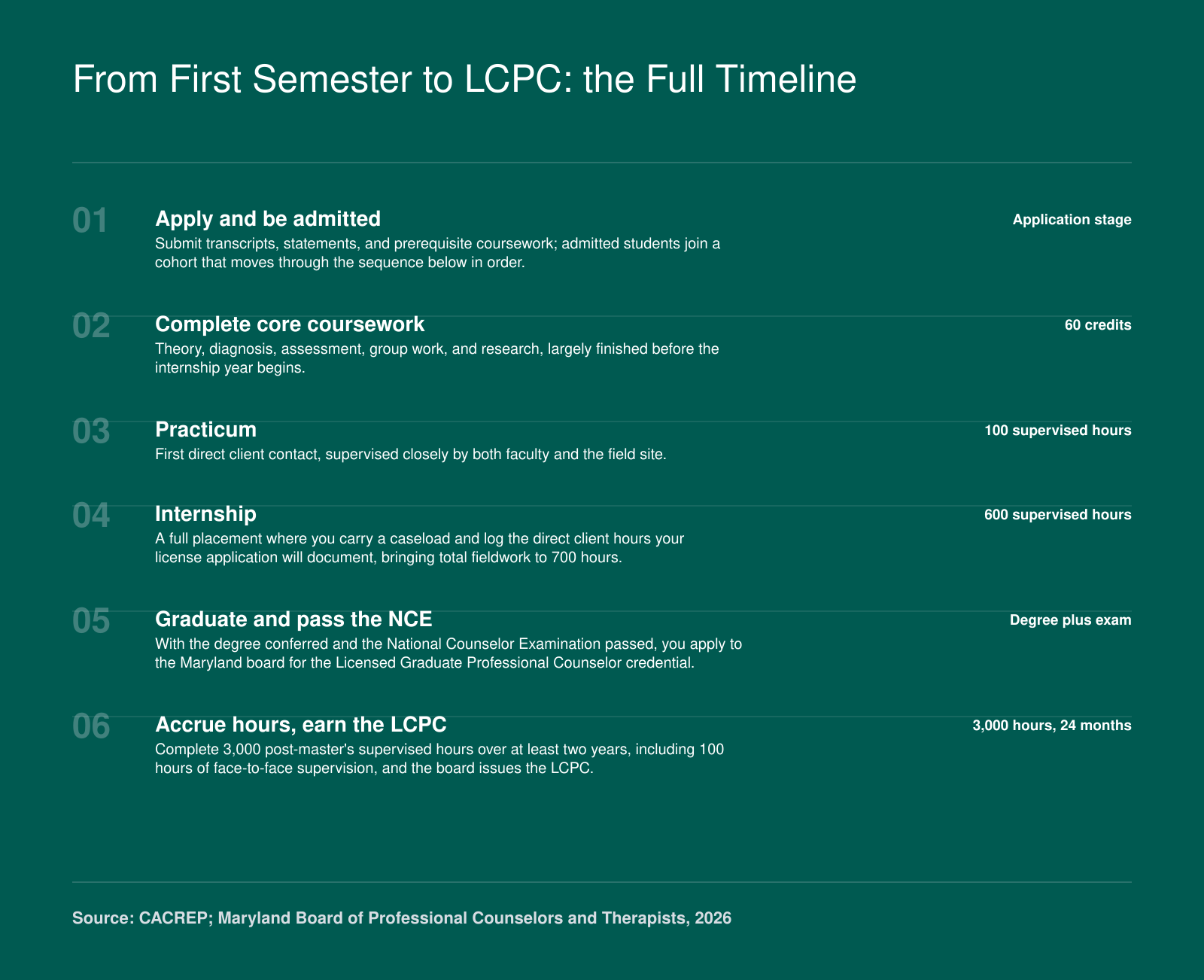
From First Semester to LCPC: the Full Timeline
The path from applicant to Licensed Clinical Professional Counselor in Maryland runs in a fixed order: admission, coursework, practicum, internship, degree, exam, then post-master's supervised hours. Johns Hopkins sets the pace of everything up to graduation. Everything after it, from the board application to the 3,000th supervised hour, runs on your own calendar and can take well past the two-year minimum.
Outcomes: Licensure Pass Rates, Employment, and How Johns Hopkins Stacks up on Cost
Some counseling master's programs hand applicants a table of licensure pass rates and job placement figures. Others leave you to ask. Johns Hopkins belongs to the second group, at least in the material available for 2026, and that gap matters when you compare programs.
What Hopkins reports, and what it doesn't
Johns Hopkins does not publish program-level NCE or CPCE pass rates, licensure attainment rates, or graduate employment rates. That silence is not unusual for a program still building a track record, but it does mean Hopkins applicants have to do the asking. Federal data thin out at the program level too: IPEDS recorded no master's degrees under the clinical mental health counseling code in 2025, which is what a newly launched program looks like. The broader counseling and mental health services family at Hopkins awarded 47 master's degrees in 2025, but that figure spans neighboring programs and is never this program's own count.
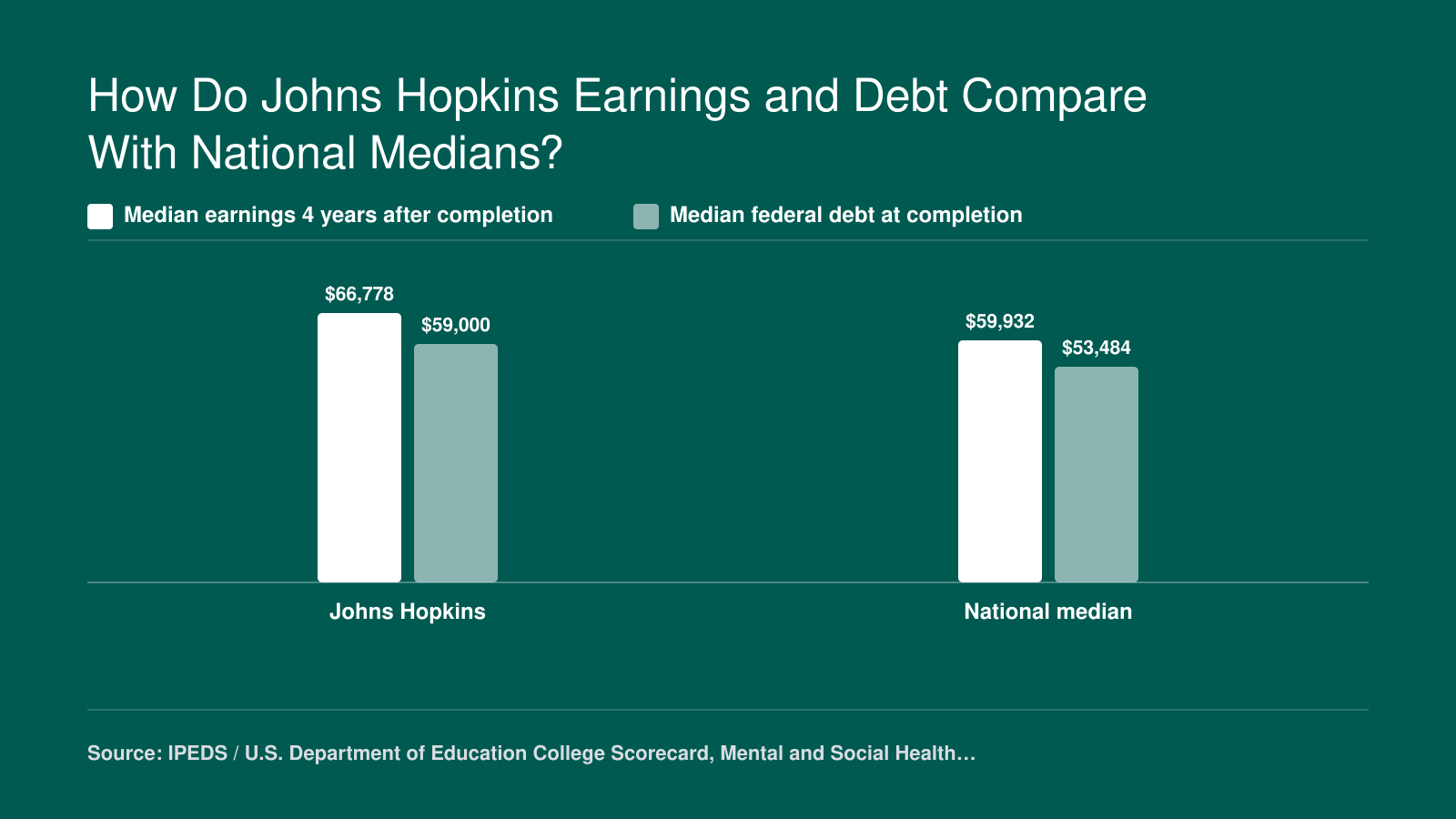
Two field-level figures do exist. College Scorecard reports median earnings of $66,778 four years after completion for Hopkins master's graduates in that same field family, against a national median of $59,932 across the 210 reporting schools, and median federal debt of $59,000 against $53,484 nationally. Both describe the whole family at Hopkins, not this program's graduates alone.
Where the price sits in Maryland
Loyola University Maryland's CACREP-accredited school counseling master's, a neighboring track rather than an identical degree, charges $785 per credit for 2026-27 across 60 hybrid credits, which comes to about $47,100 in tuition.1 It also publishes outcomes: 100% completion, a 100% certification exam pass rate, and 91% job placement at graduation for 2024-25.2 Towson University's Counseling Psychology M.A. runs 60 units primarily in person.3 The University of Maryland lists a 30-credit Counseling Psychology M.A.4 Current counseling per-credit rates for those two are not established in the sources reviewed. Hopkins does not publish a program-level rate in the federal data. The university-wide average graduate tuition and fees was $64,730 for full-time students in 2024, a school-wide figure rather than this program's price.
Reading the comparison as a decision
This is context, not a ranking. A research university's name does not by itself tell you what its counseling graduates earn or how many pass the licensure exam on the first try. Hopkins is already on CACREP's Maryland roster, so accreditation is not the gap; disclosure is. Ask the program directly for cohort size, first-time NCE pass rates, licensure attainment, and placement, then set those answers beside what Loyola already publishes. Where outcomes stay undisclosed, price certainty and accreditation status carry more weight.
How Do Johns Hopkins Earnings and Debt Compare With National Medians?
Johns Hopkins graduates in the mental and social health services family report median earnings of $66,778 four years after completion, against a national median of $59,932 across the 210 schools that report this field. Median federal debt at completion is $59,000, compared with $53,484 nationally. These figures cover the whole allied-professions degree family at Johns Hopkins, not the clinical mental health counseling program alone.
What Mental Health Counselors Actually Earn in the Baltimore Area
Frequently Asked Questions
The questions prospective students ask most about this program tend to be about admission odds, time to finish, accreditation, and whether the degree travels. Here is what the published record actually supports.
What is the acceptance rate for Johns Hopkins' clinical mental health counseling program?
Johns Hopkins does not publish a program-specific acceptance rate for the clinical mental health counseling master's. University-wide figures that circulate online describe the institution as a whole, not this program, and should not be read as its admit rate. Treat any program-level percentage you see outside Johns Hopkins' own materials as unverified.
How long does the Johns Hopkins counseling master's take to complete?
The program requires 60 graduate credits, including a 100-hour practicum and a 600-hour internship. Johns Hopkins publishes a prescribed full-time plan of study and a part-time sequence, but the official curriculum does not state a single total calendar duration for either. Students have a maximum of five years to finish, and the School of Education strongly encourages following the prescribed plan.
Is the Johns Hopkins counseling master's CACREP accredited?
Yes. The program holds CACREP accreditation, with an accreditation start date of July 10, 2021, running through October 31, 2029, according to the CACREP July 2021 accreditation decision announcement, so it sits within its active accreditation period in 2026. CACREP accreditation matters because most state counseling boards, including Maryland's, build licensure eligibility around a CACREP-accredited master's degree.
Can I qualify for LCPC licensure in another state with a Johns Hopkins degree?
A CACREP-accredited degree is the most portable credential in counseling, since most state boards recognize it, but portability is not automatic. Every state sets its own supervised postgraduate hours, exam requirements, and application rules, and some add coursework conditions. Confirm the specific board's requirements in the state where you intend to practice before you enroll.
Other master's programs at Johns Hopkins University