Best Master's in Gifted Education Programs
Compare 50+ accredited Gifted Education programs at 40+ schools, with graduate earnings, cost, debt, and completion data from IPEDS and the U.S. College Scorecard.

A master's in gifted education is a graduate degree, typically 30 to 37 credits, that trains teachers to identify and instruct advanced learners. In many states it is also the route to a gifted endorsement or add-on license. A degree that doesn't map to your state's master's in education requirements won't change your assignment or your pay. Cost spreads widely too: total program tuition runs from $10,500 at Arkansas State to $15,060 at Texas State.
The schools ranked here are ordered by federal IPEDS and College Scorecard data, not reputation surveys. Endorsement rules, though, are set state by state, and that is where otherwise similar programs diverge most.
Key Points
- Truman State charges all students $12,168, making it a strong out-of-state online option.
- Graduation rates reflect whole universities, and program-level earnings are not yet published.
- Confirm the degree leads to your state's gifted endorsement before you enroll.
10 Schools for a Master's in Gifted Education
These are the ten master's in gifted education programs that stand out for their balance of affordability, flexibility, and clear state endorsement pathways. Each card pairs program details with the institution's published graduate tuition and net price, so you can compare what you would pay, not just what the syllabus promises. Use the bullets to spot the format, credit load, and certification hooks that match your teaching situation.
Johns Hopkins University
#1Baltimore, MD · ~$65,000/yr (est.)
Best for: Twice exceptionalities focused educators
Johns Hopkins University's online master's in education with a gifted education concentration stands out for its focus on twice exceptionalities, the intersection of giftedness and learning differences. The 33-credit program aligns with NAGC and CEC standards, and it meets Maryland's requirements for the Gifted and Talented Education Specialist certification. A cohort-based capstone and practicum give educators structured practice in assessment, curriculum design, and program leadership.
- Online with twice exceptionalities concentration
- 33 total credit hours
- Six-semester program
- Meets NAGC and CEC standards
- Prepares for Maryland gifted education specialist certification
- Capstone required
- Practicum in gifted education
- Two courses per semester
University of Georgia
#2Athens, GA · ~$11,000/yr (est.)
Best for: Working teachers earning Georgia endorsement
University of Georgia's online M.Ed. in Educational Psychology delivers a gifted and creative education concentration that lets working teachers earn Georgia's Gifted In-Field Endorsement after just four courses. The fully online format, multiple start dates, and no GRE requirement make it accessible for certified educators. A practicum and final comprehensive exam connect research on gifted learners to classroom practice.
- Fully online
- No GRE or MAT required
- 37 total credit hours
- Gifted In-Field Endorsement after 4 courses
- $23,865 total program tuition
- Practicum in gifted education
- Final written comprehensive exam
Purdue University
#3West Lafayette, IN · ~$10,000/yr (est.)
Best for: Research-oriented campus learners
Purdue University's campus-based Master of Science in Education in Gifted Education emphasizes research methods, advanced educational psychology, and P-12 engagement. Students choose a thesis or non-thesis path across 34 to 37 credits, with rolling admission and scholarships available. The residential program suits educators who want to build research and leadership skills in gifted, creative, and talented education.
- Residential, campus-based program
- 34-37+ credit hours
- Thesis or non-thesis capstone options
- Rolling admissions with fall, spring, summer starts
- Scholarships and assistantships available
- Prepares for research, teaching, and P-12 engagement
University of Missouri
#4Columbia, MO · ~$14,000/yr (est.)
University of Missouri's fully online MEd in Special Education with a gifted education emphasis blends gifted-specific coursework with core studies in learning theory, instructional technology, and leadership. Thirty total credits include a practicum and meet Missouri's DESE requirements for gifted certification. The program is designed for working teachers who want to translate research into practical K-12 strategies.
- 100% online through Mizzou Online
- 30 total credit hours
- 15 credit hours gifted-focused plus 15 core
- Meets Missouri gifted certification requirements
- Includes gifted education practicum
- Covers nature and needs of gifted students
Arizona State University
#5Tempe, AZ · ~$14,000/yr (est.)
Arizona State University's online M.Ed. in Curriculum and Instruction with a gifted education concentration prepares educators, administrators, and school psychologists to serve academically gifted students. The 30-credit program provides the coursework needed for Arizona's K-12 gifted education endorsement and typically runs in 7.5-week online sessions. Multiple start dates and no GRE requirement keep it flexible for working professionals.
- Fully online format
- 30 total credit hours
- Meets Arizona K-12 gifted endorsement coursework
- 10 classes in 7.5-week sessions
- No GRE required
- Capstone required
- Focus on social-emotional needs and differentiation
Florida Atlantic University
#6Boca Raton, FL · $7,000 – $18,000/yr (est.)
Florida Atlantic University offers a Master of Education in Exceptional Student Education with a gifted education concentration on the Boca Raton campus and online. The 36-credit program leads to Florida's gifted add-on endorsement and operates within a CAEP-aligned conceptual framework. Admission requires a bachelor's degree, GRE or MAT scores, a 3.0 GPA, and prerequisite exceptional student education coursework.
- Online and face-to-face options
- 36 total credit hours
- Prepares for Florida gifted add-on endorsement
- CAEP conceptual framework supported
- Requires GRE or MAT scores
- Thesis, field project, or internship capstone
- 3.0 GPA minimum
Truman State University
#7Kirksville, MO · ~$12,000/yr (est.)
Truman State University's online Master of Arts in Gifted Education is a 30-credit asynchronous program built for working teachers. At $379 per credit, it is among the more affordable paths, and rolling admission plus multiple start dates add flexibility. The curriculum includes an internship and action research project, and it meets state certification requirements for gifted education.
- 100% asynchronous online
- 30 total credit hours
- $379 per credit, $11,370 total tuition
- Rolling admissions with multiple start dates
- Includes teaching internship and action research project
- Meets state certification requirements
- Minimum 2.75 undergraduate GPA
University of North Carolina Wilmington
#8Wilmington, NC · $8,000 – $24,000/yr (est.)
University of North Carolina Wilmington's Master of Education with a specialization in Academically or Intellectually Gifted (AIG) is a fully online program for certified K-12 teachers. Half-term courses allow working professionals to stack progress toward the M.Ed. while preparing for North Carolina's AIG add-on licensure. Faculty and local practicum mentors provide a practical, supported route into gifted education leadership.
- 100% online delivery
- Designed for certified K-12 teachers
- Flexible half-term sessions
- Prepares for North Carolina AIG add-on licensure
- Starts fall and spring
Towson University
#9Towson, MD · ~$13,000/yr (est.)
Towson University's 100% online M.Ed. in Gifted and Creative Education is Maryland-approved and aligned with NAGC advanced standards. Thirty credits combine five required courses, an internship, and four electives, with full-time or part-time pacing. Eligible employees of Baltimore County, Howard County, and Anne Arundel County public schools may qualify for reduced tuition.
- 100% online program
- 30 total credit hours
- Maryland Gifted and Talented Specialist endorsement
- Aligned with NAGC Advanced Standards
- Reduced tuition for eligible public school employees in three Maryland counties
- Full-time and part-time options
- Internship plus four electives
- Nationally known faculty
University of North Carolina at Charlotte
#10Charlotte, NC · $5,000 – $10,000/yr (est.)
University of North Carolina at Charlotte's fully online M.Ed. in Special Education with an Academically or Intellectually Gifted (AIG) concentration is designed for current teachers. The 33-credit, part-time program embeds a graduate certificate in AIG and requires a capstone research project plus classroom fieldwork. Graduates are prepared for roles as AIG specialists, program coordinators, or instructional coaches.
- Fully online, part-time format
- 33 total credit hours, 11 courses
- Embedded Graduate Certificate in AIG
- Writing-intensive capstone research project
- Classroom field experience required
- Emphasizes equity and diversity
Cost & outcomes by school
Federal data for the highest-earning Gifted Education programs, independent of the ranking above. Earnings are this field's master's graduates four years after completing, where the Scorecard reports them.
| School | Earnings | Tuition / yr | Debt | Grads/yr | Format |
|---|---|---|---|---|---|
| Towson University MD | $71,563 | $12,636 | — | 47 | Online |
| Whitworth University WA | $64,904 | $14,146 | $38,603 | 8 | Campus |
| Johns Hopkins University MD | $64,658 | $64,730 | — | 10 | Campus |
| Lamar University TX | $64,598 | $8,642 | $19,608 | 327 | Online |
| University of Georgia GA | $63,394 | $11,002 | — | 19 | Online |
| University of North Texas TX | $63,310 | $9,091 | — | 34 | Online |
| Lipscomb University TN | $63,058 | $17,334 | $26,466 | 25 | Hybrid |
| Texas State University TX | $62,709 | $8,997 | $30,500 | 38 | Online |
| Ashland University OH | $62,347 | $8,400 | $18,400 | 16 | Hybrid |
| Wichita State University KS | $61,632 | $7,986 | — | 48 | Online |
| Arizona State University AZ | $61,331 | $10,843 | $30,750 | 1,534 | Online |
| Arizona State University AZ | $61,331 | $13,587 | $30,750 | 23 | Online |
Sources: U.S. Department of Education. Tuition and graduates: IPEDS. Earnings and debt: College Scorecard, this field's master's graduates; a dash means no figure is reported.
Cost, debt & payoff
Median earnings of this field's master's graduates (4 yrs after completing) vs. their median federal loan debt · U.S. College Scorecard
Across these programs the median graduate earns about $61,331 and finishes with roughly $30,625 in debt — a ratio that clears a common rule of thumb (keep debt below first-year salary). Tuition and debt vary widely school to school, so check the per-school figures in the table above before you shortlist.
How We Rank the Best Gifted Education Schools
A master's in gifted education is worth what it costs you and what it does for your career, and those are the only things these rankings measure. Every school is evaluated with federal data from IPEDS and the College Scorecard. Name recognition, advertising spend, and reputation surveys play no part.
What Goes Into the Ranking
- Graduate tuition: Degree-aware figures that reflect what master's students pay, not undergraduate rates.
- Average net price: What students typically pay after grants and scholarships.
- Graduation and retention rates: Signals of whether students who enroll actually stay and finish.
- Earnings and debt: Median graduate earnings and borrowing for the specific program, wherever the College Scorecard publishes them.
Where the Data Falls Short
Some of these numbers describe the whole university, not the gifted education program itself. Net price and graduation rate are institution-wide figures, and net price largely reflects undergraduate aid, so read it as a rough affordability signal rather than your exact bill. A school with strong overall completion can still run a small master's program with its own track record.
Gifted education programs also tend to enroll modest cohorts, and the Scorecard withholds earnings when too few graduates are counted. For some schools here, program-level earnings simply are not available, so cost and completion carry the comparison.
How to Use These Rankings
Treat the list as a shortlist, not a verdict. Before you apply, confirm that the program leads to the gifted endorsement or certification your state recognizes. Requirements differ from state to state, and an online program based elsewhere will not automatically satisfy yours. Your state department of education or your district's HR office can tell you whether a program fits before you commit tuition dollars.
Cost and Financial Aid: What You'll Actually Pay
A quiet shift in online graduate education is making cost comparisons easier: many gifted education programs now quote one flat per-credit rate regardless of where you live. Still, the headline tuition rarely reflects what you will actually write a check for.
Per-Credit Rates and the Real Total
The advertised total is where to start. UConn's online M.A. in Gifted and Talented Education requires 30 credits1, but the university publishes a clear rate only for its separate 12-credit online certificate: $925 per credit, or $11,1002. For the master's itself, per-credit tuition and technology fees should be confirmed with the program. Among the schools ranked here, Arkansas State's online M.S.E. advertises $350 per credit for 30 credits, or $10,500; Truman State lists $379 per credit for 30 credits, or $11,370; and Georgia's online M.Ed. runs about $23,865 for 37 credits. These figures are before mandatory fees, books, and any practicum or testing costs. In-state vs out-of-state gaps at public universities can be steep, but fully online programs often charge the same rate to all residents.
Fees That Push the Total Higher
Application fees range from $30 at Arkansas State to $75 at Georgia. Some programs add technology or distance-learning fees per term, and a final comprehensive exam or capstone may carry its own cost. If a practicum is required, budget for travel or background checks. Always ask for a written cost estimate that includes all mandatory fees, because the per-credit tuition never tells the whole story.
Net Price Is an Average, Not a Quote
Federal net-price figures are useful for comparing institutions, but they are institution-wide averages after aid. They are not your specific bill. A graduate student with employer reimbursement or a graduate assistantship will pay far less than the published net price. Use net price as a rough affordability signal, not a quoted cost.
Aid Sources Teachers Actually Use
- TEACH Grant: Up to $4,000 per year for eligible students preparing to teach in a high-need field, such as special education, at a low-income school.3 Gifted education may not automatically qualify as high-need, so check with your financial aid office. The grant carries a four-year service obligation that must be completed within eight years; if you don't meet it, the grant converts to Direct Unsubsidized Loans with interest from the original disbursement date.3
- District tuition reimbursement: Many school districts reimburse graduate credits for teachers adding endorsements, such as reading and literacy. Ask about annual caps and service commitments.
- State gifted-endorsement stipends: Some states offer salary supplements or stipends for earning a gifted endorsement. Rules vary widely by state.
- Graduate assistantships: On-campus programs, such as Purdue's residential master's, may offer tuition waivers and stipends for research or teaching roles.
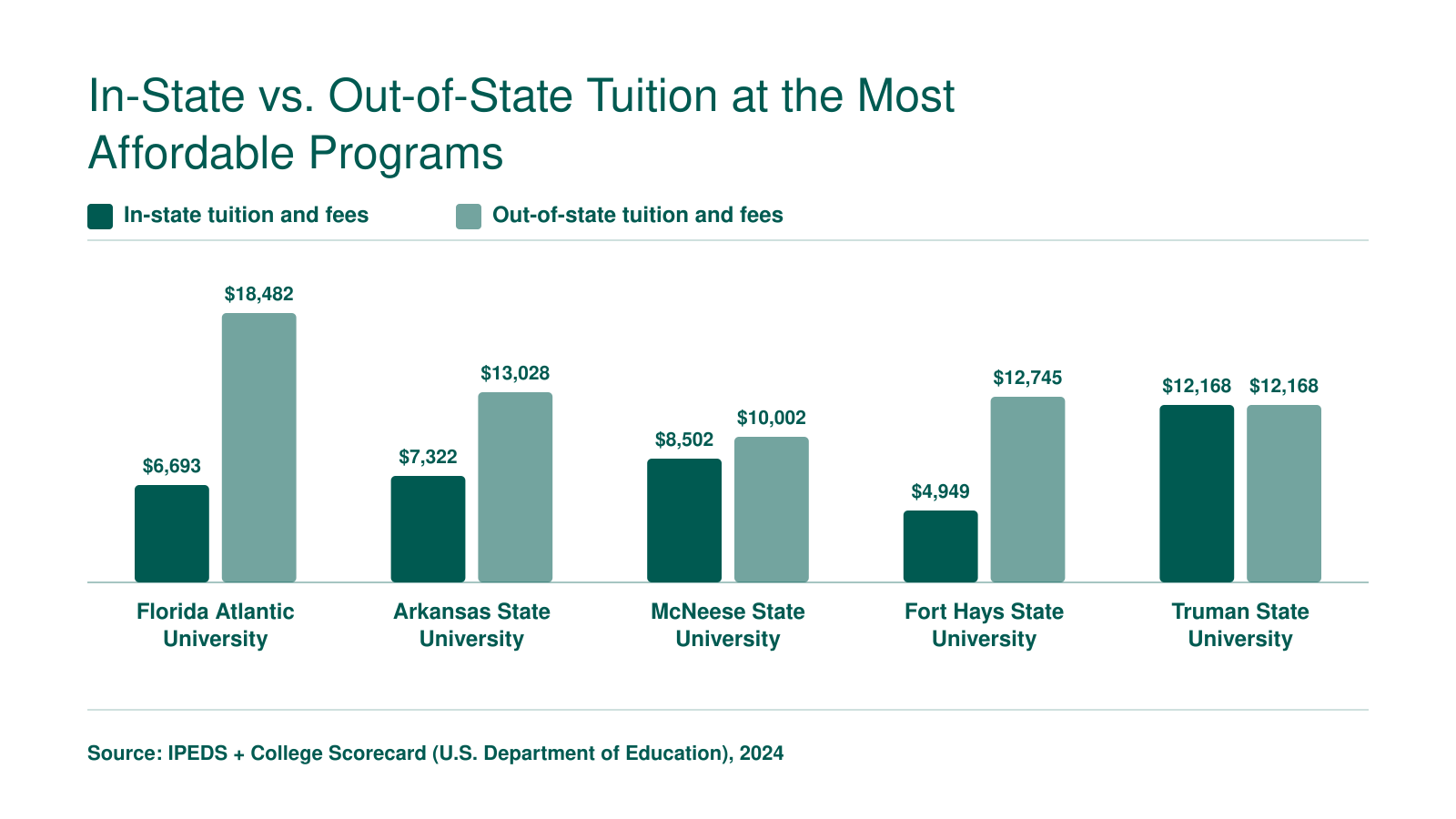
In-State vs. Out-of-State Tuition at the Most Affordable Programs
Truman State charges the same $12,168 to every student, and McNeese State shows a gap of only about $1,500, so these two are the best bets for out-of-state online students. Florida Atlantic and Fort Hays State show the widest residency gaps, so out-of-state students pay a clear premium there. These figures are annual published graduate tuition and fees, not total program cost.
Related Articles
Online vs. Campus: Choosing Your Learning Format
Gifted education master's programs generally fall into three formats, and the right one depends on how much structure you want and where you can complete a practicum. Most programs run about 30 credits (some up to 36) and take roughly 18 to 24 months part-time. We could not confirm an accelerated 12-month track in the programs we researched, so ask admissions before counting on one. Online students should also plan for fieldwork with gifted learners, usually arranged where they already work.
| Factor | Fully asynchronous online | Online with scheduled sessions | On-campus or hybrid |
|---|---|---|---|
| Schedule flexibility | Highest. Truman State, Lindenwood, and Missouri deliver coursework asynchronously, and Lindenwood lists no scheduled live class meetings. | Moderate. You log in at set times, so work and family schedules matter. Confirm meeting times with each program. | Lowest. UConn's educational psychology concentration, for example, includes four courses on campus over two summers. |
| Typical time to completion | About 18 to 24 months part-time for a 30-credit degree, such as Missouri's 30-credit MEd. | Similar part-time pace of about 18 to 24 months. Confirm any accelerated option directly. | Often a bit longer when tied to summer residencies. UConn's concentration takes slightly over two years. |
| Practicum or field experience setup | Required, and typically arranged near you. Lindenwood lists 30 fieldwork hours, Truman arranges the internship around your schedule and state certification needs, and Missouri has you observe and assist in a gifted classroom or program. | Still required. Purdue's online gifted concentration, for instance, has students work with high-ability children in an educational setting. | Required, with more structure. Concordia Chicago lists an approved eight-week P-12 field experience, and UConn's practicum is taken independently. |
| Cohort interaction | Mostly discussion boards and assignments. Peer contact is real but not live. | Regular face-to-face contact by video, which builds stronger peer and instructor relationships. | Strongest in-person networking, especially during summer residencies or campus courses. |
| Best fit for | Working teachers who need to study around a full-time job or live far from a campus. | Students who want accountability and live discussion but cannot relocate. | Students who value in-person networking, can travel for summers, or want a defined campus experience. |
Before you enroll, confirm that the program is an approved endorsement pathway for gifted education in your state. Not every master's degree qualifies for the license or certification you need.
What You Need to Apply
Requirements vary by school, so confirm details with each admissions office. These are the items you will typically need for a master's in gifted education.
- Bachelor's degree from an accredited institutionEvery program we reviewed lists a bachelor's degree as the baseline. The major is generally not restricted.
- Minimum GPA (typically 3.0)UConn, Purdue, and Johns Hopkins all point to a 3.0. UConn notes exceptions are possible, and Johns Hopkins says it considers the full application.
- GRE statusMost programs waive the GRE or do not require it. UConn and Purdue do not require it; confirm Johns Hopkins' current policy for the gifted education option.
- Teaching licenseUConn, Purdue, and Johns Hopkins do not list a license as required. Non-licensure and talent development programs, such as UConn's Giftedness, Creativity, and Talent Development degree, admit applicants without one. The tradeoff is no gifted endorsement, and none of these programs is clearly described as leading to a state license. UConn does ask for K-12 or relevant teaching experience.
- TranscriptsOfficial transcripts from prior degrees are required. Purdue evaluates the GPA from your most recently conferred degree.
- Letters of recommendationPurdue requires three recommendations. Check other schools for their counts.
- Statement of purposePurdue asks for an academic statement of purpose, a personal history statement, and a resume or CV.
- Deadlines: rolling vs. fixedUConn and Purdue use fixed dates, for example April 1 for summer at UConn and April 1 for fall at Purdue. Johns Hopkins deadlines vary by program, with some rolling admissions.
Gifted Education programs by state
Frequently Asked Questions About Master's in Gifted Education
These answers draw on the published program details and cost figures covered earlier on this page. Licensure rules vary by state, so confirm requirements with your state education agency before you enroll.
Which master's in gifted education programs accept applicants without a teaching license?
What is the total cost of a master's in gifted education after fees and books?
How long does it take to complete an online master's in gifted education?
Is a gifted education certificate enough, or do I need the full master's?
Compare Gifted Education programs on the data that matters
Explore more Education & Teaching specializations or browse every graduate field.
All Education & Teaching programs