Best Master's in Social-Emotional Learning Programs
Compare 13 accredited Social Emotional Learning programs, with graduate earnings, cost, debt, and completion data from IPEDS and the U.S. College Scorecard.

A master's in social-emotional learning is a graduate degree, usually 30 to 36 credits, that trains educators to teach, coach, and measure skills like self-regulation, empathy, and responsible decision-making. Districts increasingly write SEL into strategic plans, and they need staff who can run it, not just endorse it.
The tension is that few schools offer a dedicated SEL degree, so the ranked list here is short and selective. Several programs fold SEL into a broader education or child development degree, such as Early Childhood Education, and most do not lead to licensure.
That gap matters: tuition spans roughly $5,000 to $34,000 across these schools, yet the credential rarely changes a teacher's licensed status on its own.
Key Points
- Program-level earnings are not yet published, so rankings lean on graduation rates and net price.
- Net price is institution-wide after grants, not a quote for the SEL program.
- Most SEL master's degrees lead to no license, so verify accreditation and state rules.
Top-Ranked Master's in Social-Emotional Learning Programs
These are the strongest SEL-focused master's programs in our dataset, ranked on verifiable outcomes rather than reputation. The list includes campus, hybrid, and online options for educators and student-support professionals.
California State University-Stanislaus
#1Turlock, CA · ~$10,000/yr (est.)
Best for: Working professionals in child and family services
California State University-Stanislaus in Turlock, California, offers a campus-based master's path through its child development program with a social-emotional concentration. Graduate tuition is about $8,246 in-state and $20,846 out-of-state, and the institution-wide approximate average net price is $6,067. The program emphasizes developmental theory, rotating seminars, and field experience, and the school's overall graduation rate is 53 percent.
- 34-credit curriculum with social-emotional development concentration
- Requires GRE and a 3.0 minimum GPA
- Three letters of recommendation and prerequisite coursework required
- Rotating topical seminars and field experience built in
- Thesis, project, or comprehensive exam capstone
- Designed for educators, administrators, and family service workers
- On-campus format with close faculty collaboration
Arcadia University
#2Glenside, PA · ~$34,000/yr (est.)
Best for: Online educators pairing SEL with another certificate
Arcadia University in Glenside, Pennsylvania, delivers its SEL master's fully online, pairing the required SEL certificate with a second graduate certificate. Graduate tuition is $49,610, and the institution-wide approximate average net price is $29,466; the school's overall graduation rate is 67 percent. The flexible, self-paced format suits working educators and includes a capstone research project.
- Fully online, 30-credit, two-year MEd
- $18,300 total program tuition ($610 per credit)
- Requires a 3.0 GPA and at least one recommendation letter
- Pair an SEL certificate with a second graduate certificate, such as autism
- Culturally and emotionally responsive teaching emphasis
- Capstone research project required
- Median earnings four years after completion: about $69,200
- No campus visits required
Neumann University
#3Aston, PA · ~$11,000/yr (est.)
Best for: Pennsylvania-certified teachers seeking cohort learning
Neumann University in Aston, Pennsylvania, offers a cohort-based SEL master's for educators who already hold a Pennsylvania teaching certificate. Graduate tuition is $39,100, and the institution-wide approximate average net price is $27,804; the school's overall graduation rate is 54 percent. Classes meet at approved Delaware Valley locations, emphasizing action research and culturally responsive teaching.
- Cohort model at approved Delaware Valley off-campus sites
- Requires valid Pennsylvania teaching certification
- Curriculum includes culturally responsive teaching and bullying prevention
- Nine transfer credits permitted
- Interview with program director required
- Capstone portfolio and final presentation
- Must maintain a 3.0 GPA
Coppin State University
#4Baltimore, MD · $5,000 – $10,000/yr (est.)
Coppin State University in Baltimore, Maryland, is a public HBCU offering a fully online teacher leadership master's with an SEL concentration. Graduate tuition is $7,100 in-state and $14,024 out-of-state, and the institution-wide approximate average net price is $9,977; the school's overall graduation rate is 26 percent. The synchronous format connects licensed teachers across Maryland and aligns with National Board Certification.
- Fully online, 30-credit program
- $392 per credit
- 2.8 GPA minimum and three recommendation letters
- Synchronous online classes with Maryland teachers
- Aligned with National Board Certification
- Two action-research capstones
- Open to licensed teachers only; accepts up to 9 transfer credits
Waldorf University
#5Forest City, IA · ~$5,000/yr (est.)
Waldorf University in Forest City, Iowa, offers a fully online master's in education with an SEL concentration developed in partnership with Erin Gruwell and the Freedom Writers Foundation. Graduate tuition is $25,978, and the institution-wide approximate average net price is $19,693; the school's overall graduation rate is 21 percent. The 36-credit program is designed for working educators and does not lead to teacher licensure.
- Fully online, 36-credit program
- Complete in approximately 12 to 24 months
- 3.0 GPA minimum and capstone required
- Partnership with Erin Gruwell and Freedom Writers Foundation
- Focus on student well-being and engagement
- Does not lead to teacher licensure
- Flexible scheduling for working professionals
Cost & outcomes by school
Federal data for the highest-earning Social Emotional Learning programs, independent of the ranking above. Earnings are this field's master's graduates four years after completing, where the Scorecard reports them.
| School | Earnings | Tuition / yr | Debt | Grads/yr | Format |
|---|---|---|---|---|---|
| National University CA | $85,908 | $16,416 | $53,471 | 352 | Online |
| Arcadia University PA | $69,227 | $33,678 | — | 3 | Online |
| Whitworth University WA | $64,904 | $14,146 | $38,603 | 8 | Hybrid |
| Commonwealth University of Pennsylvania PA | $56,241 | $12,140 | — | 16 | Online |
| University of Missouri-St Louis MO | $53,964 | $15,480 | $27,027 | 21 | Campus |
| Waldorf University IA | — | $5,340 | — | — | Online |
| William Jewell College MO | — | $6,300 | — | — | Online |
| North Dakota State University ND | — | $8,786 | — | — | Campus |
| California State University-Stanislaus CA | — | $9,766 | — | — | Campus |
| Northcentral University CA | — | $17,998 | — | — | Online |
| Coppin State University MD | — | $8,514 | — | — | Online |
| Neumann University PA | — | $11,320 | — | 23 | Campus |
Sources: U.S. Department of Education. Tuition and graduates: IPEDS. Earnings and debt: College Scorecard, this field's master's graduates; a dash means no figure is reported.
Cost, debt & payoff
Median earnings of this field's master's graduates (4 yrs after completing) vs. their median federal loan debt · U.S. College Scorecard
Across these programs the median graduate earns about $64,904 and finishes with roughly $38,603 in debt — a ratio that clears a common rule of thumb (keep debt below first-year salary). Tuition and debt vary widely school to school, so check the per-school figures in the table above before you shortlist.
How We Rank SEL Master's Programs
A ranking is only useful if you can check it, so every placement here rests on public federal data from College Scorecard and IPEDS. No school pays for position, and we do not use reputation surveys, which tend to reward name recognition over outcomes.
What We Look At
These are the inputs you can verify yourself on the federal sites:
- Graduate tuition: The published price of the degree, which is the clearest starting point for comparing cost.
- Average net price: What students pay after grant aid is subtracted.
- Graduation and retention rates: Institution-wide figures showing how many students finish and how many return.
- Earnings and debt: Program-level figures, used only where the federal government publishes them.
What the Data Can't Show
Treat the numbers as a starting point, not a verdict. Graduation rates and net price describe the whole institution, not the SEL program. They can reflect undergraduates far more than master's students. Many SEL programs are small, and small programs often have no published program-level earnings or debt. When that is the case, we note the gap outright instead of estimating.
What We Do Not Measure
Federal data cannot tell you whether a curriculum is rigorous, whether faculty research matches your interests, or whether a program prepares you for the role you want. We do not score those factors. Check them yourself using the admissions and accreditation sections below, and ask each program directly about its courses, practicum or fieldwork, and graduate placement before you apply.
Online vs. Campus SEL Degrees: What 'Online' Really Means
The label "100% online" now covers everything from fully asynchronous coursework to schedules built around live class meetings, and that difference matters more than the delivery tag.
Where the formats split
The programs here lean heavily online, with a smaller campus-based group that includes Stanislaus State and Neumann University. Neumann is cohort-based and offered at Delaware Valley locations. Stanislaus builds in field experience. Harvard's residential master's is a 12-month, on-campus program, and its online offerings are Ed.M. foundations courses rather than a standalone online SEL degree.
The hidden variables
Three things decide how much of your week an online program claims:
- Live sessions: Coppin State lists synchronous online classes, and Harvard's online Ed.M. foundations courses meet synchronously within regular class hours.2 Concordia University Irvine's online master's in educational leadership with an SEL emphasis is fully asynchronous.1 Harvard's HPL101 is asynchronous, with optional Zoom sessions offered across multiple time zones.2
- Residencies: Arcadia, Waldorf, and Concordia Irvine state that no campus attendance or residency is required. For contrast, Harvard's Teaching and Teacher Leadership residency (not an SEL degree) combines 5 to 7 synchronous sessions with a summer campus stay and year-long fieldwork.3
- Practicum: Endicott's M.Ed. requires no clinical hours. Programs with field components may require in-person time in a school.
Pacing differences
Concordia Irvine runs two 3-unit courses every eight weeks, with October and January starts and a roughly 10-month finish.1 National University enrolls year-round on a similar 10-month timeline. Arcadia lets students study at their own pace over two years, while Endicott and Waldorf allow 12 to 24 months. Neumann's cohort structure moves everyone together.
What working teachers should do
Before applying, ask admissions for the live-session schedule, the time zone those sessions follow, and whether attendance is graded. Endicott's and National's program pages do not say whether live meetings are required, so confirm it directly. A program that fits your school day on paper can still fail you if a weekly session lands during dismissal duty.
Cost and Affordability: Tuition and Net Price at Each School
Programs below are ordered from lowest to highest average net price. Net price is an institution-wide average after grants and scholarships, not a quote for a single SEL program. Teachers often reduce the cost further through federal graduate loans, employer or district tuition reimbursement, and educator discounts; Endicott College's online SEL M.Ed., for example, lists $614 per credit and 36 credits for about $22,104 before aid.
| School | Graduate In-State Tuition | Graduate Out-of-State Tuition | Average Net Price | Per-Credit Cost | Total Credits |
|---|---|---|---|---|---|
| California State University-Stanislaus | 8246 | 20846 | 6067 | 34 | |
| Coppin State University | 7100 | 14024 | 9977 | 392 | 30 |
| Waldorf University | 25978 | 25978 | 19693 | 36 | |
| Neumann University | 39100 | 39100 | 27804 | ||
| Arcadia University | 49610 | 49610 | 29466 | 610 | 30 |
Related Articles
Career Paths and Salary Outcomes for SEL Graduates
Social-emotional learning has moved from an extracurricular add-on to a line item in many district strategic plans, which has created demand for people who can design, coach, and measure it. That demand shows up in a cluster of job titles rather than one clean career ladder.
Where SEL Graduates Land
Most people who earn this degree move into one of a few roles:
- SEL specialist or coordinator: builds and supports a district or school-wide social-emotional curriculum.
- Instructional coordinator: oversees curriculum, teacher training, and program evaluation, often with SEL as one portfolio among several.
- School climate or culture lead: focuses on behavior systems, belonging, and restorative practices.
- Classroom teacher with an SEL focus: keeps teaching but becomes the building's go-to resource.
- Youth program director: runs SEL-informed programming in after-school, nonprofit, or community settings.
The programs ranked here report their completions and concentrations, but program-level earnings specific to these SEL degrees are not yet published, so we rely on occupational benchmarks rather than institution-wide figures, which would overstate what graduates of this specific program earn.
What the Pay Data Shows
The closest federal benchmark is instructional coordinators, with a national median of about $77,440 per year as of 2025 ($37.23 hourly), ranging from roughly $47,980 at the 10th percentile to $121,670 at the 90th. Within local elementary and secondary schools, the median runs higher, near $82,130. Classroom teaching pays less on average: elementary teachers had a 2025 median around $63,970, secondary teachers about $72,040.1
Job listings using the actual "SEL coordinator" title tell a more modest, location-dependent story. Recent 2026 postings for Social Emotional Learning Coordinator jobs in Illinois show average pay near $61,071, while New York listings average $63,3102, Cincinnati $55,5683, and Colorado Springs $57,0294, with most roles falling between the high $30,000s and mid $70,000s. These are geographic snapshots, not a national SEL salary figure.
Is It Worth It?
Be honest with yourself about the mechanism. Many graduates do not land a new title at all. Instead, the degree moves them up a district salary schedule that pays more for a master's, so the return comes as a raise in a job they already hold rather than a jump to "SEL specialist." Weigh that steady, incremental gain against the net price of each program before enrolling.
Median Pay for Instructional Coordinators
Instructional coordinators are the closest federal occupational match to many SEL specialist roles.
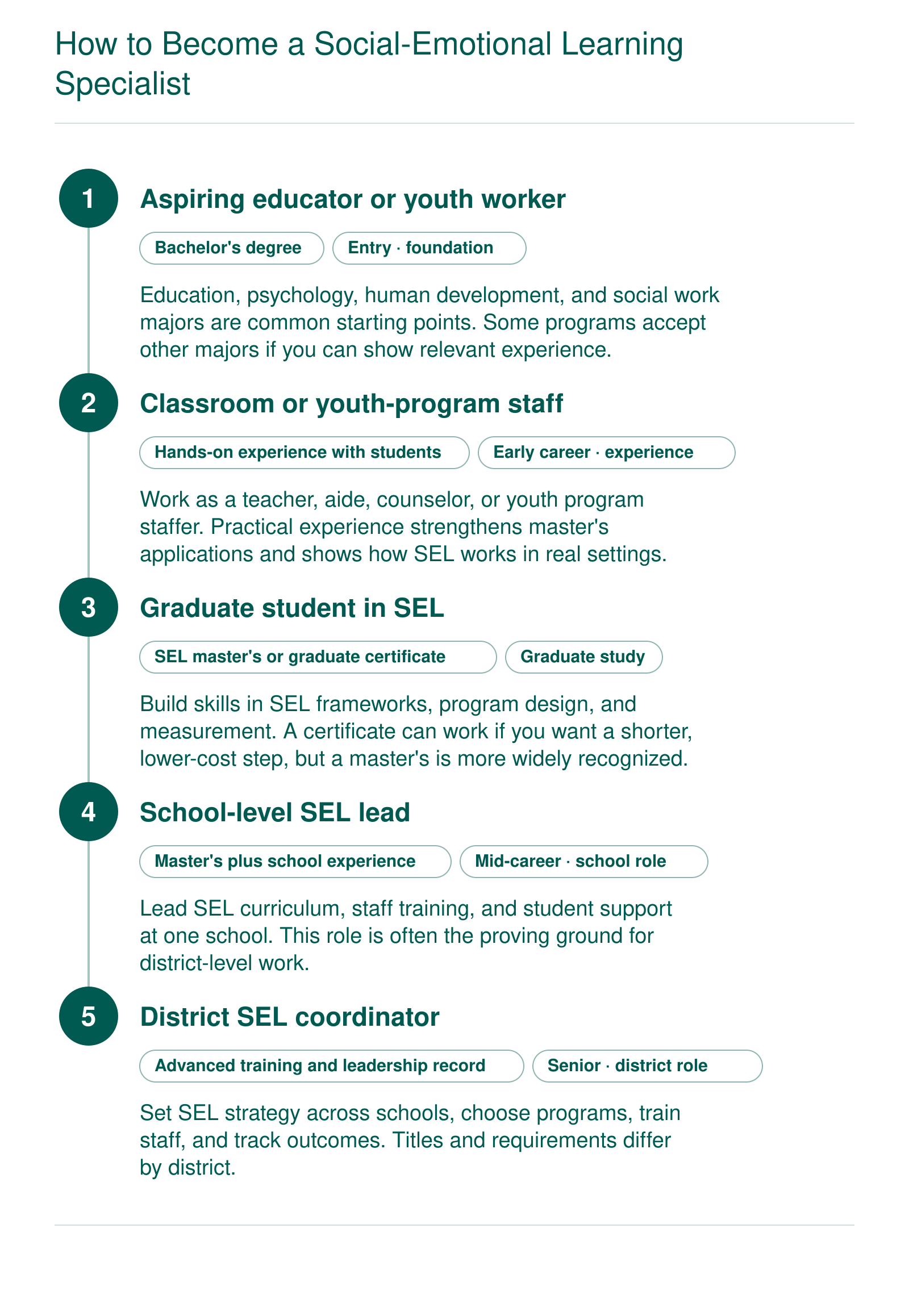
How to Become a Social-Emotional Learning Specialist
Most SEL specialists move from direct work with students to program leadership, adding graduate training along the way. Steps vary by district, and licensure-track roles such as school counselor or school psychologist follow a different path with state-specific credentials. Check your state and target district before choosing a program.
Admissions Requirements and Program Fit
Admission rules for SEL master's programs vary, and some program pages leave key details unstated. Confirm each requirement with the admissions office before you apply.
- Bachelor's degree and GPAExpect to need a bachelor's degree from an accredited institution. Arcadia University and UTEP publish a 3.0 minimum GPA. UBC asks for roughly a 76% average in senior-level coursework, and the University of Alberta mentions a minimum without giving a number. Endicott's SEL listing does not state a GPA, so check with admissions.
- Teaching license and experienceA license is not clearly mandatory at the programs where it was checked. UBC and Alberta both expect about two years of teaching or relevant experience. Alberta does not count student teaching, practicum, or daycare work toward that. Endicott describes its SEL M.Ed. as for current educators.
- Non-educator eligibilityCounselors, youth workers, HR professionals, and nonprofit staff are not categorically excluded. UBC may waive a related-degree requirement, and Alberta reviews applicants case by case. Endicott's policy for non-educators is unclear, so ask before applying.
- GRE policyNone of the program pages reviewed lists the GRE as a requirement, so plan on skipping it. Verify this on each program's current admissions page.
- Typical application materialsExpect transcripts, a résumé or CV, and a personal statement or statement of intent. Most programs also want recommendation letters. Arcadia asks for one, UTEP for two, and UBC for three. UTEP also includes a faculty interview.
- Access to a school or youth settingOnline programs with applied projects generally assume you can work in a school or youth-serving setting. Confirm early how each program handles field work if you are not currently placed in one.
Most social-emotional learning master's degrees do not lead to licensure, so check a program's accreditation and your state's requirements before you enroll if a credential is your goal.
Social Emotional Learning programs by state
Frequently Asked Questions About SEL Master's Degrees
These answers use the credit counts, timelines, and start terms that schools publish for the current admissions cycle. Where a school does not state a detail, we say so instead of guessing. Confirm deadlines on each program's admissions page before you plan around them.
How long does it take to earn a master's in social-emotional learning?
Do you need teaching certification for a master's in social-emotional learning?
Is a master's in social-emotional learning worth it?
When are application deadlines, and how many start dates do SEL master's programs offer each year?
Is an SEL graduate certificate enough, or do I need the full master's?
Compare Social Emotional Learning programs on the data that matters
Explore more Education & Teaching specializations or browse every graduate field.
All Education & Teaching programs