Best Master's in Industrial-Organizational Psychology Programs in Maryland
Compare 3 accredited Industrial Organizational Psychology programs in Maryland, with graduate earnings, cost, debt, and completion data from IPEDS and the U.S. College Scorecard.

Like a master's in organizational communication, industrial-organizational psychology applies behavioral science to the workplace: how companies hire, train, assess, and retain people. Maryland has few master's options, so the decision turns on format, cost, and fit rather than a long shortlist.
The programs ranked here carry in-state graduate tuition roughly between $16,500 and $18,300 a year, with nonresident rates climbing well past $38,000 at College Park. Delivery ranges from fully online to evening and Saturday hybrid cohorts.
Most graduates move into HR, talent management, or people analytics, fields that pair well with a master's in organizational leadership in Maryland, where employers increasingly expect data fluency alongside the psychology.
Key Points
- UMD's MPS in I-O Psychology is fully online for its Spring cohort.
- UMBC's 30-credit MPS lists 2026-2027 rates of $818 per credit for residents.
- Master's-level I-O graduates generally need no Maryland license for nonclinical organizational work.
Maryland's Top I-O Psychology Master's Programs Ranked
Campus, hybrid and online programs appear together below, with cost, graduate outcomes and delivery format all in view. Graduation rates and net prices are institution-wide figures from IPEDS and College Scorecard, not numbers for the I-O master's alone.
University of Baltimore
#1Baltimore, MD · $17,000 – $23,000/yr (est.)
Best for: Applicants skipping the GRE
The University of Baltimore is the lowest-cost option here, with graduate tuition of $14,760 in-state and $21,654 out-of-state and an institution-wide average net price after aid of $13,868. Its M.S. is a 42-credit, STEM-designated program that requires no entrance exam, and select out-of-state students can qualify for regional in-state tuition. The school graduates about 38% of its students overall, a figure that covers the whole institution, not this master's. Students can add an internship or thesis, and the program is based in Baltimore.
- 42 total credit hours
- STEM-designated program
- No entrance exam required
- Rolling admissions, fall and spring starts
- 3.0 GPA minimum, one recommendation letter
- Thesis or capstone option; internship optional
- Regional in-state tuition for select out-of-state students
- $50 application fee
University of Maryland-College Park
#2College Park, MD · ~$18,000/yr (est.)
Best for: Working professionals seeking evening blended classes
The University of Maryland-College Park pairs the strongest institution-wide graduation rate in this group (about 89%) with a 15-month professional master's built for working adults. Graduate tuition is $16,891 in-state and $36,822 out-of-state, and the institution-wide average net price after aid is $15,678. Evening classes at College Park combine with pre-recorded online lectures. College Scorecard reports median earnings of $73,895 one year after completion for this program.
- 15-month program of 10 courses, two per term
- Blended: evening classes at College Park plus recorded online lectures
- Designed for working professionals
- Two recommendation letters (minimum)
- Curriculum covers job analysis, training design and performance management
- Application deadline listed as March 12, 2026
University of Maryland-Baltimore County
#3Baltimore, MD · $15,000 – $20,000/yr (est.)
Best for: Part-time learners near the Washington corridor
UMBC delivers its I-O master's through the Shady Grove location in Rockville, with a hybrid schedule of online work plus evening and Saturday sessions. Graduate tuition is $13,356 in-state and $22,932 out-of-state, and the regional rate extends to residents of D.C., Delaware and select Virginia and Pennsylvania counties. The institution-wide average net price after aid is $16,467, and the school graduates about 70% of its students overall. Median earnings five years after completion are $71,919, and the program can be completed part-time in two years.
- 30 total credit hours, part-time available
- Two-year program with fall start
- Hybrid format with evening and Saturday classes
- Rockville location (UMBC at Shady Grove)
- Self-selected mentoring program
- Professional portfolio development
- Taught by faculty practitioners
- Compressed summer courses
Cost & outcomes by school
Federal data for the highest-earning Industrial Organizational Psychology programs, independent of the ranking above. Earnings are this field's master's graduates four years after completing, where the Scorecard reports them.
| School | Earnings | Tuition / yr | Debt | Grads/yr | Format |
|---|---|---|---|---|---|
| University of Maryland-Baltimore County MD | — | $16,524 | — | 16 | Campus |
| University of Baltimore MD | — | $16,574 | — | 13 | Campus |
| University of Maryland-College Park MD | — | $18,276 | — | — | Campus |
Sources: U.S. Department of Education. Tuition and graduates: IPEDS. Earnings and debt: College Scorecard, this field's master's graduates; a dash means no figure is reported.
Online and Hybrid Master's in I-O Psychology Options in Maryland
For students comparing Master's Programs in Maryland, the University of Maryland, College Park is the clearest route to an online master's in industrial-organizational psychology, though only one of its two cohorts is fully online. Its MPS in I-O Psychology runs online for the Spring cohort and hybrid for the Fall cohort. Both share the same curriculum, but hybrid students attend weekly in-person instruction at College Park.
Classes meet on weekday evenings. One course holds a synchronous Monday session from 5 to 8 p.m. (online or on campus, depending on format), while the second alternates live or in-person meetings with asynchronous work.1 The program runs two classes per term across five terms, roughly 15 months, and is aimed squarely at working professionals.2 A 3-credit practicum adds hands-on organizational work and reflection.
UMBC's 2026 schedule lists its I-O master's as hybrid, so expect some campus time. Its applied requirements weigh more heavily on a full-time job. The elective practicum asks 16 to 20 hours a week under a senior I-O or HR professional. The required final-semester capstone demands at least 9 on-site hours weekly, though an approved internship with a current employer can qualify.
If the University of Baltimore's I-O track interests you, ask the department about current format and meeting times before applying.
Which Maryland I-O Psychology Master's Programs Waive or Make the GRE Optional
Standardized testing has faded from most professional master's admissions, and Maryland's I-O programs follow that pattern with some loose ends compared with top industrial-organizational psychology graduate programs nationally.
- University of Maryland-College Park: The admissions FAQ says the GRE was not accepted for Fall 2024, putting it among Master's in Industrial-Organizational Psychology Programs With No GRE Required, and the catalog is silent on testing. The program lists a 3.0 minimum GPA on a 4.0 scale. Fall admission only. The program page lists January 30,1 while the 2026 catalog lists March 12, 2026, and neither source says which controls.
- UMBC: GRE not required. Expect a 3.0 or higher GPA. Applicants outside psychology or a related field need introductory psychology plus research methods or statistics. Fall only, with a May 1 deadline.
- University of Baltimore: No GRE since Fall 2023 applicants. A 3.0 from a regionally accredited institution is required. One admissions page asks for B or better in statistics and research methods, though the newer program page omits that. Fall is rolling with a July 15 priority date, and Spring closes December 1. Late applications may be considered depending on space.
What else to prepare
Plan on transcripts, letters of recommendation, and a statement of purpose. College Park says adequate prerequisite performance is required but does not list specific courses.
Confirm before you apply
Call or email admissions before submitting. Test rules and deadlines shift between cycles, and the published dates above do not agree.
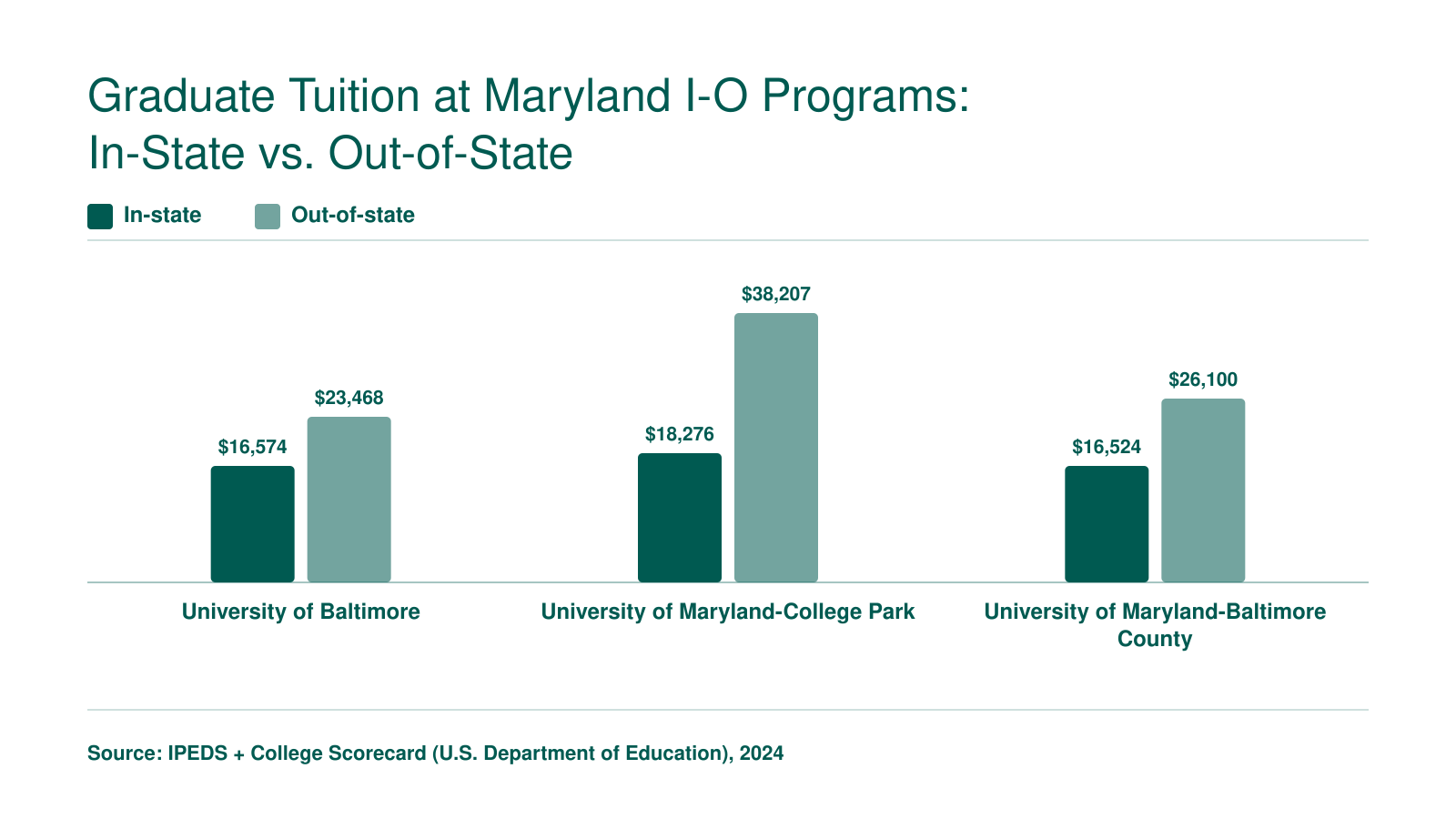
Graduate Tuition at Maryland I-O Programs: In-State vs. Out-of-State
These are annual graduate tuition and fee figures for the master's degree level, not undergraduate sticker prices. The in-state and out-of-state gap is widest at the University of Maryland-College Park, where nonresidents pay about $19,900 more per year. It is narrowest at the University of Baltimore, though no school here removes the difference entirely.
Related Articles
What a Master's in I-O Psychology Costs in Maryland and Whether You Need a License
I-O employers now expect both people expertise and analytics, so cost per credit is worth checking before you commit, especially compared with the Most Affordable Master's in Industrial-Organizational Psychology Programs.
UMBC's 30-credit MPS lists 2026-2027 rates of $818 per credit for Maryland residents and $1,405 for non-residents. That works out to $24,540 and $42,150 in tuition alone. A second UMBC page lists $861 and $1,460 ($25,830 and $43,800), so confirm the current rate with the program before budgeting.
University of Maryland-College Park's MPS also requires 30 credits (ten courses), but tuition is a flat $27,390 for 30 credits in 2026-2027, so confirm that estimate with the program rather than multiplying a per-credit rate. The University of Baltimore's M.S. requires 42 credits, the longest of the three, and offers regional in-state tuition for select out-of-state areas. Check whether you qualify and multiply by the current rate.
College Park's flat program rate erases the out-of-state premium for students in the designated sections. UMBC lists separate non-resident rates.
Do You Need a License?
Most I-O master's graduates work in HR, consulting, and analytics roles that do not require a psychology license, and some of those analytics roles are the focus of the Best Master's in Data Analytics Programs in Maryland. Many pursue voluntary credentials instead, such as SHRM-CP or SHRM-SCP and HRCI certifications, to signal HR competence to employers.
Maryland Licensing Rules for I-O Psychology Graduates
Common Questions About Maryland I-O Psychology Master's Programs
Which is better for I/O psychology: UMD or UMBC?
Can I work full-time while completing an I/O psychology master's in Maryland?
How long does an I-O psychology master's in Maryland take part-time vs. full-time?
Can a Maryland I-O master's lead into a PhD later?
Compare Industrial Organizational Psychology programs on the data that matters
Explore more Psychology specializations or browse every graduate field.
All Psychology programs