Best Master's in Counseling Psychology Programs in Ohio
Compare 3 accredited Counseling Psychology programs in Ohio, with graduate earnings, cost, debt, and completion data from IPEDS and the U.S. College Scorecard.

Ohio's counselor board generally expects 60 semester hours for the LPC, and the LPCC adds supervised experience and a further exam on top of that. A master's that falls short of those requirements can mean extra credits and extra tuition after graduation.
The label is part of the problem. Many Ohio degrees titled "counseling psychology" are actually clinical mental health counseling or counselor education programs, and that difference affects which licensure path a graduate qualifies for. The ranked list here is short and mixes campus and online options.
Counselor licensure is set by coursework content, not by a degree's title.
Key Points
- Ohio State, Xavier, and Wright State are all CACREP-accredited and campus-based.
- Average net price runs about $15,415 at Wright State and $32,997 at Xavier.
- Most licensure-track programs require about 60 credits, or 2 to 3 years full-time.
The Best Master's in Counseling Psychology Programs in Ohio, Ranked
Most Ohio programs in this field are clinical mental health counseling degrees rather than counseling psychology degrees in the strict sense. Both routes can lead to Ohio licensure, so check that a program's licensure fit, total cost, and class format match your plans. Graduation rates and net price below are school-wide averages for the whole institution, not program results.
Ohio State University
#1Columbus, OH · ~$14,000/yr (est.)
Best for: Full-time students seeking varied Columbus placements
Ohio State's Counselor Education program in Columbus prepares both clinical mental health counselors and professional school counselors. Supervised field experience runs through local agencies, private practices, schools, hospitals, and college counseling centers. The school-wide graduation rate is about 88%, and the institution-wide average net price is about $17,300. This is a clinical mental health counseling degree rather than a counseling psychology degree. Published admissions details include a December 1 application deadline, a 3.0 minimum GPA, and no required entrance exam.
- Clinical mental health counseling degree, not counseling psychology
- Two concentration options, including school counseling
- Theory paired with supervised practice
- Placements in community, private practice, school, and hospital settings
- Application deadline December 1
- 3.0 minimum GPA, no entrance exam required
- Campus-based in Columbus
Xavier University
#2Cincinnati, OH · ~$19,000/yr (est.)
Best for: Working adults needing evening classes
Xavier's on-campus Clinical Mental Health Counseling M.A. in Cincinnati is a 60-credit program built for working students, with evening, weekend, and late-afternoon classes. It reports more than 500 clinical and community placement settings in the region and meets professional clinical counselor licensure requirements in Ohio, Kentucky, and Indiana. The school-wide graduation rate is about 69%, and the institution-wide average net price is about $33,000. This is a clinical mental health counseling degree, and the GRE is optional.
- Clinical mental health counseling degree, not counseling psychology
- 60 credit hours, two years full-time
- Full-time and part-time options
- Starts fall, spring, or summer
- $739 per credit
- CACREP accredited
- 3.0 minimum GPA, test optional
- 600 hours of supervised clinical work
- Optional dual track for Ohio school and clinical counselor licensure
Wright State University
#3Dayton, OH · ~$16,000/yr (est.)
Best for: Aspiring school counselors in Dayton
Wright State's Master of Science in Counseling in Dayton offers school counseling and clinical mental health counseling tracks, with a practicum and internship for every student. Graduates are prepared to sit for the Ohio professional counselor licensure exam. The school-wide graduation rate is about 42%, and the institution-wide average net price is about $15,400. This is a counseling degree rather than a counseling psychology degree. Program-level Scorecard data show median earnings of $48,503 one year after finishing and $63,166 four years after finishing. Median debt among graduates is $55,825.
- Counseling degree with school counseling and clinical mental health tracks
- Practicum and internship required
- Psychometric assessment training
- Prepares for the Ohio professional counselor licensure exam
- Median earnings $48,503 one year after finishing
- Median earnings $63,166 four years after finishing
- Campus-based in Dayton
Cost & outcomes by school
Federal data for the highest-earning Counseling Psychology programs, independent of the ranking above. Earnings are this field's master's graduates four years after completing, where the Scorecard reports them.
| School | Earnings | Tuition / yr | Debt | Grads/yr | Format |
|---|---|---|---|---|---|
| Wright State University OH | $63,166 | $15,771 | $55,825 | 38 | Campus |
| Ohio State University OH | — | $13,901 | — | — | Campus |
| Xavier University OH | — | $19,218 | — | 10 | Campus |
Sources: U.S. Department of Education. Tuition and graduates: IPEDS. Earnings and debt: College Scorecard, this field's master's graduates; a dash means no figure is reported.
Online and Hybrid Master's in Counseling Psychology Programs in Ohio
Flexibility is what most working students want from a counseling degree, but the master's programs in Ohio ranked here are built around campus attendance. Ohio State, Xavier, and Wright State are all listed as campus-based, and none is presented as a fully online master's.
Format and specialization
- Xavier: Among the clinical mental health counseling master's programs in Ohio, Xavier's M.A. requires regular in-person attendance. Evening, weekend, and late-afternoon classes, plus full-time and part-time tracks, make it workable for people with jobs.
- Ohio State: The program is campus-based and prepares both clinical mental health and school counselors.
- Wright State: The master's in counseling is also campus-based, with a school counseling concentration among its two options.
I found no published residency or intensive requirement for any of these programs, because the daily format is already in person.
Practicum and internship still happen in person
Even the best online master's in counseling psychology programs require supervised clinical hours at a real site. Xavier's program includes 600 clinical hours supervised by licensed counselors, and Wright State builds practicum and internship into the degree.
Tip: if you live far from campus, ask the admissions office before applying whether the program will place you at a site near you or approve one you find. Get the answer in writing.
Which Ohio Counseling Master's Programs Waive or Make the GRE Optional?
Do you still need a GRE score to apply to a counseling master's in Ohio? For most applicants here, no. Admissions committees for master's programs with no GRE required have largely shifted their attention to GPA, written statements, and references instead of standardized test results.
- Ohio State University: The counselor education master's in clinical mental health counseling lists the GRE as not required. Applicants need a minimum 3.0 undergraduate GPA and submit a Special Statement of Intent, with a December 1 application deadline.
- Xavier University: The clinical mental health counseling master's requires no entrance exam and is test optional, meaning GRE or MAT scores may be submitted but are not expected. Xavier asks for a 3.0 GPA minimum and at least two letters of recommendation.
- Wright State University: The counseling master's program listing does not publish a GRE policy either way, so contact the department directly before assuming scores are or are not needed.
Without test scores doing the screening, the rest of your file carries more weight. Expect a personal statement explaining why counseling, recommendations from faculty or supervisors who have watched you work, and credit for relevant clinical, human services, or volunteer experience.
Related Articles
CACREP Accreditation and Why It Matters for Ohio Counselors
CACREP, the Council for Accreditation of Counseling and Related Educational Programs, is the national accreditor for master's-level counseling degrees. It reviews programs by specialization, so a school can hold accreditation for clinical mental health counseling, school counseling, or both. Ohio State, Xavier, and Wright State all carry current CACREP accreditation.1 Ohio State's clinical mental health counseling track and Wright State's counseling program are accredited, and Xavier's Clinical Mental Health Counseling, M.A. is accredited through March 31, 2031.1
Why It Matters for Licensure
As of 2025, graduating from a CACREP-accredited program is a requirement for professional counselor licensure in Ohio, administered by the Counselor, Social Worker and Marriage & Family Therapist Board.2 CACREP graduates also tend to have a smoother path when seeking licensure in other states, since many boards recognize the standard.2
Psychology vs. Counseling Titles
A degree labeled "counseling psychology" is not automatically CACREP-accredited; CACREP accredits counseling programs specifically.2 If a program carries a psychology title, confirm it appears in the CACREP directory and review its coursework before applying.2
Bottom line: if an Ohio LPC is your goal, verify the program's CACREP status and its 60-semester-hour structure before you enroll.
How Long Does a Counseling Psychology Master's Take in Ohio?
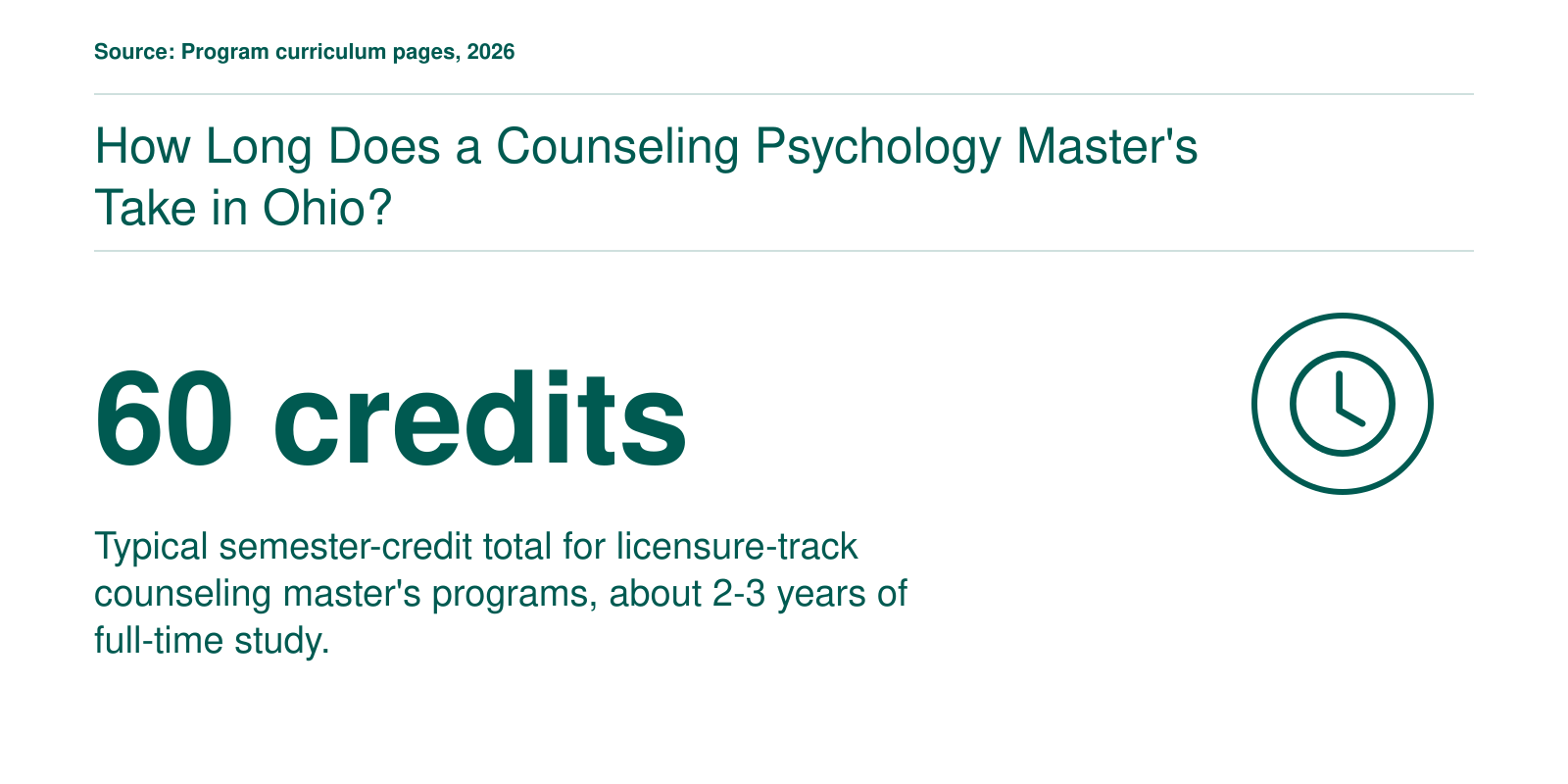
Most licensure-track counseling master's programs run about 60 semester credits, which usually means 2 to 3 years of full-time study. Practicum and internship hours are built into that credit total, so they are not extra time added after coursework. Part-time pacing, where a school offers it, stretches the degree beyond three years, so check each program's curriculum page for its pacing options and maximum time to degree.
Ohio LPC and LPCC Licensure at a Glance
Cost and Ohio Licensure for Counseling Master's Graduates
Tuition and net price
Net price is a school-wide average, not a quote for this program. Wright State's average is about $15,415, Ohio State's about $17,339, and Xavier's about $32,997. Program-level tuition tracks the same pattern. Ohio State lists roughly $13,901 in-state against $42,740 out-of-state, Wright State $15,771 against $25,759, and Xavier a single rate of $19,218. Xavier's published $739 per credit works out to about $44,340 over 60 credits, and Ohio State's $830 in-state rate to roughly $49,800. Both estimates exclude fees.
Costs beyond tuition
Budget for fees, books, and clinical placement expenses: liability insurance, background checks, and travel to practicum and internship sites. Xavier's program includes 600 clinical hours, so travel adds up.
Aid and debt
Ask each program about graduate assistantships and scholarships. Federal Direct Unsubsidized and Grad PLUS loans are the usual fallback. Program-level debt is not published for these schools, so the school-wide median graduate debt is a rough guide: about $22,750 at Wright State, $19,976 at Ohio State, and $23,250 at Xavier.
The licensure bill
The true price of becoming an LPC includes the NCE (about $210), Ohio application fees, and supervision costs. Ohio now accepts the NCE or the NCMHCE. Published application fees conflict, from $80 plus a $3.50 processing fee to a few hundred dollars, so confirm current amounts with the Ohio board before you budget.
Compare Counseling Psychology programs on the data that matters
Explore more Psychology specializations or browse every graduate field.
All Psychology programs