Best Master's in Educational Psychology Programs in Ohio
Compare 10 accredited Educational Psychology programs in Ohio at 8 schools, with graduate earnings, cost, debt, and completion data from IPEDS and the U.S. College Scorecard.

An educational psychology master's and a school psychology master's are not interchangeable in Ohio. Only the school psychology route, with NASP approval and a supervised internship, leads to licensure through the Ohio Board of Psychology. The general degree points toward research, assessment, instructional design, and training work.
Ohio programs sit on both sides of that line, campus and online, with in-state graduate tuition running from under $7,000 a year to roughly $19,600 at a private campus. The credential you need should drive the choice, not the sticker price.
Key Points
- A general educational psychology master's does not qualify you for Ohio's school psychologist license.
- Kent State offers a fully online M.Ed. in Educational Psychology.
- Youngstown State has the lowest in-state graduate tuition, while Ohio State still requires the GRE.
Best Schools for a Master's in Educational Psychology in Ohio: Ranked List
Rankings weigh cost and verifiable outcomes, and the methodology section below explains how. Several Ohio schools house their educational psychology work inside school psychology tracks, which carry NASP approval that a general educational psychology master's does not. Read each card with that distinction in mind. Graduation rates cited are institution-wide, not program-specific.
Ohio State University
#1Columbus, OH · ~$14,000/yr (est.)
Best for: Aspiring researchers seeking funded associateships
Ohio State's Educational Psychology MA, housed in the College of Education and Human Ecology, focuses on motivation, self-regulated learning, literacy and classroom cognition. Funding comes through graduate associateships and scholarships, and the university's institution-wide graduation rate is the highest on this list. NASP status applies only to Ohio State's separate school psychology programs, not to this MA, and the application deadline is December 1.
- Ranked 8th nationally by U.S. News
- Graduate associateships and scholarships available
- Application requires academic writing sample
- Requires a special statement of intent
- Application deadline is December 1
- Career paths: student development, training, assessment specialist
University of Dayton
#2Dayton, OH · ~$20,000/yr (est.)
Best for: Working professionals needing evening classes
The University of Dayton offers a school psychology M.S.E./Ed.S. with NASP specialist-level approval, a more applied route than a general educational psychology master's. It is built for working adults, with evening classes, full-time and part-time options, and test-optional admission.
- NASP-approved specialist-level program
- Test optional; three recommendation letters required
- Thesis required
- Full-time and part-time options
- Evening classes for working professionals
- Dayton and Columbus campuses from fall 2026
- Practicum and internship included
- Graduate assistantships with school districts
Miami University
#3Oxford, OH · $17,000 – $38,000/yr (est.)
Best for: Future school psychologists wanting a combined degree
Miami University's combined School Psychology M.S./Ed.S. is on the Oxford campus within the Department of Educational Psychology. Both CAEP and NASP list the program, with full NASP approval at the specialist level. Training covers assessment, intervention, consultation, mental health counseling and research methods, paired with supervised school-based field work.
- Combined M.S. and Ed.S. degree
- CAEP accredited and NASP approved
- Assessment and intervention training
- Mental health counseling and consultation training
- Research methodology coursework
- Supervised field experiences in school settings
University of Cincinnati
#4Cincinnati, OH · ~$15,000/yr (est.)
The University of Cincinnati offers an Educational Studies MA with a concentration in Educational Psychology and Child Study. The interdisciplinary program draws on cognitive psychology, child development and neuroscience, and students can use the Arlitt Child Development Center. A thesis or capstone option lets you shape the degree toward research, curriculum design or a school psychology path. We could not confirm accreditation details for this track.
- Four concentration options in the Educational Studies MA
- Thesis or capstone option
- Access to the Arlitt Child Development Center
- Focus areas include cognitive development and informal STEM learning
- Early childhood education for sustainability option
- Career paths: school psychologist, curriculum designer
Kent State University
#5Kent, OH · ~$12,000/yr (est.)
Kent State offers its M.Ed. in Educational Psychology in a fully online format, with an optional Gifted Education concentration, and on campus. Rolling admissions and spring, summer and fall starts suit working educators. NASP's full approval at Kent State applies to its separate school psychology specialist program, not to this M.Ed.
- Fully online format
- 30 total credit hours
- Rolling admissions; fall, spring and summer starts
- Two recommendation letters required
- Optional Gifted Education concentration with advanced practicum
- Six years allowed to complete
- Covers cognitive psychology and human development
- Applies psychology to learning and instruction
- Designed for classroom teachers and other professionals
- Ohio licensure preparation noted
University of Toledo
#6Toledo, OH · $18,000 – $29,000/yr (est.)
The University of Toledo's School Psychology M.A. is CAEP accredited and NASP approved, with full approval at the specialist level. Field experience starts in year one with a 100-hour pre-practicum, and students can present research at state and national conferences. It suits students who want Ohio school psychologist licensure rather than a general educational psychology degree.
- CAEP accredited and NASP approved
- 100-hour pre-practicum in the first year
- Prepares for the Praxis II exam
- Faculty are practicing school psychologists and active researchers
- Graduate assistantships available
- School Psychology Student Organization and Summer Institute
Cleveland State University
#7Cleveland, OH · ~$11,000/yr (est.)
Cleveland State's School Psychology program is a full-time, three-year M.A. and Psy.S. sequence focused on urban schools. It is NASP approved and CAEP accredited, requires no entrance exam, and uses a cohort model with a daytime schedule. Part-time study is not offered, and students are admitted once a year.
- Full-time, three-year M.A. and Psy.S. sequence
- 51 total credit hours
- NASP approved and CAEP accredited
- No entrance exam required
- Application deadline January 10; group interview
- Second-year field practicum; third-year internship with state funding
- Cohort-based, fall start only
Youngstown State University
#8Youngstown, OH · ~$7,000/yr (est.)
Youngstown State awards the M.Ed. in Intervention Services with a school psychology concentration, followed by an Ed.S. for licensure. It is CAEP accredited, and the curriculum follows Ohio, NASP and CAEP standards. GRE scores are considered only for applicants below a 3.0 GPA, and practicum placements include the Rich Center for Autism.
- CAEP accredited
- 36 credit hours; Ed.S. adds 40 more
- Summer-start cohort
- 3.0 GPA minimum; GRE considered below that
- 100 practicum hours in the first year
- Practicum at the Rich Center for Autism
- Interview, position paper and three references required
- Prepares for Praxis II and Ohio licensure
Cost & outcomes by school
Federal data for the highest-earning Educational Psychology programs, independent of the ranking above. Earnings are this field's master's graduates four years after completing, where the Scorecard reports them.
| School | Earnings | Tuition / yr | Debt | Grads/yr | Format |
|---|---|---|---|---|---|
| University of Cincinnati OH | $66,674 | $14,902 | $33,020 | 218 | Campus |
| Miami University OH | $66,494 | $16,751 | — | 22 | Campus |
| Cleveland State University OH | $58,518 | $11,297 | $63,389 | — | Campus |
| University of Dayton OH | $56,688 | $19,580 | $29,476 | 56 | Campus |
| Kent State University OH | $56,253 | $12,483 | — | 38 | Online |
| Youngstown State University OH | $54,976 | $6,848 | $41,000 | 24 | Campus |
| University of Toledo OH | — | $17,605 | $22,600 | 38 | Campus |
| Ohio State University OH | — | $13,901 | — | — | Campus |
Sources: U.S. Department of Education. Tuition and graduates: IPEDS. Earnings and debt: College Scorecard, this field's master's graduates; a dash means no figure is reported.
Cost, debt & payoff
Median earnings of this field's master's graduates (4 yrs after completing) vs. their median federal loan debt · U.S. College Scorecard
Across these programs the median graduate earns about $57,603 and finishes with roughly $33,020 in debt — a ratio that clears a common rule of thumb (keep debt below first-year salary). Tuition and debt vary widely school to school, so check the per-school figures in the table above before you shortlist.
Online and Hybrid Master's in Educational Psychology Programs in Ohio
Online delivery in this field has split along a clear line: degrees focused on learning and development have moved online, while licensure-track school psychology training stays anchored in real schools.
Kent State's M.Ed. in Educational Psychology is the fully online option among the schools here. It is built for working professionals, usually takes about two years depending on part- or full-time pacing, and allows up to six years from first enrollment to finish. Starts run in fall, spring and summer with rolling admissions.1 Kent State's program page does not say whether classes are live or self-paced, so confirm that before enrolling if you need recorded lectures to fit around a school day.1
The rest of the programs below are campus-based. For working teachers comparing master's programs in Ohio, the University of Dayton stands out with evening classes, part-time options and, from fall 2026, campuses in both Dayton and Columbus. Cleveland State, by contrast, runs a full-time cohort with daytime courses.
Weigh the tradeoff carefully. Online master's in educational psychology programs rarely include practica, while school psychology programs require supervised fieldwork. Cleveland State places students in a second-year practicum and a third-year internship, and Dayton builds both into its program.
Which Ohio Master's in Educational Psychology Programs Waive or Make the GRE Optional?
The table reflects what each school's admissions page states for 2026, and where a page says nothing we say so rather than guess. Several Ohio programs have dropped the GRE, but Ohio State still requires it and policies differ by department, so confirm with admissions before you apply.
| School | GRE Policy | Minimum GPA | Application Deadline |
|---|---|---|---|
| Ohio State University (Educational Psychology, MA) | Required | 3.0 undergraduate (graduate psychology program) | December 1 (Autumn start) |
| Kent State University (Psychological Sciences) | Optional; scores not required | N/A | December 1 |
| University of Toledo (School Psychology, MA) | Not required | N/A | December 1 and February 1 |
| Miami University (Psychology, MA) | Unclear; page lists acceptable GRE scores as an admission requirement | N/A | December 1 |
| University of Cincinnati (Educational Psychology) | No published policy | N/A | N/A |
Related Articles
What Does a Master's in Educational Psychology Cost at Ohio's Most Affordable Schools?
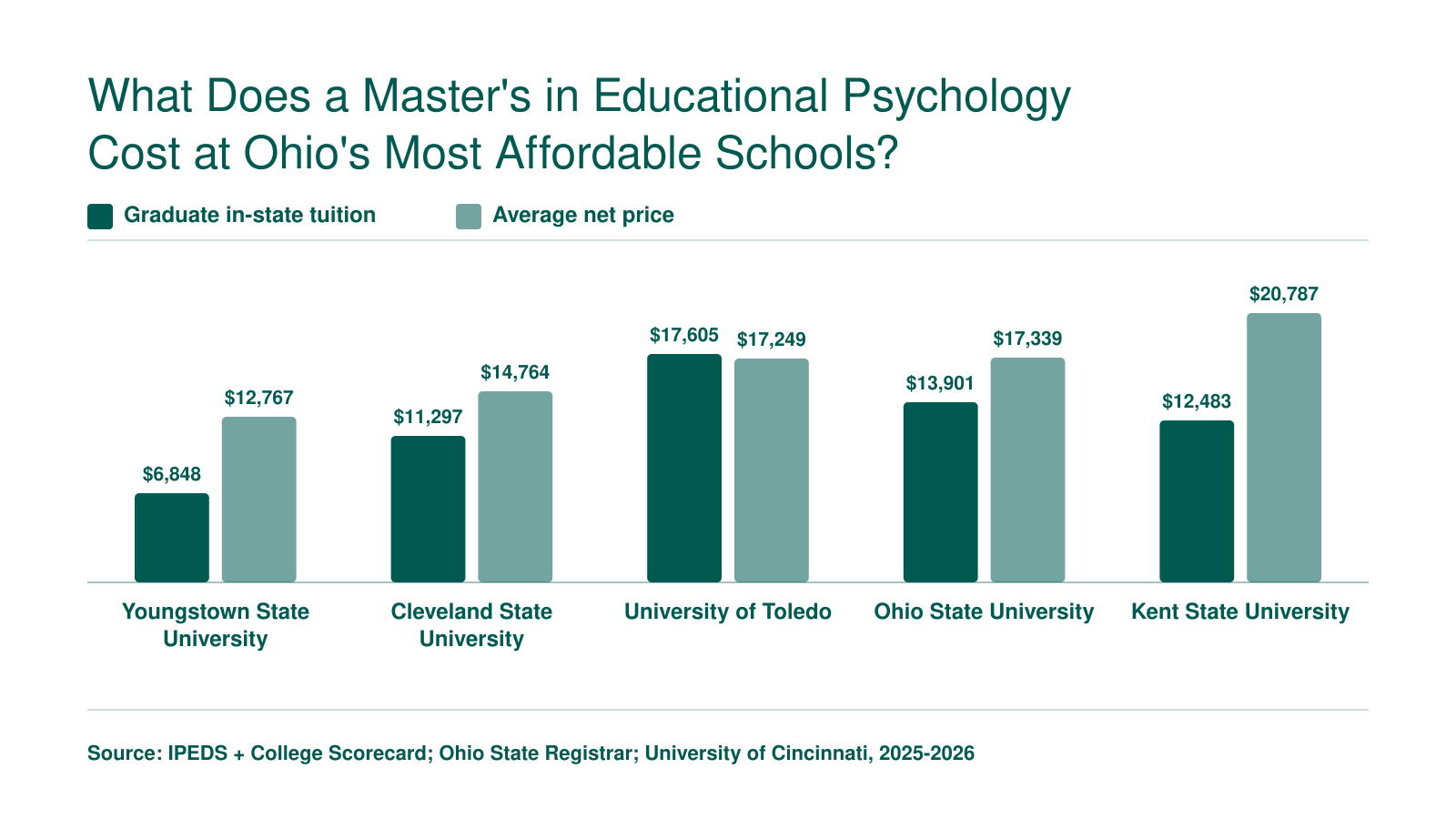
Youngstown State has the lowest graduate in-state tuition and net price among the most affordable schools here, and Kent State has the highest net price of the group. Ohio State's 2025-2026 graduate rate lists an $829.75 instructional fee per credit hour, plus a $32.63 general fee and a $9.30 student activity fee. Nonresidents add $1,874.50 per credit hour, subject to a cap tied to 8 credit hours, while online-only students pay a $200 per-term distance surcharge instead. Cincinnati, also ranked here, lists $746 per credit hour for Ohio residents, $771 for metro residents and $1,333 out of state. Net price is an institution-wide average after aid, not an exact quote, and in-state tuition reflects graduate rates. Weigh cost against your credential goal, then use the licensure callout that follows.
Ohio Licensure: Educational Psychology vs. School Psychology
How We Rank Ohio's Master's in Educational Psychology Programs
Graduate program comparisons are moving away from reputation surveys and toward outcomes students can check for themselves. Our ranking of Ohio's master's in educational psychology programs draws on federal College Scorecard and IPEDS data, not prestige or advertising. We consider several factors together:
- Cost: Graduate tuition and average net price; see the most affordable master's in educational psychology programs list.
- Completion: The institution-wide graduation rate.
- Outcomes: Program-level earnings and debt for graduates, where federal data publishes them.
- Flexibility: Whether the program is offered on campus, online or in a hybrid format; compare the best online master's in educational psychology programs ranking.
This data has limits. Net price and graduation rates describe each university as a whole, not the educational psychology program alone. Smaller programs often graduate too few students for earnings figures to be released, so a school without published earnings is not automatically a weaker choice. Use program pages and conversations with admissions staff to fill those gaps before you commit.
Frequently Asked Questions About a Master's in Educational Psychology in Ohio
What is the difference between educational psychology and school psychology?
Is a master's in educational psychology worth it for teachers?
Can I become a school psychologist in Ohio with a master's in educational psychology?
How long does a master's in educational psychology take part-time?
Compare Educational Psychology programs on the data that matters
Explore more Psychology specializations or browse every graduate field.
All Psychology programs