Most Affordable School Counseling Master's Programs
Compare 530+ accredited most affordable School Counseling programs at 480+ schools, with graduate earnings, cost, debt, and completion data from IPEDS and the U.S. College Scorecard.
The American School Counselor Association recommends 250 students per counselor, and most schools exceed that, yet a master's degree is the fixed price of entry. Keeping debt low matters.
Net price at the schools ranked here runs from $3,637 at Texas A&M International University to $10,440 at Cal State Long Beach. True total cost, CACREP versus CAEP accreditation, state licensure, and admission without teaching experience all shift that math.
Counselor pay rarely offsets heavy borrowing.
Key Points
- Xavier's 2026-2027 example: $44,340 tuition plus $36 and $220 fees.
- Grad PLUS borrowing now mainly requires enrollment before July 1, 2026.
- Some states still require classroom teaching before school counseling licensure.
Most Affordable School Counseling Schools: 2027 Rankings
These are the most affordable school counseling master's programs for 2026, ranked with a focus on real tuition costs after living expenses. The list below is ordered from the strongest value to the next most affordable options, with each school's program details and outcomes summarized.
Texas A & M International University
#1Laredo, TX · ~$7,000/yr (est.)
Best for: Texas certified teachers needing online flexibility
This online master's degree is built around a 48-credit, 16-course sequence with 7-week terms and six start dates a year. It requires a valid Texas teaching certificate and two years of teaching experience, and it prepares students for the TExES School Counselor exam. The program reports median first-year earnings around $54,900 and four-year median earnings around $60,600, with median graduate debt near $39,400. Texas residents see an advertised $367-per-credit rate; published out-of-state rates are higher.
- 48 total credit hours and 16 total courses
- 7-week online courses with six start dates per year
- Requires valid Texas teaching certificate and two years teaching experience
- Prepares for the TExES School Counselor exam
- Includes two practicums totaling 160 clock hours
- Texas State Board for Educator Certification accredited
- No thesis or capstone required
- 3.0 GPA minimum
California State University-Northridge
#2Northridge, CA · ~$9,000/yr (est.)
Best for: California educators pursuing dual credential options
This urban Los Angeles campus offers a 72-unit school counseling option inside the Counseling MS, with full-time enrollment and clinical fieldwork across two semesters. The program is approved by the California Commission on Teacher Credentialing and leads to the PPS Credential in School Counseling, with eligibility for the National Certified Counselor exam and an LPCC pathway. First-year median earnings for the program sit near $57,800, rising to about $75,700 at four years, with median graduate debt near $38,900.
- 72 total credit hours with full-time enrollment
- Approved by the California Commission on Teacher Credentialing
- Prepares for PPS School Counseling Credential
- Eligible for National Certified Counselor certification
- Pathway to Licensed Professional Clinical Counselor
- Clinical fieldwork over two semesters
- Three concentration options
California State University-Stanislaus
#3Turlock, CA · ~$10,000/yr (est.)
Best for: Cohort-based learners needing evening classes
Stanislaus State's counseling master's takes a cohort-based, 76-unit route that combines the Pupil Personnel Services credential with the Professional Clinical Counselor concentration. The program uses late afternoon and evening classes and can be completed in about three years, with either a comprehensive exam or thesis. A separate CaPE pathway pairs the PPS and PCC work with a Turlock and online format; applications for the Fall 2027 cohort opened October 1, 2026.
- 76 total credit hours
- Three-year cohort-based sequence
- Dual concentration in Pupil Personnel Services and Professional Clinical Counselor
- Late afternoon and evening classes
- Comprehensive exam or thesis option
- Requires Certificate of Clearance and two recommendation letters
- 3.0 GPA minimum
California State University-Bakersfield
#4Bakersfield, CA · $5,000 – $10,000/yr (est.)
This Bakersfield program is a 52-unit MS in Counseling with a school counseling emphasis, typically finished in two and a half years of full-time study. It builds toward 800 supervised fieldwork hours in diverse school settings, with weekday evening courses and an optional Child Welfare and Attendance Authorization. Four-year median earnings for the program are reported near $82,200.
- 52 total credit hours
- Typically completed in two and a half years
- Weekday evening classes after 5pm
- 800 supervised clinical hours
- Prepares for PPS School Counseling Credential
- Optional Child Welfare and Attendance Authorization
- Comprehensive exam in final semester
California State University-Los Angeles
#5Los Angeles, CA · ~$9,000/yr (est.)
Cal State LA's 73-unit option in school-based family counseling combines the Advanced Authorization in School Counseling with the Pupil Personnel Services Credential and Child Welfare and Attendance Services. Students receive family-systems training and can apply for California licensure as a Marriage and Family Therapist. First-year median earnings for the program are near $67,100, rising to about $88,700 at four years, with median graduate debt around $40,300.
- 73 total credit hours
- Includes Advanced Authorization in School Counseling
- Adds Pupil Personnel Services Credential with Child Welfare and Attendance
- Meets California Marriage and Family Therapist licensure requirements
- Family-systems oriented curriculum
- Main campus location
California State University-Long Beach
#6Long Beach, CA · $9,000 – $19,000/yr (est.)
Long Beach's school counseling MS runs evening courses on weeknights and places practicum and fieldwork during the K-12 school day. It meets California's Pupil Personnel Services credential standards and covers the National Certified School Counselor exam, with a faculty advisor assigned at admission. The program reports first-year median earnings near $58,700 and median graduate debt around $28,000.
- Weeknight courses from 4 to 9:45pm
- Practicum and fieldwork during K-12 school day
- Meets California Pupil Personnel Services credential standards
- Covers National Certified School Counselor examination
- Faculty advisor assigned upon admission
- Thesis or comprehensive exam option
- Two start dates per year
The University of Texas Rio Grande Valley
#7Edinburg, TX · $5,000 – $10,000/yr (est.)
This Edinburg face-to-face program is CACREP-accredited and prepares students for Texas School Counselor Certification or Licensed Professional Counselor licensure. Students train in an on-campus Counseling and Training Clinic and get exam support for the CPCE, TExES, NCE, and Texas Jurisprudence. The program reports first-year median earnings near $57,300 and median graduate debt around $36,500.
- CACREP accredited
- Face-to-face traditional format
- Specialization in School Counseling
- Prepares for Texas School Counselor Certification
- Eligible for Licensed Professional Counselor licensure
- On-campus Counseling and Training Clinic
- Exam support for CPCE, TExES, NCE, Texas Jurisprudence
California State University-San Bernardino
#8San Bernardino, CA · ~$10,000/yr (est.)
This San Bernardino program is a three-year MS in Counseling with a school counseling concentration aligned to California's Pupil Personnel Services Credential. It emphasizes evidence-based counseling, cultural responsiveness, and field training with local school districts and mental health agencies. Five-year median earnings for the program are reported near $77,200. The Fall 2027 application closes December 4, 2026.
- Three-year sequence
- School Counseling concentration
- Prepares for California PPS School Counseling Credential
- Emphasizes cultural responsiveness and evidence-based practice
- Partnerships with school districts and mental health agencies
- Dual concentration option available
- Attend information sessions encouraged
California State University-Dominguez Hills
#9Carson, CA · $9,000 – $19,000/yr (est.)
Dominguez Hills offers a two-year, full-time MS in Counseling with school and college counseling options, with weekday classes at 4pm or 7pm and fieldwork delivered online or hybrid. Admission is fall only, with priority December 1 and regular February 1 deadlines, and the GRE is not required. The program reports first-year median earnings near $51,800 and four-year median earnings near $84,800.
- Two-year full-time pathway
- School Counseling and College Counseling options
- Classes Monday through Thursday at 4pm or 7pm
- 900 clinical hours, including 800 fieldwork
- Fall only admission with December 1 priority deadline
- No GRE required
- About 30 students admitted each fall
California State University-Fresno
#10Fresno, CA · ~$9,000/yr (est.)
Fresno State's school counseling option is a 48-unit program aligned with California's Pupil Personnel Services Credential, including a practicum and a choice of comprehensive exam, project, or thesis. Admission requires a 3.0 GPA, recommendation letters, and an interview. The program reports first-year median earnings near $46,100 and median graduate debt around $25,000.
- 48 total credit hours
- Aligned with Pupil Personnel Services Credential
- Practicum required with grade B or better
- Culminating experience: exam, project, or thesis
- 3.0 GPA minimum
- 3 letters of recommendation and interview required
- Certificate of Clearance required
Cost & outcomes by school
Federal data for the highest-earning School Counseling programs, independent of the ranking above. Earnings are this field's master's graduates four years after completing, where the Scorecard reports them.
| School | Earnings | Tuition / yr | Debt | Grads/yr | Format |
|---|---|---|---|---|---|
| Fresno Pacific University CA | $94,232 | $13,780 | — | 78 | Hybrid |
| San Francisco State University CA | $91,778 | $9,370 | $40,113 | 50 | Campus |
| Concordia University-Irvine CA | $91,553 | $8,895 | $42,448 | 128 | Online |
| California State University-Los Angeles CA | $88,659 | $8,688 | $40,301 | 85 | Campus |
| California State University-East Bay CA | $85,452 | $9,107 | $39,757 | 73 | Hybrid |
| Alliant International University-San Diego CA | $84,805 | $19,690 | $41,000 | 71 | Online |
| California State University-Dominguez Hills CA | $84,789 | $8,978 | — | 24 | Campus |
| Concordia University-Chicago IL | $84,318 | $10,782 | $47,380 | 27 | Hybrid |
| Alfred University NY | $84,232 | $27,120 | $24,864 | 25 | Hybrid |
| CUNY Brooklyn College NY | $83,086 | $11,524 | $29,571 | 31 | Campus |
| CUNY Lehman College NY | $82,388 | $11,570 | $41,000 | 26 | Hybrid |
| California State University-Bakersfield CA | $82,248 | $9,611 | — | 14 | Campus |
Sources: U.S. Department of Education. Tuition and graduates: IPEDS. Earnings and debt: College Scorecard, this field's master's graduates; a dash means no figure is reported.
Cost, debt & payoff
Median earnings of this field's master's graduates (4 yrs after completing) vs. their median federal loan debt · U.S. College Scorecard
Across these programs the median graduate earns about $59,186 and finishes with roughly $41,000 in debt — a ratio that clears a common rule of thumb (keep debt below first-year salary). Tuition and debt vary widely school to school, so check the per-school figures in the table above before you shortlist.
What Earns a Program a Best-Value Spot on This List
Master's tuition keeps climbing, so a low sticker price alone no longer proves a program is a good deal. Price was the starting filter for school counseling master's programs, and value was the deciding factor. Net price after aid and financial aid metrics carry the most weight. Graduate tuition, school-wide graduation rate, and College Scorecard program-level earnings and debt, where published, support them.
Two cautions apply. The net price shown is an average across all students at the school, not a quote for any one person. Graduation rates also describe the whole school, not the counseling program. Accreditation and licensure fit come later, including a review of CACREP accredited online school counseling programs, because a cheap degree that does not lead to a license is not a bargain.
The Real Price Tag: Tuition Plus Everything Else
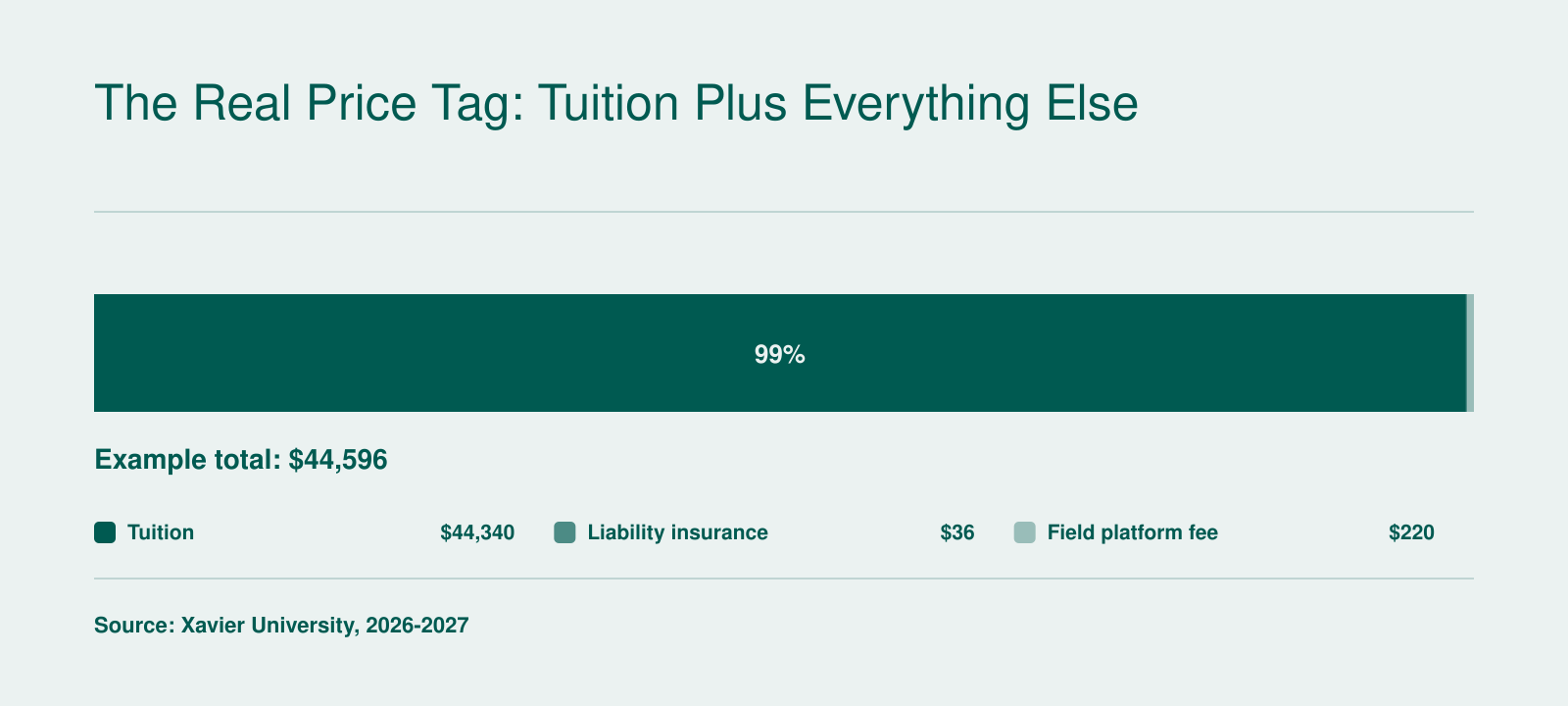
Take Xavier University's published 2026-2027 school counseling costs as one example: a 60-credit program at $739 per credit comes to $44,340 in tuition. Add a $36 liability insurance fee and a $220 field experience platform fee, and the published example total reaches $44,596 before books, background checks, or travel. Always request the full fee schedule, because sticker tuition can understate the true cost by thousands.
CACREP or CAEP: Which Accreditation Your License Actually Needs
Does it matter whether a school counseling program holds CACREP or CAEP accreditation? It can, because the two bodies review different things. CACREP accredits the counseling program itself, at the master's and doctoral level, including School Counseling and Clinical Mental Health Counseling. CAEP generally reviews the educator-preparation unit, often a college of education. Check applicable CAEP standards and your state's rules before treating the two as interchangeable.
For school counselor certification, states set their own rules, and CACREP describes its standards as entry-level preparation that states may supplement with extra coursework or supervised internship. LPC licensure is where CACREP matters most. Some states require graduation from a CACREP-accredited program, though available material does not list which ones. Moving between school and clinical credentials later may also mean added coursework or internship hours, so students considering that route should compare affordable clinical mental health counseling programs.
CACREP programs include a 100-hour practicum and a 600-hour internship under its 2024 Standards, a useful benchmark for comparing programs.
Verify Before You Apply
Look up each program in the CACREP directory and confirm your state's current rules. A cheap program that blocks licensure is not a bargain.
Related Articles
School Counselor Certification Rules in Key States
Some states still expect you to have taught in a classroom first; others let you enter school counseling straight from a master's program. That distinction shapes which credential you can realistically pursue, so confirm it before you enroll.
- Texas: School Counselor Certificate. As of September 1, 2023, two years of classroom teaching are no longer required; you still complete an approved educator preparation program and the required test.1
- Illinois: Professional Educator License with the school counselor endorsement. Teaching is not required, though at least two years of teaching reduces the supervised internship from 600 to 400 clock hours. Exam: School Counselor (235).5
- Pennsylvania: Elementary & Secondary School Counselor PK-12, with assessments in general, professional, and subject-area knowledge, submitted through TIMS.34
Many states honor the NASDTEC Interstate Agreement, and most publish separate out-of-state applicant rules (Texas requires a credentials review2; Illinois and Pennsylvania accept comparable out-of-state programs53). If you study online, verify the credential rules in the state where you plan to work before enrolling, since requirements differ widely.
Online, Hybrid, and Non-Teacher Routes Into the Profession
An online school counseling master's moves coursework to a screen, but the clinical training still happens inside a real K-12 school. Practicum and internship hours are completed in person, so confirm the program can arrange a placement in your home state.
Delivery styles differ. Sacred Heart's online M.A. is fully asynchronous but requires two 5-day residencies at Fairfield, CT. Lynchburg mixes synchronous and asynchronous classes.3 Lamar requires one residency,1 and the University of West Alabama's non-certification M.S. holds a virtual synchronous residency.2 Arkansas State's MSE is among 100% online school counseling programs, though its sources do not say whether classes are live.
Career changers have options. Arkansas State, Lamar, and West Alabama's non-certification track do not require a teaching certificate, though Arkansas State still expects classroom access for the internship. Southeastern Oklahoma State requires one,4 and Texas A&M International lists two years of teaching experience, so check before applying to school counseling master's programs no gre required.
On transfer credit, Arkansas State and West Alabama each accept up to 9 graduate hours, while Liberty allows up to 50%.5
Top First-Year Earnings Among Ranked Programs
Ways to Pay Less: Aid, Scholarships, and Payment Plans
Federal graduate borrowing changed on July 1, 2026. Grad PLUS now continues mainly under an exception for students who were already enrolled and borrowing in the same program before that date.1 The exception lasts up to three academic years or the program's remaining length, whichever is shorter. Those students keep the $20,500 annual Direct Unsubsidized limit and a $138,500 aggregate cap that includes undergraduate loans.2 New students should confirm their own limits with financial aid early.
Scholarships worth checking:
- ASCA Foundation: Awards typically run $1,000 to $5,000, often for CACREP school counseling students.
- NBCC Foundation: Military and Rural scholarships for master's students, with applications opening in November 2026.3
- State school counselor associations: Smaller awards whose terms vary by state.
Ask public universities about graduate assistantships that come with tuition waivers. Public Service Loan Forgiveness may help later if both your public school employer and your federal loans qualify. Installment plans ease cash flow too. Samford University splits fall tuition into five 20% payments.4 Claremont Graduate University's plan carries a $35 enrollment fee.5
School Counseling programs by state
School Counseling Master's FAQs
How many practicum and internship hours does a school counseling master's require?
Can I switch from a clinical mental health counseling master's to school counseling certification later?
Is the Praxis Professional School Counselor exam required in every state?
Compare School Counseling programs on the data that matters
Explore more Counseling specializations or browse every graduate field.
All Counseling programs