Most Affordable Emergency Nurse Practitioner (ENP) MSN Programs
Compare 8 accredited most affordable Emergency Nurse Practitioner programs at 7 schools, with graduate earnings, cost, debt, and completion data from IPEDS and the U.S. College Scorecard.
Emergency departments rely on nurse practitioners more each year, yet dedicated emergency NP training is offered by a limited set of graduate schools, and tuition varies widely among them.
The programs here are MSN degrees with an emergency concentration only. Mixed post-master's certificates and DNP tracks are excluded, so the costs compare like for like.
A low sticker price can mislead. Fees, residency rules, and clinical travel can erase a per-credit advantage.
Key Points
- Vanderbilt's average net price runs about $15,800 while Drexel's is roughly $38,500.
- Arkansas State charges $380 per credit, enrolling students in four states only.
- FNP-to-ENP certificates are usually the cheapest route for current FNPs.
Top Affordable Emergency Nurse Practitioner MSN Schools, Ranked
Among the ranked schools with published average net price data, the spread runs from roughly $15,800 at Vanderbilt to $38,500 at Drexel. In-state graduate tuition is often lower at the public universities on the list, but net price after aid is the more useful affordability signal for many students.
University of Alabama at Birmingham
#1Birmingham, AL · ~$9,000/yr (est.)
Best for: Post-graduate FNPs earning ENP certification
UAB's emergency nurse practitioner track is built around a large academic health system and designed for working nurses who already hold FNP certification, with a distance-accessible, cohort-based curriculum focused on emergency-specific practice. The program emphasizes interdisciplinary emergency medicine instruction and prepares graduates for the national ENP certification exam. Faculty bring more than two decades of emergency nurse practitioner practice to the clinical coursework.
- CCNE accredited
- Starts fall
- Cohort-based structure
- Work experience required
- Flexible distance-accessible interactive education
- Faculty with 22 years ENP practice
- Open to post-graduate certified FNPs
- Prepares for ENP certification exam
University of South Alabama
#2Mobile, AL · ~$9,000/yr (est.)
Best for: RNs pursuing FNP and ENP boards
South Alabama's dual role Family NP/Emergency NP track gives students a 57-credit MSN with 840 practicum hours and prepares them for both FNP and ENP certification. The hybrid curriculum combines online coursework with two required on-campus clinical skills intensives and clinicals in emergency departments, urgent care, and ground or air transport services. The program currently does not accept students from Louisiana, South Dakota, or New York.
- CCNE accredited
- 57 total credit hours
- 840 clinical hours
- Prepares for FNP and ENP boards
- Clinicals in urgent, emergency, trauma
- Emergency ground and air transport clinicals
- Not accepting students from LA, SD, NY
- Eligible for APRN licensure
Averett University
#3Danville, VA · ~$12,000/yr (est.)
Best for: Virginia nurses wanting local ENP option
Averett's MSN emergency nurse practitioner focus is one of only 13 such programs in the country and the only one in Virginia and neighboring North Carolina. The track builds on a family nurse practitioner core and adds two semesters of emergency-focused training, with small cohorts and clinical placements secured for every student. An endowed scholarship fund supports regional students pursuing the MSN.
- CCNE accredited
- 2 concentration options
- Only ENP program in Virginia and NC
- Clinical placements secured for all students
- $1 million endowed scholarship fund
- Post-master's ENP certificate available
- Careers in Level One Trauma Centers
University of Nebraska Medical Center
#4Omaha, NE · $10,000 – $15,000/yr (est.)
UNMC's concurrent MSN Family/Emergency track trains FNPs and FNP students for urgent and life-threatening conditions, with a focus on rural, frontier, and underserved communities. The plan blends online study with clinical placements over about four years and follows AAENP core competencies. A shorter post-graduate certificate path is available for practicing FNPs.
- CCNE accredited
- 4-Year program
- Prepares FNPs and FNP students
- Focus on rural and underserved communities
- Aligned with AAENP core competencies
- Expanding into EMS and prehospital settings
- Often sole provider in critical access
Vanderbilt University
#5Nashville, TN · ~$58,000/yr (est.)
Vanderbilt's emergency nurse practitioner specialty uses a hybrid format with online didactic courses and on-campus sessions, and offers full-time or part-time plans, including a two-semester option for FNP-certified applicants. Students complete clinical rotations in emergency departments, urgent care clinics, and outpatient sites while preparing for both FNP and ENP certification exams. The curriculum incorporates the 2021 AACN Essentials and is supported by doctorally prepared, practice-active faculty.
- CCNE accredited
- Full-time and part-time options
- Work experience required
- Dual FNP and ENP certification prep
- Clinical sites across the country
- Heavy focus on procedures and ultrasound
- TNCC, ACLS, PALS certifications required
- Incorporates 2021 AACN Essentials
Emory University
#6Atlanta, GA · ~$49,000/yr (est.)
Emory's emergency nurse practitioner track builds on Family Nurse Practitioner training and pairs emergency care with a dual MA in bioethics, emphasizing ethical decision-making in emergency medicine. Coursework covers sudden illness and injury plus primary care needs that arrive through emergency doors across the lifespan. Graduates prepare for FNP certification through the ANCC or AANP and are ready for emergency departments, urgent care, and trauma settings.
- CCNE accredited
- Prepares for FNP certification
- Built on Family Nurse Practitioner preparation
- Dual degree MA in Bioethics and MSN
- Covers ethics in emergency care
- Covers patients across the life span
- Emphasis on unexpected illness and injury
Samford University
#7Birmingham, AL · $20,000 – $25,000/yr (est.)
Samford's Moffett & Sanders School of Nursing offers a Family Nurse Practitioner with ENP specialty MSN that requires a current RN license, a CCNE, CNEA, or ACEN accredited BSN, and a 3.00 GPA. Applicants complete a video interview, and admitted students pay a $750 non-refundable deposit applied to first-semester tuition. Students must earn a B or better in each required course and can transfer up to 12 graduate credits.
- CCNE accredited
- 3.0 GPA minimum
- Current RN license required
- Video interview required
- $750 non-refundable admission deposit
- Transfer up to 12 graduate credits
- B or better in every course
- Six-year maximum completion window
University of Mount Union
#8Alliance, OH · ~$42,000/yr (est.)
Mount Union's online MSN with an Emergency Nurse Practitioner concentration covers 46 credit hours and can be completed in about 22 months, and the university describes it as the only ENP offering in Ohio. The program prepares students for advanced practice in emergency departments, urgent care, and trauma units, and nurses who already hold an FNP can add the ENP certification on its own.
- 2 concentration options
- 22-Month program
- 46 total credit hours
- Only ENP program in Ohio
- Standalone ENP option for FNPs
- HLC-approved MSN degree
- Accelerated BSN pathways available
Drexel University
#9Philadelphia, PA · ~$39,000/yr (est.)
Drexel's online MSN in Family/Individual Across the Lifespan with Emergency Specialization prepares students for both FNP and ENP certification through 16 courses that blend advanced assessment, diagnostic reasoning, and therapeutic procedures. Mandatory on-campus simulation lab intensives build hands-on skills, and graduates work in emergency departments, trauma centers, urgent care, and primary care. The program is CCNE accredited and ranked 8th for online graduate nursing.
- CCNE accredited
- 16 total courses
- Fully online option available
- 100% licensure pass rate
- 3.0 GPA minimum
- Mandatory on-campus intensive visits
- Prepares for FNP and ENP exams
- Ranked 8th for online graduate nursing
Rocky Mountain University of Health Professions
#10Provo, UT · ~$21,000/yr (est.)
Rocky Mountain University of Health Professions offers an Emergency Nurse Practitioner track inside its MSN for bachelor's-prepared RNs, with most of the program online and limited residencies so working nurses can keep practicing. The curriculum covers trauma management, acute illness care, and rapid triage, preparing graduates for emergency departments, urgent care clinics, and trauma centers.
- CCNE accredited
- 4 concentration options
- 2-Year program
- Limited residency format
- Post-bachelor's entry
- Prepares for APRN certification
- ENP validated by AAENP
- MSN to DNP pathway
Cost & outcomes by school
Federal data for the highest-earning Emergency Nurse Practitioner programs, independent of the ranking above. Earnings are this field's master's graduates four years after completing, where the Scorecard reports them.
| School | Earnings | Tuition / yr | Debt | Grads/yr | Format |
|---|---|---|---|---|---|
| Samford University AL | $127,084 | $21,797 | $110,952 | 38 | Hybrid |
| Drexel University PA | $126,827 | $39,261 | $51,250 | 303 | Online |
| University of South Alabama AL | $122,851 | $9,360 | $51,673 | 769 | Hybrid |
| Emory University GA | $121,958 | $48,750 | $63,050 | 467 | Hybrid |
| Vanderbilt University TN | $118,826 | $57,868 | $90,637 | 389 | Hybrid |
| University of Nebraska Medical Center NE | $114,252 | $12,006 | $49,506 | 32 | Hybrid |
| Rocky Mountain University of Health Professions UT | — | $20,920 | — | 33 | Hybrid |
Sources: U.S. Department of Education. Tuition and graduates: IPEDS. Earnings and debt: College Scorecard, this field's master's graduates; a dash means no figure is reported.
Cost, debt & payoff
Median earnings of this field's master's graduates (4 yrs after completing) vs. their median federal loan debt · U.S. College Scorecard
Across these programs the median graduate earns about $121,958 and finishes with roughly $63,050 in debt — a ratio that clears a common rule of thumb (keep debt below first-year salary). Tuition and debt vary widely school to school, so check the per-school figures in the table above before you shortlist.
Ranking Methodology: How We Found the Most Affordable ENP MSN Schools
Affordability here means what a typical student actually pays, not the brochure price. Average net price after aid and related financial aid measures carry the most weight in the ordering, because they reflect real out-of-pocket cost. In-state and out-of-state graduate tuition and fees serve as supporting inputs that sharpen the comparison.
One caution: net price and graduation rate are institution-wide figures. They describe the whole school, not emergency nurse practitioner programs specifically, so treat them as approximate context rather than a guarantee of what you will pay or whether you will finish.
Only MSN-level emergency nurse practitioner programs, including emergency nurse practitioner programs online, qualify. Standalone post-master's certificates are excluded, since their cost structure and entry requirements differ from a full degree.
How Much Does an Affordable ENP MSN Program Actually Cost?
The real cost of an ENP MSN, like other affordable nurse practitioner MSN programs, is tuition per credit multiplied by total credits, plus fees, travel, and exam costs, minus whatever aid or employer support you secure. Residency moves the bill most at public schools. UAB lists $8,640 in graduate tuition for in-state students versus $21,168 out of state, and the University of South Alabama lists $9,360 versus $18,000. Private sticker prices can mislead in the other direction: Vanderbilt posts $57,868 in tuition, while its campus-wide average net price after aid is $15,846, a figure that largely reflects undergraduate aid.
Per-credit pricing varies across affordable MSN programs. Drexel charges $1,169 per credit for 2026-27 (discounted from $1,298) across 63 credits, plus a $125 annual online fee. Ohio University's 20-credit post-master's ENP certificate is listed at $642 to $807 per credit, though which rate applies is unclear.
- Hidden costs: Budget roughly $3,000 to $5,000 for books and supplies, $1,000 to $3,000 for clinical compliance, travel for required on-campus intensives, and certification exam fees.
- Cutting the bill: Ask about employer tuition reimbursement and HRSA Nurse Corps programs. Grad PLUS loans closed to new borrowers in July 2026, so confirm current federal borrowing caps with financial aid.
Related Articles
Accreditation, ENP Certification, and Clinical Placement Realities
How do you know an affordable ENP program will actually qualify you to sit for certification? Start with accreditation, then work backward through certification eligibility and clinical placement.
Accreditation Comes First
A graduate nursing program must hold accreditation from CCNE, ACEN, or CNEA for its credits to count toward federal financial aid, state NP licensure, and board exam eligibility. Skip this, and a low sticker price buys you a degree that no state board or certifying body recognizes. Confirm the specific program's status, not just the university's, before you pay a deposit.
The ENP-C Pathway
The Emergency Nurse Practitioner-Certified (ENP-C) credential from AANPCB builds on existing Family Nurse Practitioner certification; you need the FNP first. The practice pathway requires 2,000 direct emergency-care hours as an FNP within five years, plus 100 continuing education hours (at least 30 procedural). The academic pathway relies on completing an approved emergency NP program instead.
Clinical Hours and Preceptors
Accredited NP programs generally require around 500 supervised clinical hours, though emergency-focused tracks often run higher, with 540 or more and a portion specifically in emergency settings. Ask whether the school arranges your preceptors or expects you to find your own. Self-placement can stall a working nurse for months, so a program with established clinical affiliations across many agencies saves real time.
Emergency Nurse Practitioner Salary Snapshot
Emergency NPs often earn at or above the national NP median.
Online vs. Campus ENP MSN: Cost, Scheduling, and State Approval
Online ENP pricing in these profiles ranges from $380 per credit at Arkansas State, which charges the same rate for all U.S. residents but enrolls only students in Arkansas, Mississippi, Missouri, and Tennessee, to $1,288 per credit at Simmons. Most programs deliver coursework online but still require short campus visits, while Rocky Mountain embeds a weeklong Utah residency each semester. State authorization is the bigger variable: some programs are approved in only a few states, while others accept students from most states through SARA.
Mostly online ENP MSN
Arkansas State, Drexel, Memphis, Samuel Merritt, Simmons Drexel online nurse practitioner programs are offered only part time; Simmons and Samuel Merritt allow online coursework with local clinicals. Drexel: 1-day intensive in NURS 536 and 2-day intensive in NURS 673 during winter quarter; Simmons: one Boston immersive weekend; Samuel Merritt: two Sacramento intensives. Simmons requires 756 local clinical-rotation hours; Drexel requires license verification for the state where rotations occur and for Pennsylvania. Arkansas State enrolls only residents of Arkansas, Mississippi, Missouri, and Tennessee; Memphis is not authorized in California; Samuel Merritt is authorized state by state.
Hybrid ENP MSN with weeklong residencies
Rocky Mountain University Requires a one-week Utah campus visit in each of the four semesters that include clinical-component courses. One week on the Utah campus during each of four clinical semesters. Rocky Mountain requires 960 clinical hours. Accepts students from most states through SARA; California and Massachusetts may have restrictions; applicants outside Utah should verify eligibility.
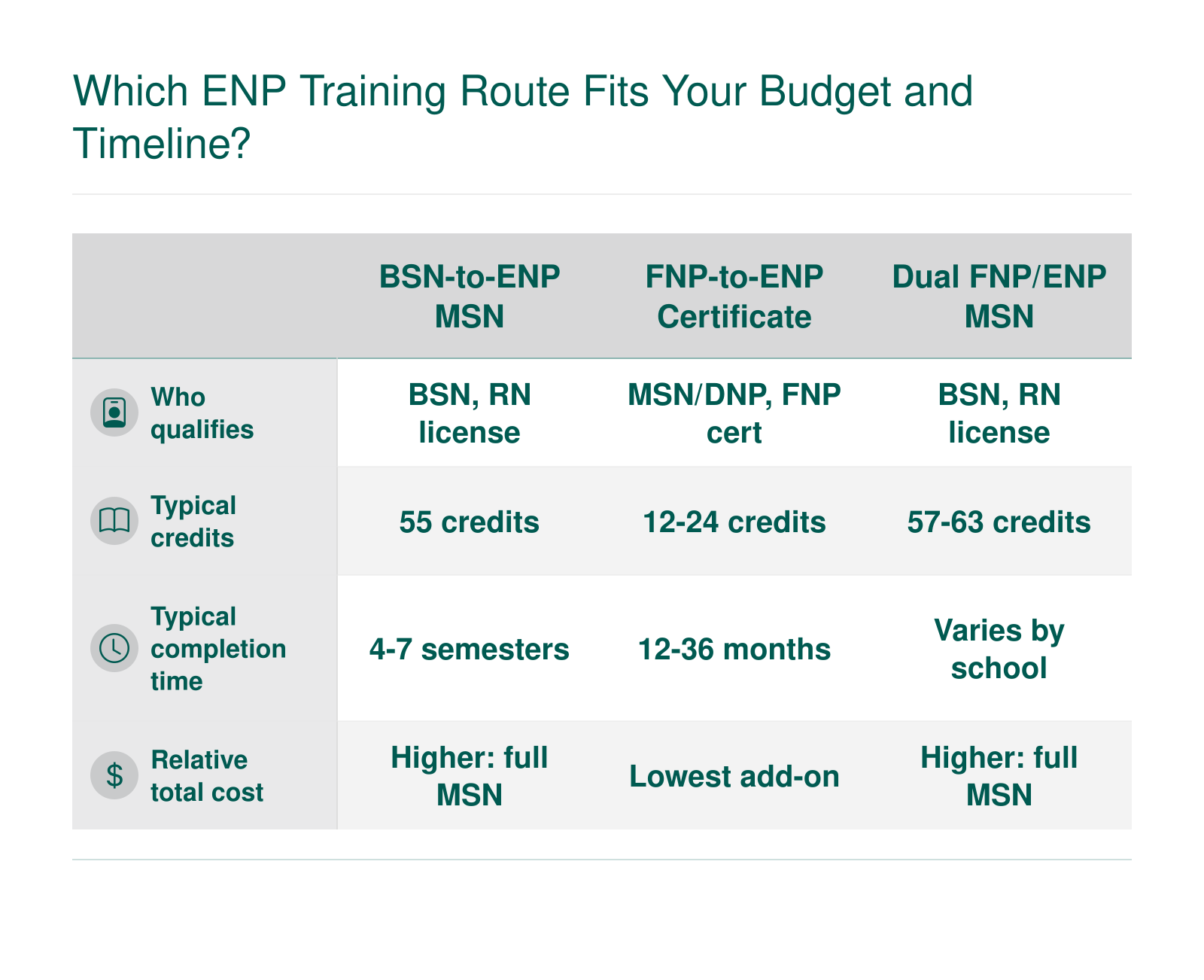
Which ENP Training Route Fits Your Budget and Timeline?
The cheapest path depends almost entirely on where you are now. If you already hold an FNP credential, a post-master's ENP certificate is usually the smallest additional investment. If you are starting with a BSN only, a full BSN-to-MSN or dual FNP/ENP track builds both credentials from the ground up.
Emergency Nurse Practitioner programs by state
Quick Answers for Budget-Minded Future ENPs
Prospective emergency nurse practitioners often weigh work, timeline, and tuition reimbursement before committing to a program. Here are practical answers to the budget questions students ask most often when comparing the programs below.
Can I work full time while completing an affordable ENP MSN program?
How long does it take to become an emergency nurse practitioner, starting from a BSN?
Are part-time ENP MSN options cheaper overall, or do they just spread out the cost?
Can my ER employer help pay for an emergency NP degree?
Compare Emergency Nurse Practitioner programs on the data that matters
Explore more Nursing specializations or browse every graduate field.
All Nursing programs